What Is the Main Purpose of a Resume: 6 Worked Examples
By Mustafa Tarabya, founder of CVBooster · Published · Updated
11 min read
The main purpose of a resume is to get you an interview for one specific job. It is not your life story and it is not a list of every task you have done; it is a one or two page argument that you match what this employer asked for. The one constraint is that the argument has to be made in the first few lines, because that is where the reader decides whether to keep going. UC Berkeley Career Engagement puts it in one sentence: "The purpose of a resume is to stimulate the interest of a potential employer enough to want to interview you." Below: what that purpose means for each section, and six complete resumes by career stage, each written for one posting. Written by Mustafa Tarabya, who hired for his own company, read every application himself and now writes CVBooster's guides.
What a resume for one job looks like
Here is the purpose at its smallest: a first resume for a part-time job, with nothing on it that the posting did not ask about.
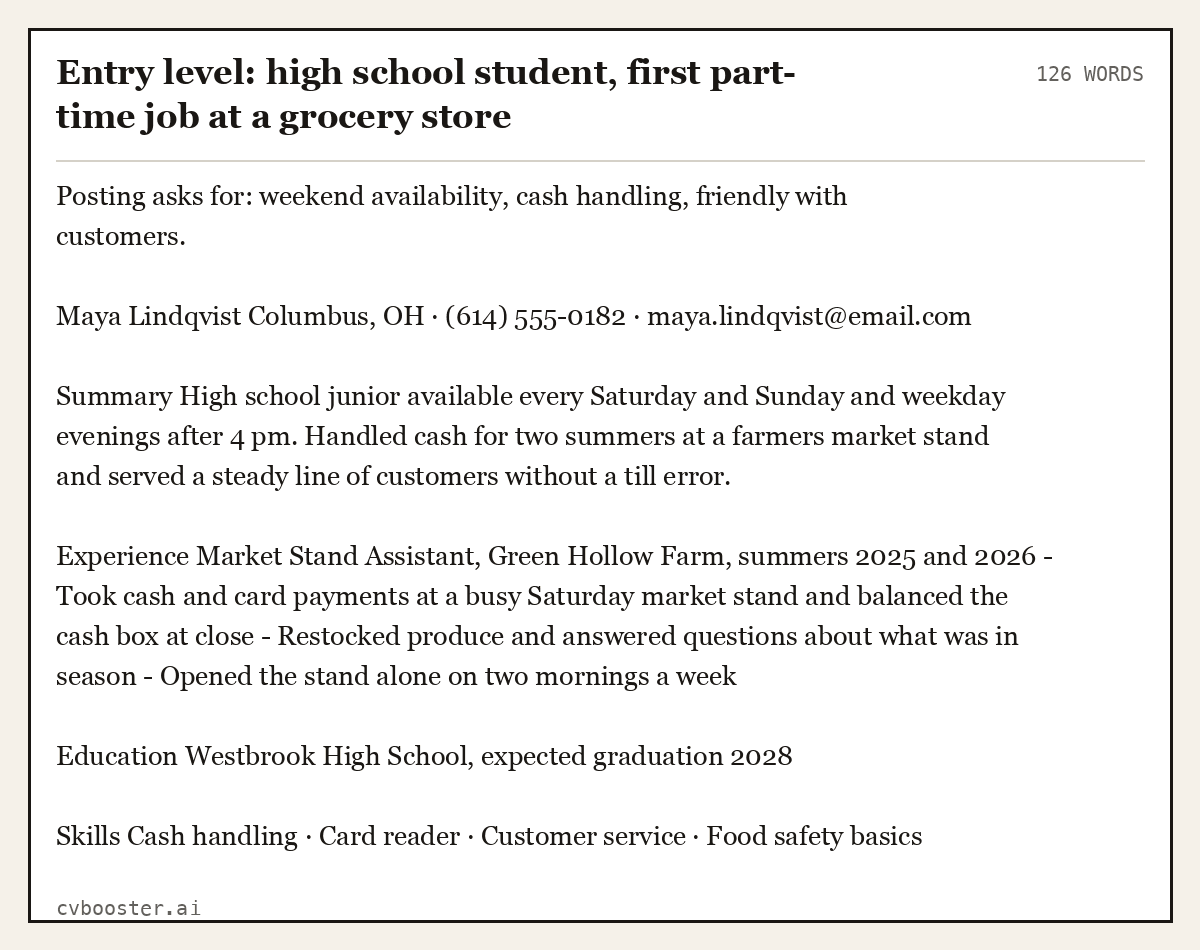
Entry level: high school student, first part-time job at a grocery store (126 words)
Posting asks for: weekend availability, cash handling, friendly with customers.
Maya Lindqvist Columbus, OH · (614) 555-0182 · maya.lindqvist@email.com
Summary High school junior available every Saturday and Sunday and weekday evenings after 4 pm. Handled cash for two summers at a farmers market stand and served a steady line of customers without a till error.
Experience Market Stand Assistant, Green Hollow Farm, summers 2025 and 2026 - Took cash and card payments at a busy Saturday market stand and balanced the cash box at close - Restocked produce and answered questions about what was in season - Opened the stand alone on two mornings a week
Education Westbrook High School, expected graduation 2028
Skills Cash handling · Card reader · Customer service · Food safety basics
Why the purpose decides everything else
You have probably been told a resume should be one page, then two pages, then "whatever it takes", by three people in the same week. The length argument goes away once you know what the document is for. A resume is a sales page with one buyer, and the buyer has a list.
That list is the job posting. When I hired for my own company, I wrote the advert myself, so I knew exactly which four things I was looking for. Most of the resumes that came back never mentioned any of them. They were not bad resumes. They were answers to a different question.
So the purpose gives you a test for every line: does this make the reader more likely to call me for this job? If yes, it stays and moves up. If no, it goes, however proud you are of it. Canada's Job Bank says the same from the other side: "The main purpose of your resume is to promote you, your skills, experience and achievements." Promotion means selection. You choose what to show.
What the purpose means for each section
- Header. Name, phone, email, city and state, a profile link if you keep it current. Its only job is to make you easy to call back.
- Summary. Three lines that repeat the two or three things the posting asks for most, in its words, with one fact that proves each.
- Experience. Reverse chronological. Each bullet is evidence for one requirement: what you did, how much, and what changed.
- Education and credentials. Whatever the posting lists as required goes where it can be found in a glance.
- Skills. The tools and terms from the posting that your experience supports. Not a list of every program you have opened.
Berkeley's advice is to "Analyze the position description to tailor your resume to each job and to understand the required and preferred qualifications, skills, and abilities." That sentence is the whole method. The examples on this page show it at six career stages, each opening with the posting it answers.
The difference between a resume and a cover letter
A resume and a cover letter share the same purpose, which is the interview, but they do different jobs. The resume is the evidence: dates, roles, numbers, skills, laid out so a reader can check them fast. The cover letter is the argument: why this job, why now, and the one or two pieces of evidence that matter most, in sentences. If you are unsure which document a posting wants, our guide to the cover letter vs resume covers it.
A CV in the US academic sense is different again. Berkeley explains: "A curriculum vitae (CV) is an academic resume and is used for research and college/university teaching positions." For almost every other US job, the resume is the document.
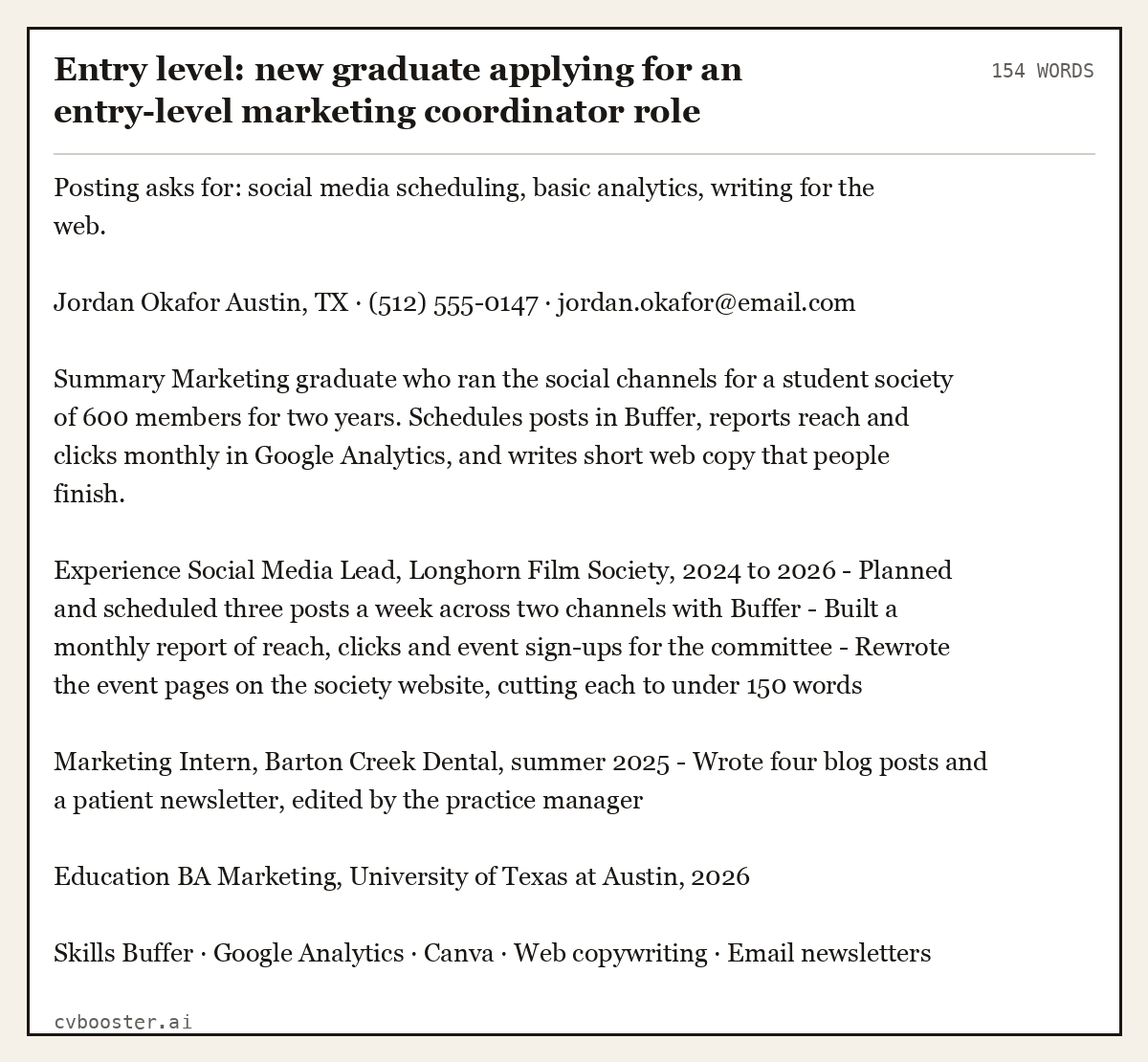
Entry level: new graduate applying for an entry-level marketing coordinator role (154 words)
Posting asks for: social media scheduling, basic analytics, writing for the web.
Jordan Okafor Austin, TX · (512) 555-0147 · jordan.okafor@email.com
Summary Marketing graduate who ran the social channels for a student society of 600 members for two years. Schedules posts in Buffer, reports reach and clicks monthly in Google Analytics, and writes short web copy that people finish.
Experience Social Media Lead, Longhorn Film Society, 2024 to 2026 - Planned and scheduled three posts a week across two channels with Buffer - Built a monthly report of reach, clicks and event sign-ups for the committee - Rewrote the event pages on the society website, cutting each to under 150 words
Marketing Intern, Barton Creek Dental, summer 2025 - Wrote four blog posts and a patient newsletter, edited by the practice manager
Education BA Marketing, University of Texas at Austin, 2026
Skills Buffer · Google Analytics · Canva · Web copywriting · Email newsletters
How to check that your resume does its job
Print the posting and your resume side by side. Underline every requirement in the posting, then find the line in your resume that proves it. Anything underlined with no matching line is a gap. Anything on your resume that matches nothing underlined is a candidate to cut or shorten.
The CareerOneStop Resume Writing Guide, from the US Department of Labor, describes itself plainly: "Use this Resume Writing Guide to help you write each section of your resume." Use it for the mechanics, and the posting for the content.
Then read only the top third of your resume, as if you had thirty other files to get through. If the reader cannot tell which job you want and why you fit after those lines, the purpose is not being served yet. Our resume review checklist goes through this in more detail.
If you want a second reader that does not get tired, CVBooster compares your resume with a posting: with a free account you fill in your resume by hand and get the ATS score and the keyword gap list. The AI rewrite, the templates and the finished resume are part of Pro. The gap list is the useful part, because it tells you what to write next.
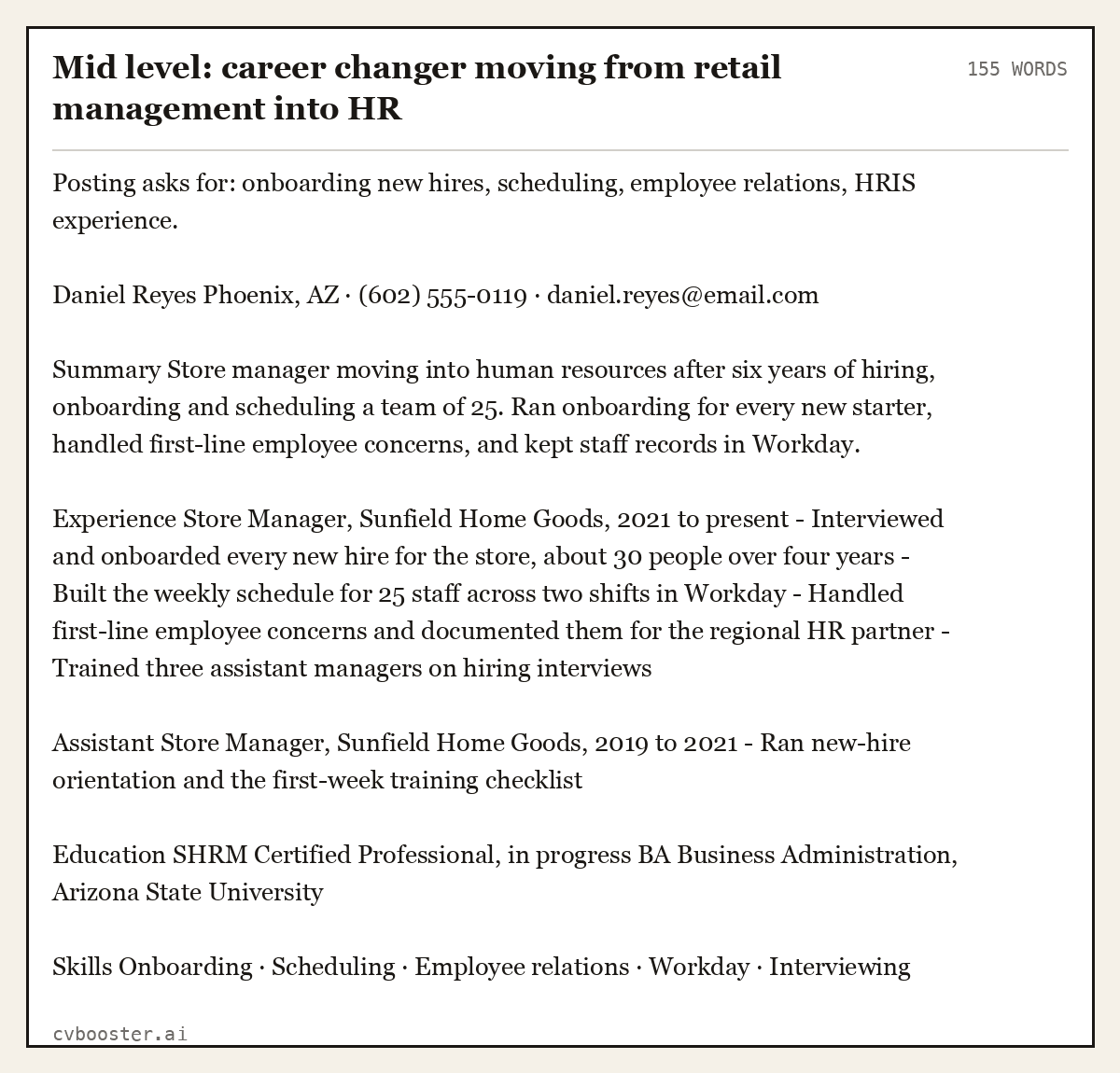
Mid level: career changer moving from retail management into HR (155 words)
Posting asks for: onboarding new hires, scheduling, employee relations, HRIS experience.
Daniel Reyes Phoenix, AZ · (602) 555-0119 · daniel.reyes@email.com
Summary Store manager moving into human resources after six years of hiring, onboarding and scheduling a team of 25. Ran onboarding for every new starter, handled first-line employee concerns, and kept staff records in Workday.
Experience Store Manager, Sunfield Home Goods, 2021 to present - Interviewed and onboarded every new hire for the store, about 30 people over four years - Built the weekly schedule for 25 staff across two shifts in Workday - Handled first-line employee concerns and documented them for the regional HR partner - Trained three assistant managers on hiring interviews
Assistant Store Manager, Sunfield Home Goods, 2019 to 2021 - Ran new-hire orientation and the first-week training checklist
Education SHRM Certified Professional, in progress BA Business Administration, Arizona State University
Skills Onboarding · Scheduling · Employee relations · Workday · Interviewing
What a resume is not for
A resume is not a record you keep for yourself, so it does not need every job since you were sixteen. It is not a legal statement, so it does not need your reasons for leaving; the Job Bank is direct about it: "It should be entirely positive, and therefore should not include reasons for leaving as it does not add any value to you as a candidate." And it is not a place to invent anything. If the posting asks for something you do not have, say what you have instead, or close the gap first. A claim that falls over in the first interview question costs you more than the gap did.
Do not include references on the resume itself. The Job Bank again: "Keep references on a separate sheet and provide them only when they are specifically requested."
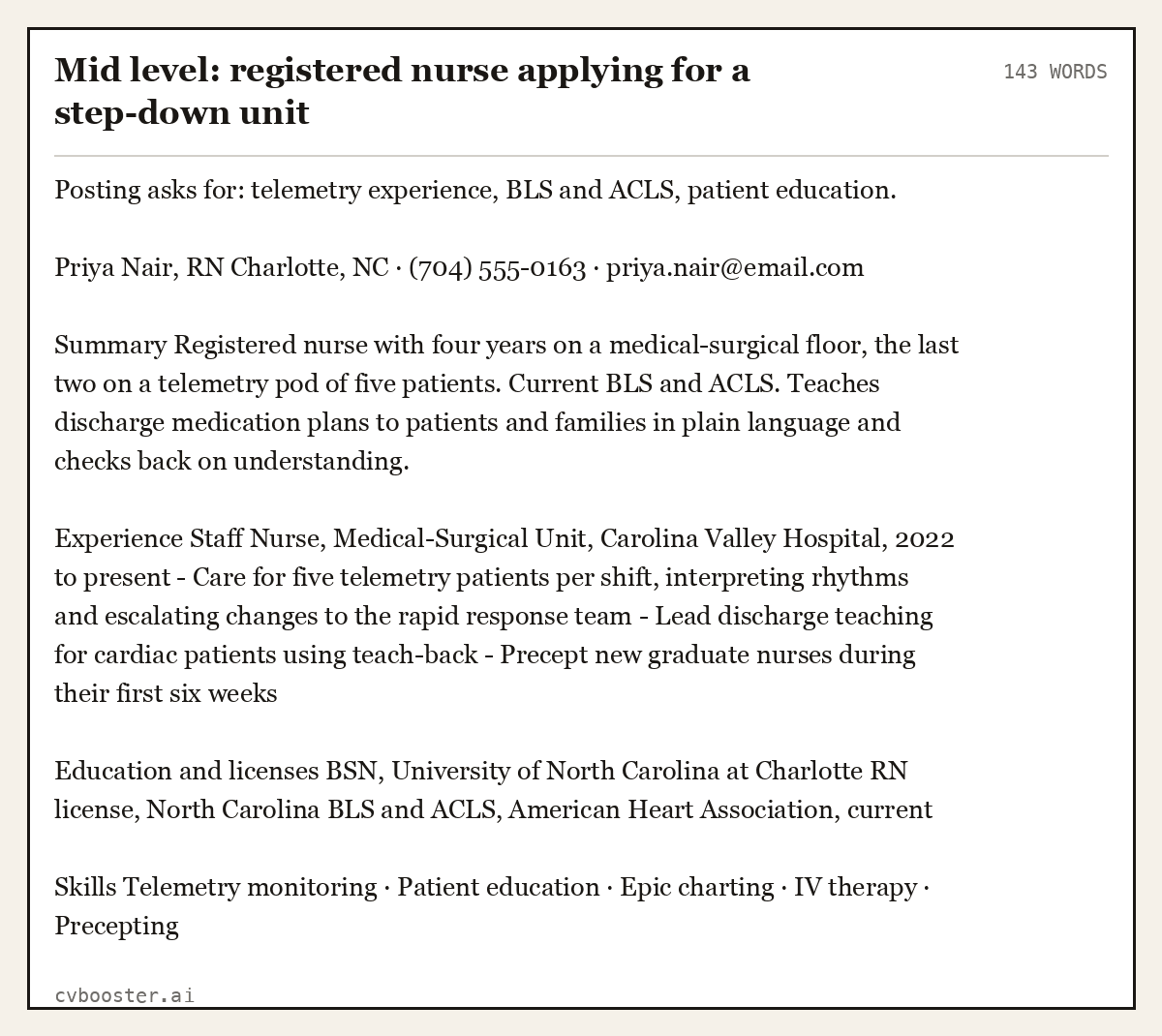
Mid level: registered nurse applying for a step-down unit (143 words)
Posting asks for: telemetry experience, BLS and ACLS, patient education.
Priya Nair, RN Charlotte, NC · (704) 555-0163 · priya.nair@email.com
Summary Registered nurse with four years on a medical-surgical floor, the last two on a telemetry pod of five patients. Current BLS and ACLS. Teaches discharge medication plans to patients and families in plain language and checks back on understanding.
Experience Staff Nurse, Medical-Surgical Unit, Carolina Valley Hospital, 2022 to present - Care for five telemetry patients per shift, interpreting rhythms and escalating changes to the rapid response team - Lead discharge teaching for cardiac patients using teach-back - Precept new graduate nurses during their first six weeks
Education and licenses BSN, University of North Carolina at Charlotte RN license, North Carolina BLS and ACLS, American Heart Association, current
Skills Telemetry monitoring · Patient education · Epic charting · IV therapy · Precepting
How long a resume should be, given its purpose
Long enough to prove the posting's requirements, short enough to be read. Berkeley's answer: "Yes, a resume can be more than one page, but it shouldn't be unless you have extensive experience related to your job objective." For most students and early career applicants that means one page. For a manager with ten years of directly relevant work, two pages is normal. Three pages almost always means the resume is answering questions nobody asked.
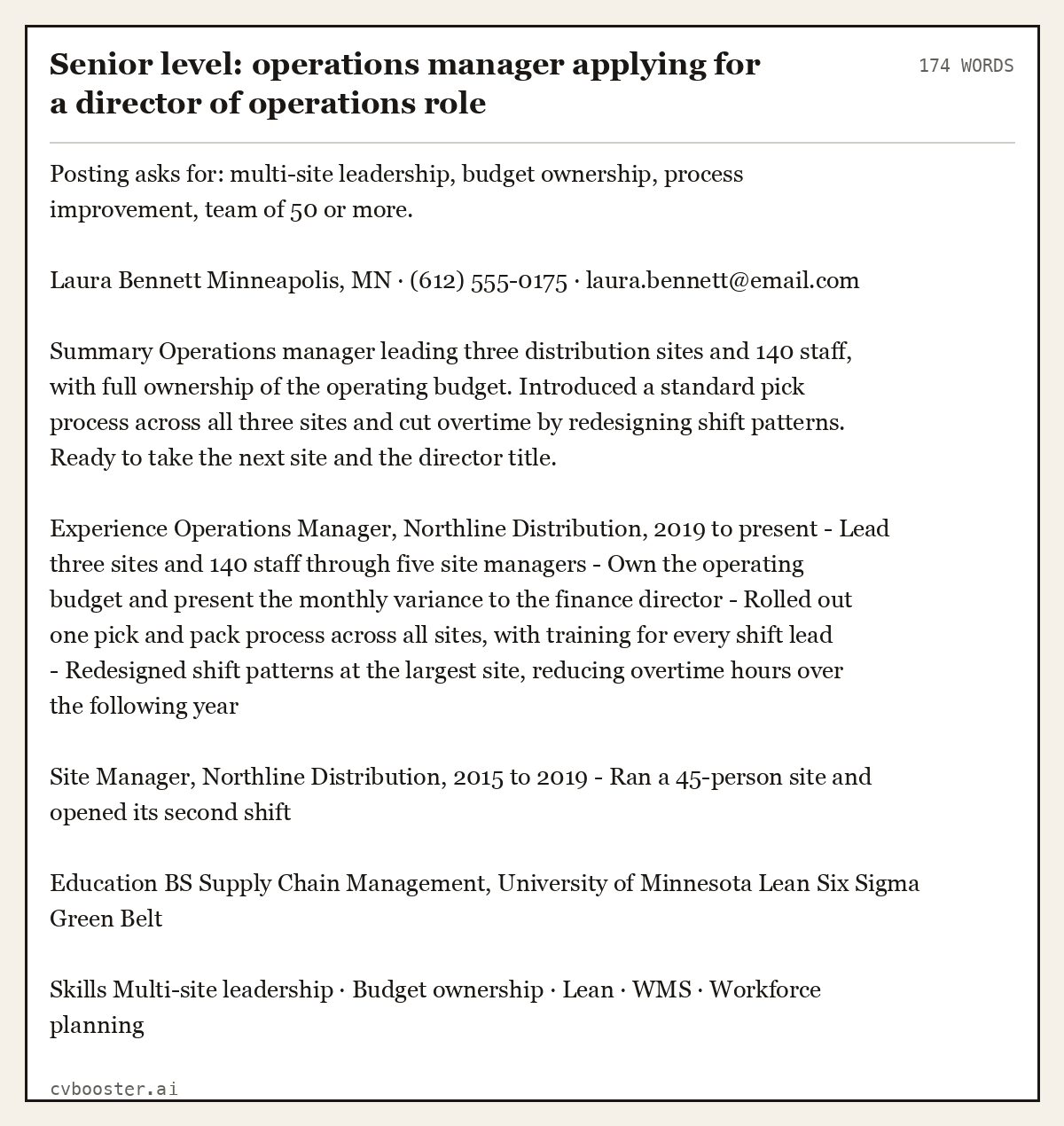
Senior level: operations manager applying for a director of operations role (174 words)
Posting asks for: multi-site leadership, budget ownership, process improvement, team of 50 or more.
Laura Bennett Minneapolis, MN · (612) 555-0175 · laura.bennett@email.com
Summary Operations manager leading three distribution sites and 140 staff, with full ownership of the operating budget. Introduced a standard pick process across all three sites and cut overtime by redesigning shift patterns. Ready to take the next site and the director title.
Experience Operations Manager, Northline Distribution, 2019 to present - Lead three sites and 140 staff through five site managers - Own the operating budget and present the monthly variance to the finance director - Rolled out one pick and pack process across all sites, with training for every shift lead - Redesigned shift patterns at the largest site, reducing overtime hours over the following year
Site Manager, Northline Distribution, 2015 to 2019 - Ran a 45-person site and opened its second shift
Education BS Supply Chain Management, University of Minnesota Lean Six Sigma Green Belt
Skills Multi-site leadership · Budget ownership · Lean · WMS · Workforce planning
What changes when you return to work
After a break, the purpose is the same and the evidence is older. Put the most relevant work first in the summary, name the break in one plain line in the experience section, and show anything you did during it that matches the posting: a course, volunteer work, freelance projects. Nobody needs the reason in detail. They need to see that you can do this job now.
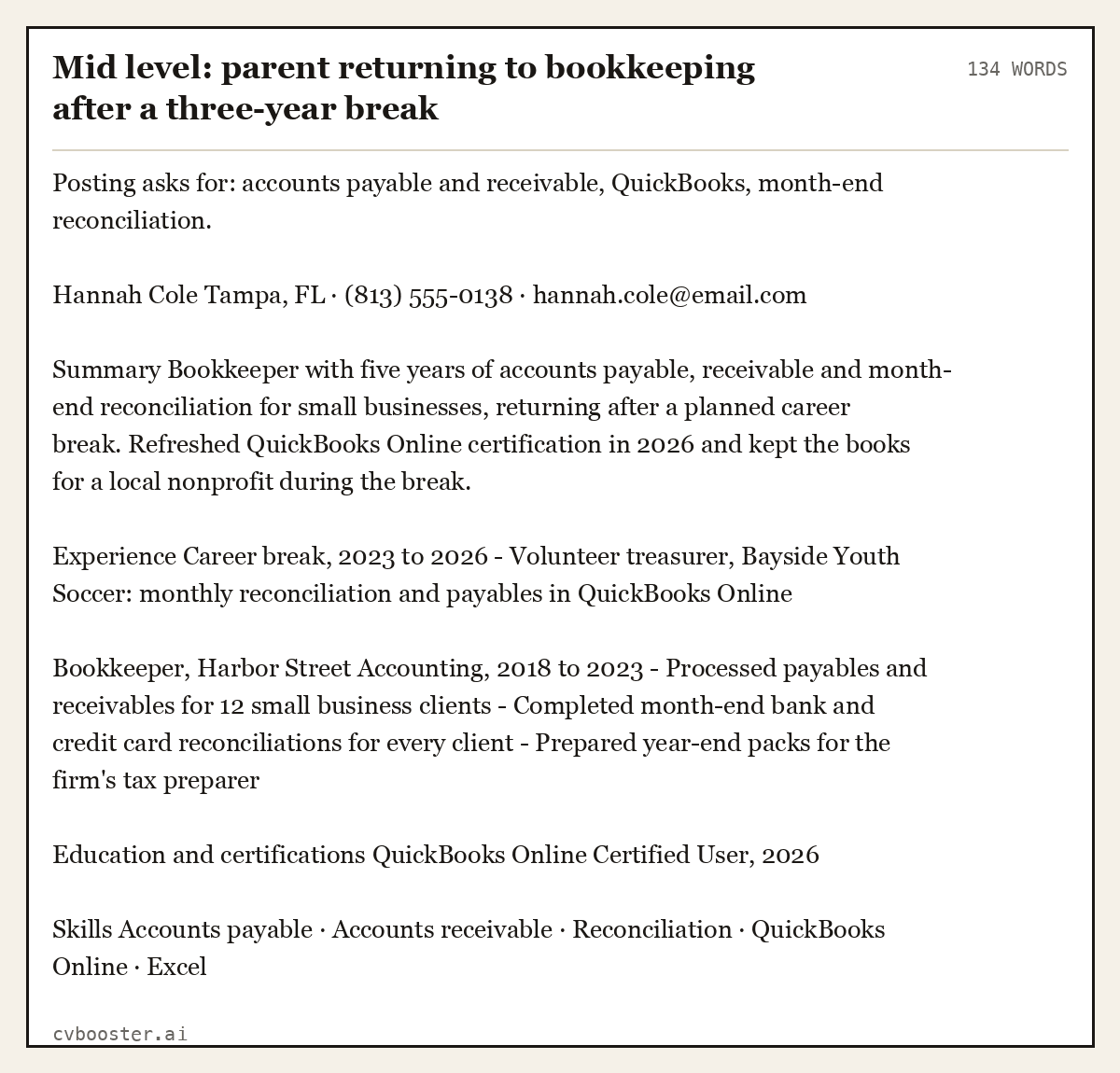
Mid level: parent returning to bookkeeping after a three-year break (134 words)
Posting asks for: accounts payable and receivable, QuickBooks, month-end reconciliation.
Hannah Cole Tampa, FL · (813) 555-0138 · hannah.cole@email.com
Summary Bookkeeper with five years of accounts payable, receivable and month-end reconciliation for small businesses, returning after a planned career break. Refreshed QuickBooks Online certification in 2026 and kept the books for a local nonprofit during the break.
Experience Career break, 2023 to 2026 - Volunteer treasurer, Bayside Youth Soccer: monthly reconciliation and payables in QuickBooks Online
Bookkeeper, Harbor Street Accounting, 2018 to 2023 - Processed payables and receivables for 12 small business clients - Completed month-end bank and credit card reconciliations for every client - Prepared year-end packs for the firm's tax preparer
Education and certifications QuickBooks Online Certified User, 2026
Skills Accounts payable · Accounts receivable · Reconciliation · QuickBooks Online · Excel
If you are starting from nothing, our guide on how to make a resume walks through each step, and the resume examples section has complete resumes by industry.
Frequently asked questions
What is the main purpose of a resume?
The main purpose of a resume is to get you an interview. It does that by showing, quickly and with evidence, that you match what one employer asked for in one posting. Everything on it should make the reader more likely to call you for that job, and anything that does not can be cut or shortened.
What is a resume, in simple terms?
A resume is a short document, usually one or two pages, that lists your contact details, a brief summary, your work experience, education and skills. Employers use it to decide who to interview. In the US a resume is the standard document for most jobs, and a CV is mainly used for academic and research roles.
Is the purpose of a resume to get a job?
Not directly. A resume gets you an interview, and the interview gets you the job. That is why a resume should be selective: it needs to make a reader curious enough to talk to you, not answer every question in advance. Save the full story for the conversation it earns you.
What is the purpose of a resume and a cover letter together?
Both aim at the interview. The resume is the evidence, laid out to be checked fast: roles, dates, numbers, skills. The cover letter is the argument in sentences: why this job, and the one or two pieces of evidence that matter most. Send them together whenever the application allows it.
Should I change my resume for every job?
Yes, at least the summary and the order of your bullets. The purpose is to match one posting, and two postings for the same title can ask for different things. Keep a full master version, then copy and cut it for each application so the strongest match always sits at the top.
Related articles
- Accounting Executive Resume: 5 Examples by Career Level
- Administration Resume Examples: 8 Samples, Entry to Manager
- Aged Care Resume: 6 Australian Examples and a Template
- Another Word for Resume: CV, Bio and 10 More Options
More articles
- Quant Job Interview Questions and Answers: 5 Full Samples
- Questions for a Recruiter Interview: What to Ask and Say
- Great Questions to Ask an Interviewee: 6 Ready Sets
Looking for a worked example for your job title? Browse the resume examples by job title.