EAP Program: What It Covers, Is It Confidential, 7 Scripts

An EAP program, or employee assistance program, is a benefit your employer pays for that gives you free, confidential counseling and referrals for personal or work problems, usually by phone, video or in person. The constraint is that it is short-term: an EAP assesses, helps for a few sessions, then refers you on. The US Office of Personnel Management defines it as a program offering "free and confidential assessments, short-term counseling, referrals, and follow-up services" in its EAP FAQ. Below: what it covers, who finds out, how to use it, and seven copyable scripts.
The benefit is described in a handbook nobody opened, behind a phone number printed on a poster in the break room, next to the fire exit map. Here is what is actually behind that number.
The first script: finding out what your EAP offers
Most people never use their EAP because they do not know the phone number or what it covers. You do not need to say why you are asking. This email works for any employer, and for HR it is a routine question.
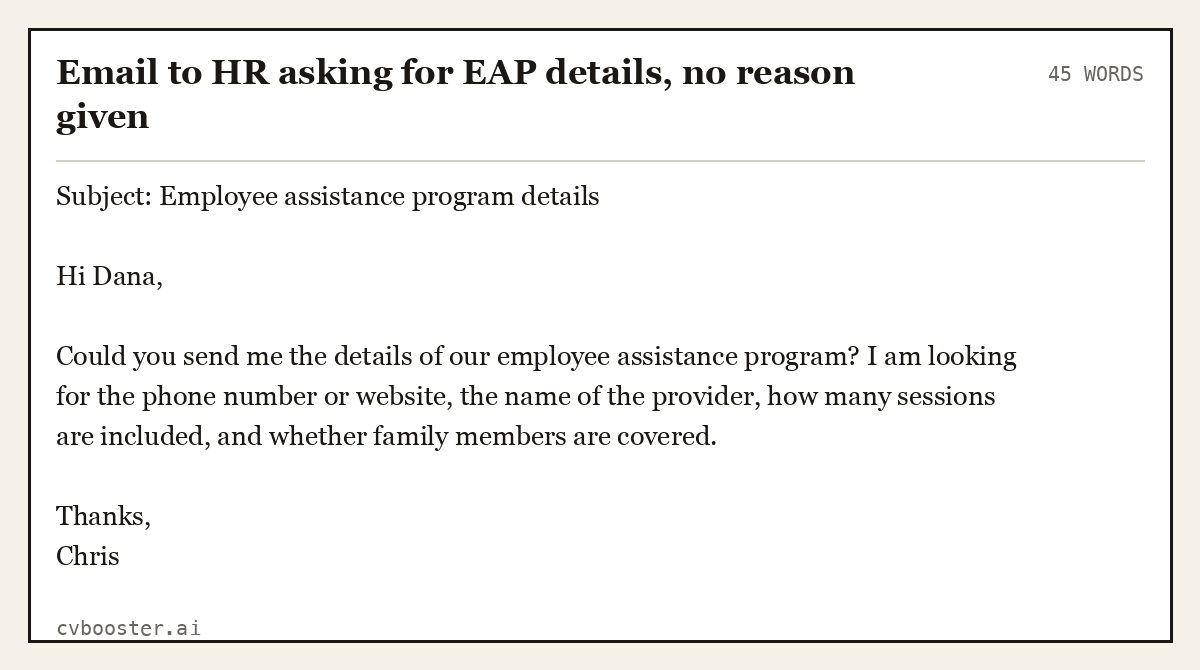
Email to HR asking for EAP details, no reason given
45 wordsSubject: Employee assistance program details
Hi Dana,
Could you send me the details of our employee assistance program? I am looking for the phone number or website, the name of the provider, how many sessions are included, and whether family members are covered.
Thanks, Chris
Create my CVOr start from one of our free resume templates
What an employee assistance program covers
OPM's definition lists the kinds of problems EAPs handle: alcohol and other substance abuse, stress, grief, family problems and psychological disorders, among others. The GSA directive on its own EAP is a good real example of the range: grief, job stress, drug addiction, alcohol dependency, mental health, emotional well-being, family matters, and legal and financial problems, with no-cost, short-term counseling for employees and family members.
In practice, an EAP is the right first call for:
- Stress and burnout at work, or a conflict with a manager or coworker.
- Anxiety, low mood or grief, including after a death or a breakup.
- Family and relationship problems, parenting, caring for an elderly parent.
- Alcohol or drug use, your own or someone close to you.
- Money and legal questions, often through a referral to a financial or legal consultant.
- A crisis at work, such as an accident or a violent incident; OPM notes many EAPs help organizations respond to these.
What an EAP usually is not: long-term therapy, psychiatric medication management, or an emergency service. If you or someone else is in immediate danger, call 911 or the 988 Suicide and Crisis Lifeline, not the EAP.
Is EAP confidential?
Yes, with a few legal exceptions. OPM answers this directly in its FAQ on whether your supervisor will find out: "Information about your discussions with the EAP cannot be disclosed without your permission." It names federal regulations (42 CFR Part 2) that require confidentiality and set penalties for unauthorized release.
The exceptions are the same everywhere counselors work. GSA's directive says that when clients disclose life-threatening situations, such as child or elder abuse, or threats of serious harm to themselves or others, counselors must report them as required by law, and that these situations are explained in the first session.
| Question | Usual answer |
|---|---|
| Does my manager find out I called? | No, not if you referred yourself |
| Does HR see what I talked about? | Not without your written permission |
| Can my manager know I attended after a referral? | Only what you agree to in a signed release |
| Can a counselor ever break confidentiality? | Yes, for threats of serious harm and abuse, as the law requires |
These answers describe how federal EAPs and most employer EAPs work. Your employer's EAP booklet is the final word for your plan, so check it or ask the provider on the first call.
How many EAP sessions do you get?
It depends on the plan your employer bought. OPM's guide for federal EAPs describes short-term counseling as services for "approximately 1 to 6 sessions", with the number often set by the agency's approach. Private employers set their own limits, so ask the provider on your first call. When the sessions run out, the counselor's job is to refer you to ongoing care, usually through your health insurance.
Who can use an EAP
Usually you, and often your household. GSA says its EAP helps employees and their families when feasible. The Washington State EAP, a public example, says on its FAQ page that all eligible Washington employees and their household adult family members can use its free and confidential services. Part-time staff and contractors are covered in some plans and not in others, so ask.
Self-referral vs manager referral
There are two ways in, and GSA's directive describes both.
- Self-referral: you call the EAP yourself, usually without telling your manager. This is the most common route and the most private one.
- Manager referral: a manager suggests the EAP, informally (here is the number) or formally in writing when a performance or conduct problem seems to come from a personal problem. Under GSA's rules, the counselor may confirm to the manager that you kept the appointment, and shares more only if you sign a release.
A manager referral is not a punishment. OPM notes there are cases where signing a release is in your interest, for example to show management you are getting help during a disciplinary process, and a supervisor might then hold disciplinary action pending improvement. If work is the problem, our guide on explaining getting fired in an interview covers the next step if things go the other way.
How to use your EAP, step by step
- Find the number. HR, the benefits portal, your intranet, or the back of the benefits booklet.
- Call or book online. An intake person asks a few questions to match you with a counselor.
- Say what you need. One or two sentences is enough. You do not need a diagnosis.
- Attend the sessions. By phone, video or in person, depending on the provider.
- Ask for the referral before the last session, if you need ongoing help.
Six more scripts you can copy
These cover the moments people get stuck on: the first call, asking for time off, the manager's side, and what to say when sessions run out.
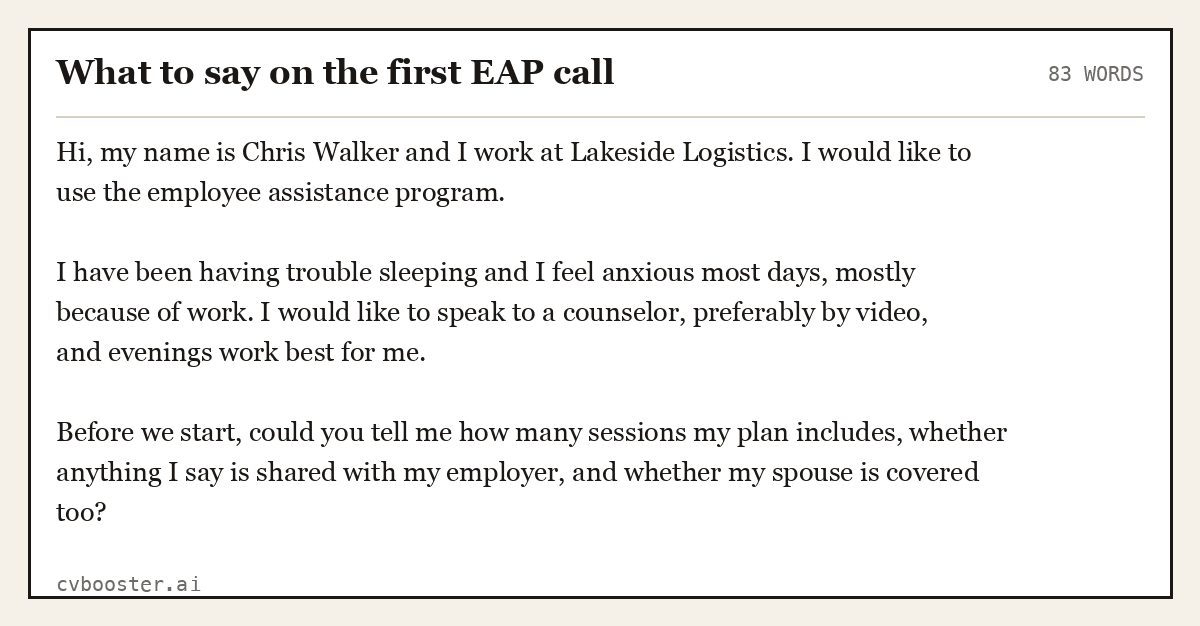
What to say on the first EAP call
83 wordsHi, my name is Chris Walker and I work at Lakeside Logistics. I would like to use the employee assistance program.
I have been having trouble sleeping and I feel anxious most days, mostly because of work. I would like to speak to a counselor, preferably by video, and evenings work best for me.
Before we start, could you tell me how many sessions my plan includes, whether anything I say is shared with my employer, and whether my spouse is covered too?
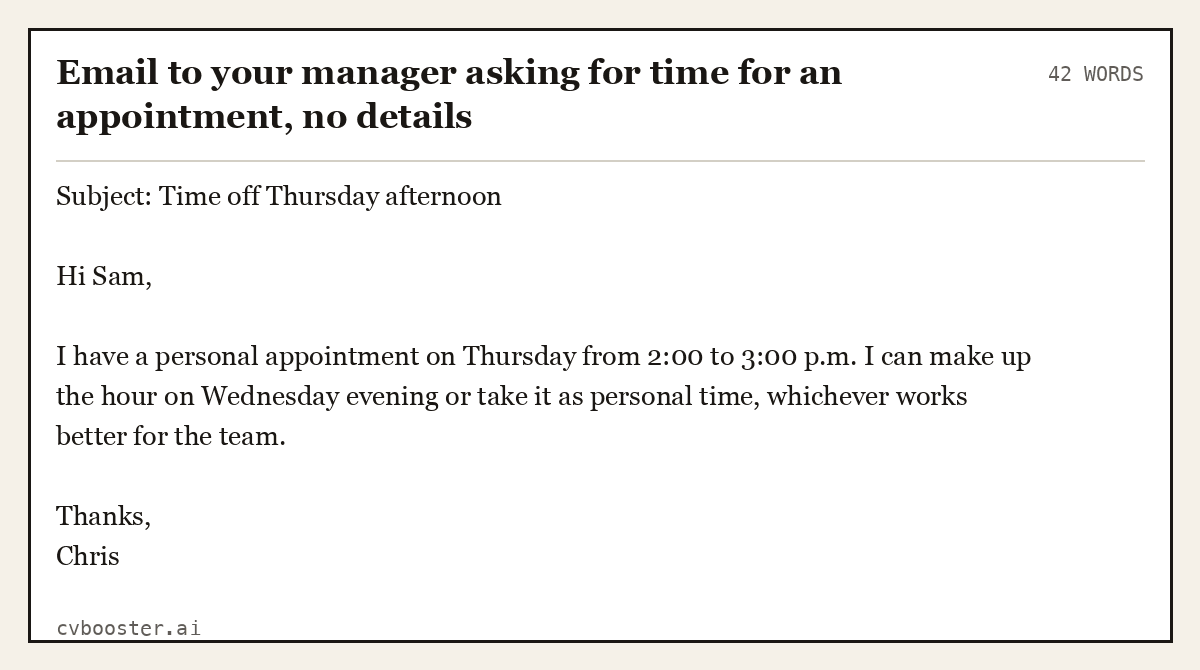
Email to your manager asking for time for an appointment, no details
42 wordsSubject: Time off Thursday afternoon
Hi Sam,
I have a personal appointment on Thursday from 2:00 to 3:00 p.m. I can make up the hour on Wednesday evening or take it as personal time, whichever works better for the team.
Thanks, Chris
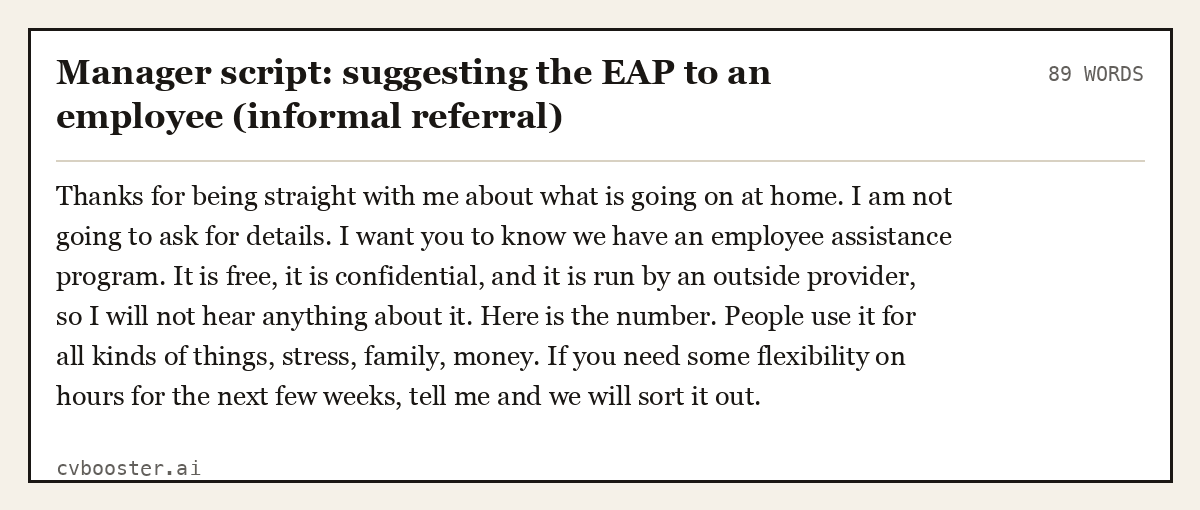
Manager script: suggesting the EAP to an employee (informal referral)
89 wordsThanks for being straight with me about what is going on at home. I am not going to ask for details. I want you to know we have an employee assistance program. It is free, it is confidential, and it is run by an outside provider, so I will not hear anything about it. Here is the number. People use it for all kinds of things, stress, family, money. If you need some flexibility on hours for the next few weeks, tell me and we will sort it out.
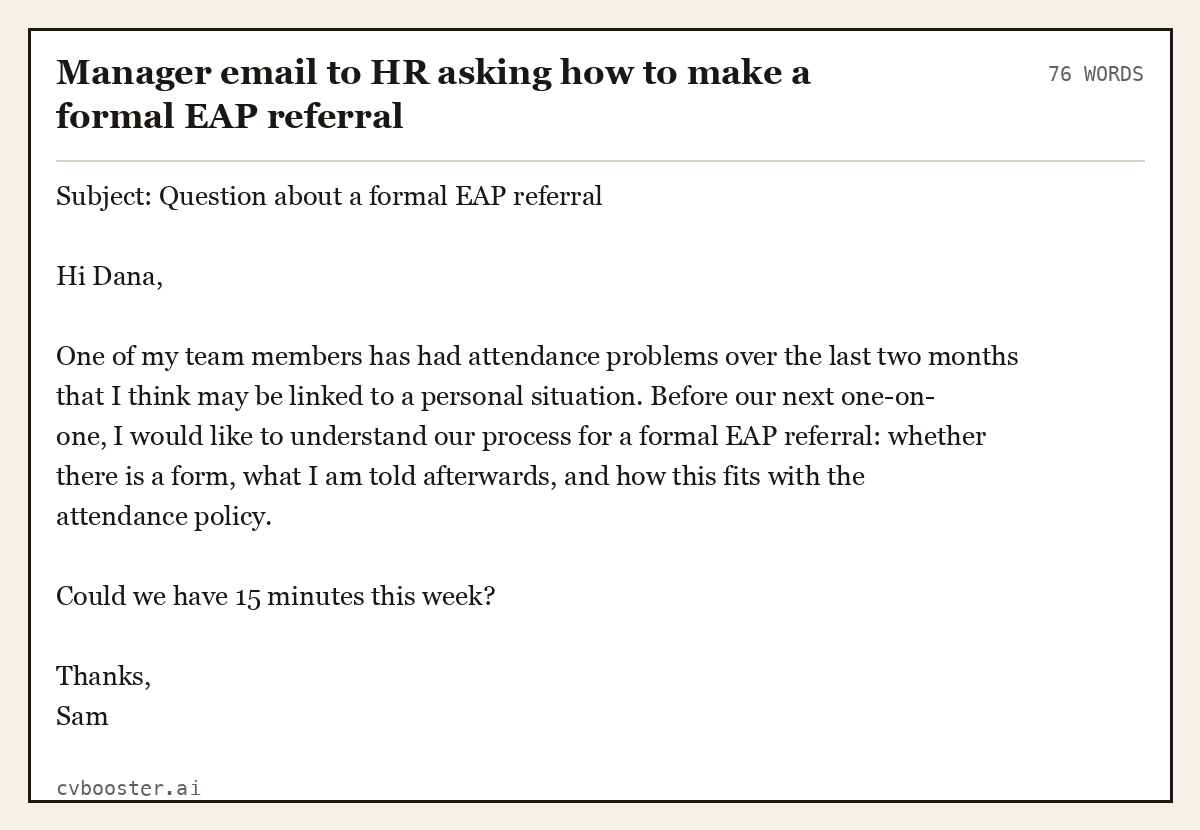
Manager email to HR asking how to make a formal EAP referral
76 wordsSubject: Question about a formal EAP referral
Hi Dana,
One of my team members has had attendance problems over the last two months that I think may be linked to a personal situation. Before our next one-on-one, I would like to understand our process for a formal EAP referral: whether there is a form, what I am told afterwards, and how this fits with the attendance policy.
Could we have 15 minutes this week?
Thanks, Sam
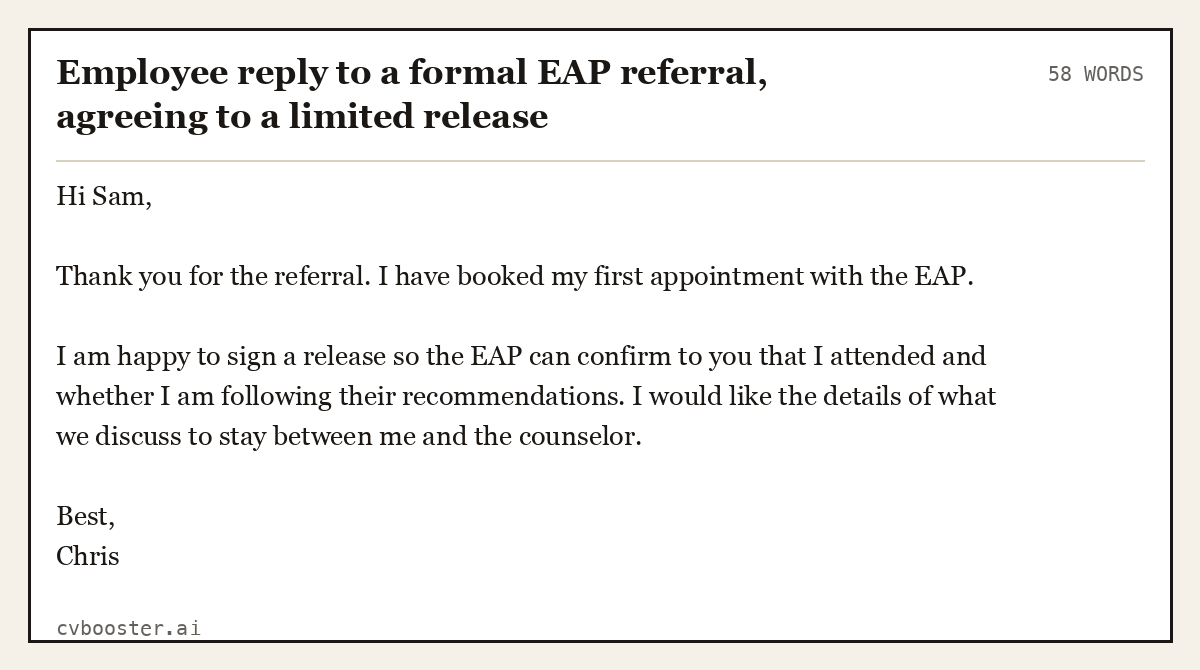
Employee reply to a formal EAP referral, agreeing to a limited release
58 wordsHi Sam,
Thank you for the referral. I have booked my first appointment with the EAP.
I am happy to sign a release so the EAP can confirm to you that I attended and whether I am following their recommendations. I would like the details of what we discuss to stay between me and the counselor.
Best, Chris
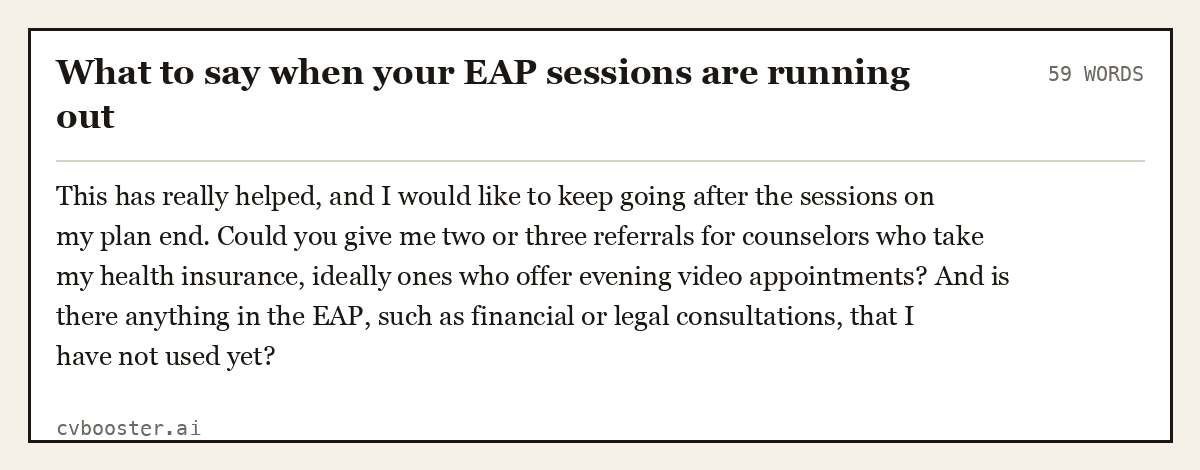
What to say when your EAP sessions are running out
59 wordsThis has really helped, and I would like to keep going after the sessions on my plan end. Could you give me two or three referrals for counselors who take my health insurance, ideally ones who offer evening video appointments? And is there anything in the EAP, such as financial or legal consultations, that I have not used yet?
EAP benefits for you and for your employer
For you, the benefit is fast, free and private help, without a waiting list or an insurance claim for the first sessions. For your employer, our reading is simple: problems at home turn into problems at work, and a few counseling sessions are a cheaper first step than losing a good person. That is not cynical. It is the whole deal, and it works in your favor.
If work itself is the problem and you are thinking about leaving, read our guides on a resignation letter due to health issues and on less stressful jobs that pay well. Coming back after sick leave? Our return to work letter from a doctor page shows what employers usually ask for.
Frequently asked questions
What is an EAP program?
An EAP, or employee assistance program, is a work-based benefit that offers free and confidential assessments, short-term counseling, referrals and follow-up for personal or work problems. OPM's definition lists stress, grief, family problems, substance use and mental health. Your employer pays an outside provider, and you contact that provider directly.
Is EAP confidential from my employer?
Yes. OPM states that information about your discussions with the EAP cannot be disclosed without your permission, and cites 42 CFR Part 2. Your manager does not learn you called if you referred yourself. Counselors must report threats of serious harm and child or elder abuse, as the law requires, and explain this in the first session.
Is an EAP free?
For employees, yes, within the plan's limits. The employer pays the provider, so the sessions included in the plan cost you nothing. If you need care beyond those sessions, the EAP refers you to providers who usually bill your health insurance, where your normal copays and deductibles apply. Ask about limits on the first call.
How many sessions does an EAP give you?
It depends on the employer's plan. OPM's guide for federal EAPs describes short-term counseling as approximately 1 to 6 sessions, set by each agency's approach. Private plans vary, so ask the provider on your first call. When you near the limit, ask for referrals to ongoing care through your insurance.
Can my family use my EAP?
Often, yes. Many plans cover spouses, partners and children living in your household. GSA's EAP helps employees and family members, and the Washington State EAP covers household adult family members. Check your plan's booklet or ask the provider, because coverage for part-time staff, contractors and adult children varies by employer.
Can my employer force me to use the EAP?
A manager can refer you, informally or in writing, when a personal problem seems to affect your work. Attending is your choice, and what you discuss stays private. With a formal referral, you may agree to a release so the EAP confirms attendance; that can help if you are in a disciplinary process.
More in this series: related guides
- AI Letter Writer: 7 Prompts and the Fixed Letters They Need
- Amazon Resume Example: 6 Resumes Using Leadership Principles
- Best Resume Builder: 9 Tools Compared on the Free Download
- Business Analyst Cover Letter: 8 Examples by Level
- Career Change Cover Letter: 8 Examples by Career Switch
- Chef Cover Letter: 8 Examples From Line Cook to Exec Chef
- Cover Letter Heading: Format and 10 Complete Examples
- Creative Resume Template: 6 Designs with Complete Examples
- Data Scientist Cover Letter: 8 Examples From Entry Level
- Digital Marketing Cover Letter: 8 Examples by Specialty
- Full Stack Development: Layers, Skills, Pay and Examples
- Help With Resume Wording: 60 Before and After Lines
- How to Make Your Resume Stand Out: 15 Moves That Work
- How to Quit a Job: 7 Steps and 8 Scripts You Can Use
- How to Start a Cover Letter: 30 Openings and 3 Letters
- Resume Fixer: 15 Fixes With Before and After Examples
- Resume PDF Download: 6 Ready Formats and How to Save a PDF
- Resume Screening: The 6 Stages and 8 Lines That Pass Them
- Simple CV Format: Section Order and 6 Examples for Any Job
- Truck Driver Cover Letter: 8 Examples for CDL Drivers
- US Resume Format: Rules and 6 Examples for American Jobs
- Walmart Resume Example: 6 Resumes for Real Store Roles
- Warehouse Worker Cover Letter: 8 Examples by Job Type
- What Is Practical Nursing: LPN Role, Training, Pay, Exam
Looking for a worked example for your job title? Browse the resume examples by job title.