What Is Practical Nursing: LPN Role, Training, Pay, Exam

Practical nursing is the hands-on, licensed level of nursing that gives basic medical care, such as vital signs, medications, dressings and charting, usually under the direction of a registered nurse or a physician. The constraint is the license: you finish a state-approved program, which typically takes about one year, and then pass the NCLEX-PN exam. The US Bureau of Labor Statistics describes the job and its pay in its Occupational Outlook Handbook. Below: duties, training, the exam, pay, LPN vs RN, and six copyable examples, from a program application statement to a full new-graduate resume.
It is the nursing job where you do most of the actual nursing and get asked, at least once a week, whether you are "a real nurse". You are. The state gave you a license to prove it.
Practical nursing in one paragraph
A practical nurse is called a licensed practical nurse (LPN) in most states and a licensed vocational nurse (LVN) in a few; it is the same role, and the BLS counts both together. LPNs take vital signs, give medications, change dressings, collect samples, help patients with daily care, and report changes to the registered nurse in charge. Exactly what an LPN may do, for example starting IVs, is set by the board of nursing in each state, so the same title can mean slightly different work in Ohio and in Texas.
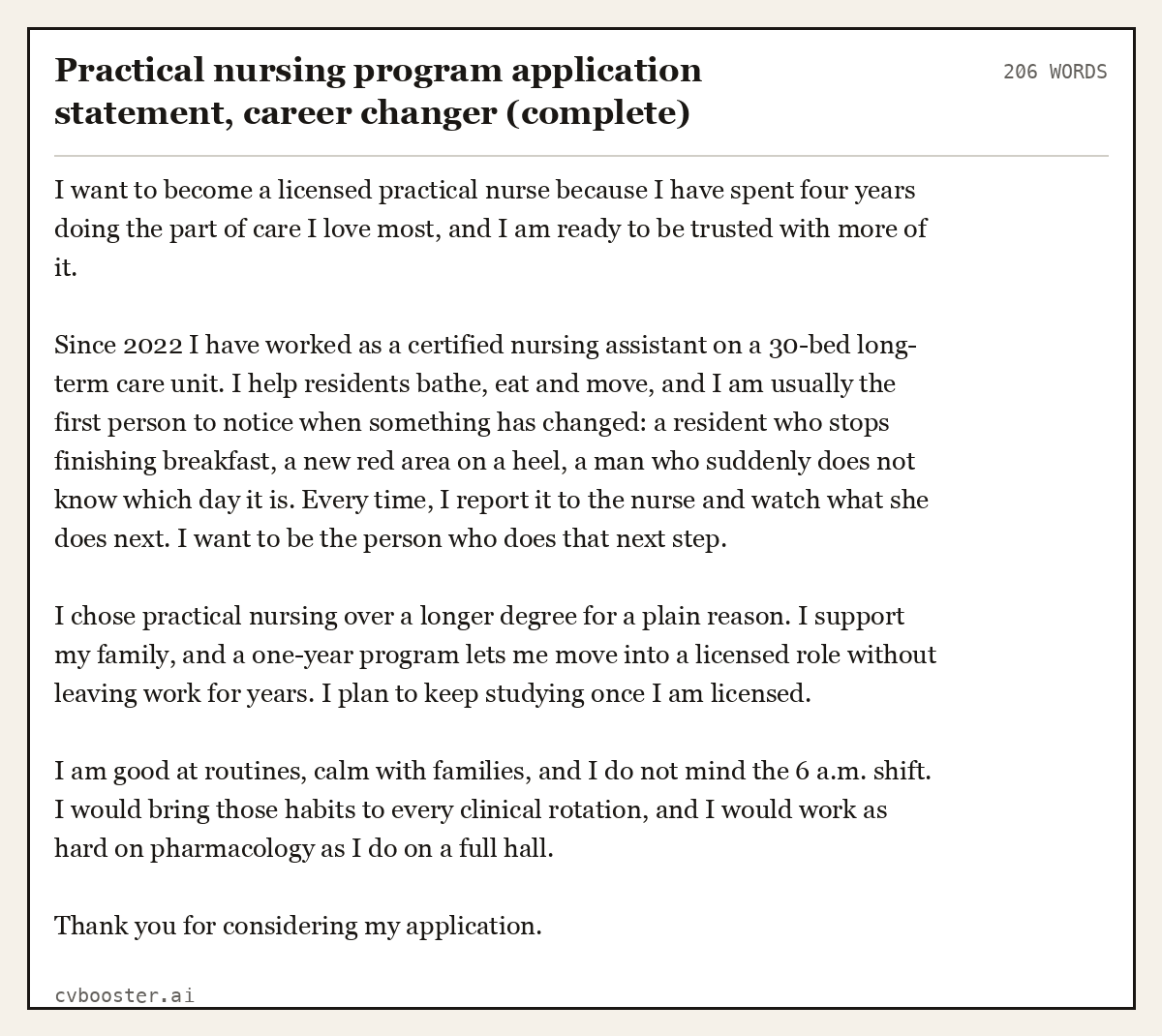
If you are applying to a practical nursing program, the first thing most schools ask for after the transcript is a short statement of why you want the work. Here is a complete one.
Practical nursing program application statement, career changer (complete)
206 wordsI want to become a licensed practical nurse because I have spent four years doing the part of care I love most, and I am ready to be trusted with more of it.
Since 2022 I have worked as a certified nursing assistant on a 30-bed long-term care unit. I help residents bathe, eat and move, and I am usually the first person to notice when something has changed: a resident who stops finishing breakfast, a new red area on a heel, a man who suddenly does not know which day it is. Every time, I report it to the nurse and watch what she does next. I want to be the person who does that next step.
I chose practical nursing over a longer degree for a plain reason. I support my family, and a one-year program lets me move into a licensed role without leaving work for years. I plan to keep studying once I am licensed.
I am good at routines, calm with families, and I do not mind the 6 a.m. shift. I would bring those habits to every clinical rotation, and I would work as hard on pharmacology as I do on a full hall.
Thank you for considering my application.
Create my CVOr start from one of our free resume templates
What a practical nurse does all shift
The BLS summary is short: LPNs and LVNs "provide basic medical care". On a real shift that means:
- Vital signs and checks: blood pressure, pulse, temperature, oxygen, blood glucose, pain scores.
- Medications: the scheduled med pass, and as-needed doses, within the state's scope of practice.
- Wound and skin care: dressings, pressure injury checks, turning schedules.
- Daily care: helping with eating, bathing, dressing and moving, often alongside nursing assistants.
- Charting: recording what you did and what you saw in the electronic record.
- Reporting: telling the registered nurse or physician when a patient's condition changes.
- Supervision: in long-term care, LPNs often lead the nursing assistants on their hall.
According to the BLS work environment data, nursing and residential care facilities are the largest employer at 37%, followed by hospitals at 16%, home healthcare services at 12% and physician offices at 11%. So most LPN jobs are not in hospitals, which surprises a lot of applicants. For a full list of duties by setting, see our LPN duties for resume guide.
How long is a practical nursing program
The BLS says LPNs and LVNs must complete a state-approved educational program, which "typically takes about 1 year". The same handbook notes that certificate and diploma programs are commonly found in community colleges and technical schools, including some high schools. Its typical entry-level education for the job is a postsecondary nondegree award, which means a certificate or diploma rather than a degree.
A typical program mixes three parts:
| Part | What you study or do |
|---|---|
| Classroom | Anatomy and physiology, pharmacology, nutrition, nursing fundamentals |
| Skills lab | Vital signs, injections, dressings, safe transfers, on manikins and classmates |
| Clinical rotations | Supervised shifts in long-term care, rehab, clinics or hospitals |
Before you enroll, check that the program is approved by your state board of nursing, because only an approved program lets you sit the license exam.
The NCLEX-PN: the license exam
After the program, you must pass an exam to be licensed. For practical nurses that exam is the NCLEX-PN, run by the National Council of State Boards of Nursing; its official NCLEX site publishes the test plans, including the 2026 PN Test Plan, and the registration rules. NCSBN's exams page explains that registering is a multistep process that includes your nursing regulatory body and Pearson VUE: you apply to the board of the state where you want to work, then register with Pearson VUE.
The order that works:
- Finish your state-approved program.
- Apply for licensure with your state board of nursing.
- Register for the NCLEX-PN with Pearson VUE.
- Receive your authorization to test, schedule, and sit the exam.
- Once you pass, the board issues your license and you can work as an LPN.
Practical nurse pay and job outlook
The BLS handbook lists a 2025 median pay of $64,400 per year, or $30.96 per hour, for licensed practical and licensed vocational nurses, with 666,900 jobs in 2025. It projects employment to grow 3 percent from 2025 to 2035, about as fast as the average for all occupations. Pay varies by state and setting, so check the state data on the same page before you compare offers.
LPN vs RN: the real difference
The question most people ask next. Both are licensed nurses; the difference is training, scope and pay.
| Licensed practical nurse (LPN/LVN) | Registered nurse (RN) | |
|---|---|---|
| Training | State-approved program, typically about 1 year | Bachelor's degree, associate's degree, or diploma from an approved program |
| Exam | NCLEX-PN | NCLEX-RN |
| Typical role | Basic care, medications, reporting changes | Assessment, care plans, supervising LPNs and assistants |
| Median pay, 2025 (BLS) | $64,400 per year | $97,550 per year |
The RN figures come from the BLS registered nurses page, which says registered nurses usually take one of three education paths: a bachelor's degree in nursing, an associate's degree in nursing, or a diploma from an approved nursing program. Many people start as an LPN, work, and then take an LPN-to-RN bridge program. If that is your plan, say so in your application; schools like a plan.
Examples you can copy when you apply
These are the documents people actually write on the way into practical nursing: a resume summary, an email to the program, an interview answer, a cover letter and a full resume.
LPN resume summaries for three levels (new graduate, experienced, career changer)
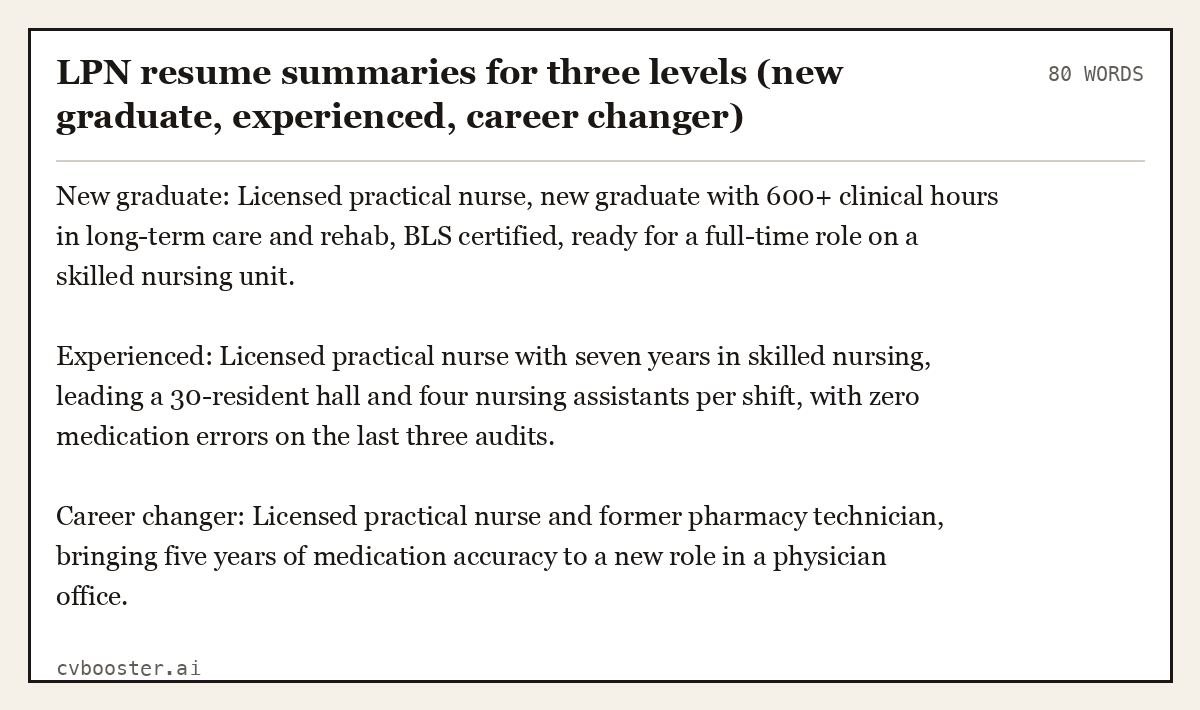
80 wordsNew graduate: Licensed practical nurse, new graduate with 600+ clinical hours in long-term care and rehab, BLS certified, ready for a full-time role on a skilled nursing unit.
Experienced: Licensed practical nurse with seven years in skilled nursing, leading a 30-resident hall and four nursing assistants per shift, with zero medication errors on the last three audits.
Career changer: Licensed practical nurse and former pharmacy technician, bringing five years of medication accuracy to a new role in a physician office.
Want a summary for your exact setting? Our LPN objective for resume page has more.
Email to a practical nursing program asking about prerequisites (complete)
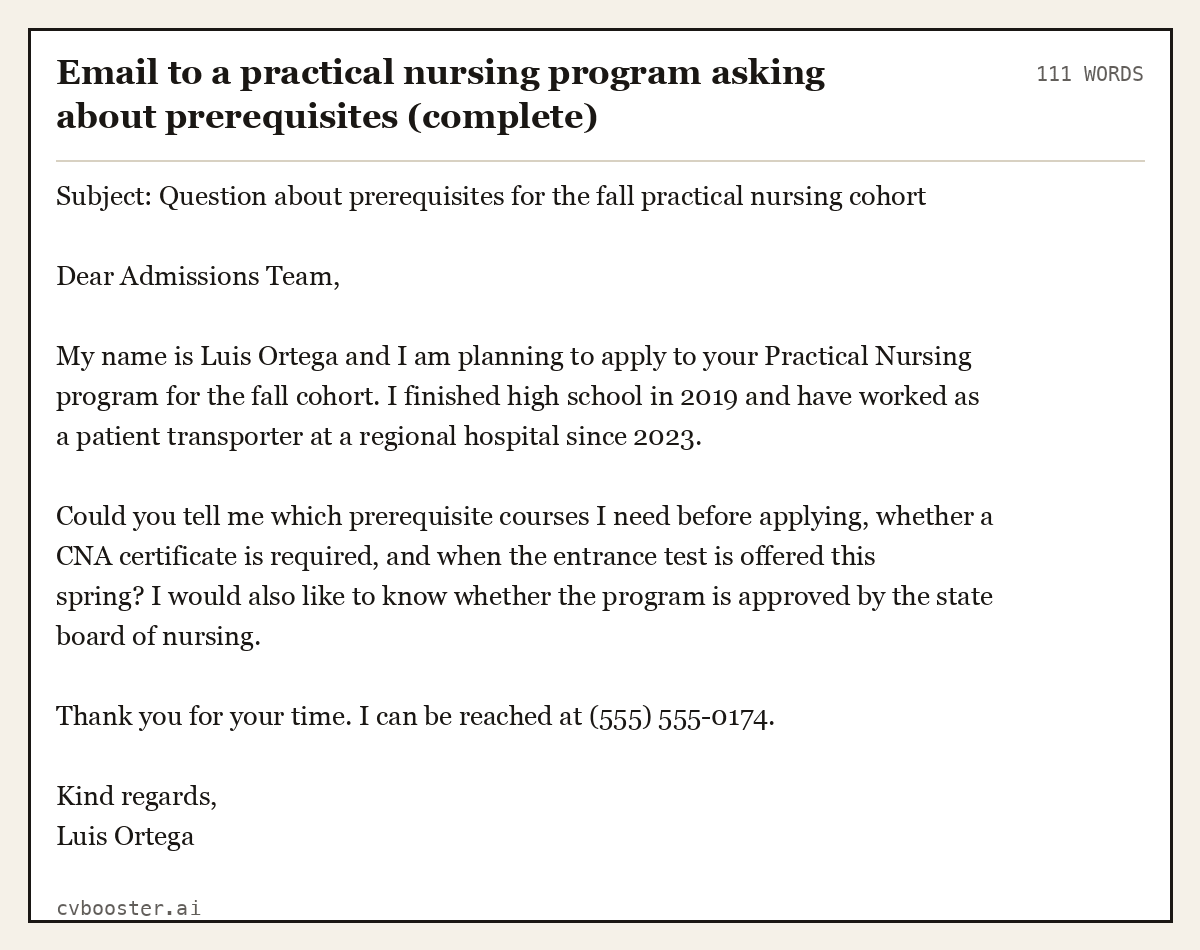
111 wordsSubject: Question about prerequisites for the fall practical nursing cohort
Dear Admissions Team,
My name is Luis Ortega and I am planning to apply to your Practical Nursing program for the fall cohort. I finished high school in 2019 and have worked as a patient transporter at a regional hospital since 2023.
Could you tell me which prerequisite courses I need before applying, whether a CNA certificate is required, and when the entrance test is offered this spring? I would also like to know whether the program is approved by the state board of nursing.
Thank you for your time. I can be reached at (555) 555-0174.
Kind regards, Luis Ortega
Interview answer: Why practical nursing and not an RN degree?
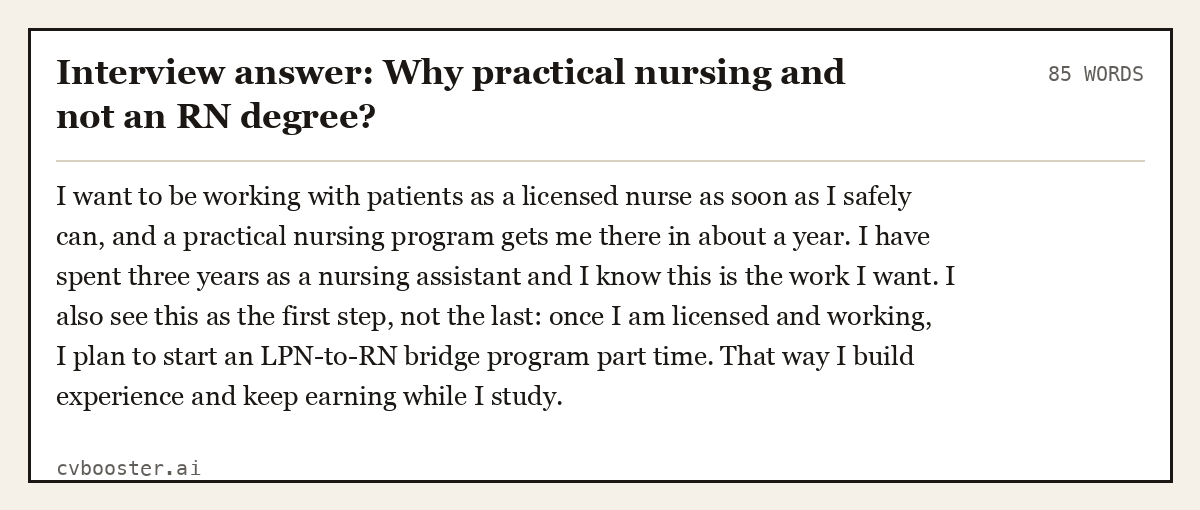
85 wordsI want to be working with patients as a licensed nurse as soon as I safely can, and a practical nursing program gets me there in about a year. I have spent three years as a nursing assistant and I know this is the work I want. I also see this as the first step, not the last: once I am licensed and working, I plan to start an LPN-to-RN bridge program part time. That way I build experience and keep earning while I study.
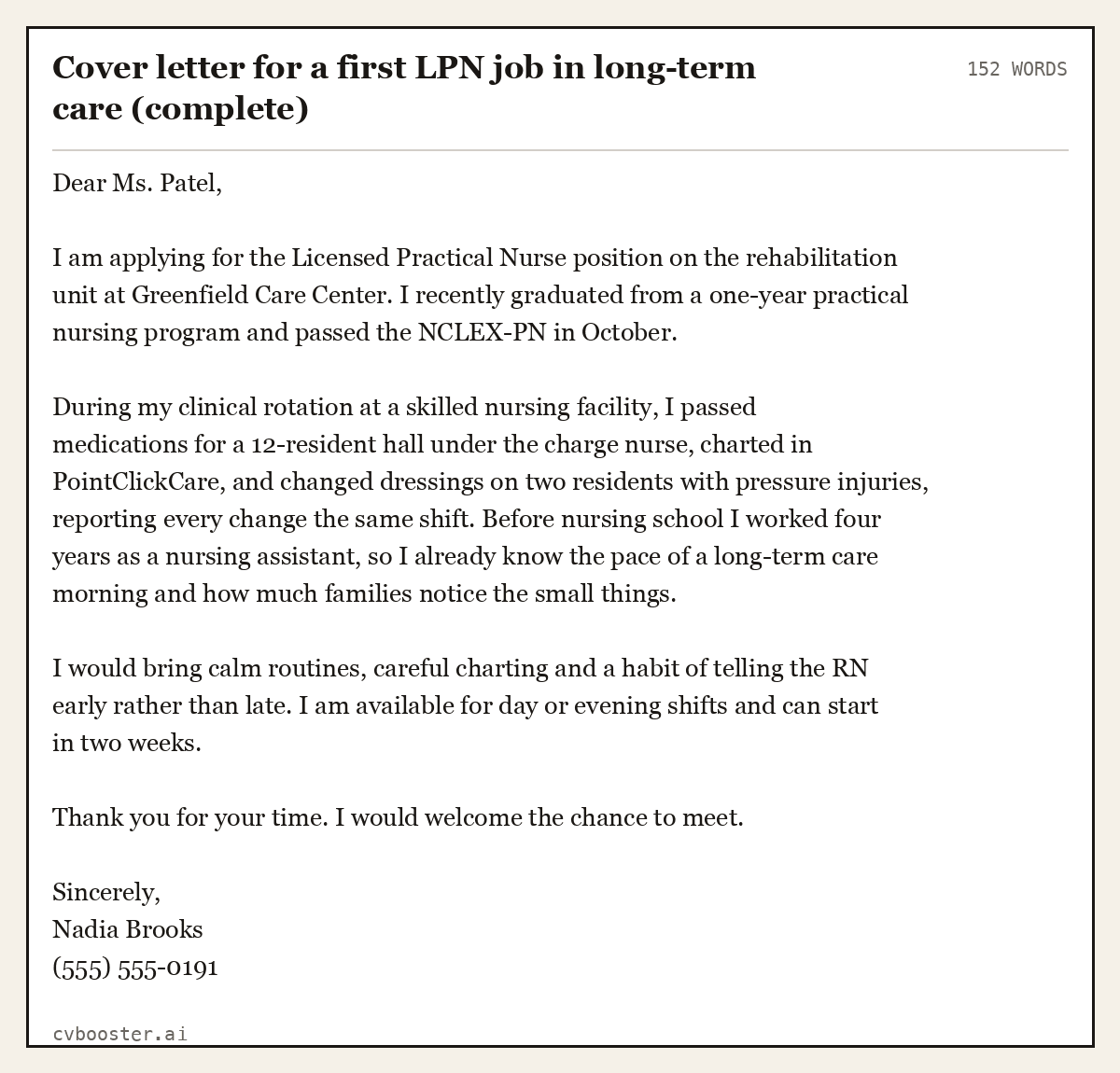
Cover letter for a first LPN job in long-term care (complete)
152 wordsDear Ms. Patel,
I am applying for the Licensed Practical Nurse position on the rehabilitation unit at Greenfield Care Center. I recently graduated from a one-year practical nursing program and passed the NCLEX-PN in October.
During my clinical rotation at a skilled nursing facility, I passed medications for a 12-resident hall under the charge nurse, charted in PointClickCare, and changed dressings on two residents with pressure injuries, reporting every change the same shift. Before nursing school I worked four years as a nursing assistant, so I already know the pace of a long-term care morning and how much families notice the small things.
I would bring calm routines, careful charting and a habit of telling the RN early rather than late. I am available for day or evening shifts and can start in two weeks.
Thank you for your time. I would welcome the chance to meet.
Sincerely, Nadia Brooks (555) 555-0191
The last example is the full resume. Notice the license and BLS sit in their own block, and the CNA years stay on the page, because nursing experience of any kind counts.
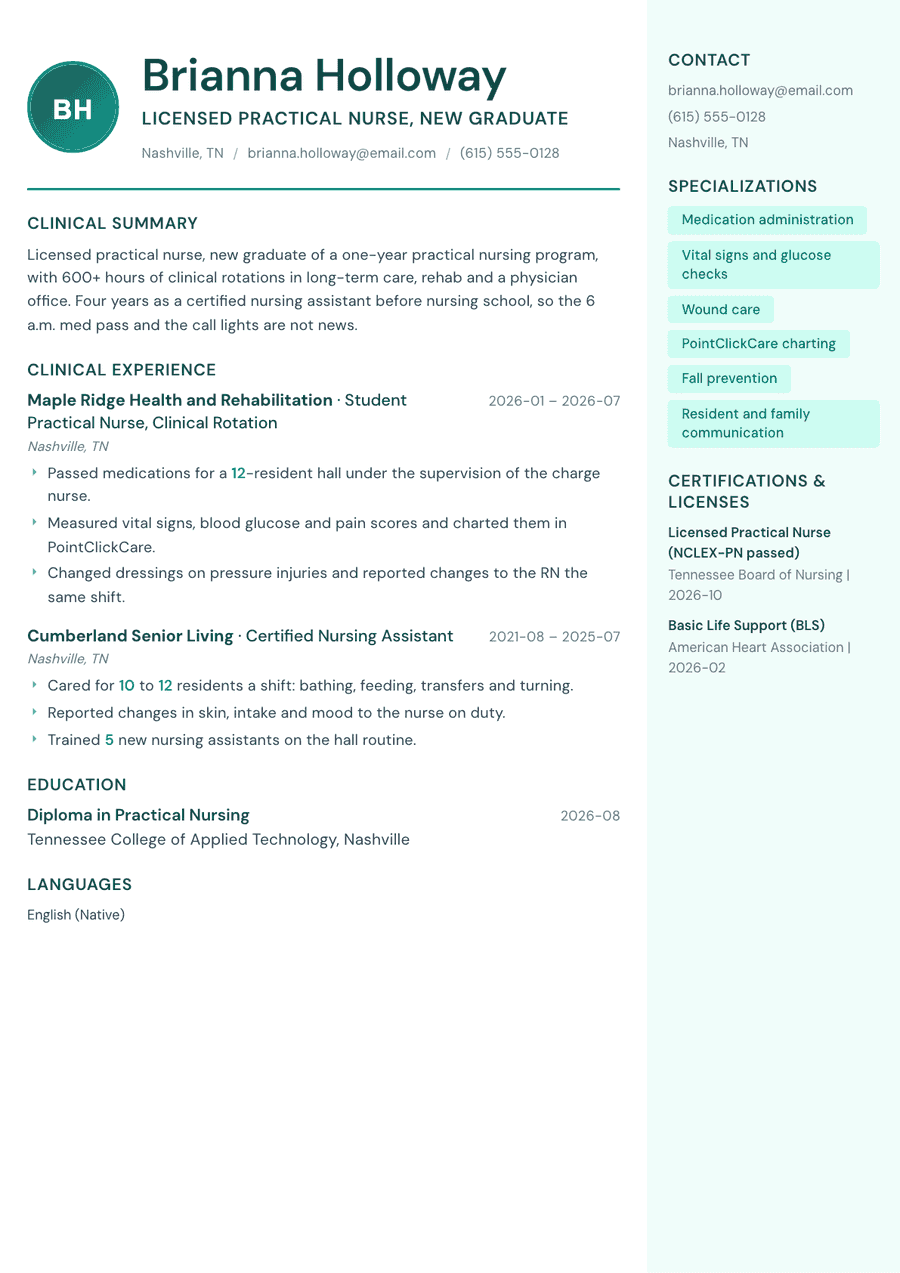
New graduate licensed practical nurse resume (complete)
229 wordsBrianna Holloway Licensed Practical Nurse, New Graduate (615) 555-0128 · brianna.holloway@email.com · Nashville, TN
Summary Licensed practical nurse, new graduate of a one-year practical nursing program, with 600+ hours of clinical rotations in long-term care, rehab and a physician office. Four years as a certified nursing assistant before nursing school, so the 6 a.m. med pass and the call lights are not news.
Experience Student Practical Nurse, Clinical Rotation, Maple Ridge Health and Rehabilitation, Nashville, TN | Jan 2026 to Jul 2026 - Passed medications for a 12-resident hall under the supervision of the charge nurse. - Measured vital signs, blood glucose and pain scores and charted them in PointClickCare. - Changed dressings on pressure injuries and reported changes to the RN the same shift.
Certified Nursing Assistant, Cumberland Senior Living, Nashville, TN | Aug 2021 to Jul 2025 - Cared for 10 to 12 residents a shift: bathing, feeding, transfers and turning. - Reported changes in skin, intake and mood to the nurse on duty. - Trained 5 new nursing assistants on the hall routine.
Education Diploma, Practical Nursing, Tennessee College of Applied Technology, Nashville, 2026
Certifications Licensed Practical Nurse (NCLEX-PN passed), Tennessee Board of Nursing, 2026 Basic Life Support (BLS), American Heart Association, 2026
Skills Medication administration, Vital signs and glucose checks, Wound care, PointClickCare charting, Fall prevention, Resident and family communication
Languages English (Native)
Remedy template: Use this template
For more complete resumes, see the licensed practical nurse resume examples, the skills lists in LPN skills for resume, and, if you are still applying to programs, our resume for nursing school.
Frequently asked questions
What is a practical nurse?
A practical nurse is a licensed nurse who gives basic medical care, such as vital signs, medications, wound care and charting, usually under a registered nurse or physician. Most states call the role licensed practical nurse (LPN); a few use licensed vocational nurse (LVN). Both need a state-approved program and a passed NCLEX-PN exam.
How long does it take to become a practical nurse?
The Bureau of Labor Statistics says a state-approved practical nursing program typically takes about one year. After that you apply to your state board of nursing, register for the NCLEX-PN with Pearson VUE, and sit the exam. Allow a few extra weeks after graduation for the board application and the test date.
Is an LPN a real nurse?
Yes. An LPN holds a state nursing license, passed a national licensing exam, and practices nursing within the scope the state allows. The difference from a registered nurse is training length and scope: RNs usually handle assessments and care plans, and often supervise LPNs, while LPNs carry out much of the direct care.
How much do practical nurses make?
The BLS lists a 2025 median pay of $64,400 per year, or $30.96 per hour, for licensed practical and licensed vocational nurses. Half earn more and half earn less, and pay depends on state, setting and shift. Check the state tables on the BLS page before comparing offers or programs.
What is the difference between an LPN and an RN?
An LPN finishes a program of about one year and passes the NCLEX-PN. An RN completes a bachelor's degree, associate's degree or approved diploma and passes the NCLEX-RN. RNs have a wider scope and a BLS 2025 median pay of $97,550 per year, compared with $64,400 for LPNs.
Can an LPN become an RN later?
Yes. Many LPNs take an LPN-to-RN bridge program, often part time while working, which builds on what they already learned. After finishing, they pass the NCLEX-RN to be licensed as registered nurses. Check that any bridge program is approved by your state board of nursing before you enroll.
More in this series: related guides
- AI Letter Writer: 7 Prompts and the Fixed Letters They Need
- Amazon Resume Example: 6 Resumes Using Leadership Principles
- Best Resume Builder: 9 Tools Compared on the Free Download
- Business Analyst Cover Letter: 8 Examples by Level
- Career Change Cover Letter: 8 Examples by Career Switch
- Chef Cover Letter: 8 Examples From Line Cook to Exec Chef
- Cover Letter Heading: Format and 10 Complete Examples
- Creative Resume Template: 6 Designs with Complete Examples
- Data Scientist Cover Letter: 8 Examples From Entry Level
- Digital Marketing Cover Letter: 8 Examples by Specialty
- EAP Program: What It Covers, Is It Confidential, 7 Scripts
- Full Stack Development: Layers, Skills, Pay and Examples
- Help With Resume Wording: 60 Before and After Lines
- How to Make Your Resume Stand Out: 15 Moves That Work
- How to Quit a Job: 7 Steps and 8 Scripts You Can Use
- How to Start a Cover Letter: 30 Openings and 3 Letters
- Resume Fixer: 15 Fixes With Before and After Examples
- Resume PDF Download: 6 Ready Formats and How to Save a PDF
- Resume Screening: The 6 Stages and 8 Lines That Pass Them
- Simple CV Format: Section Order and 6 Examples for Any Job
- Truck Driver Cover Letter: 8 Examples for CDL Drivers
- US Resume Format: Rules and 6 Examples for American Jobs
- Walmart Resume Example: 6 Resumes for Real Store Roles
- Warehouse Worker Cover Letter: 8 Examples by Job Type
Looking for a worked example for your job title? Browse the resume examples by job title.