Return to Work Letter From Doctor: Rules and 7 Full Samples

A return to work letter from a doctor is a short signed note from your health care provider stating that you can go back to work on a specific date, either with no restrictions or with listed restrictions. The one condition is scope: the letter should address your ability to do your job, not your full medical history, because federal rules limit what an employer can ask for. Those limits come from the FMLA fitness-for-duty rule at 29 CFR 825.312 and from the EEOC's enforcement guidance on medical inquiries under the Americans with Disabilities Act. Below are what the letter must contain, what your employer can and cannot require, and seven complete letters and emails.
You were out sick, you are better, and now the last obstacle between you and your paycheck is a single sheet of paper your doctor's office has promised to fax by end of day three days in a row. The note itself takes two minutes to write. Here is what a complete one looks like:
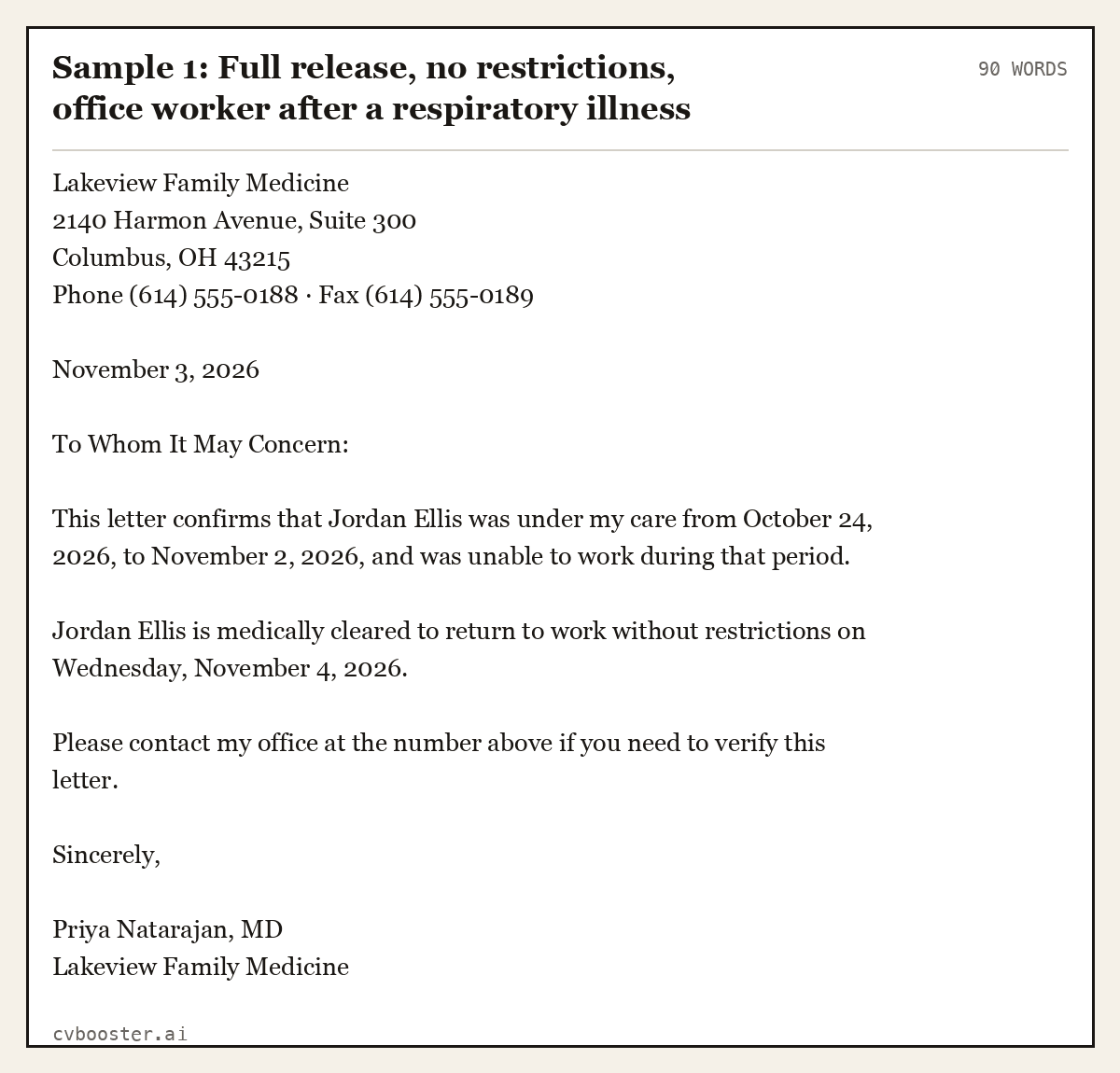
Sample 1: Full release, no restrictions, office worker after a respiratory illness
90 wordsLakeview Family Medicine 2140 Harmon Avenue, Suite 300 Columbus, OH 43215 Phone (614) 555-0188 · Fax (614) 555-0189
November 3, 2026
To Whom It May Concern:
This letter confirms that Jordan Ellis was under my care from October 24, 2026, to November 2, 2026, and was unable to work during that period.
Jordan Ellis is medically cleared to return to work without restrictions on Wednesday, November 4, 2026.
Please contact my office at the number above if you need to verify this letter.
Sincerely,
Priya Natarajan, MD Lakeview Family Medicine
Create my CVOr start from one of our free resume templates
What a return to work letter must include
A return to work note does not need to be long. It needs to answer the questions your employer is allowed to ask, and nothing else.
| Element | Why it is there | Example wording |
|---|---|---|
| Provider letterhead | Lets HR verify the source | Clinic name, address, phone, fax |
| Date of the letter | Shows when the assessment was made | November 3, 2026 |
| Your full name | Matches the note to your personnel file | Jordan Ellis |
| Dates you were unable to work | Covers the absence | October 24 to November 2, 2026 |
| Return date | The single most important line | Cleared to return on November 4, 2026 |
| Restrictions, if any | Tells your manager what you can and cannot do | No lifting over 20 pounds for 3 weeks |
| Duration of restrictions | So the restriction does not become permanent by accident | Until November 25, 2026, then reassess |
| Provider signature and credentials | Authenticates the note | Priya Natarajan, MD |
What it should usually leave out: your diagnosis, test results, medications, and anything about conditions unrelated to the absence. Your employer may have a policy that asks for more in specific situations, which is covered below, but the default is the minimum.
What the FMLA allows your employer to require
If your absence was FMLA leave for your own serious health condition, the Department of Labor's rule on fitness-for-duty certification applies. The regulation, 29 CFR 825.312, says the employer may have "a uniformly-applied policy or practice that requires all similarly-situated employees" to present certification from their health care provider "that the employee is able to resume work."
Four parts of that rule matter for your letter:
- Only the condition that caused the leave. The rule says "An employer may seek a fitness-for-duty certification only with regard to the particular health condition that caused the employee's need for FMLA leave."
- Essential functions, if you were told in advance. Your employer can require that the letter address the essential functions of your job, but only if it gave you a list of those functions "no later than with the designation notice." If you received that list, give it to your doctor.
- No second opinions. The regulation is direct: "No second or third opinions on a fitness-for-duty certification may be required." The employer may contact your provider to clarify or authenticate the letter, but "The employer may not delay the employee's return to work while contact with the health care provider is being made."
- You pay for it. "The cost of the certification shall be borne by the employee, and the employee is not entitled to be paid for the time or travel costs spent in acquiring the certification."
There is one more line that can cost you your job if you miss it. If your employer gave proper notice, "an employee who does not provide a fitness-for-duty certification or request additional FMLA leave is no longer entitled to reinstatement under the FMLA." Read your designation notice before you go back. The Department of Labor's FMLA page explains the notices you should have received.
For intermittent leave, the rule is different. The regulation says an employer "is not entitled to a certification of fitness to return to duty for each absence taken on an intermittent or reduced leave schedule," but may ask "up to once every 30 days if reasonable safety concerns exist."
What the ADA allows, with or without FMLA
The ADA applies whether or not your leave was FMLA leave. The EEOC's enforcement guidance on disability-related inquiries and medical examinations sets the general standard: inquiries and examinations of employees must be "job-related and consistent with business necessity."
For a simple sick-day note, the EEOC says an employer "may ask an employee to justify his/her use of sick leave by providing a doctor's note or other explanation, as long as it has a policy or practice of requiring all employees, with and without disabilities, to do so."
For a return after medical leave, the guidance answers the question directly. If the employer has a reasonable belief that your ability to do essential functions will be impaired, or that you would pose a direct threat, it may ask questions or require an exam, but "Any inquiries or examination, however, must be limited in scope to what is needed to make an assessment of the employee's ability to work." And: "The employer may not use the employee's leave as a justification for making far-ranging disability-related inquiries or requiring an unrelated medical examination."
Whatever you hand over is protected. The guidance says the ADA requires employers to treat medical information "as a confidential medical record." In practice, your note should go to HR or the person designated to handle medical records, not into a group email to your team.
The 29 CFR 825.312 rule itself ties the two laws together: "Requirements under the Americans with Disabilities Act (ADA), as amended, apply."
FMLA, ADA, or a plain sick note: which rules apply
| Situation | Main rule | What the employer can ask for |
|---|---|---|
| A few sick days, no FMLA | Employer policy, within EEOC limits | A doctor's note if the policy applies to all employees |
| FMLA leave for your own serious health condition | 29 CFR 825.312 | Certification that you can resume work; essential functions if listed in advance |
| Intermittent FMLA leave | 29 CFR 825.312(f) | Certification up to once every 30 days, only with reasonable safety concerns |
| Medical leave where the employer has objective concerns | EEOC ADA guidance | Inquiries or an exam limited to your ability to do the job |
| A state law or union contract covers return to work | 29 CFR 825.312(g) | Whatever that law or contract provides |
That last row comes straight from the regulation: "If State or local law or the terms of a collective bargaining agreement govern an employee's return to work, those provisions shall be applied." If you are in a union, check your contract before you call the clinic.
Six more samples: letters with restrictions and the emails around them
Each sample is complete. Names, clinics, and companies are fictional.
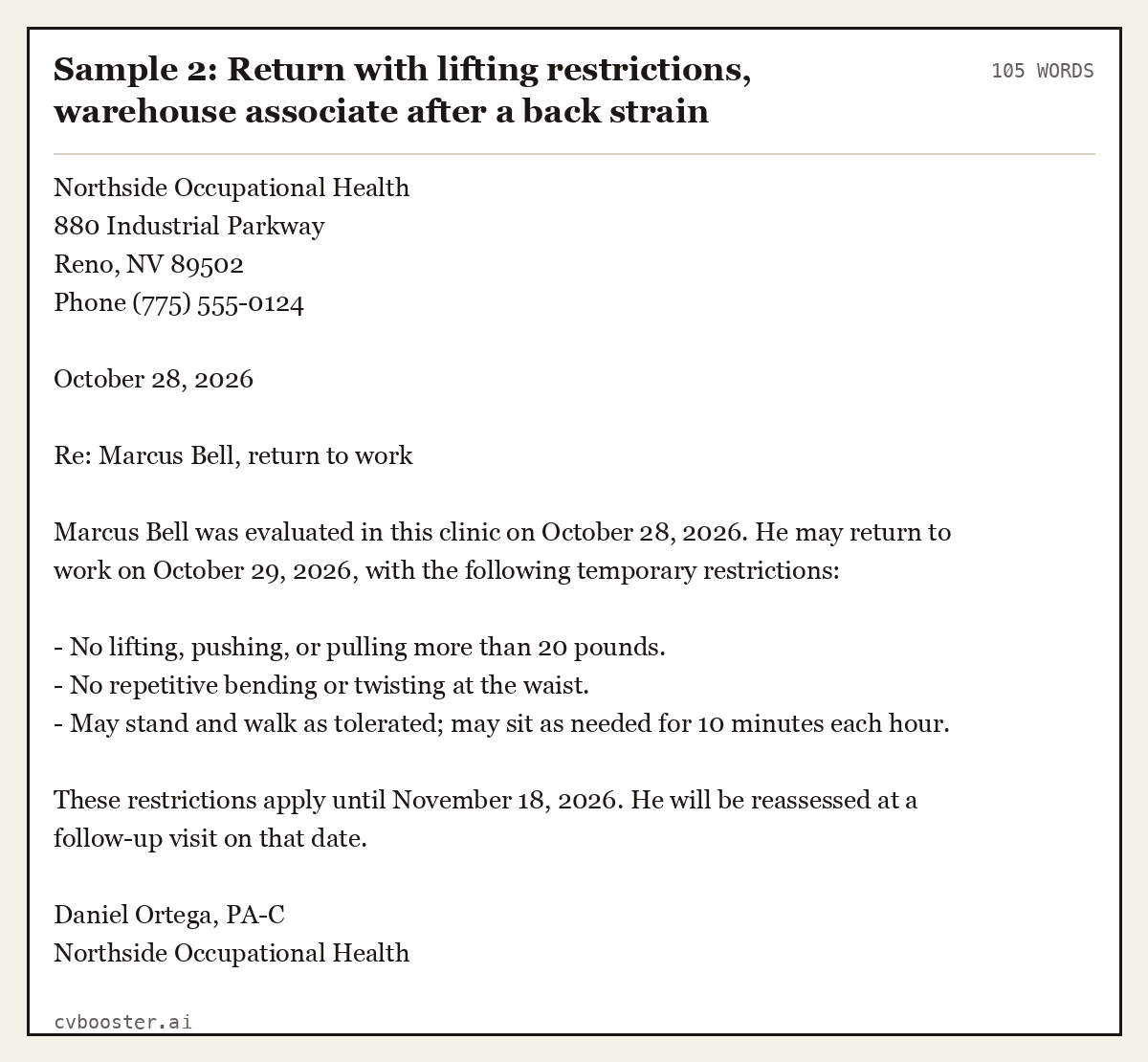
Sample 2: Return with lifting restrictions, warehouse associate after a back strain
105 wordsNorthside Occupational Health 880 Industrial Parkway Reno, NV 89502 Phone (775) 555-0124
October 28, 2026
Re: Marcus Bell, return to work
Marcus Bell was evaluated in this clinic on October 28, 2026. He may return to work on October 29, 2026, with the following temporary restrictions:
- No lifting, pushing, or pulling more than 20 pounds. - No repetitive bending or twisting at the waist. - May stand and walk as tolerated; may sit as needed for 10 minutes each hour.
These restrictions apply until November 18, 2026. He will be reassessed at a follow-up visit on that date.
Daniel Ortega, PA-C Northside Occupational Health
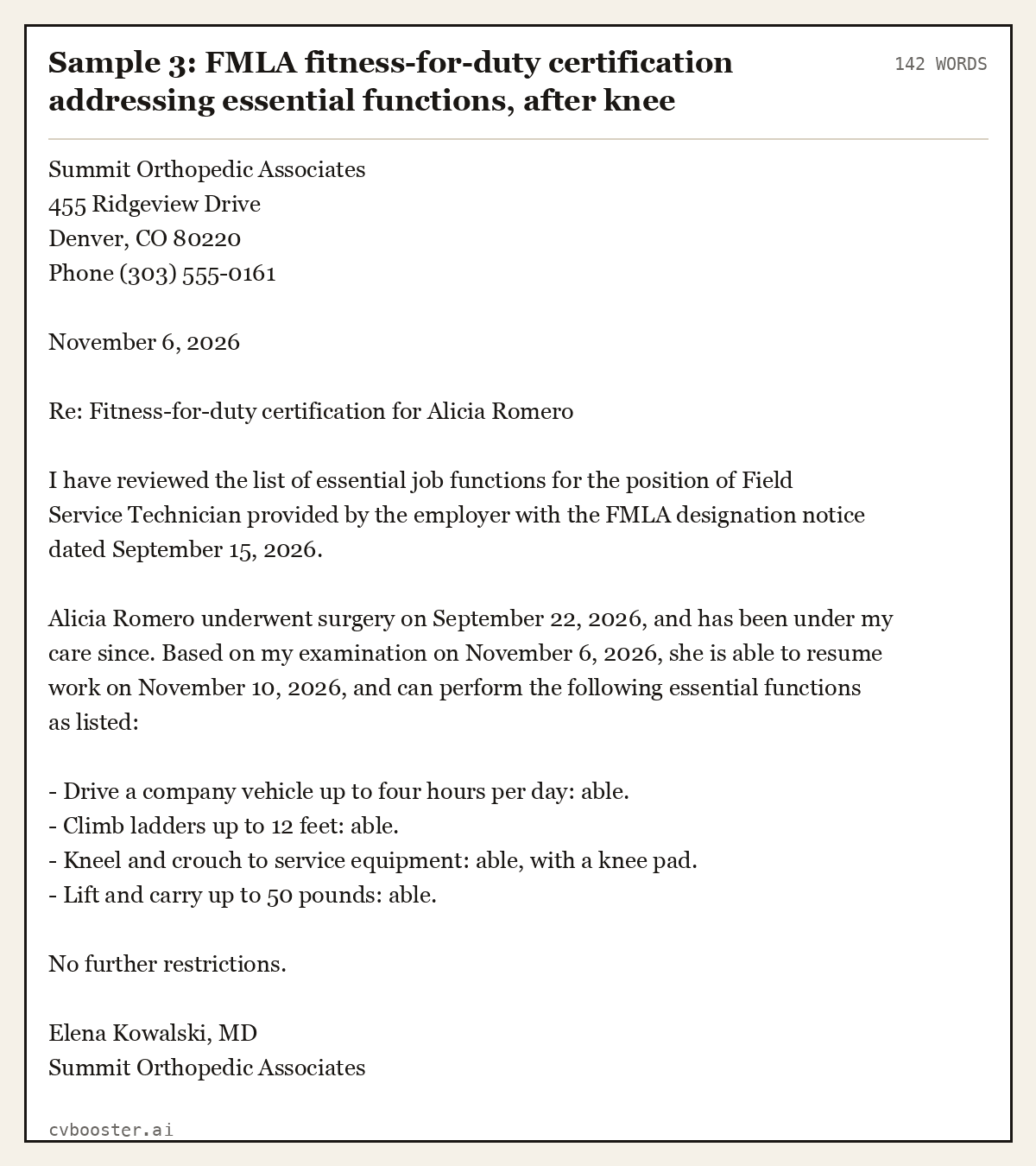
Sample 3: FMLA fitness-for-duty certification addressing essential functions, after knee surgery
142 wordsSummit Orthopedic Associates 455 Ridgeview Drive Denver, CO 80220 Phone (303) 555-0161
November 6, 2026
Re: Fitness-for-duty certification for Alicia Romero
I have reviewed the list of essential job functions for the position of Field Service Technician provided by the employer with the FMLA designation notice dated September 15, 2026.
Alicia Romero underwent surgery on September 22, 2026, and has been under my care since. Based on my examination on November 6, 2026, she is able to resume work on November 10, 2026, and can perform the following essential functions as listed:
- Drive a company vehicle up to four hours per day: able. - Climb ladders up to 12 feet: able. - Kneel and crouch to service equipment: able, with a knee pad. - Lift and carry up to 50 pounds: able.
No further restrictions.
Elena Kowalski, MD Summit Orthopedic Associates
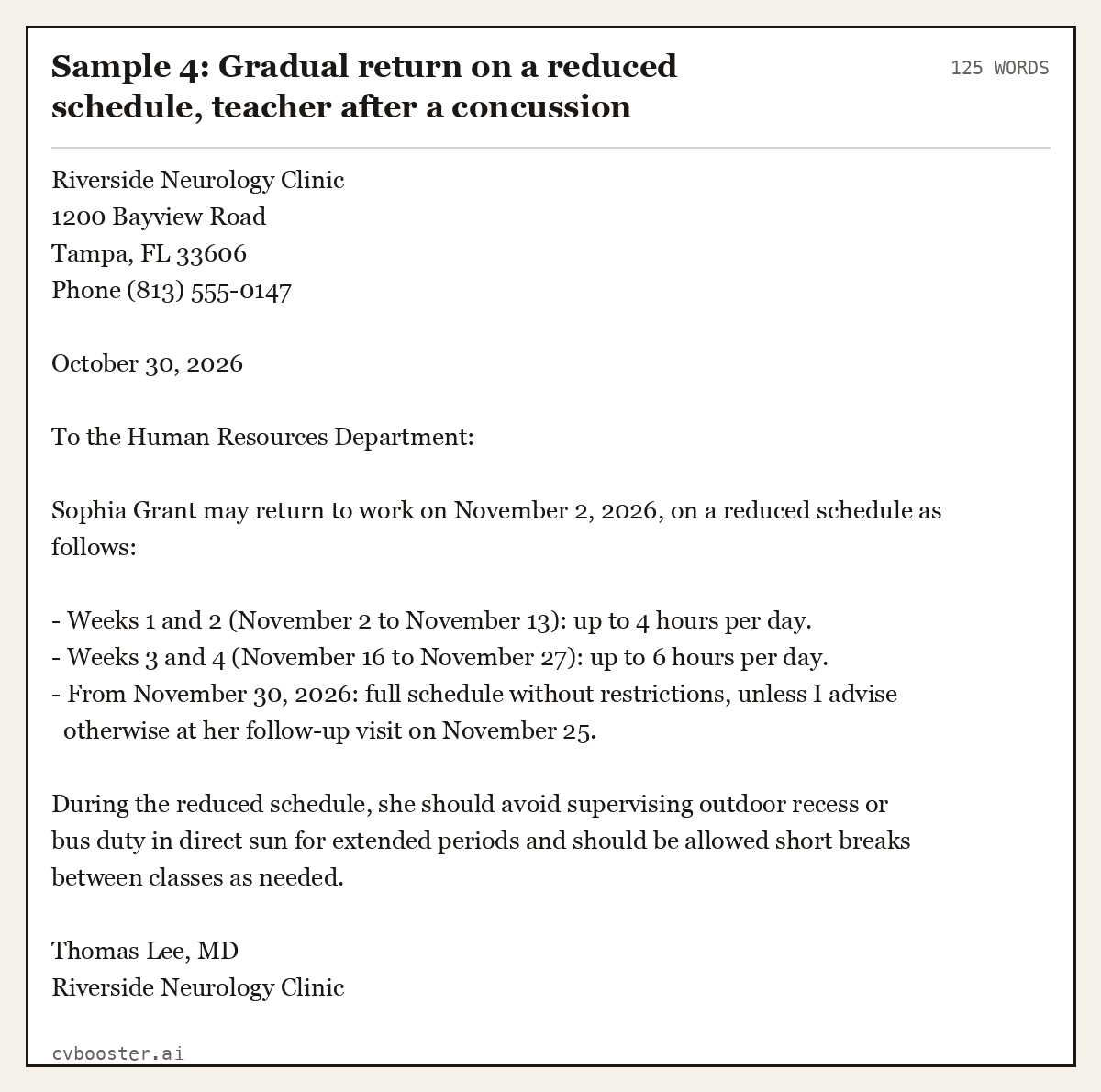
Sample 4: Gradual return on a reduced schedule, teacher after a concussion
125 wordsRiverside Neurology Clinic 1200 Bayview Road Tampa, FL 33606 Phone (813) 555-0147
October 30, 2026
To the Human Resources Department:
Sophia Grant may return to work on November 2, 2026, on a reduced schedule as follows:
- Weeks 1 and 2 (November 2 to November 13): up to 4 hours per day. - Weeks 3 and 4 (November 16 to November 27): up to 6 hours per day. - From November 30, 2026: full schedule without restrictions, unless I advise otherwise at her follow-up visit on November 25.
During the reduced schedule, she should avoid supervising outdoor recess or bus duty in direct sun for extended periods and should be allowed short breaks between classes as needed.
Thomas Lee, MD Riverside Neurology Clinic
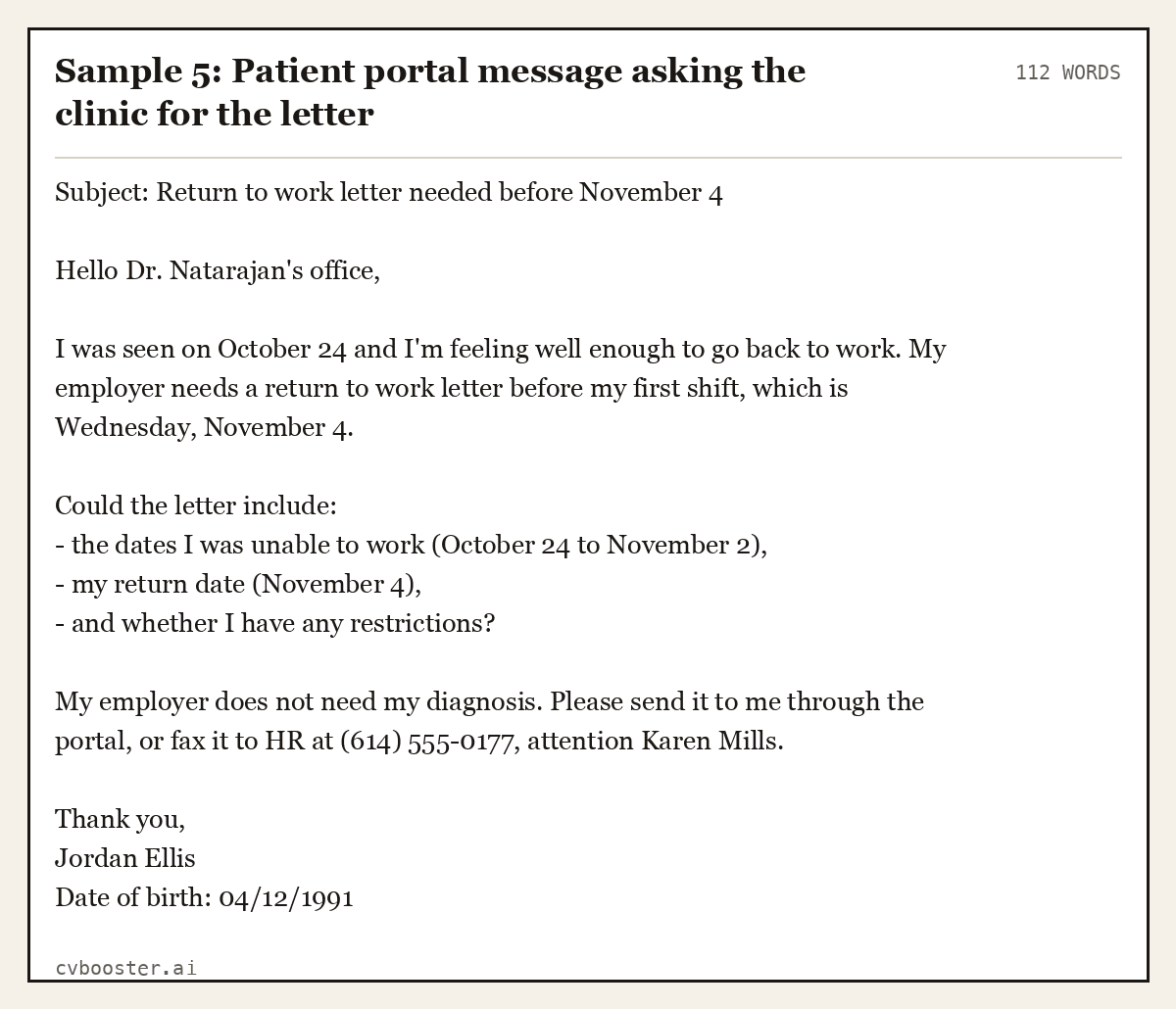
Sample 5: Patient portal message asking the clinic for the letter
112 wordsSubject: Return to work letter needed before November 4
Hello Dr. Natarajan's office,
I was seen on October 24 and I'm feeling well enough to go back to work. My employer needs a return to work letter before my first shift, which is Wednesday, November 4.
Could the letter include: - the dates I was unable to work (October 24 to November 2), - my return date (November 4), - and whether I have any restrictions?
My employer does not need my diagnosis. Please send it to me through the portal, or fax it to HR at (614) 555-0177, attention Karen Mills.
Thank you, Jordan Ellis Date of birth: 04/12/1991
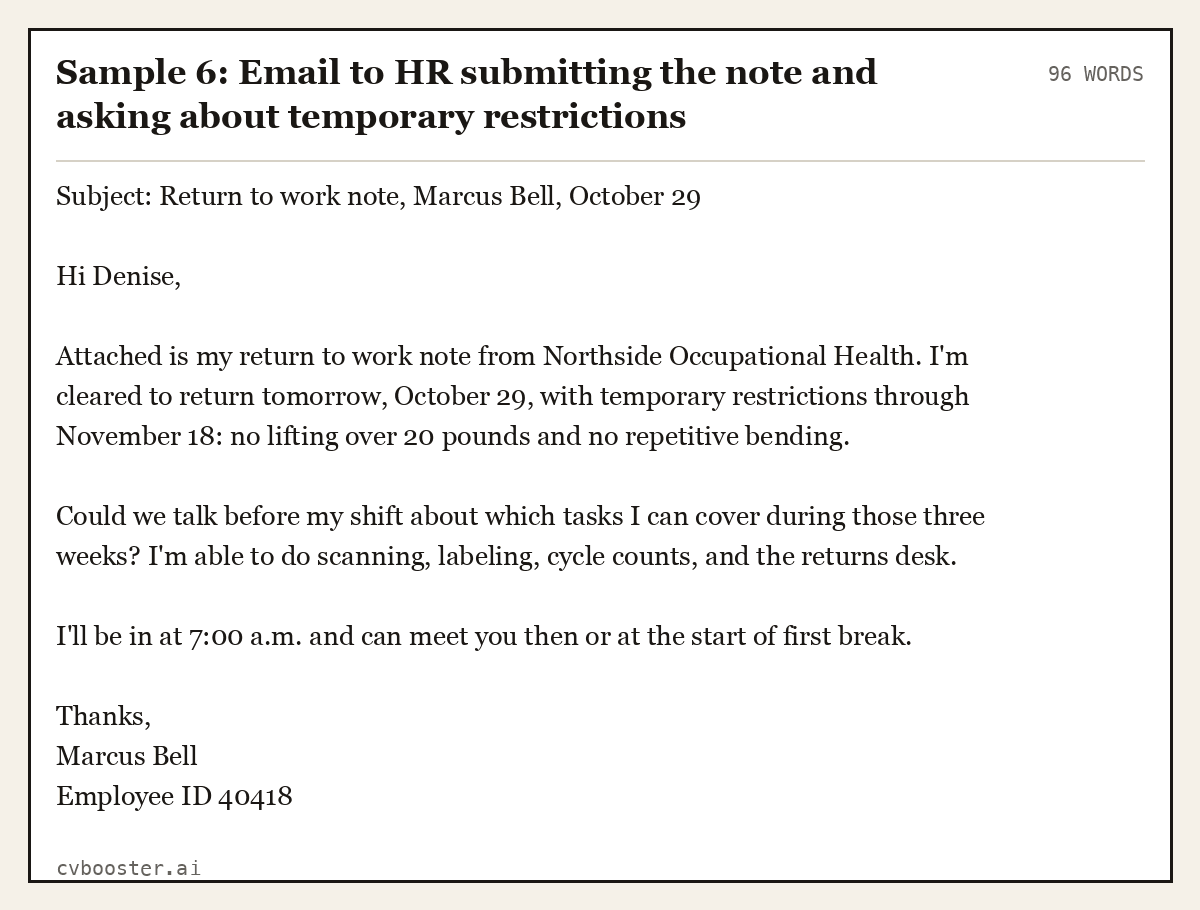
Sample 6: Email to HR submitting the note and asking about temporary restrictions
96 wordsSubject: Return to work note, Marcus Bell, October 29
Hi Denise,
Attached is my return to work note from Northside Occupational Health. I'm cleared to return tomorrow, October 29, with temporary restrictions through November 18: no lifting over 20 pounds and no repetitive bending.
Could we talk before my shift about which tasks I can cover during those three weeks? I'm able to do scanning, labeling, cycle counts, and the returns desk.
I'll be in at 7:00 a.m. and can meet you then or at the start of first break.
Thanks, Marcus Bell Employee ID 40418
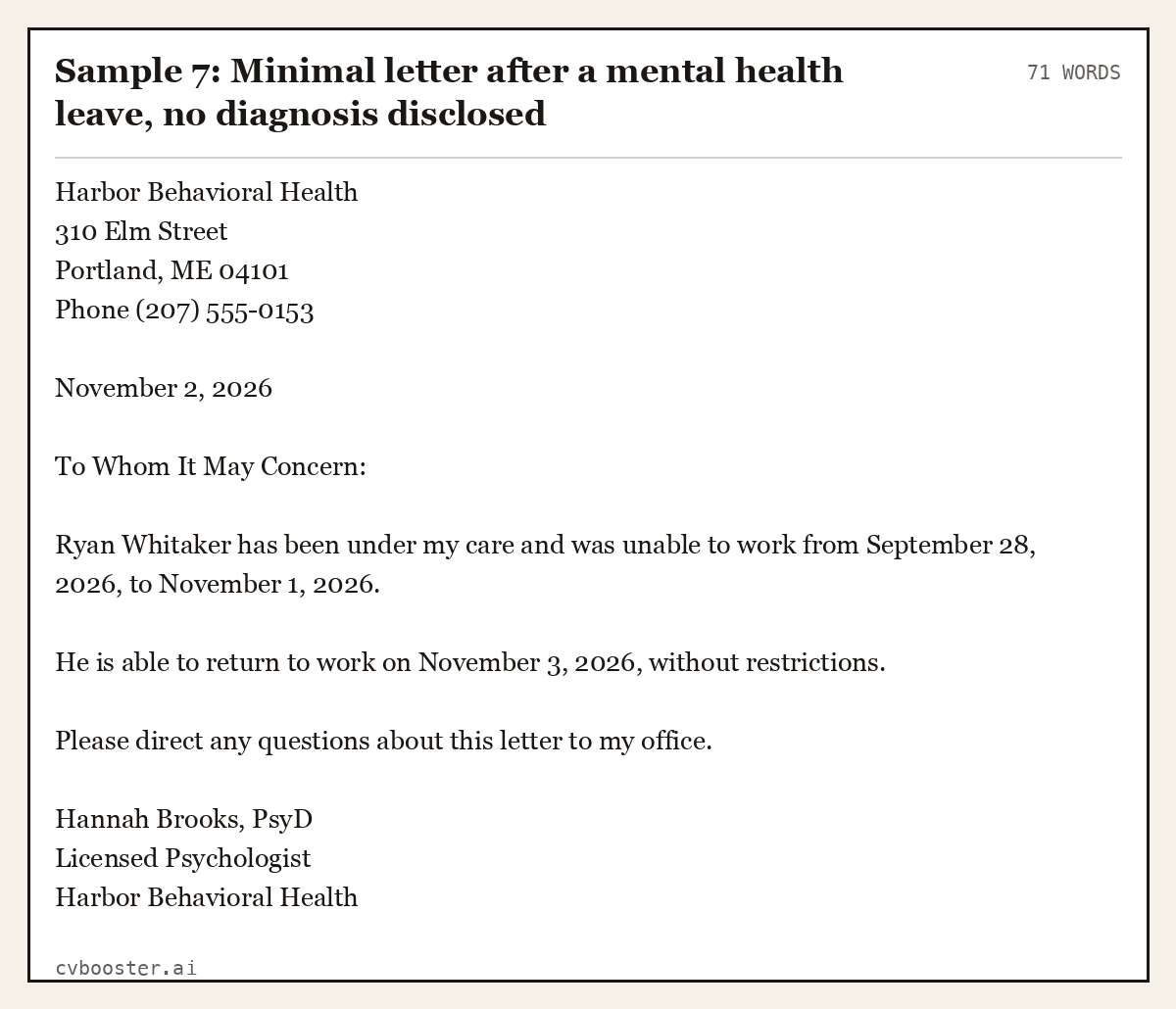
Sample 7: Minimal letter after a mental health leave, no diagnosis disclosed
71 wordsHarbor Behavioral Health 310 Elm Street Portland, ME 04101 Phone (207) 555-0153
November 2, 2026
To Whom It May Concern:
Ryan Whitaker has been under my care and was unable to work from September 28, 2026, to November 1, 2026.
He is able to return to work on November 3, 2026, without restrictions.
Please direct any questions about this letter to my office.
Hannah Brooks, PsyD Licensed Psychologist Harbor Behavioral Health
Seven samples, seven situations
| Sample | Situation | What it shows |
|---|---|---|
| 1 | Short illness | The complete minimum: dates, return date, no restrictions |
| 2 | Injury with limits | Specific restrictions with an end date |
| 3 | FMLA after surgery | Answering the employer's essential-functions list item by item |
| 4 | Gradual return | A reduced schedule with dates for each step |
| 5 | Requesting the letter | Telling the clinic exactly what to include |
| 6 | Submitting the letter | Asking HR about tasks during restrictions |
| 7 | Sensitive condition | A full release that discloses nothing extra |
Common problems and how to fix them
**The note says may return when able.** That is not a date. Ask the clinic for a specific return date or an assessment date.
The restrictions have no end date. An open-ended restriction can turn a three-week limit into a permanent question. Ask for an end date or a reassessment date, as in Sample 2.
Your employer asks for your diagnosis. Under the EEOC guidance, inquiries must be limited to what is needed to assess your ability to work. You can say the note covers your ability to do your job and ask which job function the employer has a concern about.
Your employer wants a second opinion on an FMLA return. The FMLA regulation says no second or third opinions may be required on a fitness-for-duty certification.
Your manager is not sure your restrictions can be accommodated. If your restriction relates to a disability, the ADA's reasonable accommodation process may apply. Ask HR in writing, as in Sample 6, so there is a record of the request.
The clinic is slow. Use the portal message in Sample 5. A precise request gets filled faster than a phone message asking for a note.
Back at work, and looking ahead
Most people return to the same job. Some come back to a role that no longer fits, or decide the time off was the push to look for something else. If you are in that second group, two of our guides help: how to explain employment gaps on a resume without oversharing, and, if you decide to leave, a resignation letter due to a health issue. If you work in healthcare and your leave made you rethink your pay, our nurse assistant salary guide shows how to compare offers with BLS data.
A return to work letter covers a few weeks. Your resume covers the next job. If the time off made you want to update it, you can do that in our resume builder: filling in any template is free and so is the ATS score; PDF or Word download and AI help are Pro.
Frequently asked questions
What should a return to work letter from a doctor say?
It should state your name, the dates you were unable to work, the date you can return, any restrictions with how long they last, and the provider's signature, credentials, and contact details on letterhead. It usually should not include your diagnosis, because employer inquiries must be limited to your ability to do the job.
Can my employer require a doctor's note to return to work?
Yes, within limits. The EEOC says an employer may ask for a doctor's note to justify sick leave if it requires one from all employees. After FMLA leave for your own serious health condition, 29 CFR 825.312 lets an employer require a fitness-for-duty certification under a uniformly applied policy.
What is a fitness for duty letter?
It is the FMLA term for a return to work certification. Under 29 CFR 825.312, your health care provider certifies that you are able to resume work, and if your employer listed your essential job functions with the designation notice, the provider certifies whether you can perform them. The employee pays for the certification.
Does a return to work note have to include my diagnosis?
Usually not. The EEOC guidance says inquiries and exams of returning employees must be limited in scope to what is needed to assess the ability to work, and the FMLA rule limits certification to the condition that caused the leave. A note with dates, a return date, and restrictions covers most situations.
Can my employer delay my return while it checks the doctor's note?
Not under the FMLA. The regulation says the employer may contact your provider to clarify or authenticate a fitness-for-duty certification but may not delay your return to work while that contact is being made. It also says no second or third opinions on the certification may be required.
Looking for a worked example for your job title? Browse the resume examples by job title.