Statement of Suitability Civil Service Example: EO and HEO
By Mustafa Tarabya, founder of CVBooster · Published · Updated
14 min read
A statement of suitability is scored against the essential criteria printed in the advert, in the order the advert prints them, so the fastest way to fail is to write a beautiful paragraph that answers none of them. The word limit is the second constraint: 500 and 750 are the two most common, and the form cuts you off. The guidance quoted here is from civil-service-careers.gov.uk, read on 12 September 2026, which says the statement is "your opportunity to give examples of how you fit the requirements of the job". A full 500-word EO statement and a full 750-word HEO statement follow, each annotated criterion by criterion. Written by Mustafa Tarabya, who hired for his own company, read every application himself and now writes CVBooster's guides.
What a statement of suitability has to do
Statement of suitability and personal statement are the same document under two names, and some adverts say "supporting statement" for the same box.
civil-service-careers.gov.uk states its purpose plainly: "to showcase your relevant skills and experience against the job requirements". The same page tells applicants to read the specification first, to "include specific facts and figures that demonstrate the tangible results of your work", and to keep to the limit, warning that a brief statement "will not provide the required depth of detail and evidence to be assessed fully".
The advert hands you the marking scheme. The person specification lists the essential criteria as bullets, and the box states the word count.
The method: map the criteria, then budget the words
Three steps, before you write a sentence.
- Copy the essential criteria out, keeping their wording and their order.
- Divide the word limit by the number of criteria.
- Put one example against each, with a number in it.
Example at EO, annotated criterion by criterion
The advert: EO Caseworker, Insolvency Service, Birmingham, 500 words, four essential criteria. Those criteria, in the advert's order: managing a caseload to deadlines; accurate written communication with the public; handling confidential or sensitive information; and accurate use of case management systems.
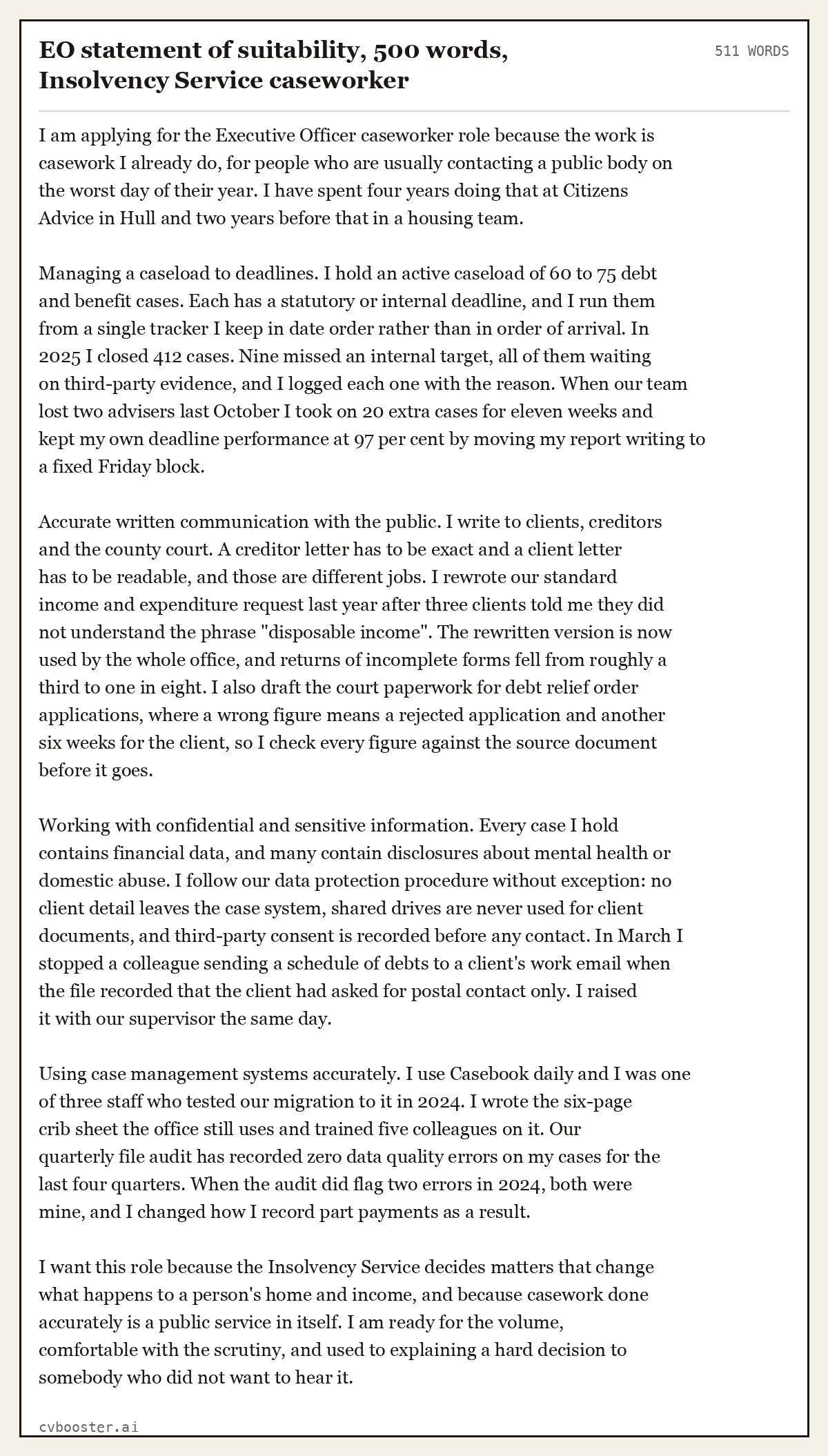
EO statement of suitability, 500 words, Insolvency Service caseworker (511 words)
I am applying for the Executive Officer caseworker role because the work is casework I already do, for people who are usually contacting a public body on the worst day of their year. I have spent four years doing that at Citizens Advice in Hull and two years before that in a housing team.
Managing a caseload to deadlines. I hold an active caseload of 60 to 75 debt and benefit cases. Each has a statutory or internal deadline, and I run them from a single tracker I keep in date order rather than in order of arrival. In 2025 I closed 412 cases. Nine missed an internal target, all of them waiting on third-party evidence, and I logged each one with the reason. When our team lost two advisers last October I took on 20 extra cases for eleven weeks and kept my own deadline performance at 97 per cent by moving my report writing to a fixed Friday block.
Accurate written communication with the public. I write to clients, creditors and the county court. A creditor letter has to be exact and a client letter has to be readable, and those are different jobs. I rewrote our standard income and expenditure request last year after three clients told me they did not understand the phrase "disposable income". The rewritten version is now used by the whole office, and returns of incomplete forms fell from roughly a third to one in eight. I also draft the court paperwork for debt relief order applications, where a wrong figure means a rejected application and another six weeks for the client, so I check every figure against the source document before it goes.
Working with confidential and sensitive information. Every case I hold contains financial data, and many contain disclosures about mental health or domestic abuse. I follow our data protection procedure without exception: no client detail leaves the case system, shared drives are never used for client documents, and third-party consent is recorded before any contact. In March I stopped a colleague sending a schedule of debts to a client's work email when the file recorded that the client had asked for postal contact only. I raised it with our supervisor the same day.
Using case management systems accurately. I use Casebook daily and I was one of three staff who tested our migration to it in 2024. I wrote the six-page crib sheet the office still uses and trained five colleagues on it. Our quarterly file audit has recorded zero data quality errors on my cases for the last four quarters. When the audit did flag two errors in 2024, both were mine, and I changed how I record part payments as a result.
I want this role because the Insolvency Service decides matters that change what happens to a person's home and income, and because casework done accurately is a public service in itself. I am ready for the volume, comfortable with the scrutiny, and used to explaining a hard decision to somebody who did not want to hear it.
What the sifter is scoring
- Criterion: managing a caseload to deadlines. Evidence: 60 to 75 live cases, 412 closed, nine misses logged with reasons, and a named change made under pressure.
- Criterion: accurate written communication with the public. Evidence: a rewritten standard letter and a measured fall in incomplete returns.
- Criterion: working with confidential or sensitive information. Evidence: the specific procedure followed, plus one incident challenged and escalated.
- Criterion: case management systems. Evidence: the named system, the migration testing, the crib sheet, four clean audits.
- Structure: the criteria appear in the advert's own order, each as a bold lead-in, so the sifter can find them without reading the whole piece.
- Word split: 55 opening, roughly 115 per criterion, 55 closing. Total 500.
Example at HEO, annotated criterion by criterion
The advert: Higher Executive Officer Operations Manager, Maritime and Coastguard Agency, Southampton, 750-word statement of suitability, five essential criteria, Success Profiles elements behaviours and experience.
Essential criteria as listed: leading and developing an operational team; managing performance against service standards; stakeholder relationships across organisations; analysing data to improve a service; and managing budgets or resources.
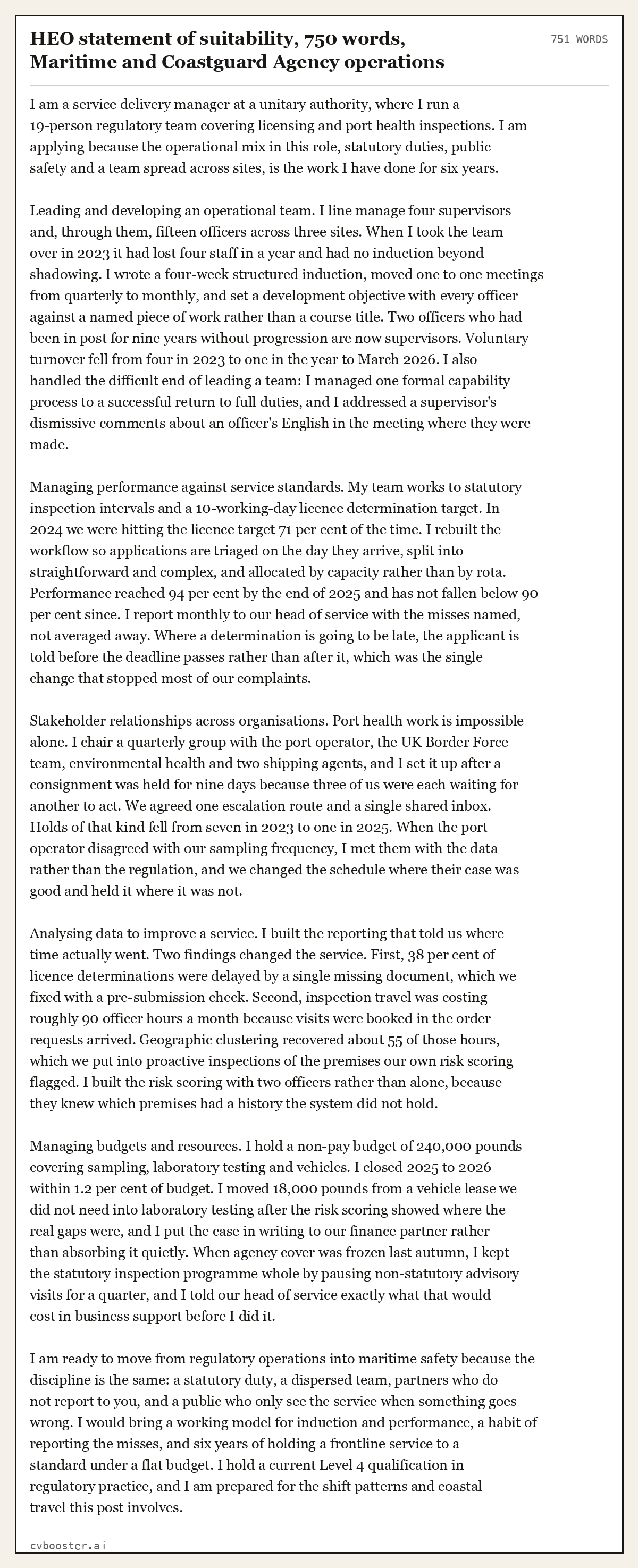
HEO statement of suitability, 750 words, Maritime and Coastguard Agency operations manager (751 words)
I am a service delivery manager at a unitary authority, where I run a 19-person regulatory team covering licensing and port health inspections. I am applying because the operational mix in this role, statutory duties, public safety and a team spread across sites, is the work I have done for six years.
Leading and developing an operational team. I line manage four supervisors and, through them, fifteen officers across three sites. When I took the team over in 2023 it had lost four staff in a year and had no induction beyond shadowing. I wrote a four-week structured induction, moved one to one meetings from quarterly to monthly, and set a development objective with every officer against a named piece of work rather than a course title. Two officers who had been in post for nine years without progression are now supervisors. Voluntary turnover fell from four in 2023 to one in the year to March 2026. I also handled the difficult end of leading a team: I managed one formal capability process to a successful return to full duties, and I addressed a supervisor's dismissive comments about an officer's English in the meeting where they were made.
Managing performance against service standards. My team works to statutory inspection intervals and a 10-working-day licence determination target. In 2024 we were hitting the licence target 71 per cent of the time. I rebuilt the workflow so applications are triaged on the day they arrive, split into straightforward and complex, and allocated by capacity rather than by rota. Performance reached 94 per cent by the end of 2025 and has not fallen below 90 per cent since. I report monthly to our head of service with the misses named, not averaged away. Where a determination is going to be late, the applicant is told before the deadline passes rather than after it, which was the single change that stopped most of our complaints.
Stakeholder relationships across organisations. Port health work is impossible alone. I chair a quarterly group with the port operator, the UK Border Force team, environmental health and two shipping agents, and I set it up after a consignment was held for nine days because three of us were each waiting for another to act. We agreed one escalation route and a single shared inbox. Holds of that kind fell from seven in 2023 to one in 2025. When the port operator disagreed with our sampling frequency, I met them with the data rather than the regulation, and we changed the schedule where their case was good and held it where it was not.
Analysing data to improve a service. I built the reporting that told us where time actually went. Two findings changed the service. First, 38 per cent of licence determinations were delayed by a single missing document, which we fixed with a pre-submission check. Second, inspection travel was costing roughly 90 officer hours a month because visits were booked in the order requests arrived. Geographic clustering recovered about 55 of those hours, which we put into proactive inspections of the premises our own risk scoring flagged. I built the risk scoring with two officers rather than alone, because they knew which premises had a history the system did not hold.
Managing budgets and resources. I hold a non-pay budget of 240,000 pounds covering sampling, laboratory testing and vehicles. I closed 2025 to 2026 within 1.2 per cent of budget. I moved 18,000 pounds from a vehicle lease we did not need into laboratory testing after the risk scoring showed where the real gaps were, and I put the case in writing to our finance partner rather than absorbing it quietly. When agency cover was frozen last autumn, I kept the statutory inspection programme whole by pausing non-statutory advisory visits for a quarter, and I told our head of service exactly what that would cost in business support before I did it.
I am ready to move from regulatory operations into maritime safety because the discipline is the same: a statutory duty, a dispersed team, partners who do not report to you, and a public who only see the service when something goes wrong. I would bring a working model for induction and performance, a habit of reporting the misses, and six years of holding a frontline service to a standard under a flat budget. I hold a current Level 4 qualification in regulatory practice, and I am prepared for the shift patterns and coastal travel this post involves.
What the sifter is scoring
- Criterion: leading and developing an operational team. Evidence: turnover from four to one, two internal promotions, and an uncomfortable moment handled rather than smoothed over.
- Criterion: managing performance against service standards. Evidence: 71 to 94 per cent against a named target, with the mechanism explained.
- Criterion: stakeholder relationships. Evidence: a group convened, an escalation route agreed, holds down from seven to one, and one disagreement resolved on the evidence.
- Criterion: analysing data. Evidence: two findings, each with a number and the change it produced.
- Criterion: budgets and resources. Evidence: a named budget, a variance, a reallocation put in writing, and a trade-off stated in advance.
- Behaviour overlap: the leadership paragraph also evidences gov.uk's Leadership bullet "effectively manage conflict, misconduct and non-inclusive behaviour, raising with senior managers where appropriate", which is useful if the same behaviour is assessed at interview.
- Word split: 65 opening, roughly 135 per criterion, 105 closing. Total 750.
The word budget, criterion by criterion
Divide, do not improvise. These are the splits behind the two statements above.
| Limit | Criteria in the advert | Words per criterion | Opening and closing |
|---|---|---|---|
| 500 | 4 | About 105 | 55 opening, 55 closing |
| 750 | 5 | About 125 | 65 opening, 90 closing |
| 750 | 6 | About 105 | 60 opening, 60 closing |
| 1,250 | 4 plus behaviours | About 250 | 100 opening, 150 closing |
Inside each block, the split that works is one sentence of context, three or four of your own actions, and one of result with a number in it. Cut the context first when you are over.
What the two statements have in common
Neither statement tells a story in chronological order. Both are built as a grid: the advert's criterion, then the writer's evidence for it, in the advert's own sequence.
Both use bold lead-ins. A sifter marking forty applications should be able to find criterion three in two seconds. Some forms strip formatting, in which case start the paragraph with the criterion's own words instead.
Both name the organisation, the size of the thing being managed and a date range. Both put the least flattering fact in on purpose: nine missed deadlines at EO, a capability process at HEO. Panels read hundreds of flawless summaries, and the specific miss is what makes the rest believable.
The sentences that cost marks
- Before: I am a highly motivated and results-driven individual with excellent organisational skills. After: I hold 60 to 75 live cases and closed 412 last year, with nine internal misses logged and explained.
- Before: I have excellent communication skills and can adapt my style to any audience. After: I rewrote the income and expenditure request after three clients said they did not understand "disposable income".
- Before: I have extensive experience of stakeholder management at a senior level. After: I chair a quarterly group with the port operator, Border Force, environmental health and two shipping agents.
- Before: I am passionate about public service and would welcome the opportunity to contribute. After: The Insolvency Service decides matters that change what happens to a person's home and income.
- Before: I successfully managed a significant budget with no overspend. After: I closed the year within 1.2 per cent on a 240,000 pound non-pay budget and moved 18,000 pounds into testing.
- Before: I led my team through a period of considerable change. After: Turnover fell from four to one and two officers with nine years in post became supervisors.
Before you submit
- Count the essential criteria in the advert and count the blocks in your statement. The numbers must match.
- Use the advert's own words for each criterion. Do not paraphrase the marking scheme.
- Check every block has a number. A block without one is an assertion.
- Read the advert for which Success Profiles elements apply. civil-service-careers.gov.uk lists the five as behaviours, strengths, ability, experience and technical, and says each advert shows which are in use.
- If behaviours are also assessed, do not spend your statement on them. Behaviour boxes are marked separately, and the gov.uk Success Profiles behaviours framework sets out what those boxes want.
- Expect one seven-point scale at sift. The Crown Office and Procurator Fiscal Service publishes the descriptors, from "No positive evidence and/ or substantial negative evidence demonstrated" up to "The evidence provided wholly exceeds expectation at this level".
- Paste the finished text into the form early and check nothing was truncated or reflowed.
- Behaviour boxes worked in full at four grades: Leadership, Changing and Improving and Developing Self and Others.
- Two more behaviour boxes written out grade by grade: Making Effective Decisions and Working Together.
- One sample for each of the nine behaviours sits on the behaviour statement hub, and the five elements are explained in the Success Profiles guide.
Frequently asked questions
How do you write a statement of suitability?
List the essential criteria from the advert in their printed order, divide the word limit between them, and write one evidenced example against each with a number in it. Lead each block with the criterion so a sifter can find it. Keep the opening to two sentences saying who you are and why this post, and spend everything else on evidence.
What is a statement of suitability in the civil service?
It is the written box where you show how you meet the job requirements, and civil-service-careers.gov.uk describes its purpose as showcasing "your relevant skills and experience against the job requirements". Departments also call it a personal statement or a supporting statement. It is marked at sift against the advert's essential criteria, usually on the same seven-point scale used for behaviours.
How long should a statement of suitability be?
As long as the advert says, and no longer. Five hundred and 750 words are the most common limits, 1,250 appears on senior or CV-plus-statement adverts, and the online form normally enforces the count. Writing well under the limit is penalised in practice, because you leave criteria thinly evidenced while other candidates evidence all of them.
What is the difference between a statement of suitability and a personal statement?
There is no practical difference in Civil Service recruitment. The two names appear on different adverts for the same box, and both are assessed against the essential criteria listed in the advert. Follow whichever word the advert uses, and match the structure to the criteria rather than to the label.
Should a statement of suitability cover the behaviours?
Only if the advert asks it to. When behaviours have their own 250-word boxes, spend the statement on the essential criteria and experience instead, and keep the behaviour evidence for the boxes. When the advert replaces the boxes with a single statement covering named behaviours, use the gov.uk bullets for your grade as the structure and give each behaviour its own paragraph.
More in this series: Civil Service applications
- Changing and Improving Civil Service Example: AO to G7
- Civil Service Behaviours Framework: All 9, Level by Level
- Civil Service Behaviours: 9 Examples, One Per Behaviour
- Civil Service Interview Questions and 15 Full Answers
- Civil Service Judgement Test: 8 Questions and Answers
- Civil Service Strengths Examples: 10 Worked Answers
- Civil Service Success Profiles: the Five Elements, Explained
- Communicating and Influencing: 4 Civil Service Examples
- Delivering at Pace: 4 Civil Service Examples, EO to G7
- Developing Self and Others: 4 Civil Service Examples
- Leadership Civil Service Example: 4 Statements, EO to G7
- Making Effective Decisions: 4 Civil Service Examples
- Managing a Quality Service: 4 Worked Examples, EO to G7
- Seeing the Big Picture Civil Service Example: AO to G7
- Working Together Civil Service Example: AO to Grade 7
Related articles
- How to Write a Personal Statement for a Job Application
- Changing and Improving Civil Service Example: AO to G7
- Civil Service Behaviours Framework: All 9, Level by Level
- Civil Service Judgement Test: 8 Questions and Answers
More articles
- Support Worker Interview Questions and 15 Model Answers
- Supporting Statement Example: 4 Full Statements, Annotated
- How to Tailor Your Resume for Every Job Application (in 5 Minutes)
Looking for a worked example for your job title? Browse the resume examples by job title.