Licensed Professional Counselor Resume Examples: free
Write a Licensed Professional Counselor Resume That Clears Clinical Screening
By Mustafa Tarabya, founder of CVBooster · Published · Updated
Build a licensed professional counselor resume with a clinical sample, licensure placement, modality keywords and a full writing guide.
Sample resumes for a licensed professional counselor
The same licensed professional counselor content laid out in three CVBooster templates, so you can see what the finished document looks like before you write a word.
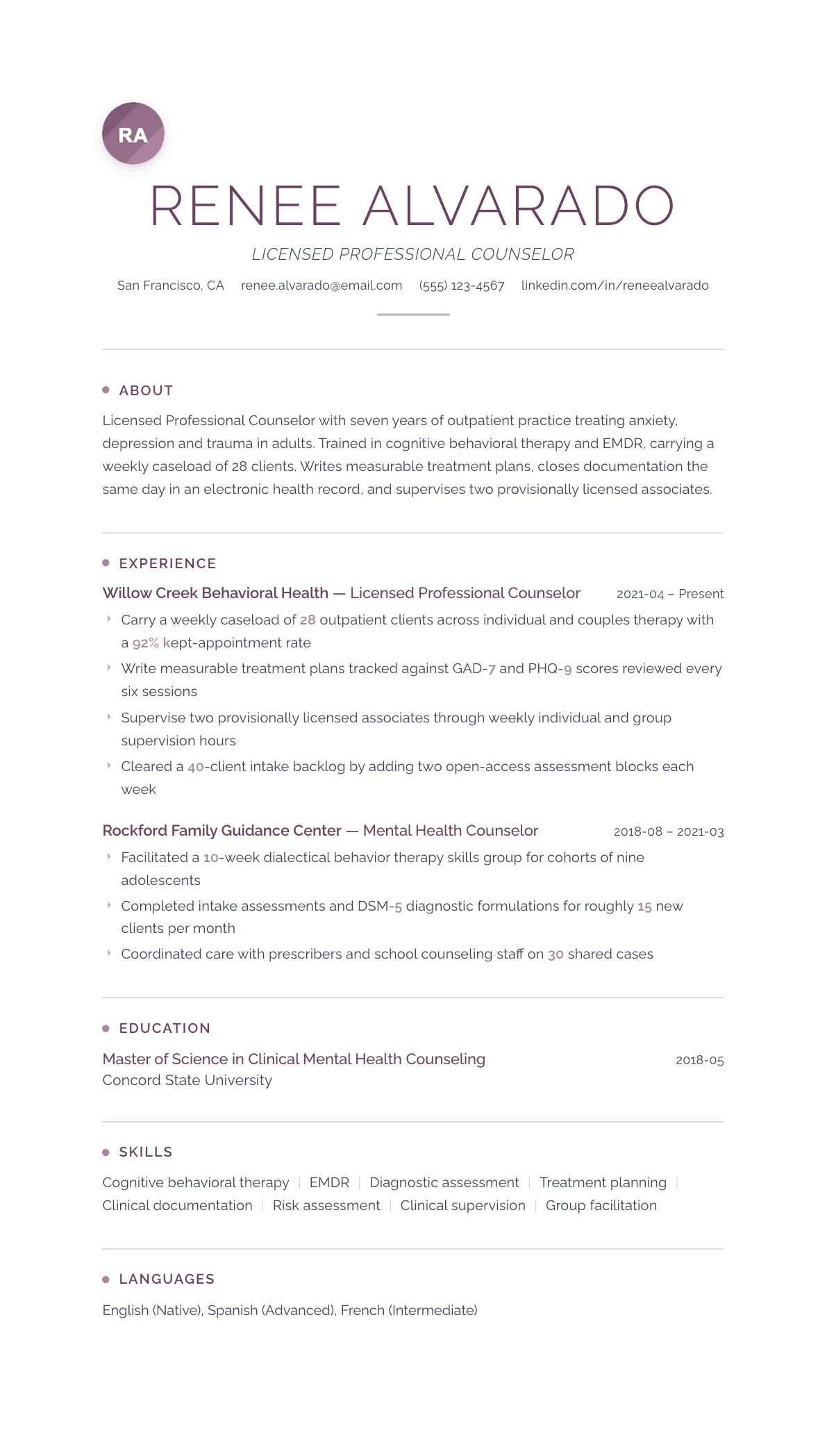
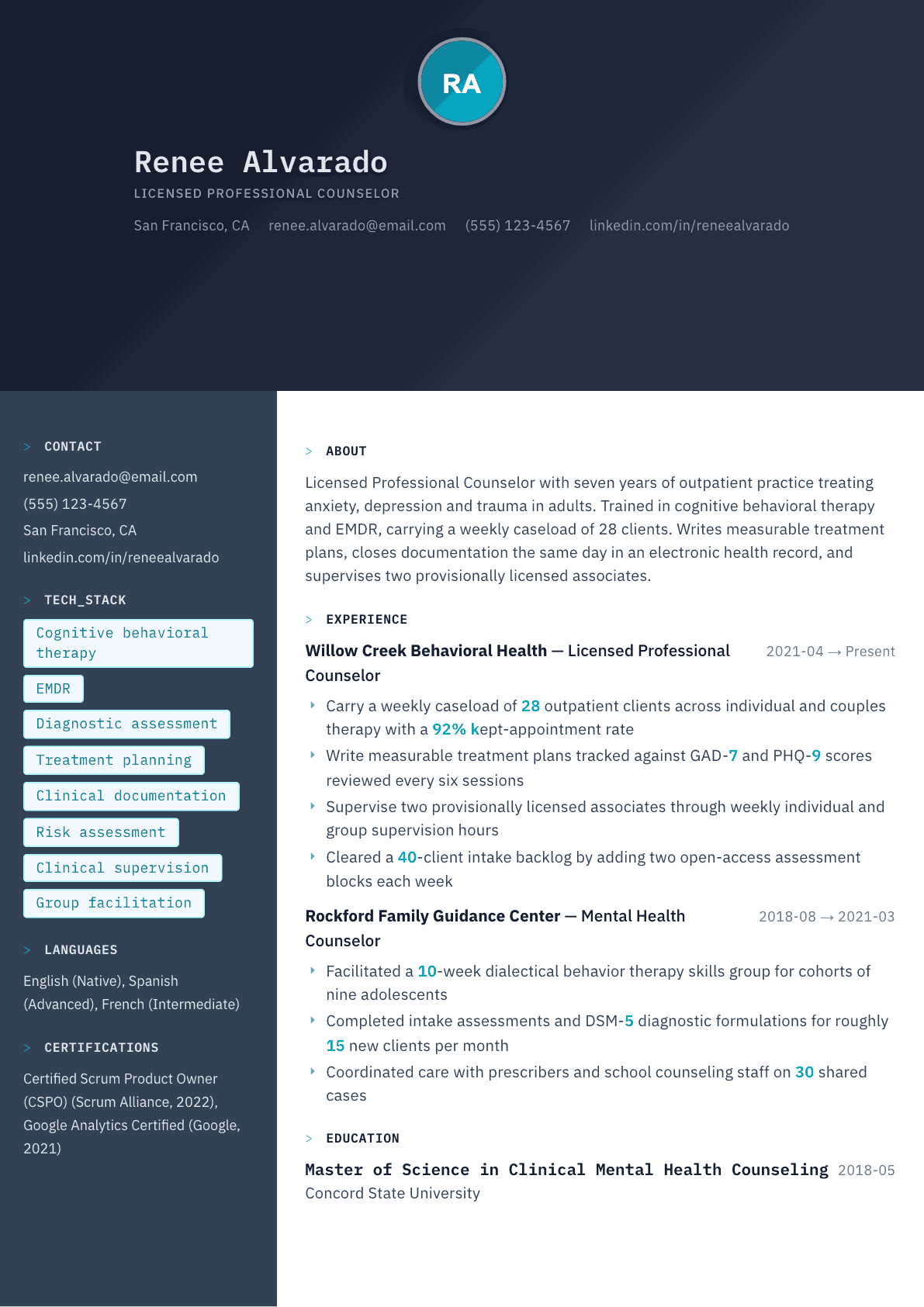
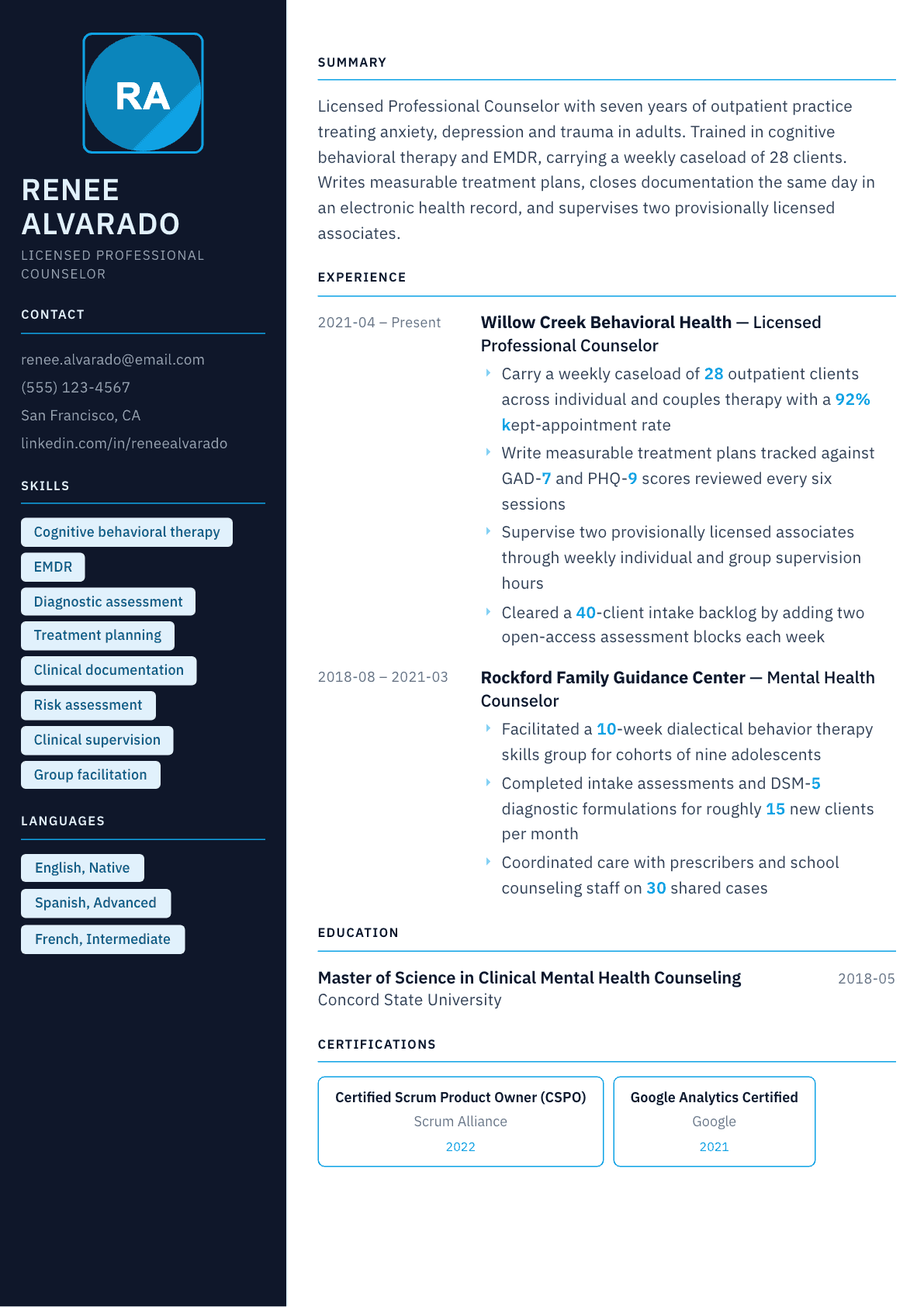
Example Licensed Professional Counselor summary
Licensed Professional Counselor with seven years treating adults for anxiety, mood and trauma presentations in outpatient and community clinics. Maintains a caseload near 30 with measurable treatment plans, structured risk assessment and same-week documentation. Trained in cognitive behavioral therapy, EMDR and motivational interviewing. Seeking a clinical role with supervision responsibility and a trauma-focused caseload.
Skills to list on a Licensed Professional Counselor resume
- Individual therapy
- Couples counseling
- Group therapy
- Cognitive behavioral therapy
- Dialectical behavior therapy
- EMDR
- Motivational interviewing
- Diagnostic assessment
- Treatment planning
- Suicide risk assessment
- Safety planning
- Clinical documentation
- Case consultation
- Clinical supervision
- Telehealth counseling
What actually gets this resume read
- Put your license type, state and license number line near the header so credentialing staff never have to ask.
- Name the modalities you practice and the training behind each one instead of listing therapy as a single skill.
- Give every clinical job a caseload size, a client population and the setting, whether outpatient, community or hospital based.
- Show outcome measures you actually track, such as GAD-7, PHQ-9 or session attendance, rather than claiming client improvement.
- List the electronic health record you chart in and note whether you close documentation within the agency deadline.
- If you supervise associates or interns, give the number supervised and the supervision credential that authorizes it.
How to write a licensed professional counselor resume
A licensed professional counselor resume passes through a credentialing coordinator before a clinical director ever opens it. The coordinator is checking one thing: is this person licensed in our state right now, and if not, how far along is the reciprocity paperwork. If that answer takes more than five seconds to find, the file sits in a pile while faster applications get interview slots.
The clinical director reads for something else entirely. She wants to know what kind of caseload you can absorb, which presentations you are comfortable holding, whether your notes will survive a payer audit, and how you handle a client who discloses intent to harm themselves in the last four minutes of a session. Almost none of that is visible in a resume that says "provided individual and group therapy to a diverse population."
What follows is the order those two readers work in, with example summaries for a resident under supervision, a fully licensed clinician and a supervising counselor, before and after bullets, and the questions that come up most when counselors sit down to rewrite this document.
Put licensure above the fold, with the state and the number line
The license is the gate. Write it after your name in the header the way it appears on the board roster, then repeat it in a short credential block directly under the header with the issuing state, the license number line and the expiration month. If you hold licenses in more than one state, list all of them, and mark which are compact or reciprocal.
Counselors under supervision have their own problem: the title varies by state, so a resume that just says "counselor" hides the fact that you are accruing hours. Name the provisional credential exactly as your board writes it, add the number of supervised clinical hours accrued so far, and name your approved supervisor's credential.
- Credential block: license title, state, expiration month, and any second-state or telehealth registration you hold.
- Under supervision: provisional title, hours accrued toward independent licensure, and supervisor credential.
- National credentials such as the NCC sit in the same block, since agency contracts sometimes require them.
Describe the caseload the way a clinical director thinks about it
Every clinical position on the page needs four facts: the setting, the population, the caseload size and the session mix. "Community mental health, adults with serious mental illness, 30 weekly clients, mostly individual with one process group" tells a director whether you can step into her open panel. Without those four facts she has to interview you to learn what the resume should have said.
Then use the bullets for the clinical work that is specific to you. Which presentations do you carry: complex trauma, panic, obsessive compulsive disorder, grief, perinatal mood, adolescent self-harm. Which modality did you actually train in, and with whom. A counselor who lists EMDR should be able to say the training body in an interview, so write it as trained work rather than an interest.
Leave out the sentences that describe counseling itself. Building rapport, maintaining confidentiality and demonstrating empathy are the floor of the profession, not evidence, and they push the specific work down the page.
Show that your documentation survives review
Nothing sinks a counseling hire faster than a clinician who cannot close notes. Say which record system you chart in, whether notes are closed the same day or within the agency window, and whether you have written treatment plans against measurable objectives that a utilization reviewer accepted. If you have handled prior authorizations or concurrent reviews with a payer, that is worth its own line.
Outcome measures belong here too. Naming the instruments you administer and how often you rescore them, GAD-7, PHQ-9, PCL-5 or an agency measure, shows you practice with data rather than impression. It also matches language that grant funded and value based programs put straight into their job postings.
Risk, ethics and the sentence most resumes are missing
A director wants to see one bullet about acute risk before she calls you. Describe the structured screening you use, the safety planning approach, when you have initiated a hold or a wellness check, and how you documented consultation. This is the single most distinguishing line on a counseling resume because it is the one supervisors lose sleep over.
Ethics work belongs beside it: mandated reporting, records requests, subpoenas, dual relationship management in a small town, and any ethics or supervision training you have completed. Counselors who write about boundaries in concrete situations read as clinicians who have been supervised well.
Keywords the screening software pulls from counseling postings
Behavioral health postings recycle a short vocabulary: intake assessment, diagnostic impression, treatment plan, progress notes, evidence based practice, crisis intervention, telehealth, caseload management, interdisciplinary consultation and the license title itself. Mirror the exact phrasing of the posting once in your credential block or skills list and once inside a real bullet where it is doing work.
Do not build a keyword block of modalities you have read about. Directors ask about modalities in the first interview, and an answer that thins out immediately costs more than the keyword gained.
- Match the posting's license title exactly, including the state abbreviation it uses.
- Name the record system, since agencies filter for prior experience in the one they run.
- Include telehealth platform experience if you carry a remote panel, along with the states you can serve.
Licensed Professional Counselor resume summary examples
Resident under supervision
Provisionally licensed counselor with 1,400 supervised clinical hours in a community clinic, carrying 18 adult clients for anxiety, depression and adjustment concerns. Trained in cognitive behavioral therapy and motivational interviewing, closes notes same day, and works toward independent licensure under an approved supervisor.
Five years licensed
Licensed professional counselor with five years of outpatient practice and a standing caseload near 28 clients, weighted toward trauma and mood presentations. Uses EMDR and cognitive processing therapy, rescores GAD-7 and PCL-5 every six sessions, and clears prior authorizations without a lapse in coverage.
Supervising counselor
Licensed professional counselor and approved supervisor with eleven years in outpatient and integrated primary care. Oversees five associates, chairs the agency clinical case review, and rebuilt the intake pathway so new clients reach a first session within nine days instead of twenty-four.
Work experience bullets: before and after
Before: Provided individual therapy to a diverse client population.
After: Carried 28 weekly adult clients in outpatient care, weighted toward trauma, panic and postpartum mood presentations, with sessions split between office and telehealth.
Caseload size, presentation mix and delivery format let a director place you on her panel instead of guessing.
Before: Wrote treatment plans and progress notes.
After: Wrote measurable treatment plans tied to GAD-7 and PHQ-9 rescoring every six sessions, and closed progress notes the same day across two audit cycles with no chart returned.
The measures, the cadence and the audit result turn routine paperwork into evidence that your documentation holds up.
Before: Handled clients in crisis when needed.
After: Completed structured suicide risk screening at intake and on any disclosure, built collaborative safety plans with means restriction, and documented consultation before every hold decision.
A named screening practice and a documented consultation habit answer the question supervisors worry about most.
Before: Supervised newer counselors at the agency.
After: Supervised five provisionally licensed associates through weekly individual and group hours, reviewed recorded sessions against a competency rubric, and signed off four for independent licensure.
The count, the method and the outcome show supervision as a practiced skill rather than an added duty.
Before: Ran therapy groups for clients.
After: Facilitated a twelve-week dialectical behavior therapy skills group of nine adults, tracked diary card completion, and kept attendance above eight members per session across four cohorts.
Naming the curriculum, the size and the retention detail proves you can hold a group rather than schedule one.
Hard skills
- Diagnostic assessment
- Biopsychosocial intake
- Individual therapy
- Group therapy
- Cognitive behavioral therapy
- Dialectical behavior therapy skills
- EMDR
- Motivational interviewing
- Measurable treatment planning
- Suicide risk screening and safety planning
- Outcome measure administration
- Telehealth practice
- Clinical supervision
- Prior authorization and utilization review
Soft skills
- Therapeutic alliance building
- Boundary management
- Consultation seeking
- Cultural humility
- Case conceptualization
- Composure during disclosure
Certifications worth listing
- National Certified Counselor (NCC) (National Board for Certified Counselors)
- Certified Clinical Mental Health Counselor (CCMHC) (National Board for Certified Counselors)
- Approved Clinical Supervisor (ACS) (Center for Credentialing and Education)
- EMDR Basic Training (EMDR International Association)
Mistakes that cost licensed professional counselor candidates the interview
- Burying the license state and expiration in the education section, which forces credentialing staff to email you before anything moves.
- Writing that you are trained in a long list of modalities without naming a single training body or a client group you used them with.
- Skipping caseload size entirely, so a clinical director cannot tell a school-based part-time panel from a full community mental health load.
- Leaving risk work off the page, which reads as inexperience even when you have handled acute disclosures for years.
- Describing supervision received as though it were supervision provided, an ambiguity that becomes awkward in the interview.
- Sending an identical resume to a private practice and a community agency, when one hires on niche and the other hires on volume.
Licensed Professional Counselor resume questions
Where should my license number go on a counselor resume?
Put the license title and state after your name, then repeat it in a credential block under the header with the number line and expiration month. Credentialing staff copy it directly into their verification system, so make it easy to read.
How do I write a resume while I am still under supervision?
Use your board's exact provisional title, state how many supervised clinical hours you have accrued, name your approved supervisor's credential, and give your expected eligibility timeline. Agencies hire pre-licensed clinicians constantly, but only when the paperwork picture is clear.
Should a counseling resume list every modality I have studied?
List only what you would be comfortable defending in an interview. Two or three modalities with the training body and the presentations you used them for carry more weight than eight names that thin out under a single follow-up question.
How long should a licensed professional counselor resume be?
One page through your first several years, two pages once you have multiple settings, supervision duties, group curricula and specialty training. Anything longer usually means the daily counseling tasks that every clinician performs were never cut.
Do private practice and agency counselor resumes differ?
Yes. Agencies read for caseload volume, documentation reliability and crisis coverage. Private practice groups read for the niche that fills a waitlist and for insurance panel status. Lead with whichever of those the posting spends its first paragraph describing.
Related resume examples
- Social Worker Resume example
- Case Manager Resume example
- Counselor Resume example
- Behavioral Health Counselor Resume example
- Marriage and Family Therapist Resume example
- Psychology Intern Resume example