Life Coach Resume Examples: free ATS score and gap list
Write a Life Coach Resume That Shows Credentialed Coaching Hours
By Mustafa Tarabya, founder of CVBooster · Published · Updated
Life coach resume example with coaching hours, credential keywords and client outcome language, plus a guide to writing each section.
Sample resumes for a life coach
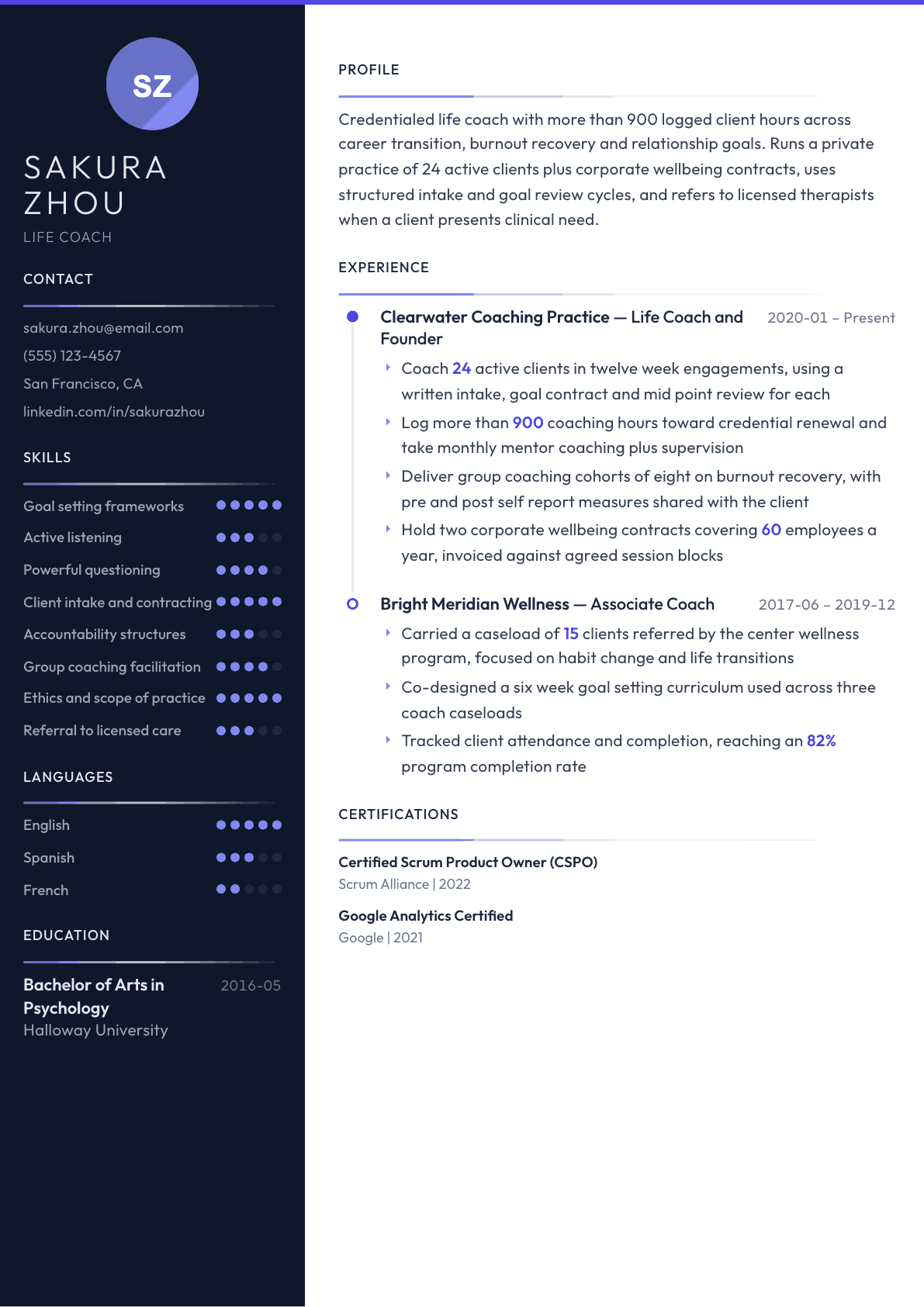
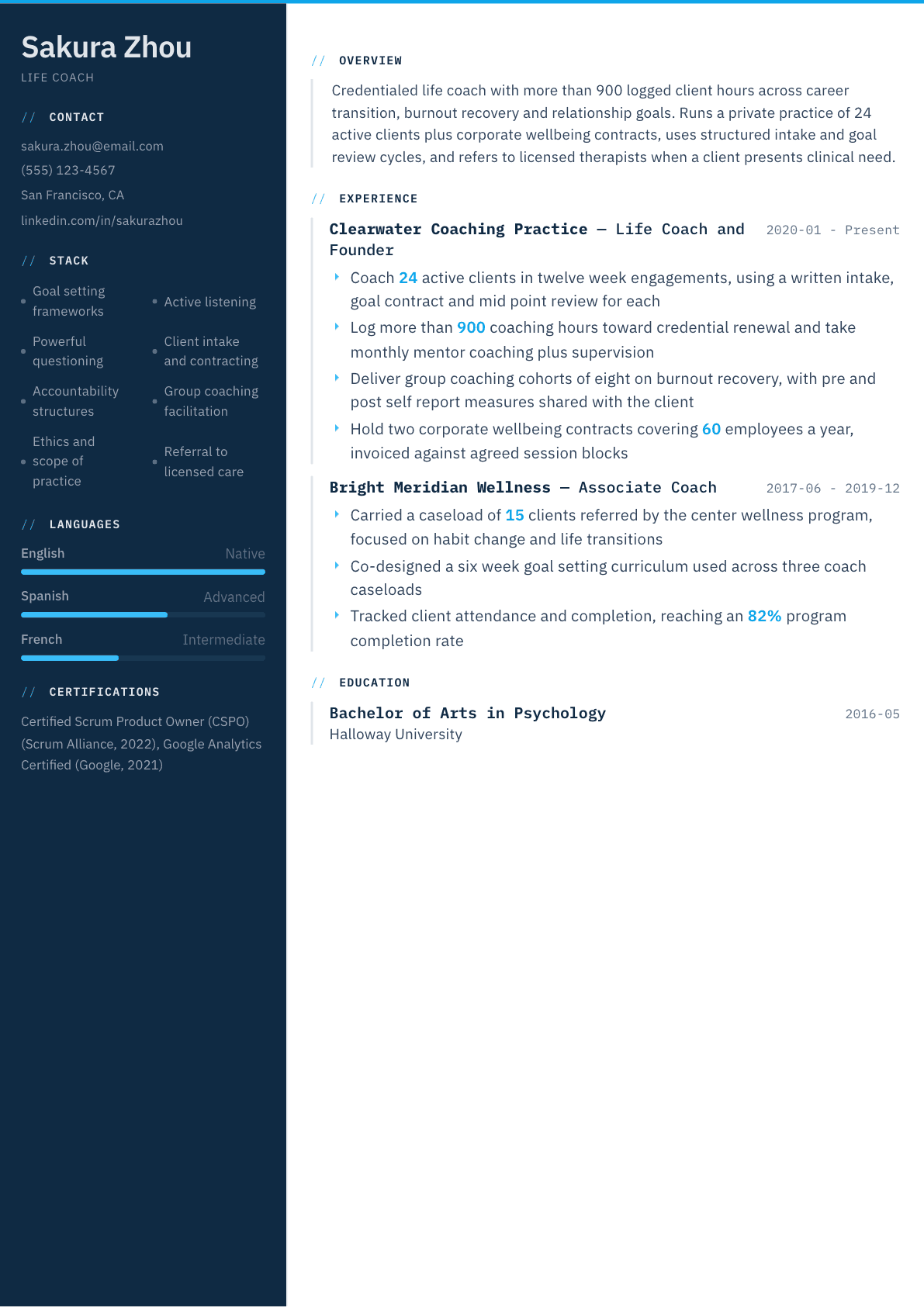
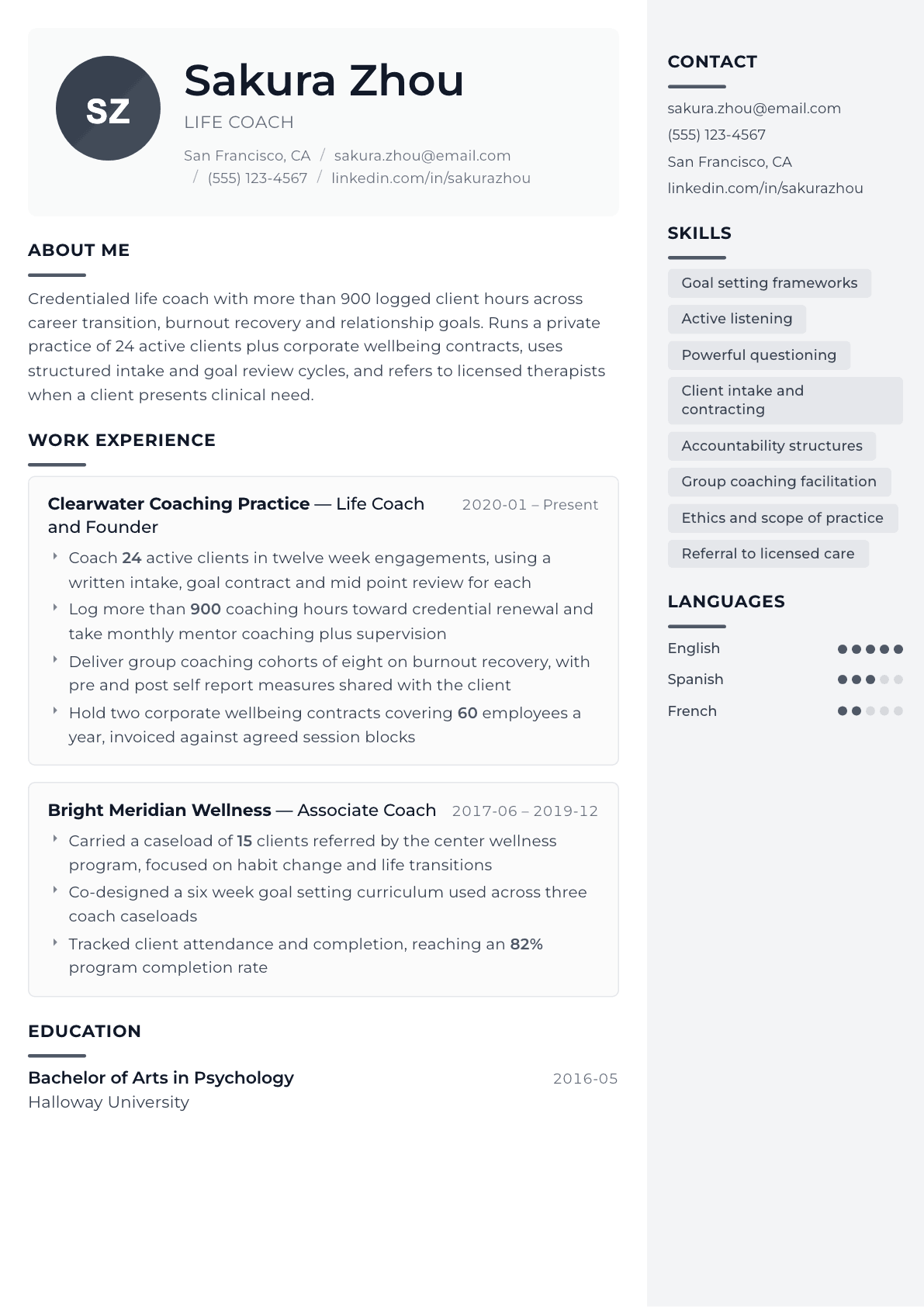
The same life coach content laid out in three CVBooster templates, so you can see what the finished document looks like before you write a word.
Example Life Coach summary
Life coach with more than 900 logged client hours and a credential in good standing, working across career transition, burnout recovery and habit change. Runs twelve week engagements with written goal contracts and mid point reviews, delivers group cohorts, and holds corporate wellbeing contracts. Clear on scope of practice and refers to licensed clinicians when needed. Seeking a coaching lead role inside a wellbeing provider.
Skills to list on a Life Coach resume
- Coaching agreements and contracting
- Client intake and assessment
- Goal setting frameworks
- Active listening
- Powerful questioning
- Accountability structures
- Motivational interviewing techniques
- Group coaching facilitation
- Burnout and stress strategies
- Habit change methods
- Ethics and confidentiality
- Referral and scope boundaries
- Session note keeping
- Practice marketing
What actually gets this resume read
- Lead with your credential and coach training hours, because that is the first filter a coaching employer applies.
- Report logged client coaching hours as a number, since credential bodies and hiring managers both count them.
- Define your niche in the first line: career transition, burnout, parenting, relationships or executive presence.
- Describe your engagement structure, such as twelve week blocks with intake, goal contract and mid point review.
- Show that you know scope of practice by naming when you refer a client to a licensed therapist instead.
- Include group and corporate work separately from private clients, because they are sold and delivered differently.
How to write a life coach resume
Coaching has no license, which is exactly why a life coach resume has to work harder than most. Anyone can print the title. The person reading you, whether a wellbeing provider, a corporate learning team or a coaching platform running an intake screen, is trying to separate trained practitioners from enthusiasts, and the separators are countable: hours of accredited coach training, logged client hours, mentor coaching, supervision, and a credential that somebody external issued.
The second thing a reader tests is scope discipline. Coaching sits next to therapy and the boundary matters legally and ethically. A resume that describes healing trauma or treating anxiety worries any serious employer, while one that names the referral point to a licensed clinician reassures them immediately.
This guide covers the credential block, how to describe a niche and an engagement structure, how to write outcomes when your work is confidential, three summaries across career stages, and the questions coaches ask when they move from a private practice into an employed coaching role.
Format: credential and hours block above the experience
One page. Under your contact details, put a training and hours block: the accredited coach training program and its contact hours, your credential level and the issuing body, logged client coaching hours, mentor coaching completed, and whether you are in ongoing supervision. That block answers the screening question before anyone reads a bullet.
If you are pre-credential, say where you are in the pathway rather than omitting it. A coach who states the training completed and the hours accumulated toward a credential reads as a professional in progress. A coach with no numbers at all reads as untrained.
- Training block: program name, contact hours, credential level, issuing body, renewal status.
- Hours block: total logged client hours, split between paid and pro bono if that helps the reader.
- Practice block: mentor coaching hours, supervision arrangement, and continuing education.
Summary: niche, structure, credential, boundary
Name your niche in the first clause. Career transition, burnout recovery, new manager confidence, parenting, relationships, health behavior change or executive presence. A generalist life coach is hard to place and hard to sell, and hiring teams buy specificity.
Then the structure you work in and the credential you hold. Finish with the boundary: that you refer to licensed clinicians when clinical need appears. Three lines that show a trained practitioner who knows where coaching stops.
Experience: caseload, engagement design, and delivery format
Open each entry with active caseload and engagement length. Twenty four active clients in twelve week engagements is a different practice from six clients in open-ended monthly sessions, and both are legitimate, but a reader cannot tell which you run unless you say.
Describe your engagement design as a process. A written intake, a goal contract the client signs, session cadence, a mid point review and a closing session with a self-assessment is a method. Method is what an employer is buying, because it is what they can train other coaches on.
Separate delivery formats. One to one, group cohorts, workshops, and corporate contracts have different economics and different skills, so give each its own bullet with numbers of clients or participants.
- Caseload: active clients, engagement length, session cadence, delivery format.
- Method: intake, goal contract, review points, closing assessment, note keeping.
- Groups and corporate: cohort size, program length, contract structure, participants reached.
- Professional practice: mentor coaching, peer supervision, continuing education, ethics training.
Writing outcomes when the work is confidential
Coaches often say nothing about results because client work is private. You can be specific without breaching anything by reporting on your practice rather than on people. Completion rates, retention across an engagement, referral and rebooking rates, cohort attendance and anonymous post-program self-report scores are all yours to publish.
When you use a client example, strip it to the structure: a mid-career professional moving from an operations role into a first team lead position over a twelve week engagement. No employer, no industry detail that identifies, no direct quotation without written permission.
Scope of practice: the paragraph that wins trust
Add a short line about how you handle clinical presentation: screening at intake, a written referral pathway, and a relationship with named licensed practitioners you refer to. Employers in wellbeing and human resources are alert to this because the liability lands on them.
Avoid clinical vocabulary you are not licensed to use. Treatment, diagnosis, therapy, patient and counseling belong to regulated professions. Coaching language is client, engagement, goal, session and agreement, and using it correctly is itself a professionalism signal.
Life Coach resume summary examples
Newly credentialed
Life coach with an accredited 125-hour coach training program completed and 120 logged client hours toward an associate level credential. Works with early-career clients on habit change and confidence in eight week engagements, uses a written goal contract, and takes monthly mentor coaching.
Established practice
Life coach with more than 900 logged client hours and a professional credential in good standing, focused on burnout recovery and career transition. Runs 24 active clients in twelve week engagements with intake, goal contract and mid point review, plus two corporate wellbeing contracts.
Lead coach or coach trainer
Lead coach with a master level credential, more than 2500 client hours, and four years supervising a team of six associate coaches. Designs group programs, provides mentor coaching toward credentialing, and owns quality standards including intake screening and clinical referral pathways.
Work experience bullets: before and after
Before: Coached clients on personal and professional goals.
After: Coached 24 active clients in twelve week engagements on burnout recovery and career transition, using a written intake, a signed goal contract and a mid point review for each.
Caseload, engagement length, niche and the method behind it turn a job title into a described practice.
Before: Helped clients achieve better work-life balance.
After: Guided a cohort of eight professionals through a six week burnout recovery program, collecting anonymous pre and post self-report scores that showed improvement in workload boundaries.
A defined program with anonymous measures gives evidence without touching any individual client confidentiality.
Before: Built a client base through referrals.
After: Grew the practice to a full caseload with 60% of new clients arriving through past client referral, and kept a waitlist rather than shortening engagements.
A referral share is a defensible quality signal, and the waitlist decision shows practice judgment.
Before: Followed professional coaching ethics.
After: Screened for clinical presentation at intake and referred four clients to licensed clinicians during the year, maintaining a named referral network of therapists and a psychiatrist.
A concrete referral count and a named network prove scope discipline instead of asserting it.
Before: Delivered coaching for a corporate client.
After: Held two corporate wellbeing contracts covering 60 employees a year, delivered in blocks of six sessions with quarterly anonymized themes reported back to the human resources sponsor.
Contract structure, reach and anonymized reporting show you can work inside an organization without breaching trust.
Hard skills
- Coaching agreements and contracting
- Client intake and goal setting
- Structured engagement design
- Powerful questioning technique
- Accountability and habit design
- Motivational interviewing technique
- Group coaching facilitation
- Program design and curriculum writing
- Session note keeping and confidentiality
- Scope screening and clinical referral
- Outcome measurement and self-report tools
- Practice marketing and client acquisition
Soft skills
- Deep listening without advising
- Holding silence in a session
- Challenging a client kindly
- Boundary maintenance
- Cultural sensitivity across client backgrounds
Certifications worth listing
- Associate Certified Coach (ACC) (International Coaching Federation)
- Professional Certified Coach (PCC) (International Coaching Federation)
- Master Certified Coach (MCC) (International Coaching Federation)
- Board Certified Coach (BCC) (Center for Credentialing and Education)
Mistakes that cost life coach candidates the interview
- Leading with a personal transformation story instead of the training hours and credential a screener is looking for.
- Using clinical words such as treatment, therapy or patient, which suggest you do not understand the scope boundary.
- Listing no numbers at all, so the reader cannot tell a full practice from three friends and a website.
- Naming clients or their employers, which breaks confidentiality and disqualifies you with any serious buyer.
- Presenting testimonials as evidence when practice-level figures such as completion and referral rates are stronger.
- Hiding pro bono and volunteer coaching, when early hours are exactly what a credential pathway is built on.
Life Coach resume questions
Do I need a certification to work as a life coach?
No jurisdiction licenses coaching, but almost every employer and platform screens for accredited training and a recognized credential. Without one you are competing on story alone, and stories do not survive a structured hiring process.
How do I show results when coaching is confidential?
Report on your practice rather than on individuals. Completion rates, retention through an engagement, referral share, cohort attendance and anonymous post-program self-report scores all describe your effectiveness without identifying a single client.
Should I put my coaching hours on my resume?
Yes, near the top. Logged client hours are the closest thing coaching has to a common measure of experience, and credential bodies count them, so a reader uses that number the way a clinical field uses years in practice.
How is a life coach resume different from a therapist resume?
A therapist resume leads with license, modalities and clinical setting. A coaching resume leads with training hours, credential, niche and engagement design, and it must show where you stop and refer rather than where you treat.
Can I move from a private coaching practice into an employed coaching role?
Often yes, if you translate the practice into employer terms. Show caseload capacity, standard engagement design, program delivery, note keeping and supervision, because an employer is hiring a repeatable method rather than a personal brand.
Related resume examples
- Career Coach Resume example
- Counselor Resume example
- Social Worker Resume example
- Peer Support Specialist Resume example
- Addiction Counselor Resume example
- Caseworker Resume example