Media Planner Resume Examples: free ATS score and gap list
Build a Media Planner Resume Agencies Take Seriously
By Mustafa Tarabya, founder of CVBooster · Published · Updated
Media planner resume example with real flowchart and budget language, the planning tools to list, ATS keywords, and a section by section guide.
Sample resumes for a media planner
The same media planner content laid out in three CVBooster templates, so you can see what the finished document looks like before you write a word.
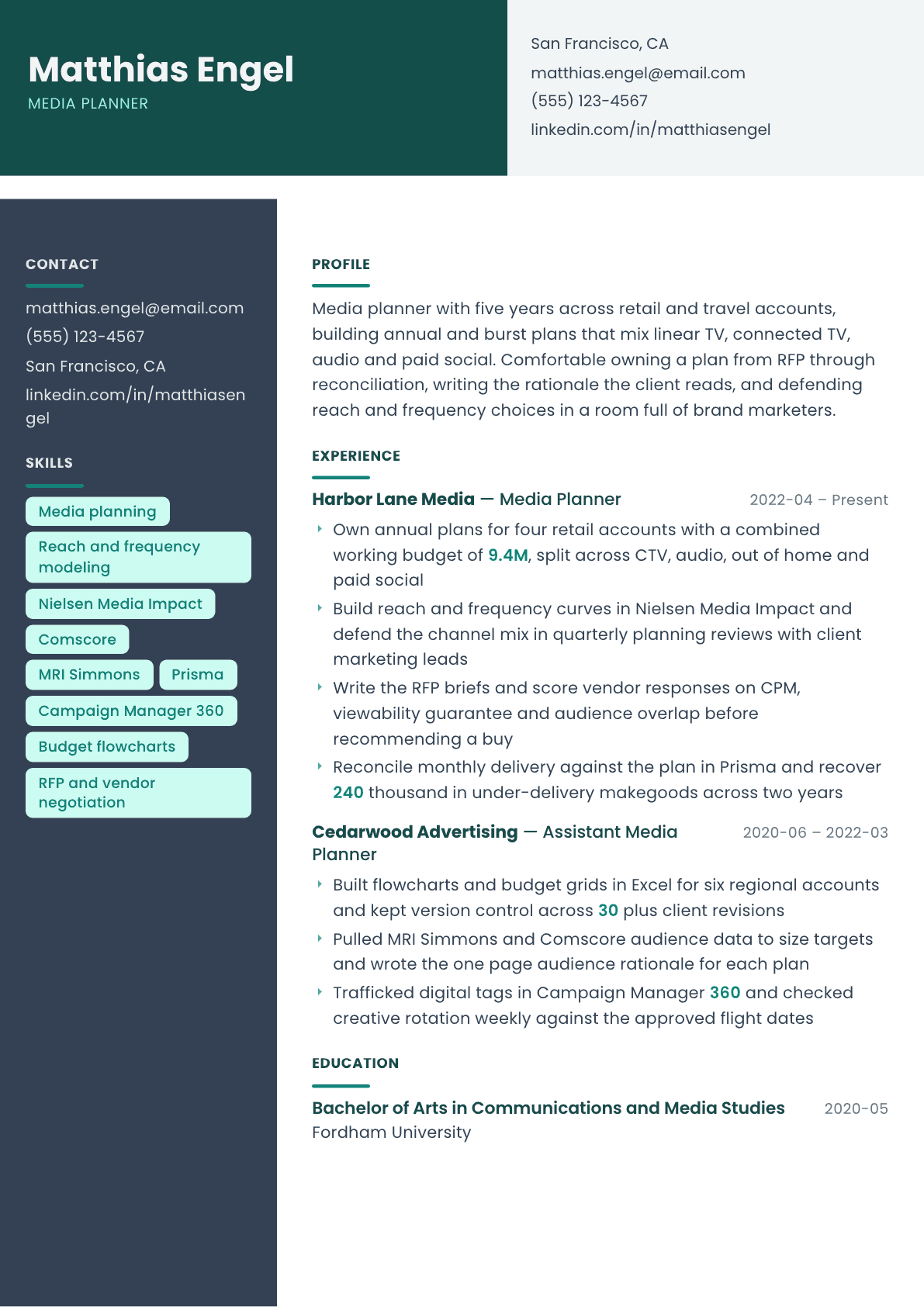
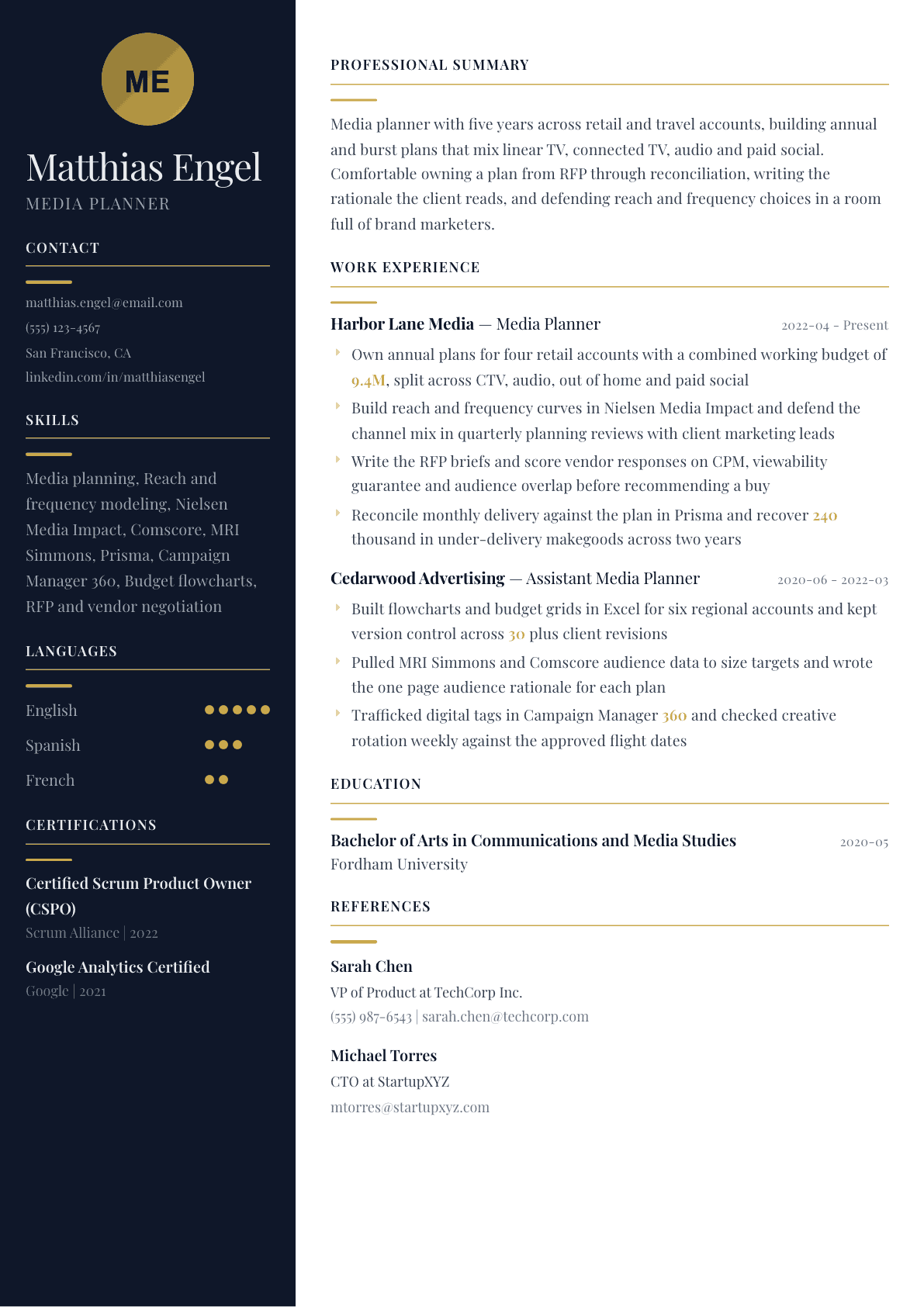
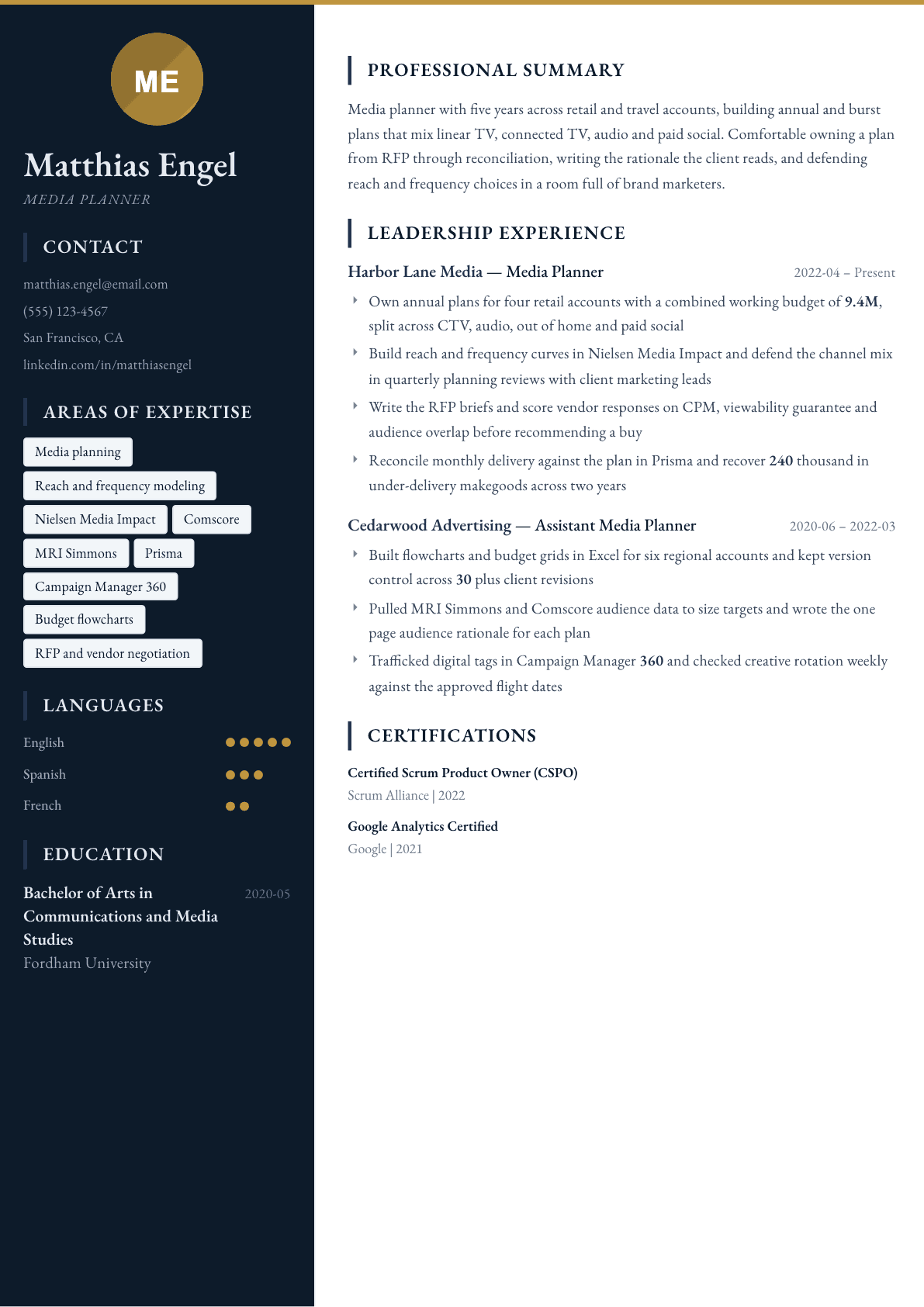
Example Media Planner summary
Media planner with five years in agency planning across retail and travel, responsible for annual budgets near ten million in working media. Builds reach and frequency curves in Nielsen Media Impact, runs the RFP and vendor scoring process, and reconciles delivery in Prisma. Known for rewriting the channel mix mid-flight when audience data moves, and for rationale documents clients can read without a translator.
Skills to list on a Media Planner resume
- Media planning
- Reach and frequency analysis
- Channel mix strategy
- Audience segmentation
- Nielsen Media Impact
- Comscore
- MRI Simmons
- Prisma
- Campaign Manager 360
- Budget flowcharts
- RFP management
- Post-campaign analysis
- Connected TV planning
- Out of home planning
- Vendor negotiation
- Excel modeling
What actually gets this resume read
- Name the channels you actually planned, because a linear TV planner and a paid social planner are screened for different jobs.
- Put the working budget you managed on every job line, since agencies size a planner by the dollars they have handled.
- List the planning systems by name: Nielsen Media Impact, Comscore, MRI Simmons, Prisma, Campaign Manager 360.
- Show one full plan cycle from brief to reconciliation so the reader knows you can close a campaign, not only open one.
- Say which client categories you planned, because retail, pharma and auto planning follow very different rules and cycles.
- Add the moment you changed a plan mid-flight and what the data told you, since that is what senior planners are hired for.
How to write a media planner resume
A media planner resume is screened by a group media director who is trying to answer one question quickly: has this person built a plan of the size and shape we run here. Everything else, the degree, the internships, the awards, is secondary to channel scope and working budget. If those two facts are not visible in the first ten lines, the resume goes into the maybe pile and usually stays there.
The second reader is a talent partner filtering on tool names. Agency job descriptions are written from a template that lists the planning stack by brand: Nielsen Media Impact, Comscore, MRI Simmons, Prisma, Campaign Manager 360. A resume that says only strategic media planning across multiple channels matches none of those strings and never reaches the media director at all.
This guide covers the section order agencies expect, how to write a job line that shows scope in one glance, how to turn plan work into bullets that a director recognizes as real, and the questions planners ask when they sit down to rewrite.
Format: one page, scope in the job line, tools in a named block
Reverse chronological, one page until roughly eight years in agency life. Media planning is a career of accounts and budgets, so the account list belongs directly under each employer, not buried in a bullet. A director should be able to read your employer, your title, the accounts and the budget without moving her eyes far.
Put a tools block near the top rather than at the bottom. Planning systems are licensed per seat and per agency, so the specific ones you have logged into are a genuine differentiator that an application tracking system also happens to match on.
- Header: name, city and state, phone, email, and a line naming your channel focus.
- Section order: summary, planning tools, experience with accounts and budgets, education.
- Under each employer, add one line: accounts, categories, and the working budget you planned.
- Keep award mentions to a single line unless the award was for a plan you built.
Summary: channels, budget, categories, and one thing you own
Three lines. Name the channels you plan, the yearly working budget you have handled, the client categories, and one part of the process you own end to end. A planner who owns the RFP process is a different hire from a planner who owns post-campaign analysis, and directors staff against those gaps.
Avoid the phrase integrated planner unless you follow it with the actual channel list. Integrated means video, audio, out of home, print and paid social to one agency, and paid social plus display to another. Spell it out and let the reader match you against the brief on her desk.
Experience: build every bullet around a plan decision
The bullet a media director stops on describes a decision, the data behind it, and what happened. Not the task. Every planner builds flowcharts, so the flowchart is context, never the achievement. The achievement is the reallocation you argued for, the vendor you cut, the frequency cap you set and why, the makegood you recovered.
Anchor the numbers that matter in this craft: working budget, target reach at an effective frequency, cost per thousand against the benchmark you were held to, share of budget by channel, and the delivery gap you closed at reconciliation. These are the figures a director checks against her own plans to judge whether you are describing something real.
One bullet per job should show the full cycle: brief in, plan out, in-flight change, post-campaign readout. Planners who have never reconciled a campaign or presented a wrap report are junior in practice regardless of title, and directors can tell.
- Lead with the decision, then the tool, then the result.
- Give channel splits when you rebalanced a plan, so the reader sees the size of the move.
- Name the audience source behind a targeting call rather than saying data-driven.
- Include one client-facing moment: a planning review, an annual presentation, a difficult recommendation.
Tools and methods: name the systems, then the method
List the syndicated research and planning systems separately from the ad servers and buying platforms, because those are different job families and mixing them makes a planner look like a buyer. Nielsen Media Impact, Comscore, MRI Simmons and Kantar sit in one group. Campaign Manager 360, Prisma and Excel sit in another.
Then name the methods: reach and frequency modeling, effective frequency thresholds, media mix rationale, competitive spend analysis, brand and response weighting. A planner who can name the method reads as someone who has argued a plan rather than filled a template.
Keywords agencies actually filter on
Agency postings recycle the same phrases: media planning, reach and frequency, flowchart, working budget, RFP, media rationale, post-campaign analysis, connected TV, out of home, audience segmentation, CPM. Use each one where it is true, once in the summary or tools block and once inside a bullet where it carries a fact. A block of keywords with no evidence around them fails the human read that follows the software.
Media Planner resume summary examples
Assistant planner, first two years
Assistant media planner supporting three regional retail accounts with a combined 6M working budget. Builds flowcharts and budget grids, pulls MRI Simmons and Comscore audience data, and traffics digital tags in Campaign Manager 360. Seeking a planner seat with ownership of a full annual plan cycle.
Five years in
Media planner with five years across retail and travel, owning annual plans near 9M in working media spanning connected TV, audio, out of home and paid social. Builds reach and frequency curves in Nielsen Media Impact, runs the RFP and vendor scoring process, and presents rationale directly to client marketing leads.
Supervisor or associate director
Media supervisor leading a three-person planning pod across four accounts and 24M in annual working budget. Sets the channel framework each planning cycle, reviews every plan before it reaches the client, and rebuilt the agency post-campaign template so wrap reports end in a recommendation for the next flight.
Work experience bullets: before and after
Before: Created media plans and flowcharts for client campaigns.
After: Built annual flowcharts for four retail accounts totaling 9.4M in working media across connected TV, audio, out of home and paid social.
Account count, budget and the channel list turn an activity every planner performs into a statement of scope.
Before: Used research tools to identify target audiences.
After: Sized a lapsed-buyer target in MRI Simmons and Comscore, then rebuilt the channel mix to shift 22% of budget from linear TV to connected TV and audio.
The named sources and the size of the reallocation show a real planning decision rather than tool familiarity.
Before: Worked with vendors on media buys.
After: Wrote the RFP brief for a national audio flight, scored eight vendor responses on CPM, audience overlap and makegood terms, and consolidated the buy into two partners.
Naming the scoring criteria and the outcome proves you ran the process instead of forwarding responses.
Before: Monitored campaign delivery and made adjustments.
After: Tracked weekly delivery against plan in Prisma, caught a 12% under-delivery on a display partner in week three, and recovered the impressions as bonus weight before the flight closed.
The timing, the size of the gap and the recovery show in-flight judgment, which is what separates planners from coordinators.
Before: Presented campaign results to clients.
After: Presented quarterly wrap reports to client marketing directors, tying reach curves and cost efficiency back to the original plan assumptions and recommending two channel changes for the next cycle.
A readout that ends in a recommendation reads as ownership; presenting results alone reads as reporting.
Hard skills
- Media planning
- Reach and frequency modeling
- Channel mix strategy
- Nielsen Media Impact
- Comscore
- MRI Simmons
- Prisma
- Campaign Manager 360
- Budget flowcharts
- RFP management
- Competitive spend analysis
- Post-campaign analysis
- Connected TV planning
- Out of home planning
Soft skills
- Client presentation
- Vendor negotiation
- Attention to detail under version control
- Cross-team coordination
- Written rationale
- Deadline discipline
Certifications worth listing
- Google Ads Certification (Google)
- Campaign Manager 360 Certification (Google)
- Meta Certified Media Planning Professional (Meta)
- IAB Digital Media Buying and Planning Certification (Interactive Advertising Bureau)
Mistakes that cost media planner candidates the interview
- Listing accounts without the working budget, which leaves the reader unable to size your experience.
- Describing flowchart building as an accomplishment when every planner in the pile builds flowcharts.
- Blending planning and buying language so the reader cannot tell which seat you are applying for.
- Naming research tools in a skills list but never showing a targeting decision that came out of one.
- Skipping reconciliation and post-campaign work, which makes a five-year planner read like a two-year one.
- Writing multichannel or integrated without ever naming the channels you have personally planned.
Media Planner resume questions
Should a media planner resume list the client accounts by name?
Yes, unless a confidentiality clause prevents it. Name the brand and the category directly under the employer. Agencies hire for category familiarity, and a reader who recognizes the account immediately understands the budget scale, the seasonality and the client rhythm you worked in.
How do I show budget size without exposing confidential client spend?
Use rounded annual working budget figures and group accounts together rather than itemizing each one. A line reading four retail accounts near 9M in combined working media gives the reader everything she needs to size you and reveals nothing a competitor could act on.
What if I have only planned digital channels and the job asks for full funnel?
Say what you have planned, then show the adjacent work honestly. Naming the audio or connected TV flights you supported, the syndicated research you pulled, and the offline reach questions you have modeled makes a digital planner credible for a broader seat without overclaiming.
Do I need a portfolio or plan samples as a media planner?
Most agencies do not ask for one, but a single anonymized flowchart and rationale page is powerful in the interview. Strip client names and exact spend, keep the channel logic and the reach curve, and bring it to the second conversation rather than attaching it to the application.
Should I include internships and student media competitions on my resume?
Keep them for the first two years, then cut them. A National Student Advertising Competition plan or an agency internship carries real weight for an assistant planner opening. Once you have owned a live annual plan, those entries take space that scope and budget detail should occupy.