Media Buyer Resume Examples: free ATS score and gap list
Write a Media Buyer Resume That Proves You Move Budget
By Mustafa Tarabya, founder of CVBooster · Published · Updated
Media buyer resume example with negotiation and pacing bullets, the buying platforms to name, ATS keywords, and a full writing guide.
Sample resumes for a media buyer
The same media buyer content laid out in three CVBooster templates, so you can see what the finished document looks like before you write a word.
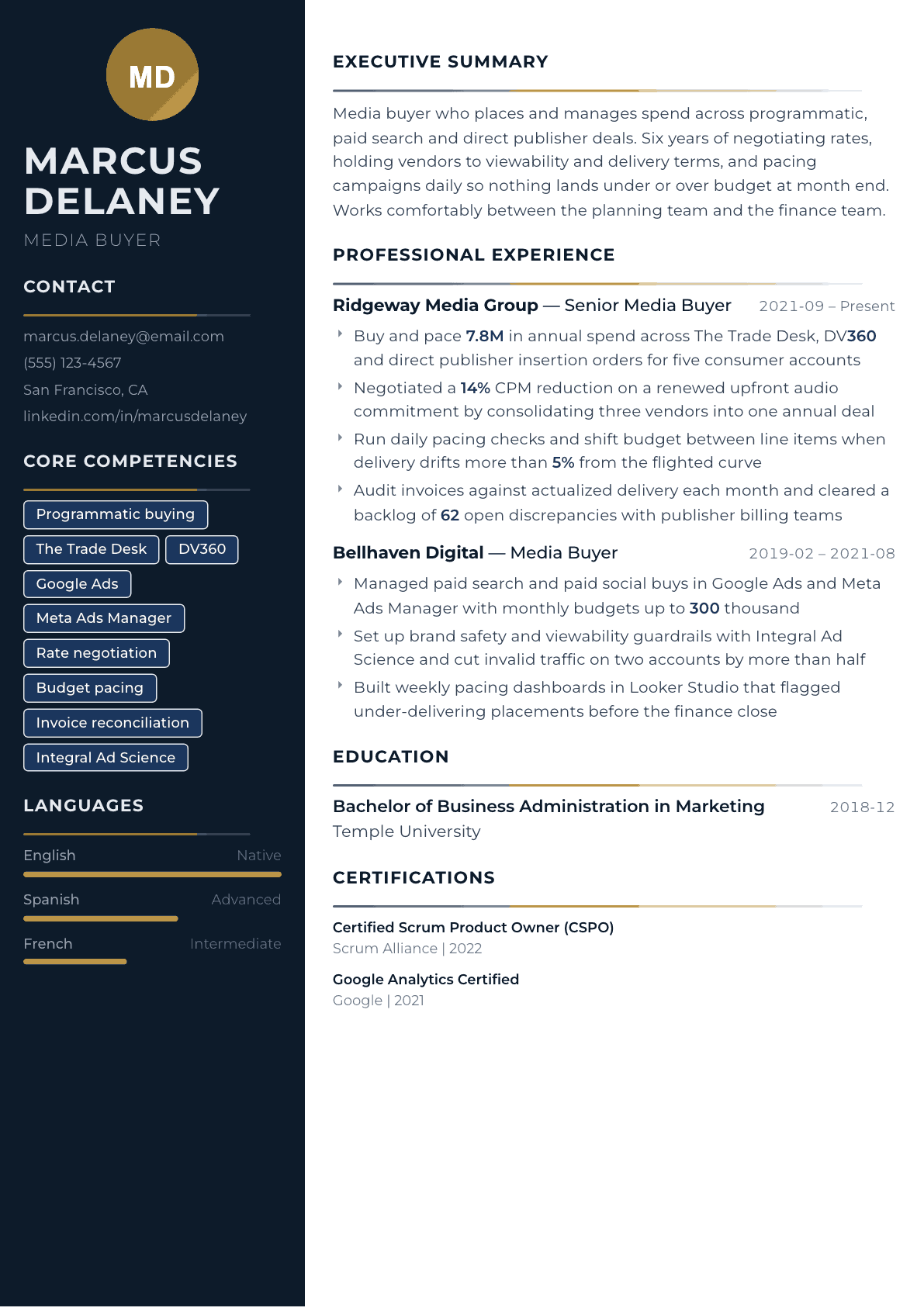
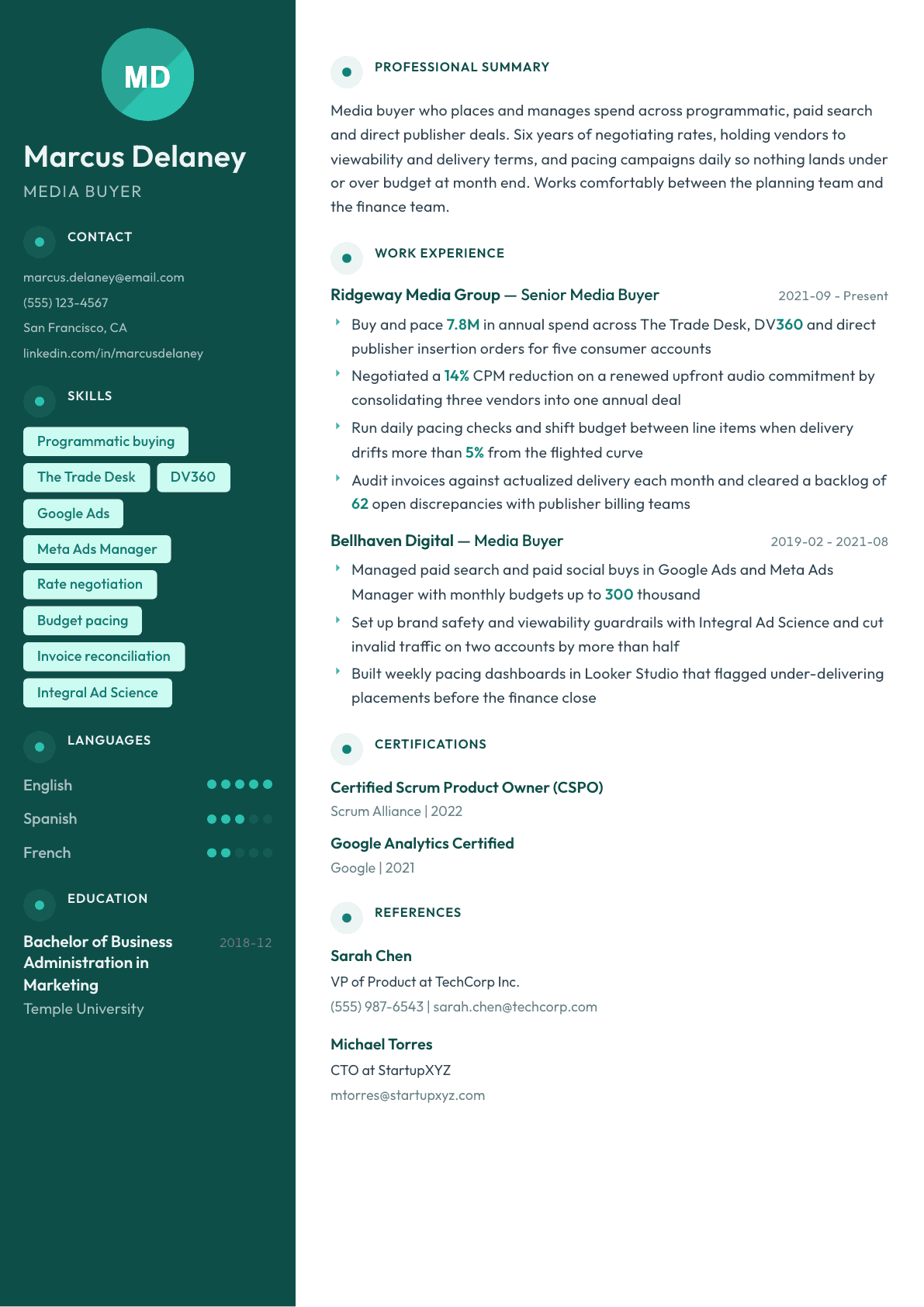
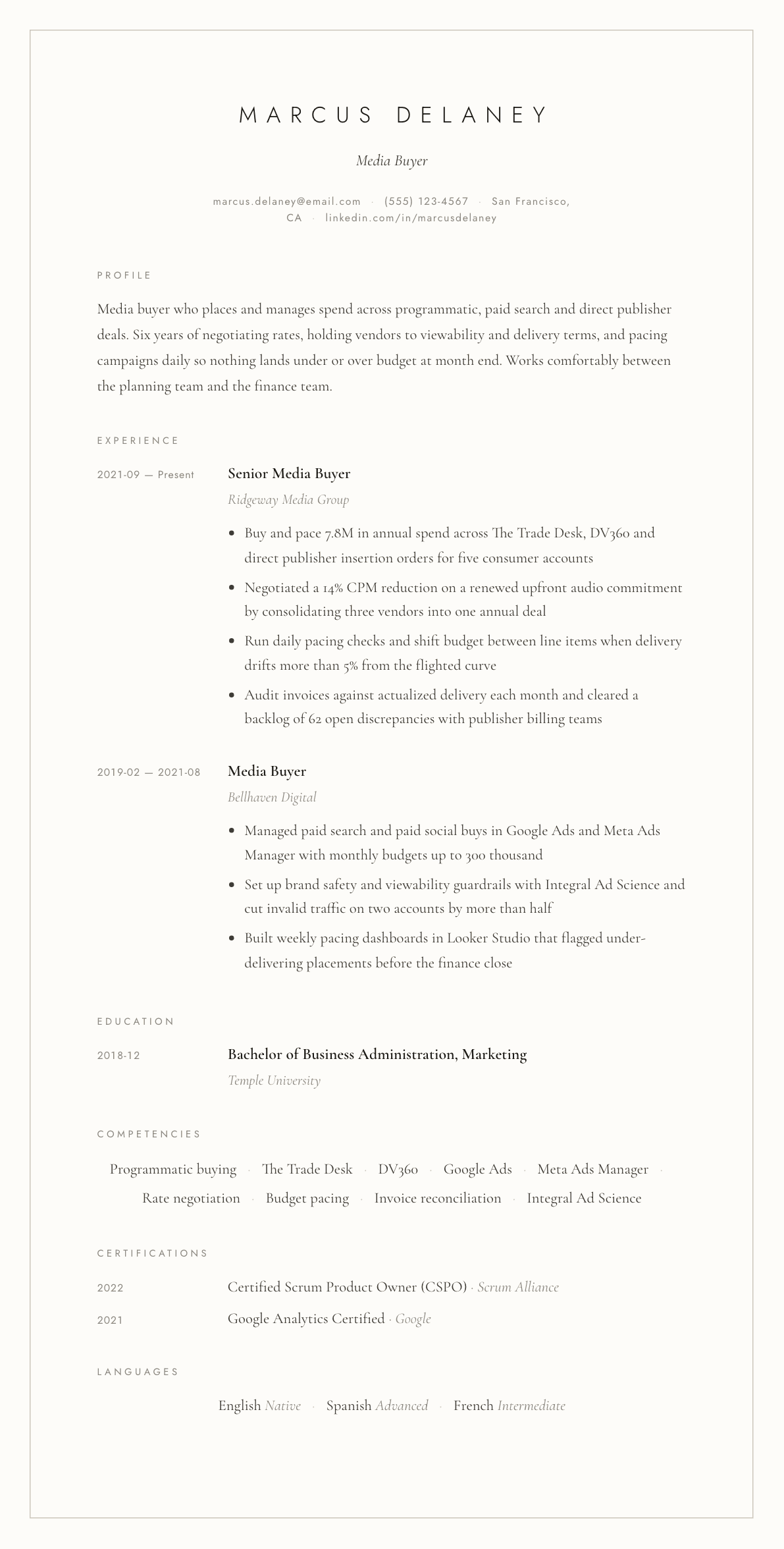
Example Media Buyer summary
Media buyer with six years placing programmatic, search and direct publisher spend for consumer accounts, currently pacing close to eight million in annual budget. Negotiates upfront commitments and holds vendors to viewability and delivery terms, then reconciles actualized delivery against invoices every month. Hands-on daily in The Trade Desk, DV360 and Meta Ads Manager, and trusted by finance to close the month without open discrepancies.
Skills to list on a Media Buyer resume
- Programmatic buying
- The Trade Desk
- DV360
- Google Ads
- Meta Ads Manager
- Insertion orders
- Rate negotiation
- Budget pacing
- Invoice reconciliation
- Makegood management
- Viewability standards
- Brand safety controls
- Integral Ad Science
- Looker Studio
- Audience targeting
What actually gets this resume read
- Lead with the annual spend you personally placed, because that number is the first thing a buying director looks for.
- Name every demand side platform and ad server you have logged into, since buying is screened on platform hands-on time.
- Describe a negotiation with the terms you won: rate, added value, makegood policy, or an audience guarantee.
- Show pacing discipline with a concrete threshold, such as the drift level that triggers you to move budget between lines.
- Include the billing and reconciliation work, because buyers who close the month cleanly are rarer than buyers who spend.
- Separate direct publisher buying from programmatic buying, since employers hire for one of the two more often than both.
How to write a media buyer resume
A media buyer is hired on two proofs: the amount of money you have placed and the discipline with which you closed it out. Buying directors read a resume from the top looking for annual spend, the platforms you log into daily, and any sign that you understand the difference between spending a budget and pacing one. Creativity is not the filter here. Custody of money is.
The trap most buyers fall into is writing like a planner. Planning language, audience insight and channel rationale, belongs one seat over. A buying resume should smell like negotiation, delivery terms, pacing curves, discrepancy resolution and invoices that reconcile. When both sets of language are mixed together, the reader assumes you did neither job deeply.
What follows is the structure buying directors expect, how to write bullets about negotiations you cannot fully disclose, the platform and measurement vocabulary that gets past filters, and the questions buyers ask most when rewriting their resume.
Format: spend first, platforms second, everything else after
Use reverse chronological order and keep it to one page through the first eight years. Directly under each employer, add a scope line with the annual spend you placed, the channels, and the client or brand type. That single line does more work than any bullet, because it answers the sizing question before the reader has to hunt.
Give platforms their own block near the top and split it into demand side platforms, search and social, ad servers, and verification. A buyer who lumps The Trade Desk, Google Ads and Integral Ad Science into one undifferentiated list looks like someone who has read about them rather than worked in them.
- Scope line under each employer: annual spend, channels, account types.
- Platform block split by function, not one long comma list.
- Keep certifications with the platform block so a filter finds both together.
- Education goes last unless you are in your first two years.
Summary: the number you placed and the terms you won
Open with the annual spend under your control, then the buying types, then one negotiation or efficiency outcome. A media buyer summary that opens with results-driven professional wastes the only three lines a busy director will read carefully.
Say explicitly whether your experience is programmatic, direct publisher, broadcast, or a mix. Employers usually have a hole in exactly one of those, and buyers who leave it ambiguous get filtered out of both piles rather than into one.
Experience: negotiation, pacing, and the month-end close
Structure each job around three things a buying director can verify in an interview. The first is what you bought and how much. The second is a negotiation with real terms: a rate reduction, added value weight, an audience guarantee, a makegood policy you got written into an insertion order. The third is control, meaning pacing rules, delivery monitoring, and how you handled a campaign drifting off curve.
Pacing deserves a bullet of its own with a threshold in it. Saying you monitored campaigns daily means nothing. Saying you rebalanced line items whenever delivery drifted beyond a set band from the flighted curve tells a director you have an actual operating rule, which is the thing she is trying to hire.
Finish each job with the unglamorous work: actualization, invoice matching, discrepancy resolution with publisher billing. Buyers who close a clean month are the ones finance defends at budget time, and very few candidates put it on paper.
- One negotiation bullet with the term you improved, not just that you negotiated.
- One pacing bullet with a numeric threshold and the action it triggers.
- One verification bullet naming the brand safety or viewability standard you enforced.
- One reconciliation bullet with the volume of discrepancies handled or cleared.
Platforms and measurement: be specific, be honest about depth
Name every buying seat you have worked in and separate the ones where you were the administrator from the ones where you were a viewer. The Trade Desk, DV360, Amazon DSP, Google Ads, Meta Ads Manager and StackAdapt all behave differently, and a director will open the platform with you in a technical screen.
Add the measurement layer next to the buying layer: verification vendors, attribution setup, and the reporting tool you built pacing views in. A buyer who can pull her own delivery data does not need an analyst to know a campaign is off track.
Keywords that survive the filter
Buying postings repeat a compact vocabulary: media buying, programmatic, insertion order, CPM, CPA, pacing, makegoods, viewability, brand safety, invalid traffic, reconciliation, added value, upfront. Place each one where you can back it with a fact. Two mentions each, one in the platform or summary block and one inside a bullet with a number attached, is the right density.
Media Buyer resume summary examples
First buying seat
Media buyer with under two years placing paid search and paid social budgets up to 200K a month in Google Ads and Meta Ads Manager. Runs daily pacing checks, builds weekly delivery reports in Looker Studio, and handles first-line invoice matching with publisher billing teams.
Six years in
Media buyer pacing 7.8M in annual spend across The Trade Desk, DV360 and direct publisher insertion orders for five consumer accounts. Negotiated a 14% CPM reduction on a renewed audio commitment by consolidating vendors, and closes every month with invoices reconciled against actualized delivery.
Associate director of buying
Associate buying director overseeing 30M in annual spend and a team of four buyers across programmatic, broadcast and direct digital. Sets the pacing and discrepancy policy the team works to, leads upfront negotiations, and reduced average time to invoice resolution from 45 days to 12.
Work experience bullets: before and after
Before: Managed programmatic campaigns across multiple platforms.
After: Placed and paced 7.8M in annual programmatic spend across The Trade Desk and DV360 for five consumer accounts, including private marketplace and guaranteed deals.
Spend, named platforms and deal types give a buying director the scope she needs before reading anything else.
Before: Negotiated with vendors to get better rates.
After: Consolidated three audio vendors into one annual commitment and secured a 14% CPM reduction plus bonus weight in the fourth quarter flight.
The specific term and the mechanism behind it prove a negotiation happened rather than a price being quoted.
Before: Monitored campaign pacing to stay on budget.
After: Ran daily pacing reviews and shifted budget between line items whenever delivery drifted more than 5% from the flighted curve, closing every quarter within 1% of plan.
A numeric trigger and a closing accuracy figure show an operating rule instead of a habit.
Before: Worked on brand safety and ad verification.
After: Set inventory allowlists and viewability floors in Integral Ad Science across two accounts and cut invalid traffic on both to under 1% of impressions.
Naming the vendor, the controls and the resulting rate makes verification work concrete and checkable.
Before: Handled invoicing and billing reconciliation.
After: Reconciled actualized delivery against publisher invoices each month and cleared a backlog of 62 open discrepancies with billing teams over one quarter.
Volume and a time window turn a routine duty into evidence that you close months cleanly.
Hard skills
- Programmatic buying
- The Trade Desk
- DV360
- Amazon DSP
- Google Ads
- Meta Ads Manager
- Insertion orders
- Rate negotiation
- Budget pacing
- Makegood management
- Invoice reconciliation
- Viewability and brand safety controls
- Integral Ad Science
- Looker Studio
Soft skills
- Negotiation
- Numerical accuracy
- Vendor relationship management
- Escalation judgment
- Calm under month-end pressure
- Clear internal reporting
Certifications worth listing
- The Trade Desk Edge Academy Certification (The Trade Desk)
- Google Ads Certification (Google)
- Display and Video 360 Certification (Google)
- Meta Certified Media Buying Professional (Meta)
Mistakes that cost media buyer candidates the interview
- Leaving out annual spend, which forces the reader to guess whether you are a junior or a senior buyer.
- Writing planner language about audience insight instead of buying language about terms and delivery.
- Claiming platform experience without separating seats you administered from seats you only viewed.
- Omitting reconciliation and billing work, the part of the job finance cares about most.
- Saying you optimized campaigns without naming the lever you pulled or the threshold that triggered it.
- Listing every ad tech vendor you have heard of, which reads as padding to anyone who works in the platforms.
Media Buyer resume questions
How much detail about client spend can a media buyer safely include?
Rounded annual totals and channel splits are standard practice and rarely sensitive. Avoid naming a specific rate you paid a specific publisher for a named client, since that is commercially confidential and a director will notice the indiscretion immediately.
Is programmatic experience enough, or do I need direct buying too?
It depends entirely on the shop. Independent agencies often want both, while performance-led teams hire purely programmatic buyers. State clearly which one you have done at depth, then list any adjacent exposure separately so nobody feels misled in the technical screen.
Should I list certifications from buying platforms?
Yes, and keep them current. Platform certifications are free or inexpensive, expire on a cycle, and appear verbatim in agency job descriptions, so they clear keyword filters. They will not win you the role, but a missing one gives a screener an easy reason to skip.
How do I show results when the campaign goal was awareness, not sales?
Use the measure the client actually bought against: cost per thousand versus benchmark, on-target reach, viewable impression rate, completion rate, or share of voice. Buying results are judged on efficiency and delivery quality, so those figures are more credible than a borrowed revenue number.
Can a paid social specialist move into a general media buying role?
Often yes, because the pacing, reconciliation and negotiation habits transfer. Rewrite your bullets around budget custody rather than creative testing, name any programmatic or direct experience you have had, and be specific about the platform depth you would need to build.