Advocacy Specialist Resume Examples: what gets the call
Amplify Your Impact with an Advocacy Specialist Resume
By Mustafa Tarabya, founder of CVBooster · Published · Updated
Create an advocacy specialist resume highlighting your policy campaigns, grassroots organizing, and coalition-building expertise.
Sample resumes for a advocacy specialist
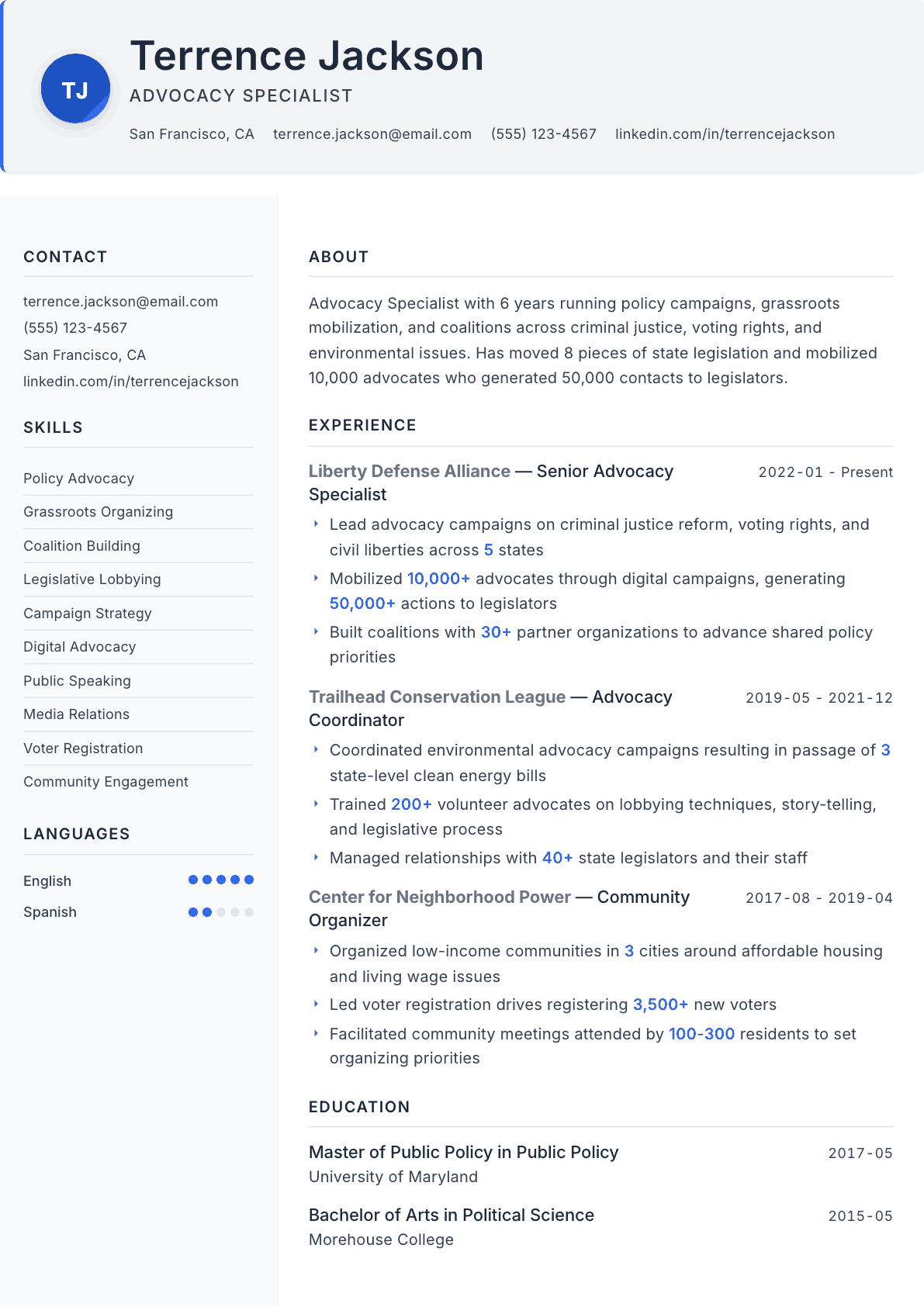
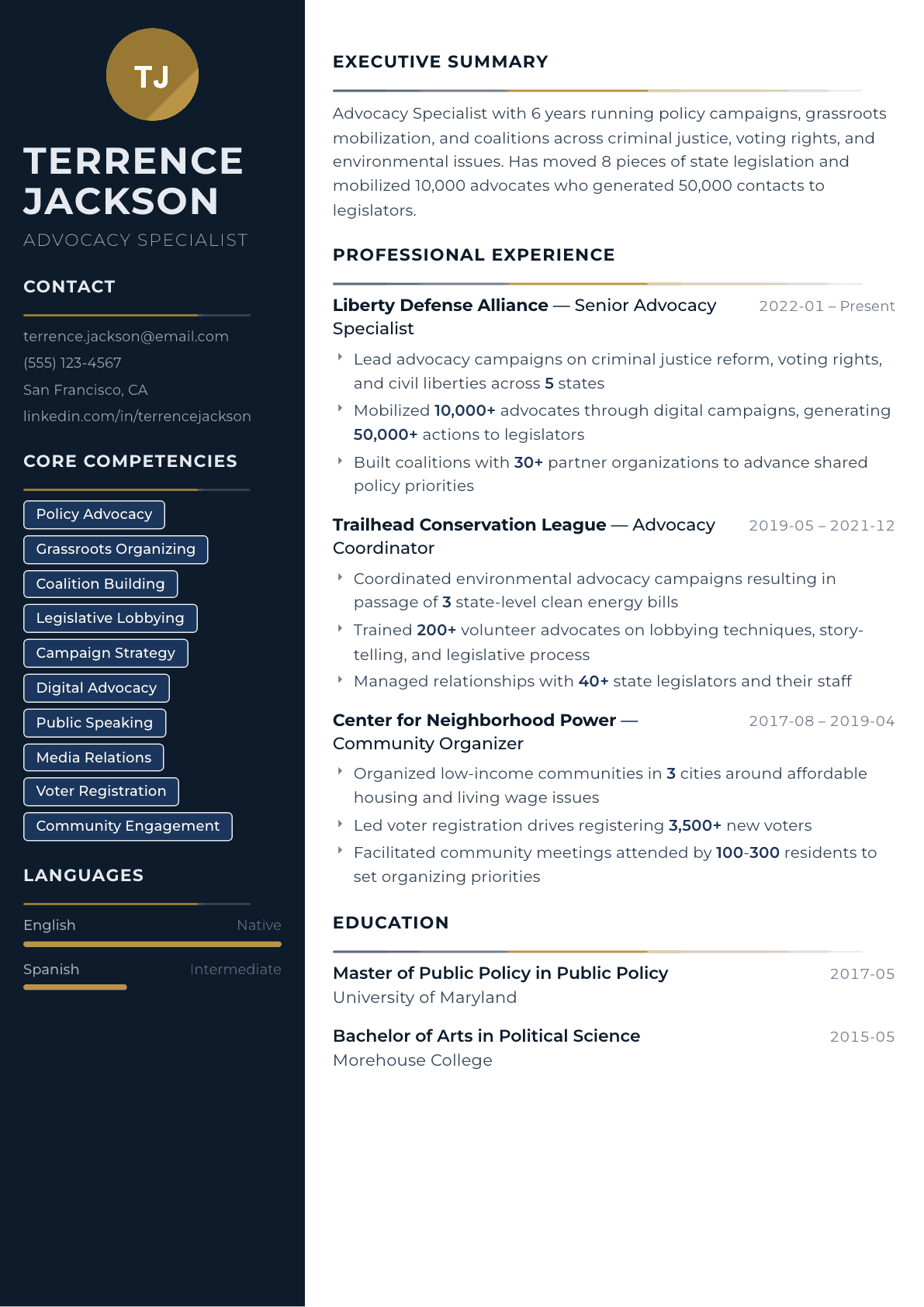
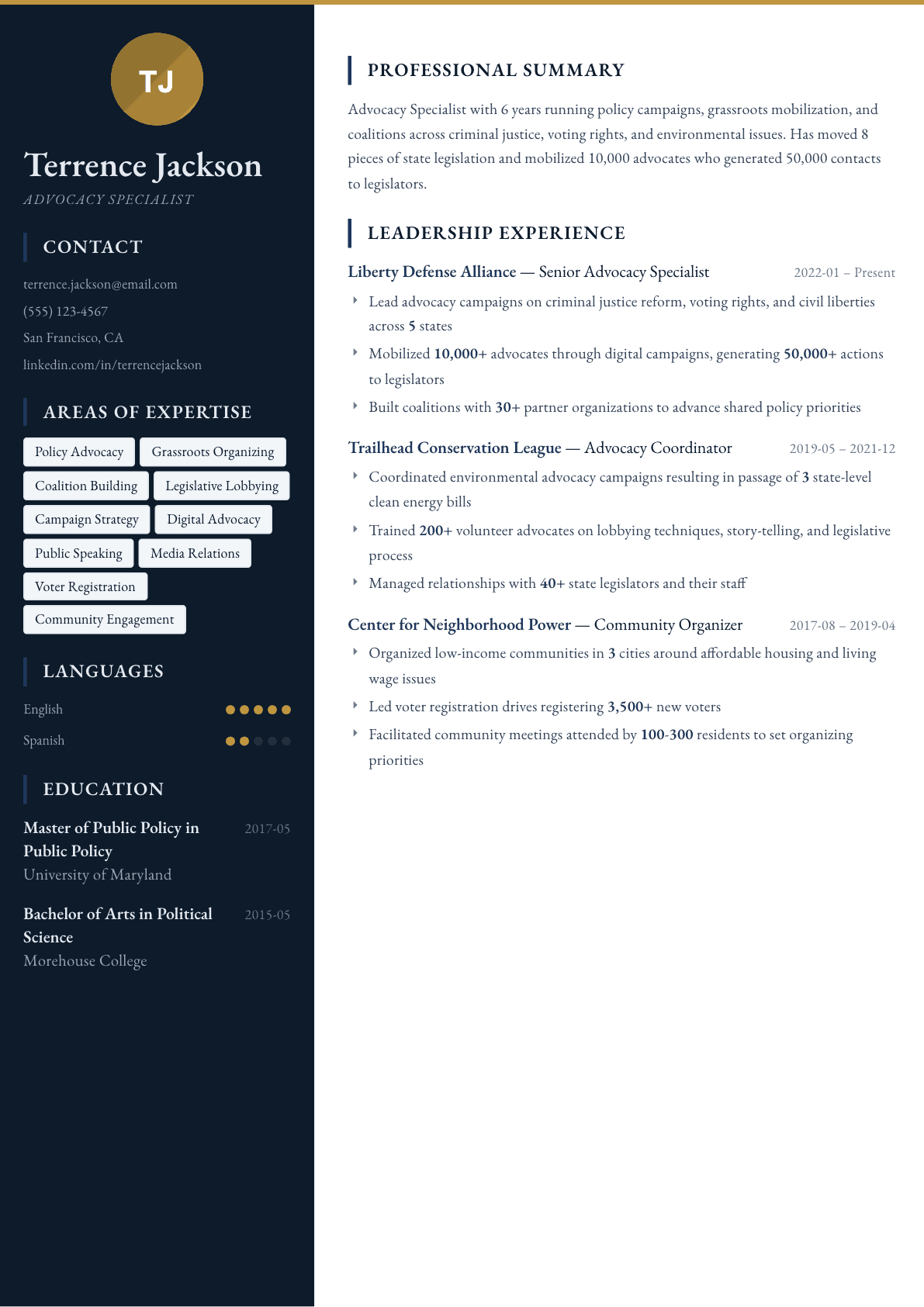
The same advocacy specialist content laid out in three CVBooster templates, so you can see what the finished document looks like before you write a word.
Example Advocacy Specialist summary
Advocacy Specialist, 6 years of state-level policy campaigns and grassroots mobilization across 5 states. Moved 8 bills, built a 30-organization coalition, and trained 200 volunteer advocates on lobbying and testimony. Looking for a director of advocacy role.
Skills to list on a Advocacy Specialist resume
- Policy Advocacy
- Grassroots Organizing
- Coalition Building
- Legislative Lobbying
- Campaign Strategy
- Digital Advocacy
- Public Speaking
- Media Relations
- Voter Engagement
- Community Mobilization
- Stakeholder Relations
- Research & Analysis
- Event Planning
- Social Media Campaigns
What actually gets this resume read
- Highlight legislative wins: bills passed, policies changed, or regulations influenced through your advocacy.
- Quantify your mobilization impact: advocates mobilized, actions generated, petitions signed.
- Show coalition-building skills with the number of partner organizations and stakeholders engaged.
- Include digital advocacy metrics: email open rates, online actions, social media engagement.
- Mention lobbying experience and relationships with elected officials and their staff.
How to write a advocacy specialist resume
Advocacy work covers two jobs that share a title, and the resume has to declare which one you do. Systems advocacy means moving policy: legislative campaigns, rulemaking comment, coalition work, grassroots mobilization. Individual advocacy means standing beside one person in a system that is failing them: benefits appeals, tenant defense, patient rights, victim services, special education. Hiring managers at nonprofits and agencies recruit for one or the other, and a resume that blends them reads as unfocused to both.
Whichever side you work, the reader is testing for evidence that something changed. Advocacy attracts passionate applicants, and passion is assumed rather than credited. What earns the interview is a bill that passed, a rule that was amended, a benefit that was restored, a coalition that held together, or a number of people who took an action because of something you organized.
This guide covers how to structure an advocacy specialist resume, three summaries from a community organizer through a campaign lead, before-and-after bullets that replace mission language with outcomes, and the questions advocates ask when the win took years and many hands.
Format: issue areas visible before the job history
One page under seven years, two after. Reverse chronological, and add a short issue areas line under the header naming the policy domains you know: housing, immigration, disability rights, criminal legal reform, health access, voting rights, environment. Advocacy hiring is issue-specific and that line answers the first question in the reader's mind.
Keep the layout plain. Nonprofit and government applicant systems parse simple documents well, and a mission-driven employer reads a heavily designed resume for an advocacy job as a mismatch of priorities.
- Header: name, city and state, phone, email, and the issue areas you work in.
- Order: summary, issue areas, experience, policy and campaign skills, education, languages.
- List languages spoken with the level, since direct advocacy work often depends on them.
Summary: which advocacy, which level of government, which outcome
Three or four lines. Name the type of advocacy, the level you work at, and one concrete result. Local council, state legislature, state agency rulemaking, congressional and federal agency work each require different relationships, and an advocate who has only worked city hall should say so rather than implying federal reach.
If you do direct individual advocacy, describe the population you serve and the systems you navigate: public benefits, housing court, immigration proceedings, special education planning, hospital discharge. Then give your caseload and your outcome rate, since that is the equivalent of a campaign win in this half of the field.
Experience: the ask, the mechanism, the movement it produced
Write each campaign as an ask, a mechanism and a result. The ask is the specific policy change you sought. The mechanism is what you did about it: testimony at a hearing, a coalition letter, constituent meetings with legislative staff, a public comment drive during a rulemaking window, earned media, a rapid response action. The result is what actually moved, stated honestly, including a bill that advanced without passing.
Quantify mobilization carefully. Advocates supported, letters and comments generated, meetings arranged between constituents and elected officials, volunteers trained, and turnout at a hearing are all countable. Give the number and the mechanism so a reader can judge whether the list came from an email tool or from real organizing.
Coalition work deserves its own bullets. The number of partner organizations, whether you convened or joined, the agreement you negotiated between groups who wanted different things, and whether the coalition survived past the campaign. Advocacy directors know that holding a coalition together is the hardest part of the job and the least visible.
For individual advocacy, describe the caseload, the appeals or hearings you prepared, the accommodations or benefits secured, the interagency work, and the documentation standard you kept. Then show where individual cases fed a pattern you escalated into policy work, because that link is what senior advocacy roles are built on.
Policy skills, writing and compliance
Name the technical craft: bill tracking and analysis, drafting testimony, writing public comment, fact sheets and issue briefs, legislative research, coalition memoranda, and constituent story collection with informed consent. Advocacy is a writing job, and hiring managers screen writing samples closely.
Show that you know the rules that bind the work. Lobbying registration and reporting requirements, the limits on lobbying activity by charitable organizations, election-season restrictions on nonpartisan voter work, and grant restrictions on advocacy funding. An advocate who understands these boundaries protects the organization, and directors notice when someone does.
List the tools: the constituent relationship platform, the digital action and petition tool, legislative tracking services, voter file software, and the email and text platforms used for rapid response. Naming them saves onboarding time.
Keywords advocacy postings repeat
The phrases that recur are policy advocacy, grassroots organizing, coalition building, legislative affairs, public testimony, community engagement, stakeholder relations, campaign strategy, constituent mobilization, digital advocacy, rulemaking comment, and technical assistance. Mirror the posting wording once in the summary and once inside a bullet where a result sits behind it. Avoid stacking mission adjectives, which every applicant in this field already uses.
Advocacy Specialist resume summary examples
Community organizer
Community organizer working with low-income residents in three cities on affordable housing and wage policy. Facilitated resident meetings drawing 100 to 300 people, ran voter registration drives that signed up 3,500 residents, and trained neighborhood leaders to testify at council hearings.
Six years in advocacy
Advocacy Specialist running state-level campaigns on criminal legal reform and voting rights across five states. Mobilized more than 10 thousand supporters generating tens of thousands of contacts to legislators, built a coalition of 30 partner organizations, and contributed to eight bills that became law.
Campaign and policy lead
Policy and campaigns lead directing a four-person advocacy team across legislative, regulatory and grassroots work. Sets the annual policy agenda with the board, manages relationships with 40 legislative offices, drafts testimony and public comment, and oversees the coalition table for a statewide reform effort.
Work experience bullets: before and after
Before: Advocated for policy change on important social issues.
After: Led the state campaign for a clean energy standard: drafted the coalition testimony, organized constituent meetings in 14 districts, and the bill passed in the second session.
A named ask, the specific tactics and an honest timeline let a director judge the work instead of the enthusiasm.
Before: Mobilized community members to take action.
After: Built a supporter base of 10 thousand through door canvassing and digital signup, generating more than 50 thousand emails and calls to legislators during three floor votes.
The recruitment method and the action volume distinguish real organizing from a purchased email list.
Before: Worked with partner organizations on shared goals.
After: Convened 30 partner organizations into a housing coalition, negotiated a shared platform between tenant and developer-aligned members, and kept the table intact through two legislative sessions.
Naming the disagreement you resolved shows the coalition skill that hiring directors most need and least often see.
Before: Trained volunteers on how to advocate.
After: Trained 200 volunteer advocates on the legislative process, meeting preparation and personal story delivery, and staffed them through 90 district office meetings.
Curriculum plus the meetings actually held proves the training produced action rather than attendance.
Before: Helped clients get the benefits they were entitled to.
After: Carried a caseload of 45 benefits appeals, prepared hearing files and represented clients at administrative hearings, restoring or securing benefits in the large majority of cases.
Caseload, forum and outcome describe individual advocacy in the terms a legal services supervisor uses.
Hard skills
- Policy analysis and bill tracking
- Legislative testimony and public comment
- Coalition building and management
- Grassroots organizing and canvassing
- Campaign planning and strategy
- Digital advocacy and action tools
- Constituent story collection with consent
- Media relations and message development
- Administrative hearing preparation
- Benefits and entitlement navigation
- Lobbying disclosure compliance
- Community needs assessment
Soft skills
- Public speaking to hostile rooms
- Building trust with affected communities
- Negotiating across disagreeing partners
- Persistence across multiple sessions
- Cultural humility in direct work
Certifications worth listing
- Certified Nonprofit Professional (CNP) (Nonprofit Leadership Alliance)
- Certified Fund Raising Executive (CFRE) (CFRE International)
- National Advocate Credential (National Organization for Victim Assistance)
- Mental Health First Aid (National Council for Mental Wellbeing)
Mistakes that cost advocacy specialist candidates the interview
- Filling the resume with mission language, when every applicant for these roles cares about the issue and the reader is looking for outcomes.
- Claiming credit for a legislative win without describing your specific contribution, which an experienced director will probe immediately.
- Blending systems advocacy and individual case advocacy so the reader cannot tell which job you are applying for.
- Reporting supporter numbers with no mechanism behind them, which reads as a list rather than an organized base.
- Leaving out the level of government you have worked, so city hall experience is mistaken for federal reach and then corrected in the interview.
- Ignoring lobbying registration and nonprofit advocacy limits, which makes a compliance-conscious employer nervous.
- Omitting language skills and community ties, which are often the deciding qualification in direct advocacy roles.
Advocacy Specialist resume questions
How do I take credit for a policy win that many organizations worked on?
Describe your role rather than the outcome alone. Say you drafted the coalition testimony, organized the district meetings, or ran the comment drive, then note that the measure passed. Directors respect precise credit and distrust anyone who claims a whole campaign.
What if the bill I worked on did not pass?
Show how far it moved and what you built along the way: committee votes secured, cosponsors added, hearings held, a coalition that still exists. Advocacy careers are full of multiyear fights, and honest reporting of an unfinished campaign reads as experience, not failure.
Should an advocacy resume include a writing sample?
Have one ready even when it is not requested, because this is a writing job. A piece of testimony, a public comment or an issue brief with your name on it is the most persuasive attachment you can offer, and many hiring managers ask for it at the first interview.
How do I move from direct service into policy advocacy?
Use your caseload as the evidence base. Show where you spotted a pattern across clients, documented it, and brought it to a policy team, an agency or a legislative office. That path from individual cases to systems change is exactly what advocacy directors hope to hire.
Do I need a graduate degree for advocacy specialist roles?
Not usually. A social work, public policy or law degree helps at senior policy levels and is required for some legal advocacy positions, but most postings weigh campaign results, community relationships and writing ability far more heavily than the credential.
Related resume examples
- Community Organizer Resume example
- Policy Analyst Resume example
- Outreach Coordinator Resume example
- Volunteer Coordinator Resume example
- Program Coordinator Resume example
- Employment Specialist Resume example