AI Research Scientist Resume Examples: read this first
Publish Your Career with an AI Research Scientist Resume
By Mustafa Tarabya, founder of CVBooster · Published · Updated
Craft an exceptional AI research scientist resume that highlights your publications, novel architectures, and breakthrough contributions to machine learning and artificial intelligence.
Sample resumes for a ai research scientist
The same ai research scientist content laid out in three CVBooster templates, so you can see what the finished document looks like before you write a word.
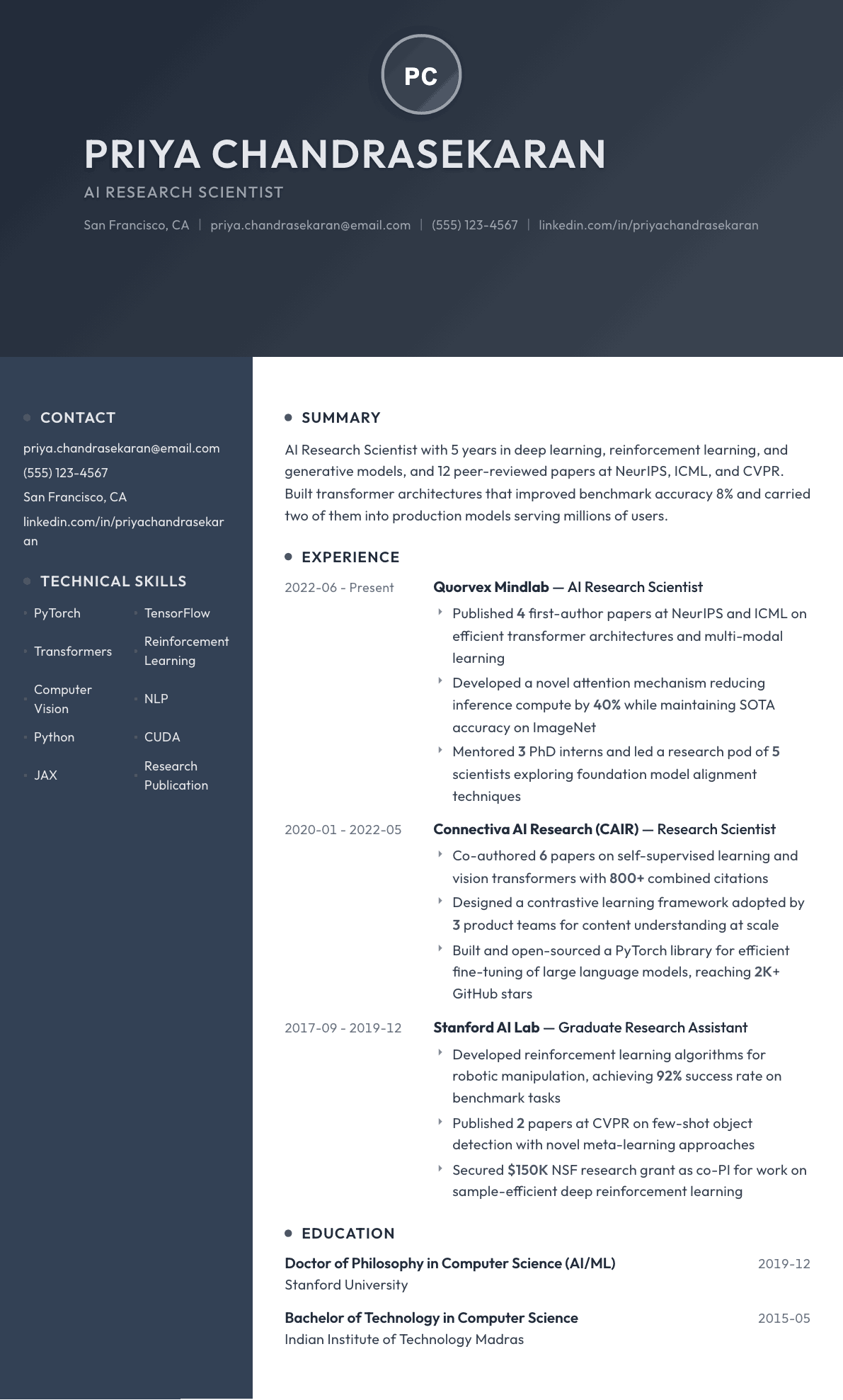
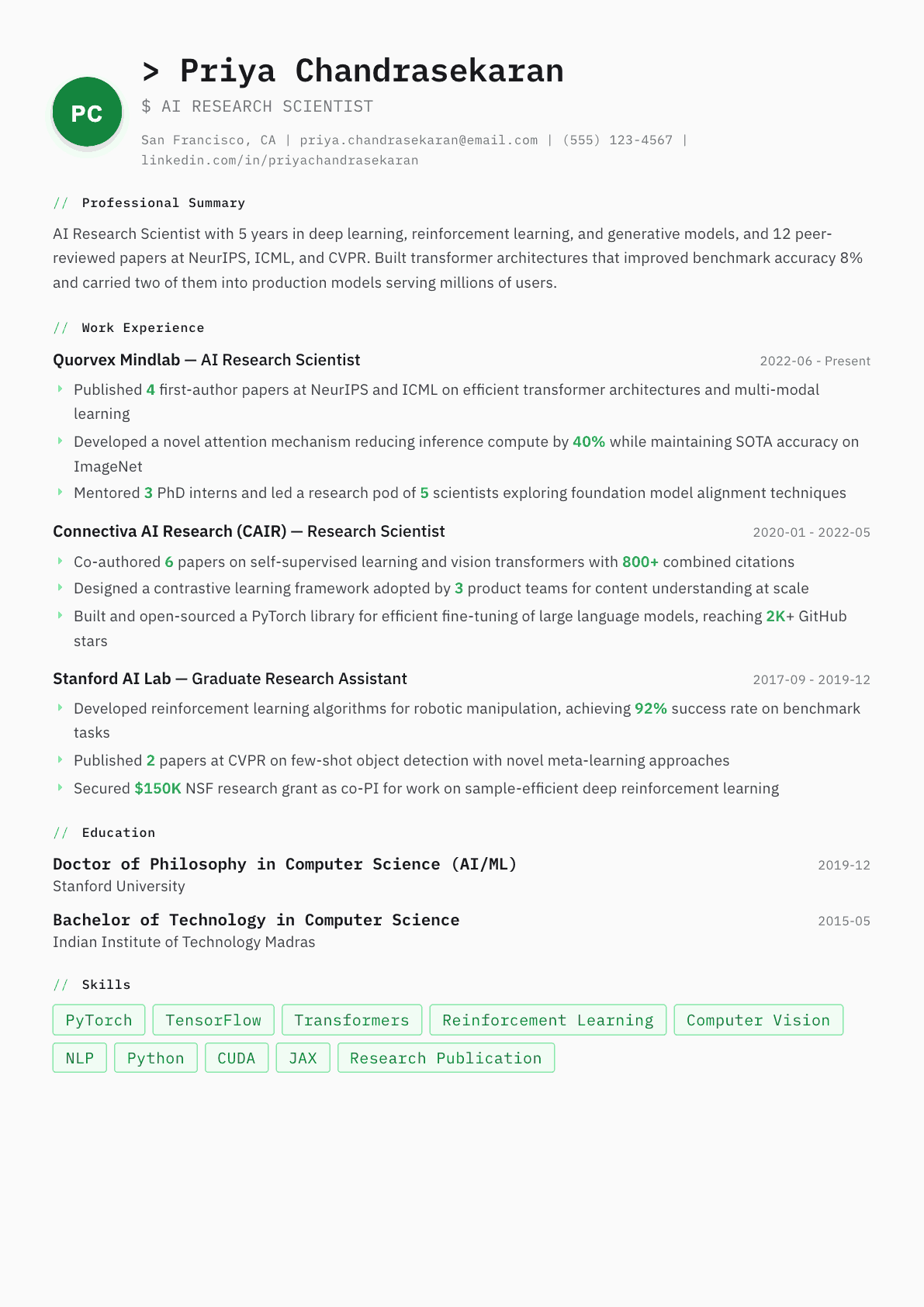
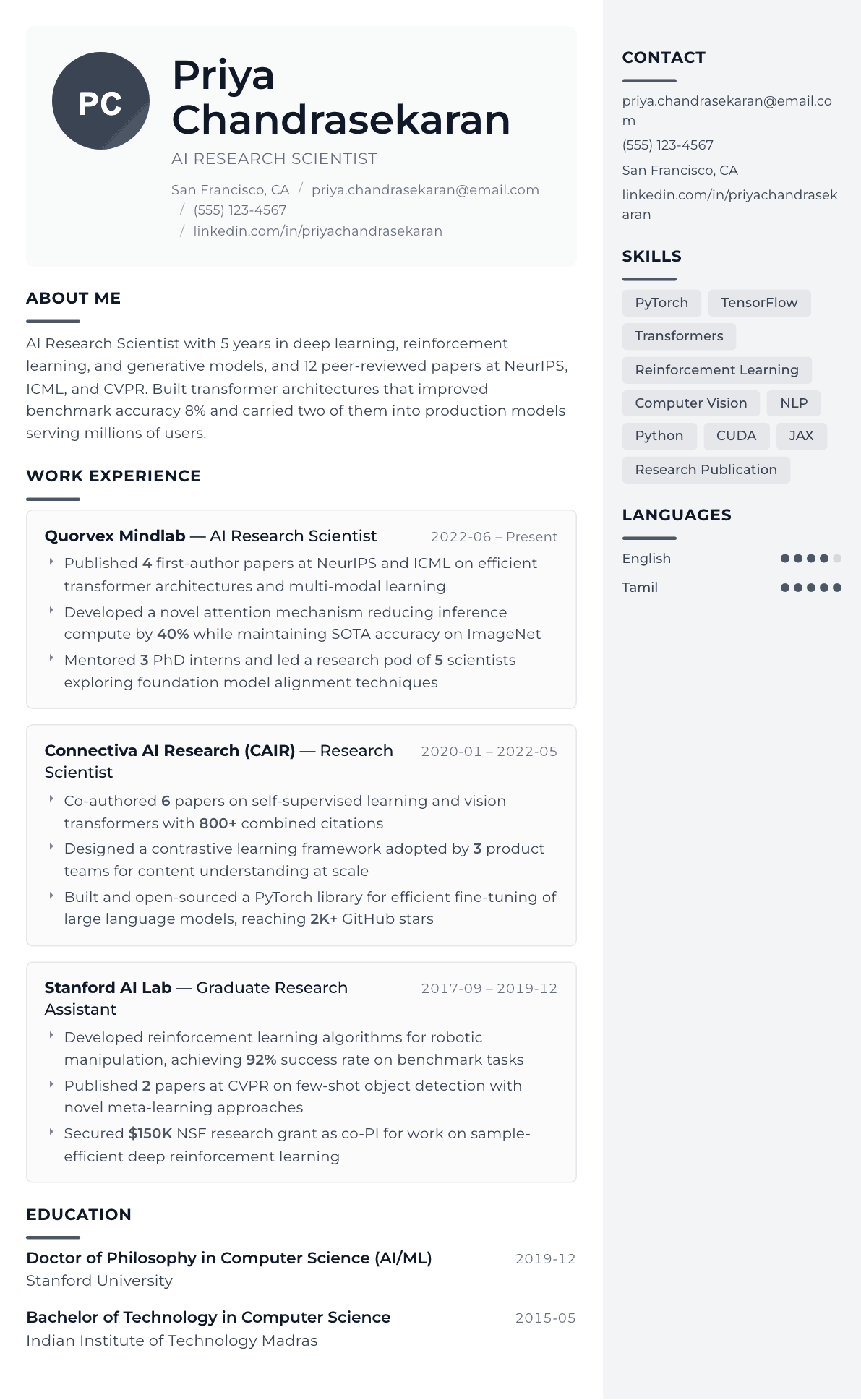
Example AI Research Scientist summary
AI Research Scientist, 12 peer-reviewed papers at NeurIPS, ICML, and CVPR with 800+ citations. Designed an attention mechanism that cut inference compute 40% at no accuracy loss, and moved research into production models serving millions of users. Leads a research pod of 5.
Skills to list on a AI Research Scientist resume
- PyTorch
- TensorFlow
- Transformer Architectures
- Reinforcement Learning
- Computer Vision
- Natural Language Processing
- Python
- CUDA/GPU Computing
- JAX
- Research & Publication
- Statistical Analysis
- Experiment Design
What actually gets this resume read
- Lead with your publication record: list venues (NeurIPS, ICML, CVPR), citation counts, and first-author papers.
- Quantify research impact: benchmark improvements, citation counts, and adoption by product teams.
- Highlight open-source contributions with GitHub stars, forks, or community adoption metrics.
- Include grants, fellowships, and awards to demonstrate competitive funding success.
- Show the bridge between research and production: models deployed, users served, or latency reduced.
How to write a ai research scientist resume
An AI research scientist resume is closer to an academic record than to an engineering resume, and it is read by scientists rather than by recruiters alone. The first thing a research manager looks for is the publication list: which venues, which position in the author order, and whether the work forms a line of inquiry or a scattering of unrelated papers. First-author work at a top conference is the currency of the field, and burying it below a skills grid is the most common self-inflicted wound in this market.
The second thing they look for is whether you can build. Industry research labs are full of people who can describe a method and short of people who can implement it, scale the training run, debug a loss curve at three in the morning and hand something to a product team. Show the systems half: the frameworks, the accelerator setup, the distributed training, the evaluation harness you wrote.
This guide covers the section order a research hiring committee expects, three summaries from a finishing doctoral candidate to a senior scientist, five rewritten bullets, and the questions researchers ask when a publication record has to coexist with production work on two pages.
Format: publications above everything except the summary
Two pages for industry, longer as an academic curriculum vitae when the posting asks for one. Order for an industry lab: summary, research interests, education, publications, research and industry experience, technical skills, then awards and service. The publication section moves above experience only when your papers are the strongest thing you have, which is true for most people leaving a doctoral program.
Format publications in a consistent citation style with venue, year and author list, and mark your position clearly. Bold your name if the template allows it, otherwise use an asterisk convention explained once. Group by peer-reviewed conference, journal, and preprint or workshop, and do not blur the boundary between them, because a committee reading your file will notice immediately.
- Venue names spelled out on first use, since the abbreviations vary by subfield.
- Author position marked, with equal contribution noted where it applies.
- Citation counts only if they are substantial, given as a single total rather than per paper.
- Preprints listed separately from peer-reviewed work, never mixed in to pad the list.
Summary and research interests: state a line of work, not a topic list
The summary should name the problem you work on, the methods you use, and the strongest evidence you have. A scientist working on efficient attention and inference cost is instantly placeable. A scientist working on deep learning and artificial intelligence is not, because that describes the entire field.
Add a short research interests line under the summary with three or four areas, phrased the way papers in your subfield phrase them. This is what a hiring committee scans to decide which of their teams you would join, and vague phrasing sends the file to nobody in particular.
Experience: research contribution, not project participation
Each research role needs the question you worked on, the method you developed, the experimental scale, and the result against a baseline. Improvements should be reported against a named benchmark and a named baseline, because a gain without a comparison point is unreadable. Include the scale honestly: model size, dataset, training compute in accelerator terms, and how many runs the conclusion rests on.
Reproducibility and infrastructure work belong here too, even though they feel less glamorous. Evaluation harnesses you wrote, ablation suites, data pipelines and released code all show a scientist whose results survive contact with other people. Open-source releases with real adoption are worth naming with the repository and what it does.
Mentorship and collaboration matter for senior roles. Interns supervised, students co-advised, cross-team collaborations that produced a joint paper, and reviewing service for conferences all indicate someone who can grow a research group rather than only produce personal output.
Show the bridge from research to product
Industry labs are increasingly judged on transfer, so a resume that shows research reaching production is materially stronger. Say which model went into which product surface, how it was served, what latency or cost constraint you had to meet, and how the offline result held up when real traffic arrived.
This is also where you address a common doubt about research candidates: that they cannot work to a deadline or a constraint. A bullet about meeting an inference budget, quantizing a model to fit a serving target, or cutting training cost through a data or architecture decision answers that doubt directly.
- The product surface and the user-facing behavior the model drives.
- The serving constraint: latency budget, hardware target, or memory limit.
- The gap between offline evaluation and online result, and what closed it.
- Collaboration with the engineering team that owns the deployment.
Technical skills, grants and the terms a search will match
Keep the skills block compact and honest: PyTorch, JAX, TensorFlow, Python, CUDA and GPU or TPU experience, distributed training frameworks, experiment tracking, and the statistical and experimental design methods you use. Do not list every library you have imported; a committee reads a long skills list as inexperience rather than breadth.
Funding and recognition carry real weight. Fellowships, competitive grants, best paper awards, challenge results and invited talks all belong in their own short section. So does service: program committee membership and reviewing for the venues you publish in, which signals standing in the community that citation counts alone do not.
AI Research Scientist resume summary examples
Finishing doctoral candidate
Machine learning researcher finishing a PhD on sample-efficient reinforcement learning, with 4 peer-reviewed papers including 2 first-author at NeurIPS and ICML. Built the lab evaluation harness used across three projects, and interned on a production recommendation team.
Five years in industry research
AI Research Scientist with 5 years publishing at NeurIPS, ICML and CVPR. Published 12 peer-reviewed papers with 800 citations, developed an attention mechanism that reduced inference compute by 40% at comparable accuracy, and moved two research models into production serving.
Senior research scientist
Senior research scientist leading a pod of five scientists on efficient multimodal models, with 30 publications, sustained first-author output and two open-source releases in wide use. Mentors doctoral interns, serves on program committees, and partners directly with product engineering on deployment.
Work experience bullets: before and after
Before: Published papers on deep learning at top conferences.
After: Published 4 first-author papers at NeurIPS and ICML on efficient transformer architectures and multimodal learning, with two receiving spotlight presentations and one adopted as a baseline by later work in the area.
Author position, named venues and downstream adoption convert a generic publication claim into a research standing.
Before: Developed a new attention mechanism that improved performance.
After: Developed a sparse attention variant that cut inference compute by 40% while matching the dense baseline within half a point on ImageNet top-1, validated across three model sizes and five random seeds.
Naming the baseline, the benchmark and the number of seeds is what makes a result credible to another researcher.
Before: Trained large models on GPU clusters.
After: Ran distributed training on 256 GPUs using fully sharded data parallelism, cutting a seven-day pretraining cycle to under two days and building the checkpointing and restart tooling the team reused across later projects.
Accelerator count, the parallelism strategy and the reusable tooling prove systems capability beyond model design.
Before: Worked with product teams to deploy models.
After: Worked with the search engineering team to move a retrieval model into production behind a 50 millisecond latency budget, using distillation and quantization to fit the serving target while retaining most of the offline gain.
A stated constraint and the techniques used to meet it answer the main doubt about research candidates.
Before: Mentored interns and junior researchers.
After: Mentored 3 doctoral interns through full research cycles, from problem selection to submission, with two projects resulting in accepted first-author papers and one intern returning as a full-time scientist.
Outcomes for the people you mentored show research leadership rather than a supervisory title.
Hard skills
- PyTorch
- JAX
- TensorFlow
- Python
- Transformer architectures
- Reinforcement learning
- Computer vision
- Natural language processing
- CUDA and GPU computing
- Distributed and sharded training
- Experimental design and ablation studies
- Statistical analysis and significance testing
- Model compression and quantization
- Scientific writing and peer review
Soft skills
- Problem selection
- Scientific skepticism
- Written argument
- Cross-team collaboration
- Mentoring researchers
- Conference presentation
Mistakes that cost ai research scientist candidates the interview
- Placing a skills grid above the publication list, which inverts what a research committee reads first.
- Mixing preprints and workshop papers into the peer-reviewed section, which reviewers spot and treat as padding.
- Reporting benchmark improvements with no named baseline, dataset or evaluation protocol.
- Describing model scale vaguely, so the reader cannot tell a small ablation from a full pretraining run.
- Hiding engineering contribution, which leaves the impression you cannot implement your own methods.
- Listing every library ever imported instead of the frameworks and systems you genuinely work in.
- Omitting the transfer of any research into a product, which many industry labs treat as a hiring requirement.
AI Research Scientist resume questions
Should an AI research scientist use a resume or an academic CV?
Use a two-page resume for industry labs unless the posting asks for a curriculum vitae, which is common in research institutes and faculty-adjacent roles. Keep a full CV ready as a separate document, since interviewers frequently request the complete publication record later.
How should I list publications when I am not first author?
List them in the standard citation order with your name marked, and note equal contribution where it applies. Do not reorder authors or omit senior authors. A committee cross-checks the papers, and any inconsistency is far more damaging than a middle-author position.
Do citation counts belong on the resume?
A single total is acceptable when it is meaningful, and it should match a public profile the reader can verify. Per-paper counts clutter the list. For early-career researchers, venue quality and first-author position carry more weight than any citation total.
How do I compete without publications at the top venues?
Lead with reproducible artifacts: open-source implementations with real adoption, competitive benchmark or challenge results, detailed technical writing, and production models you built. Many industry labs weigh demonstrated capability alongside publication record, especially for applied research roles.
How much engineering detail belongs on a research resume?
Enough to prove you can run your own experiments at scale: frameworks, accelerator setup, distributed training approach and the evaluation infrastructure you built. Keep it to two or three bullets so the research contribution remains the dominant story on the page.
Related resume examples
- Machine Learning Engineer Resume example
- Computer Vision Engineer Resume example
- NLP Engineer Resume example
- Data Scientist Resume example
- Data Analyst Resume example
- Bioinformatics Scientist Resume example