Machine Learning Engineer Resume Examples: free score
Train a Machine Learning Engineer Resume That Predicts Success
By Mustafa Tarabya, founder of CVBooster · Published · Updated
Build an ML engineer resume that showcases your model development, deployment, and data pipeline expertise to top AI companies.
Sample resumes for a machine learning engineer
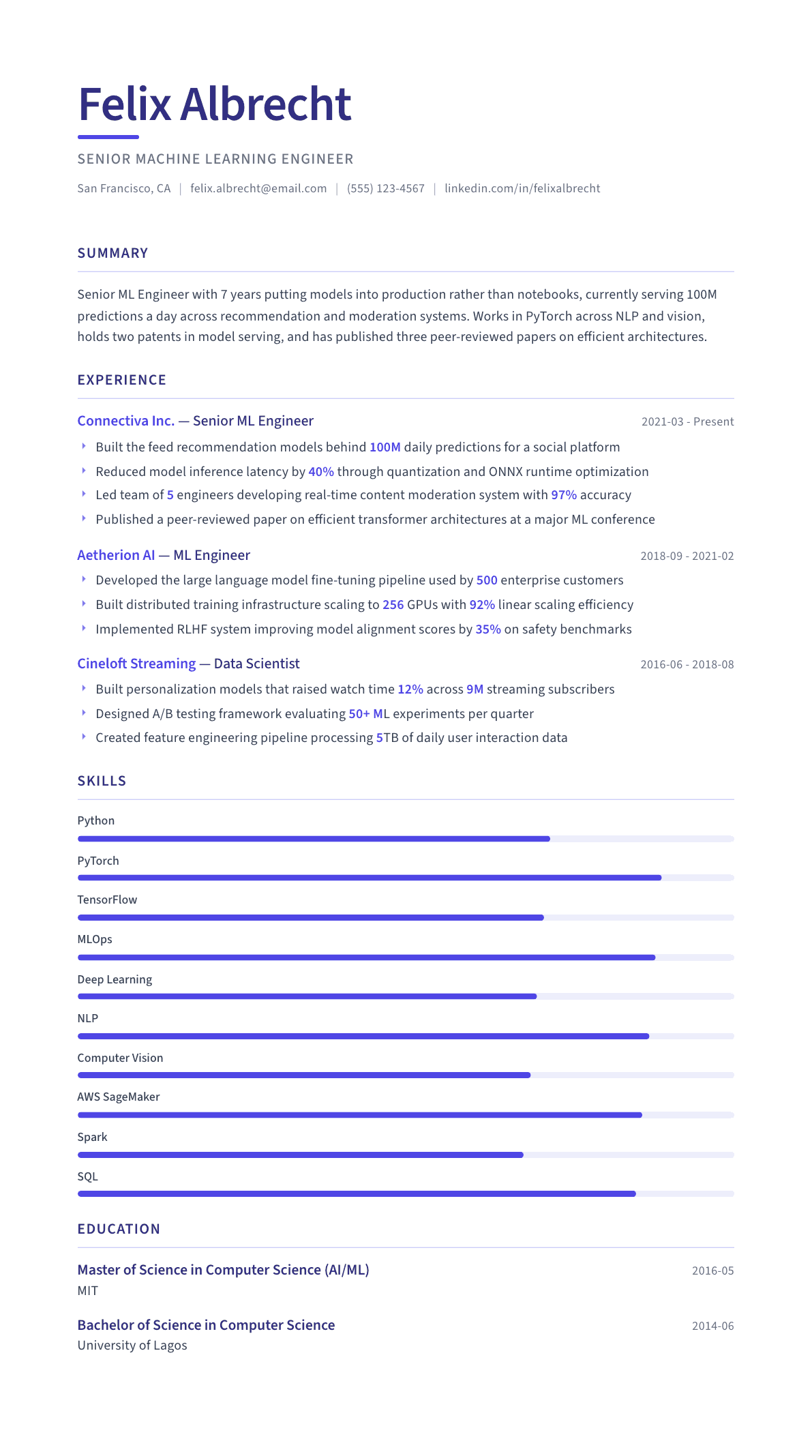
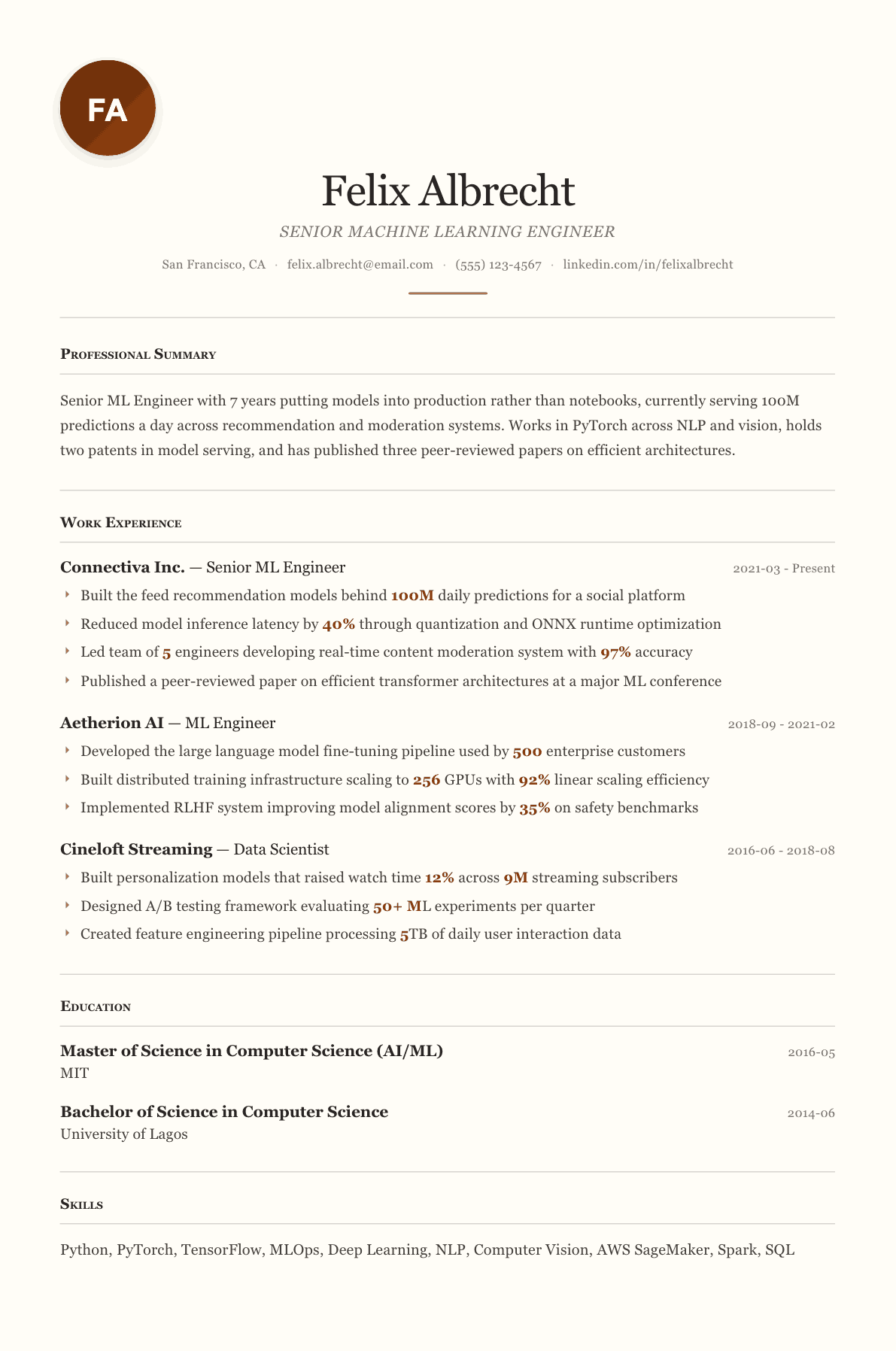
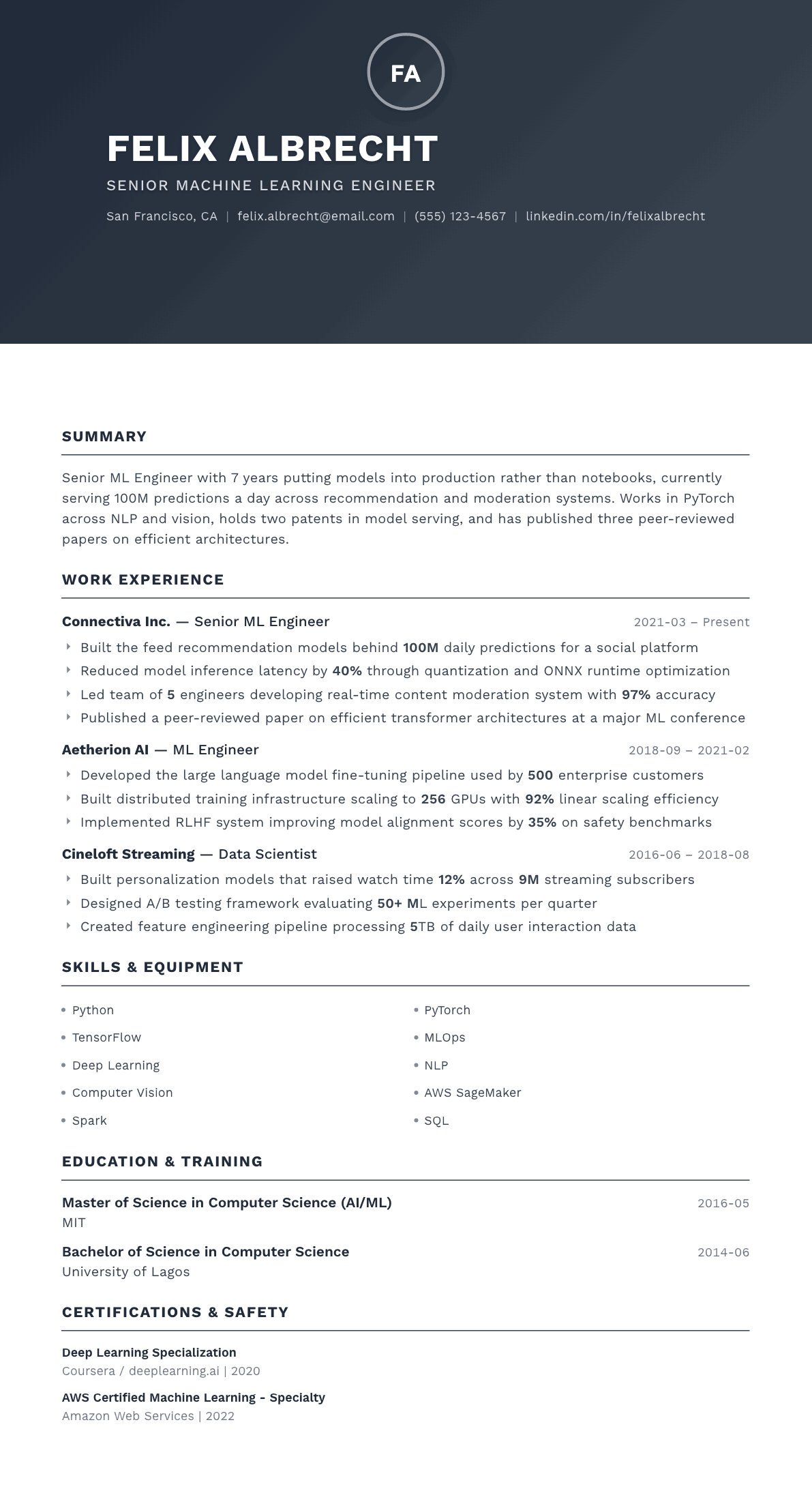
The same machine learning engineer content laid out in three CVBooster templates, so you can see what the finished document looks like before you write a word.
Example Machine Learning Engineer summary
ML engineer, 7 years, owning models end to end from training data to the serving path. Leads a team of five on real-time content moderation at 97% accuracy, cut inference latency 40% with quantization and ONNX, and trains at 256-GPU scale with 92% linear efficiency.
Skills to list on a Machine Learning Engineer resume
- Python
- PyTorch
- TensorFlow
- Scikit-learn
- Deep Learning
- NLP
- Computer Vision
- MLOps
- AWS SageMaker
- Spark
- SQL
- Docker
- Kubernetes
- A/B Testing
- Feature Engineering
What actually gets this resume read
- Highlight model performance metrics (accuracy, latency, throughput).
- Include publications and patents if applicable.
- Show experience with production ML systems, not just research.
- List specific frameworks (PyTorch, TensorFlow, JAX).
- Quantify business impact of your models.
How to write a machine learning engineer resume
The question behind every machine learning engineer screen is whether your models ever served real traffic. A notebook that reached a good validation score and a service that answers requests under a latency budget, retrains on a schedule and degrades safely when the data shifts are separated by most of the actual job. Hiring managers have learned to look for the second, because the first is now easy to produce.
That is why the strongest sections of this resume are usually the least glamorous: the feature pipeline, the offline and online evaluation, the rollout method, and what you did when a live model started making worse predictions than the week before. Framework lists are close to worthless as differentiators, since everyone applying names the same three.
This guide covers how to structure the resume for a machine learning hiring loop, how to write about models and metrics so a reviewer trusts the numbers, three summaries from a first industry role to a senior engineer, before and after bullets, and the research-versus-production question that decides many of these applications.
Format: one page early, two with publications or a long project list
Reverse chronological, single column, plain. Two pages are accepted once you have publications, patents or several production systems to describe. Put a repository link in the header, and if you have public work such as a competition placing, a maintained package or an open model, put it where it is seen immediately.
Structure the skills into three groups rather than one list: modeling, engineering and infrastructure, and data. This tells a reviewer instantly whether you are a modeler who can deploy or an engineer who can model, which is the classification every machine learning team makes before deciding which interview loop to run you through.
- Header: name, city, email, repository link, and a publication profile only if you have peer-reviewed work.
- Order: summary, skills in three groups, experience, selected projects, publications, education.
- Career changers from data analysis or software engineering keep the prior role in full, because deployment and data skills transfer directly.
Summary: problem domain, production status, and scale
Three lines. Name the problem domains you have worked in, whether your models run in production, and the data and traffic scale. Recommendation, ranking and search, forecasting, fraud and risk, computer vision, speech, and natural language work with large models are distinct hiring tracks and reviewers filter on them.
Say where you sit between research and engineering. A machine learning engineer who owns training pipelines and serving infrastructure is a different hire from one who focuses on model quality and hands deployment to a platform team. Both are legitimate, and being clear prevents an interview loop aimed at the wrong strengths.
Models and metrics: say what you optimized and what it cost
Name the model class and why it fit the problem: gradient boosted trees on tabular data, a sequence model, a fine-tuned transformer, a two-tower retrieval model, a time series model with seasonality. Then give the metric that mattered and both numbers, before and after. Use the metric the domain actually uses, such as area under the curve, precision at a threshold, recall on the positive class, mean absolute error, or a ranking metric.
Always pair the quality metric with the operational one. Latency at the ninety-ninth percentile, throughput, model size, training time and cost, and inference hardware. A model that improved accuracy but tripled response time is a tradeoff decision, and describing the tradeoff is how a resume shows engineering maturity rather than leaderboard chasing.
The business outcome closes the loop. Fraud caught, tickets deflected, inventory held, click-through or conversion moved, hours of manual review removed. Tie the offline metric to the online result where you have it, and say honestly when the online result was smaller than the offline gain suggested, because every experienced reviewer knows that is normal.
The production surface: pipelines, evaluation and monitoring
Describe how the model got and kept its data. Feature engineering and where features live, a feature store or a shared transformation library, training and serving skew and how you avoided it, backfills, labeling and label delay, and how the training set was split so the evaluation was not leaking.
Then how it was released and watched. Shadow deployment, a canary or a controlled online experiment, a rollback path, model and data versioning, reproducible training runs, drift detection on inputs and outputs, and scheduled or triggered retraining. Naming an experiment you designed and its guardrails is one of the strongest signals available on this resume.
- Name the serving path: a real-time endpoint, a batch scoring job, or an on-device model, since each implies a different skill set.
- Say which orchestration and tracking tools you used, such as Airflow, a managed pipeline service, or an experiment tracker.
- Mention responsible practice concretely: bias evaluation across groups, explanation methods, and documentation for a model review.
Keywords in machine learning postings
These postings repeat a recognizable set: Python, PyTorch, TensorFlow, scikit-learn, SQL, Spark, feature engineering, model deployment, MLOps, Docker, Kubernetes, cloud machine learning platforms, experimentation, and the domain words for the problem. Mirror the posting wording once in the grouped skills and once inside a bullet where it sits on a system you built. Avoid stacking every model architecture you have read about, since interviewers pick the least supported item to probe.
Machine Learning Engineer resume summary examples
First industry role
Machine learning engineer with a year building demand forecasting models in Python and scikit-learn, plus a graduate project that served a text classifier as a live endpoint. Comfortable with SQL, feature pipelines, experiment tracking and writing the tests that keep a training run reproducible.
Four years in
Machine learning engineer with four years owning fraud detection models in production, serving about 3,000 predictions a second at a ninety-fifth percentile latency under 40 milliseconds. Built the feature pipeline and the retraining schedule, and raised recall on confirmed fraud from 61% to 78% without increasing manual review volume.
Senior machine learning engineer
Senior machine learning engineer with nine years across ranking and recommendation, owning the training platform three model teams use. Led a retrieval and ranking rebuild that lifted engagement in a controlled experiment, set the drift monitoring and rollback standard, and mentors four engineers through model review.
Work experience bullets: before and after
Before: Built machine learning models using Python and TensorFlow.
After: Built a gradient boosted churn model on 40 engineered features from three source systems, raising precision at the retention offer threshold from 0.31 to 0.52 and cutting wasted offers by a third.
A named model class, the feature work and a threshold metric with a business consequence make the result checkable.
Before: Deployed models to production.
After: Deployed the ranking model as a containerized endpoint behind a canary release, holding the ninety-ninth percentile latency under 60 milliseconds and keeping a one-command rollback that was used once during a bad feature release.
Serving detail, a latency budget and an actually used rollback prove production ownership rather than a handoff.
Before: Worked on data pipelines for model training.
After: Built the Airflow training pipeline with a shared transformation library used at both training and serving time, eliminating a skew bug that had been quietly costing recall on the newest customer segment.
Training and serving skew is a real failure mode, and fixing it demonstrates knowledge that only comes from production work.
Before: Ran experiments to test model performance.
After: Designed an online experiment with a predefined primary metric, a minimum detectable effect and two guardrail metrics, ran it for three weeks, and recommended against launch when the guardrail on support contacts moved the wrong way.
Recommending against a launch on a guardrail is the clearest evidence of experimental discipline a reviewer can be given.
Before: Monitored models after deployment.
After: Added drift detection on input distributions and prediction mix with alerting on a weekly window, which surfaced an upstream schema change within a day instead of the month it had previously taken to notice.
Naming what was monitored and the detection time it saved converts monitoring from a claim into an operational result.
Hard skills
- Python for machine learning
- PyTorch and TensorFlow
- scikit-learn and gradient boosting
- Feature engineering and feature stores
- SQL and data modeling
- Spark and distributed processing
- Model serving and inference APIs
- Airflow and pipeline orchestration
- Experiment tracking and model registry
- Docker and Kubernetes
- Cloud machine learning platforms
- Online experimentation and testing
- Drift detection and monitoring
- Evaluation metric design
Soft skills
- Framing a business problem as a model problem
- Explaining model behavior to non-specialists
- Skepticism about your own results
- Cross-team collaboration with product and data
- Design review
- Knowing when not to use a model
Certifications worth listing
- AWS Certified Machine Learning, Specialty (Amazon Web Services)
- Google Cloud Professional Machine Learning Engineer (Google Cloud)
- Microsoft Certified: Azure Data Scientist Associate (Microsoft)
- Databricks Certified Machine Learning Associate (Databricks)
Mistakes that cost machine learning engineer candidates the interview
- Showing only notebook work, so a reviewer cannot tell whether any model you built has ever answered a real request.
- Quoting accuracy on an imbalanced problem, which tells an experienced reader that the evaluation was not thought through.
- Giving a model metric with no operational figure beside it, when latency, cost and size decide whether a model can be used.
- Listing every architecture you have read about, which invites the interviewer to probe the weakest item on the list.
- Leaving out data work entirely, when labeling, leakage, skew and pipeline reliability consume most of the working week.
- Never mentioning what happened after launch. Monitoring, retraining and a model that got worse are the most credible material you have.
Machine Learning Engineer resume questions
How is a machine learning engineer resume different from a data scientist one?
The engineering half carries more weight. Serving, pipelines, latency, versioning and monitoring belong front and center, while a data scientist resume leans further into analysis, experiment design and communicating findings to a business audience.
Do I need publications to get hired as a machine learning engineer?
Only for research-facing roles. Most product teams prefer evidence that models you built are running and being maintained. If you do have peer-reviewed work, list it in a short section rather than letting it displace production experience.
Do competition placings help on a machine learning resume?
A strong placing is a credible signal of modeling skill and it opens screening conversations. It does not substitute for deployment experience, so pair it with at least one project that served predictions to real users.
What metrics should I put on a machine learning engineer resume?
The metric the domain uses with before and after values, an operational number such as tail latency or cost, and the business outcome where you have it. Three linked numbers convince a reviewer far more than one impressive score.
How do I show machine learning work if my models never went to production?
Take one project the whole way yourself: wrap the model in an endpoint, containerize it, add monitoring and write down how you would retrain it. That one end-to-end example answers the question every reviewer of this resume is asking.
Related resume examples
- Data Scientist Resume example
- AI Research Scientist Resume example
- Data Engineer Resume example
- MLOps Engineer Resume example
- Computer Vision Engineer Resume example
- Junior Software Engineer Resume example