Bioinformatics Scientist Resume Examples: free ATS score
Build a Bioinformatics Scientist Resume That Survives Peer Review
By Mustafa Tarabya, founder of CVBooster · Published · Updated
A bioinformatics scientist resume example with pipeline, genomics and statistics detail, plus a guide to writing every section for industry roles.
Sample resumes for a bioinformatics scientist
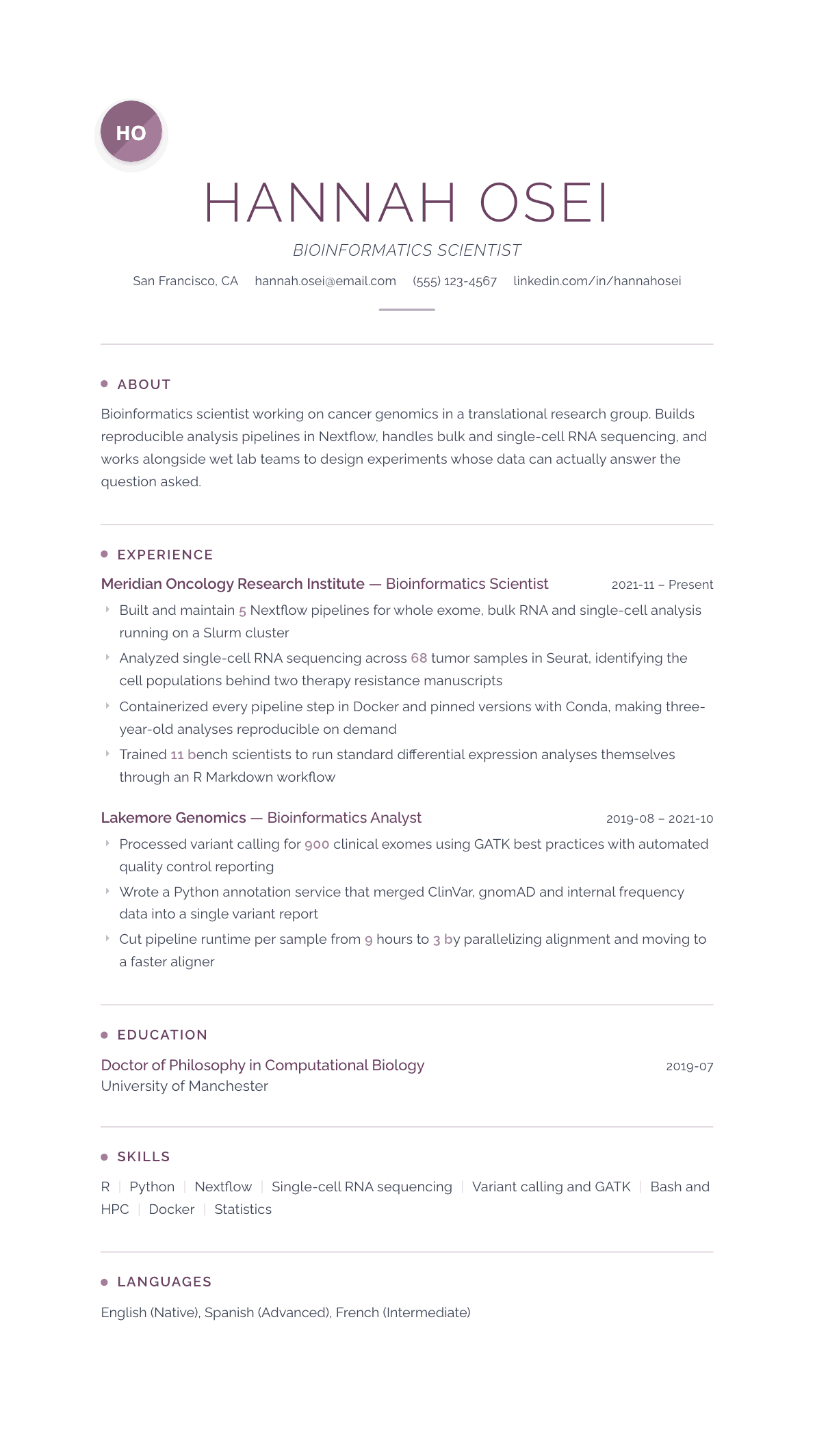
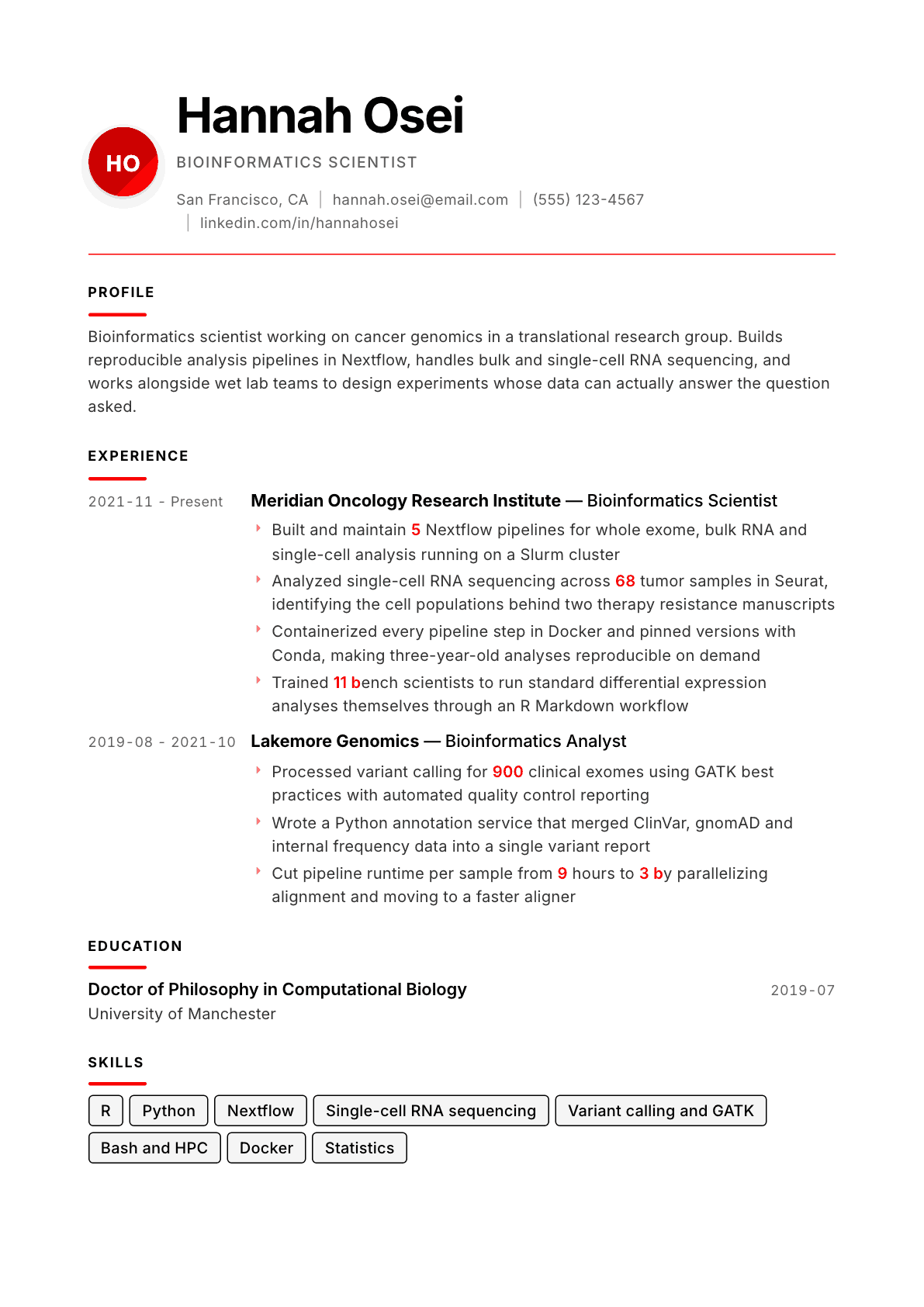
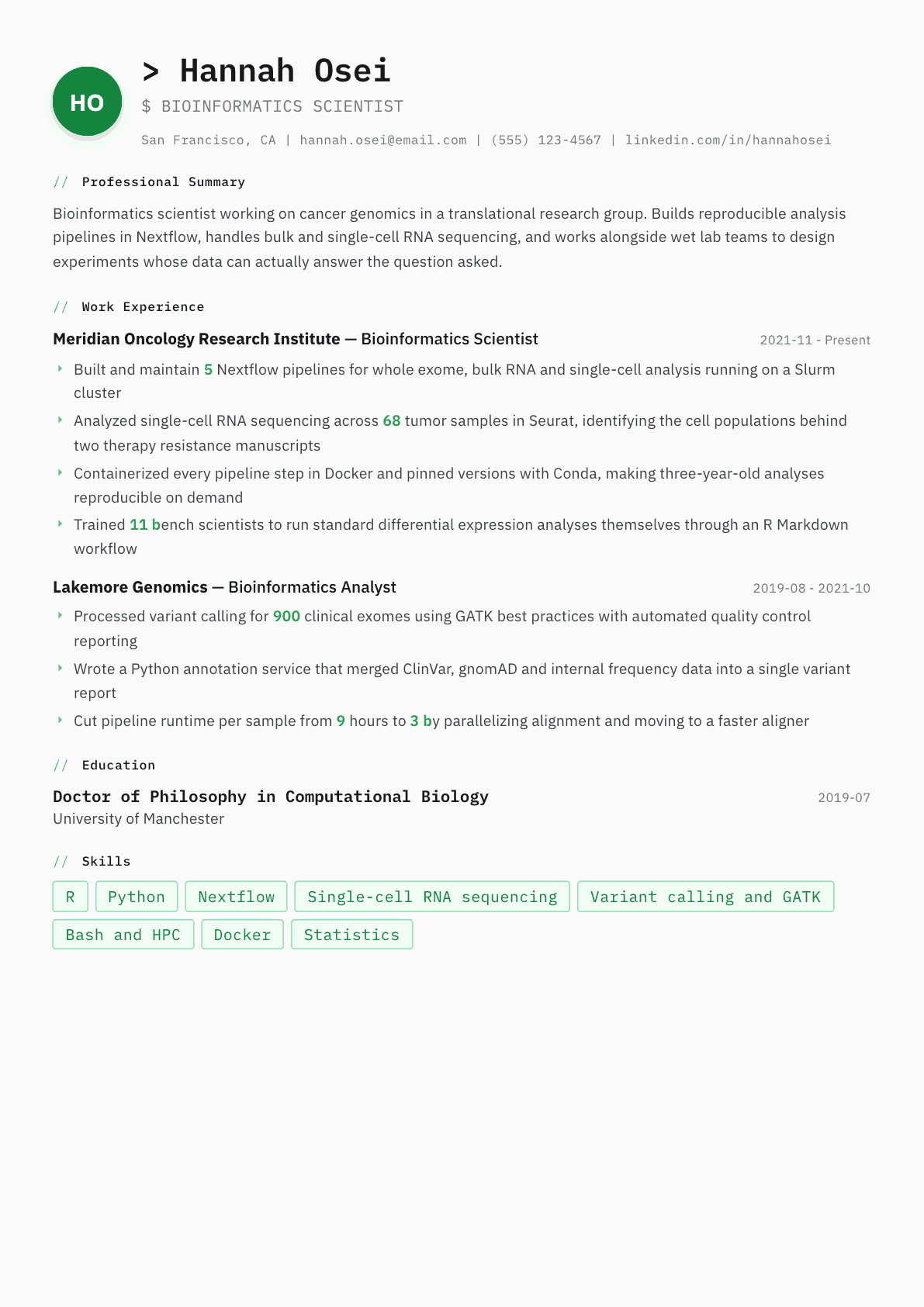
The same bioinformatics scientist content laid out in three CVBooster templates, so you can see what the finished document looks like before you write a word.
Example Bioinformatics Scientist summary
Bioinformatics scientist with a doctorate in computational biology and five years in translational cancer genomics. Builds reproducible Nextflow pipelines for exome, bulk RNA and single-cell analysis on high performance computing clusters. Analyzed single-cell data across 68 tumor samples behind two published manuscripts and cut per-sample variant calling runtime from nine hours to three. Seeking a computational biology role in therapeutic discovery.
Skills to list on a Bioinformatics Scientist resume
- R
- Python
- Bioconductor
- Nextflow
- Snakemake
- Single-cell RNA sequencing
- Bulk RNA sequencing
- Variant calling and GATK
- Seurat
- Docker
- High performance computing
- Bash scripting
- Statistical modeling
- Genome annotation
- Data visualization
- Git
What actually gets this resume read
- Name the assay types you have analyzed, because bulk RNA, single-cell, exome and proteomics hire as different specialties.
- Show reproducibility work explicitly: workflow managers, containers and version pinning separate scientists from scripters.
- Quantify the data scale you handled in samples, cells or genomes rather than in vague terms like large datasets.
- Include publications and preprints with your position in the author list, since that is how the field reads contribution.
- Mention the wet lab collaboration side, because industry teams hire for experimental design conversations, not only code.
- List statistics by method, such as differential expression, survival analysis or multiple testing correction, not just statistics.
How to write a bioinformatics scientist resume
A bioinformatics scientist resume gets read by two very different people. In academia and core facilities it is a principal investigator who wants to know which assays you can analyze, whether your methods are defensible, and where your name sits on the author list. In industry it is a computational biology lead who wants all of that plus reproducibility, engineering discipline and the ability to sit in an experimental design meeting and tell a bench scientist that the planned sample size cannot answer her question.
The most common failure is a resume that reads as a list of tools. R, Python, Bioconductor, Nextflow, Seurat, GATK, one after another, with no indication of which assays you have actually analyzed or what conclusion your analysis supported. Tools are cheap. The scarce things are judgment about experimental design, disciplined handling of batch effects and multiple testing, and pipelines that still run three years later.
This guide covers the format used in industry, the summary, experience bullets that show method and consequence, how to handle publications, and the questions computational biologists ask when writing this document.
Format: an industry resume, not an academic record
For industry positions, write a two page resume, not a curriculum vitae. Reverse chronological, with a short technical profile at the top, then experience, then a compact publications section. Move teaching, posters and conference attendance off the page entirely. A hiring manager reading twenty applications will not reach page five, and a long academic document signals that you have not adjusted to the setting you are applying to.
For academic and core facility posts, a curriculum vitae is still expected and publications move forward, but the advice about specificity in the experience section applies unchanged.
- Header: name, title, city, email, GitHub, and an ORCID identifier or Google Scholar link.
- Order for industry: profile, technical skills, experience, selected publications, education.
- Cap selected publications at five to eight, with your author position clear.
Summary: assay types, scale, and the biology you support
Three or four lines. Name the assays you analyze, the therapeutic or research area, the compute environment, and the collaboration you do. Assay type is the strongest filter in this field: bulk RNA sequencing, single-cell transcriptomics, whole exome and genome sequencing, spatial transcriptomics, proteomics and metagenomics are separate specialties with different pitfalls, and a lead hires for one of them.
Do not write experienced in next generation sequencing analysis and stop there. It tells the reader nothing about whether you can handle ambient RNA in single-cell data, or whether you know why a variant call set needs joint genotyping. Specificity is credibility here.
Experience: method, scale, reproducibility, and the biological result
Every substantive bullet should carry three things: the assay and scale, the method or tool chain, and what the analysis let the group conclude or do next. The last part is the one candidates skip, and it is what separates a scientist from a service provider. An analysis that identified the cell populations behind a resistance mechanism is a different claim from an analysis that produced differential expression tables.
Reproducibility deserves an explicit bullet. Workflow managers such as Nextflow or Snakemake, containerization, environment pinning, version-controlled analysis code, and parameter tracking. Industry teams have all been burned by an analysis nobody can rerun after the author left, so a candidate who describes this discipline is answering a fear the job description rarely states.
Give scale in the units the field uses: samples, cells, genomes, libraries, or cohort size. Then note the compute environment, whether a Slurm cluster, a cloud batch service or a workstation, because the practicalities of running an analysis across thousands of cells are part of the skill.
Statistics needs to be named by method rather than claimed as a category. Differential expression with a specific framework, multiple testing correction, batch effect handling, survival analysis, dimensionality reduction choices, power considerations at the design stage. A single sentence about how you handled a confound will do more for you than a skills list line reading statistics.
Finally, show the wet lab interface. Sitting in design meetings, advising on replicate numbers, flagging a batch confound before samples were prepared, or training bench scientists to run standard analyses themselves. Industry groups hire computational scientists partly to prevent expensive experiments that cannot be interpreted.
- Name every assay type explicitly rather than writing sequencing analysis.
- One bullet on reproducibility naming the workflow manager and the container approach.
- Give sample, cell or cohort counts and the compute environment.
- End at least two bullets with the biological or program decision the analysis supported.
Skills and publications: grouped, honest, and short
Group skills into languages, assays and methods, workflow and infrastructure, and statistics. Keep the assay group first for industry roles, since that is what the reviewer is matching against. Only list a tool you could open today and use without a tutorial, because technical screens in this field move quickly to specifics such as normalization choices and quality control thresholds.
For publications, select rather than exhaust. Five to eight entries, first author and co-first work marked, with a one clause note on your contribution where it is not obvious. If a manuscript is a preprint, say so honestly. A short curated list reads as judgment; a complete list reads as an unedited academic record pasted into the wrong document.
Keywords these postings use
Bioinformatics job descriptions repeat: RNA sequencing, single-cell, variant calling, GATK, Nextflow, Snakemake, Bioconductor, Seurat, Python, R, Docker, high performance computing, cloud compute, quality control, batch effect, differential expression, multiple testing, reference genome, annotation and reproducible analysis. Use the true ones inside sentences about your own work, and repeat your two central assay types in both the profile and the experience section.
Bioinformatics Scientist resume summary examples
Recent doctorate
Computational biology doctorate with thesis work on bulk and single-cell RNA sequencing in immune tissue, analyzing forty samples in R and Seurat. Built a Snakemake pipeline used by two other laboratory members and co-authored three publications. Seeking an industry bioinformatics position in immunology or oncology.
Five years in translational research
Bioinformatics scientist in translational oncology, running exome, bulk RNA and single-cell pipelines in Nextflow on a Slurm cluster. Analyzed single-cell data across sixty-eight tumor samples behind two therapy resistance manuscripts, and cut per-sample variant calling runtime from nine hours to three.
Principal scientist
Principal bioinformatics scientist leading computational strategy for a discovery program, with three scientists reporting in. Sets the analysis standards, reviews study designs before samples are collected, owns the containerized pipeline library, and presents computational evidence in program reviews alongside the biology and chemistry leads.
Work experience bullets: before and after
Before: Analyzed RNA sequencing data for the lab.
After: Analyzed single-cell RNA sequencing across sixty-eight tumor samples in Seurat, identifying the myeloid populations that became the basis of two therapy resistance manuscripts.
Assay, scale, tool and the biological conclusion together show a scientist rather than an analysis service.
Before: Built pipelines for sequencing analysis.
After: Built and maintain five Nextflow pipelines for whole exome, bulk RNA and single-cell analysis, each step containerized in Docker with pinned dependency versions.
Naming the workflow manager, the assay coverage and the containerization proves reproducibility discipline.
Before: Made the pipeline faster.
After: Cut per-sample variant calling runtime from nine hours to three by parallelizing alignment across cluster nodes and moving to a faster aligner with matched sensitivity.
The runtime figures plus the note on matched sensitivity show the speedup did not quietly cost accuracy.
Before: Worked with the wet lab team.
After: Reviewed study designs before sample collection, flagging a processing batch confound that would have been inseparable from the treatment effect, and adjusted the randomization with the laboratory lead.
It shows judgment applied early, which is where a computational scientist saves an experiment rather than salvaging it.
Before: Trained colleagues on data analysis.
After: Trained eleven bench scientists to run standard differential expression analyses themselves through a documented R Markdown workflow with fixed quality control thresholds.
A count, a mechanism and the quality safeguard turn informal help into a durable capability for the group.
Hard skills
- R and Bioconductor
- Python for scientific computing
- Nextflow and Snakemake
- Single-cell RNA sequencing analysis
- Bulk RNA sequencing and differential expression
- Variant calling with GATK
- Genome alignment and annotation
- Docker and reproducible environments
- High performance computing and job schedulers
- Statistical modeling and multiple testing correction
- Data visualization
- Git and version control
Soft skills
- Experimental design consultation
- Explaining methods to bench scientists
- Scientific writing
- Skepticism about weak signals
- Collaboration across research programs
Mistakes that cost bioinformatics scientist candidates the interview
- Submitting a full academic curriculum vitae to an industry role, where nobody reads past the second page.
- Listing tools without ever naming the assay types those tools were applied to.
- Reporting analyses with no biological conclusion, which makes the work read as a service rather than science.
- Omitting reproducibility practices, the single concern that industry computational leads raise most often.
- Claiming statistics as a skill while never naming a correction method, a design consideration or a confound you handled.
- Including every publication and poster instead of curating a short list with your contribution made clear.
Bioinformatics Scientist resume questions
Should a bioinformatics scientist use a resume or a curriculum vitae?
Use a two page resume for industry and a curriculum vitae for academic or core facility roles. The industry version keeps a short selected publications list and drops teaching, posters and service, which frees space for pipelines, assay experience and collaboration with experimental teams.
How do I list publications on a bioinformatics resume?
Select five to eight, mark first and co-first authorship, and add a short clause on your contribution when it is not obvious from the position. Label preprints honestly. A curated list demonstrates judgment, which matters more to an industry reader than sheer volume.
What matters more, biology knowledge or programming ability?
Both are screened, but the imbalance that sinks candidates is strong code with weak biological reasoning. If you cannot explain why a normalization choice matters for the tissue in question, the interview stalls regardless of how clean your pipelines are.
Do I need cloud computing experience for bioinformatics roles?
Increasingly yes for industry positions, since analyses that outgrow a local cluster move to cloud batch services. Name the platform and what you ran there. Traditional high performance computing with a job scheduler still counts, so state which environment you actually worked in.
How do I move from academic bioinformatics into industry?
Rewrite the document as a resume, lead with assay types rather than research questions, and add explicit evidence of reproducibility, documentation and teamwork. Then show one case where your analysis changed a decision, since industry groups fund computation to shorten programs.
Related resume examples
- Data Scientist Resume example
- Research Scientist Resume example
- Geneticist Resume example
- Data Engineer Resume example
- Data Analyst Resume example
- AI Research Scientist Resume example