NLP Engineer Resume Examples: free ATS score and gap list
Articulate Your Career with an NLP Engineer Resume
By Mustafa Tarabya, founder of CVBooster · Published · Updated
Create a standout NLP engineer resume showcasing your expertise in large language models, text processing, and conversational AI systems.
Sample resumes for a nlp engineer
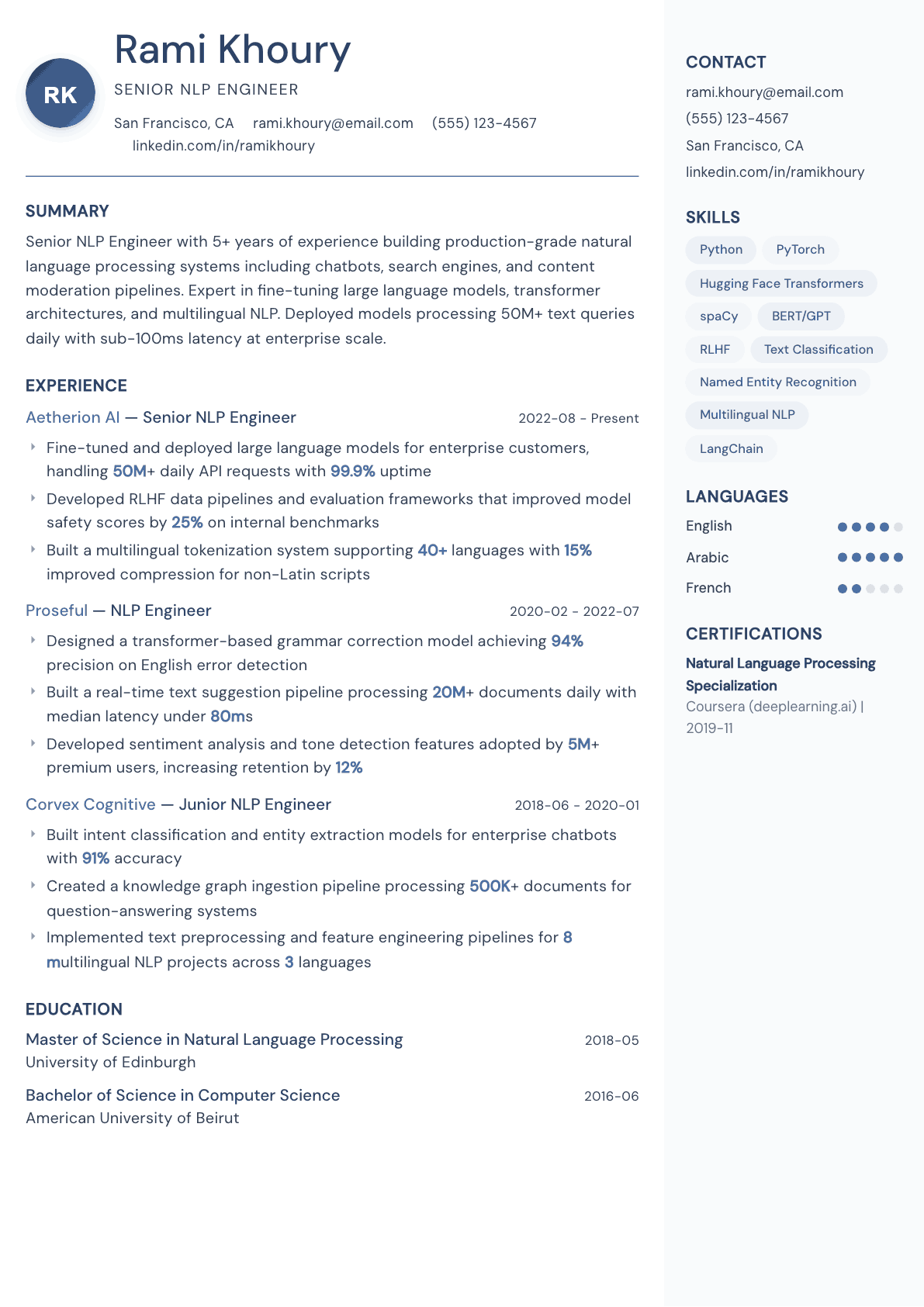
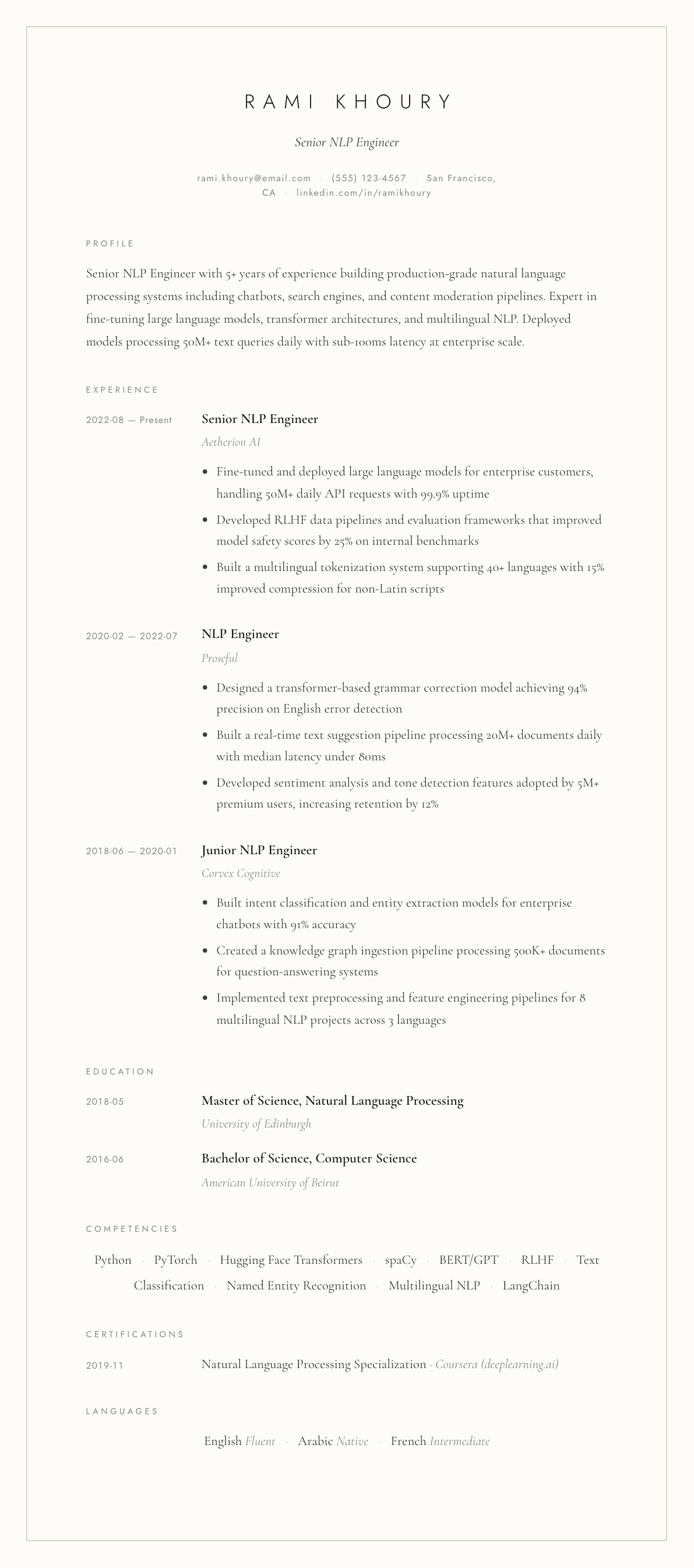
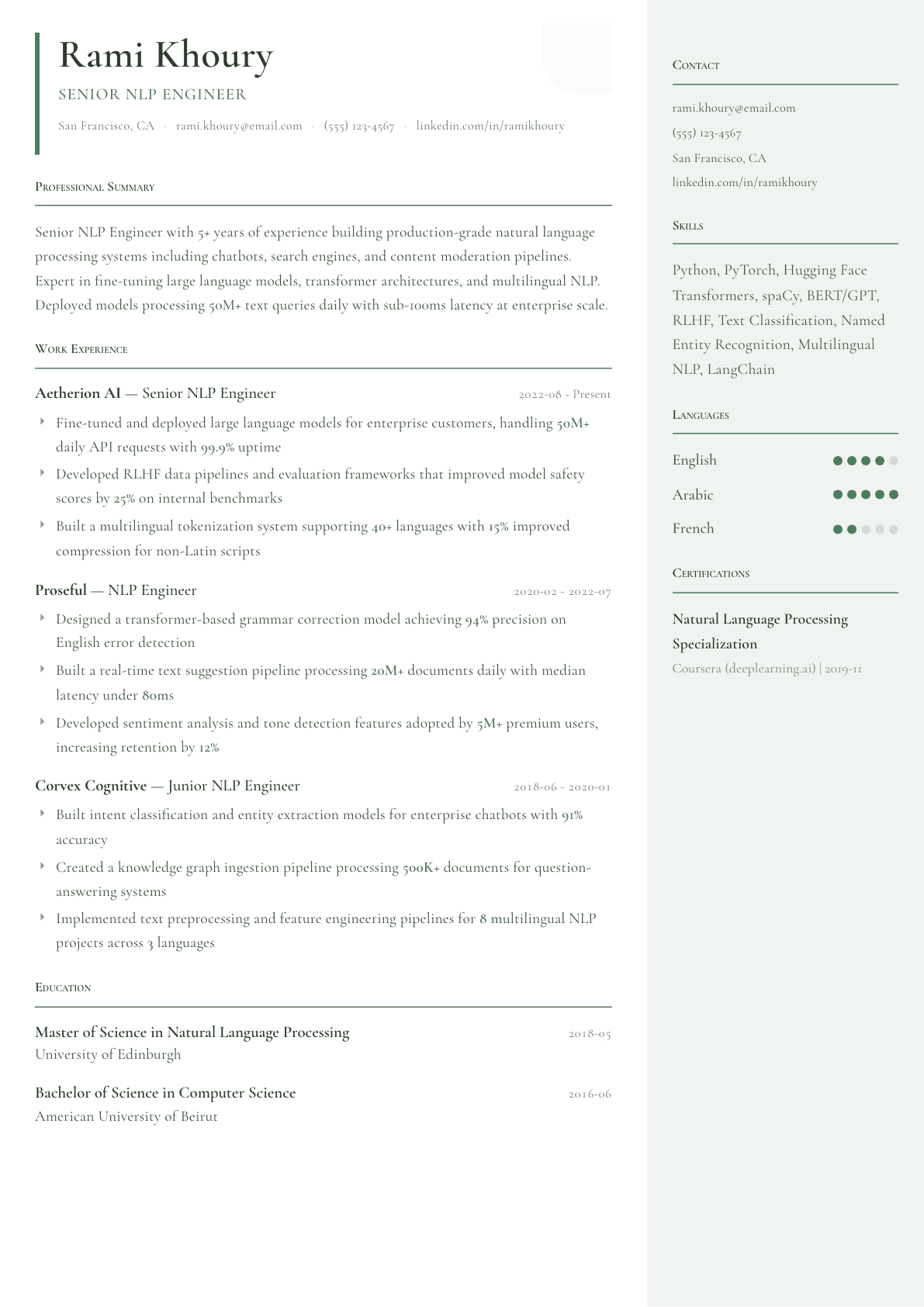
The same nlp engineer content laid out in three CVBooster templates, so you can see what the finished document looks like before you write a word.
Example NLP Engineer summary
Senior NLP Engineer with 5 years of experience building production natural language processing systems at scale. Fine-tuned large language models handling 50M+ daily queries with sub-100ms latency and improved model safety scores by 25%. Expert in transformer architectures, RLHF, multilingual NLP, and deploying conversational AI to enterprise customers.
Skills to list on a NLP Engineer resume
- Python
- PyTorch
- Hugging Face Transformers
- spaCy
- BERT/GPT/LLaMA
- RLHF
- Text Classification
- Named Entity Recognition
- Sentiment Analysis
- Multilingual NLP
- LangChain
- Information Retrieval
What actually gets this resume read
- Specify LLM experience: fine-tuning, RLHF, prompt engineering, RAG, or distillation techniques.
- Quantify NLP metrics: accuracy, F1 score, BLEU, ROUGE, or perplexity improvements.
- Highlight production deployment: latency, throughput, and uptime SLAs for NLP services.
- Mention multilingual capabilities and specific language pairs or scripts you have worked with.
- Include experience with modern NLP frameworks: Hugging Face, LangChain, spaCy, or custom pipelines.
How to write a nlp engineer resume
The NLP engineer title covers two very different jobs, and a resume that does not pick one gets read as neither. The first is a modeling job: pretraining or fine-tuning transformer models, building evaluation sets, running preference optimization, deciding on tokenization for a new language. The second is a systems job: retrieval pipelines, embedding stores, latency budgets, guardrails, and the unglamorous work of keeping a language model useful when real user text arrives.
Most teams hiring today want the second more than the first, and most candidates write for the first. If your last two years were spent building retrieval augmented generation over messy internal documents, chunking strategies, reranking and evaluation harnesses, that is the resume a hiring manager wants and it should not be disguised as research.
This guide covers how to declare which NLP engineer you are, which evaluation numbers survive scrutiny, how to write about model work when the model was not yours, and the mistakes that make an otherwise strong candidate look like a person who only calls an API.
Format: modeling or systems, decided in the first three lines
Reverse-chronological, one page under six years. Under the summary, add a short technical profile block: languages and scripts you have worked in, model families you have fine-tuned or served, serving stack, and the largest text volume you have processed. That block does the work a hiring manager would otherwise do by reading the whole page.
Publications and preprints get their own short section if you have them, with venue and your author position. If you have none, do not invent a research section out of course projects, because a modeling team will notice immediately and a systems team does not care.
- Header: name, title, city, email, and a public repository or model hub profile if it holds real work.
- Order: summary, technical profile, experience, selected projects, skills, education, publications.
- Career changers from linguistics or data analysis should keep a projects section with evaluation numbers attached.
- Name the languages and scripts, not just "multilingual", because handling Arabic morphology is not the same job as handling Spanish.
Summary: the task, the model family, the scale, the constraint
Name the task you own: classification, named entity recognition, retrieval, summarization, dialogue, machine translation, moderation. Then the model family and how you touched it: fine-tuned an encoder, adapted a decoder with LoRA, distilled a large model into a small one, or served an off the shelf model behind a retrieval layer.
Finish with the constraint you engineered against, because constraints are what make an NLP system hard. Latency under a tight budget, on-device inference, a language with little labeled data, a domain vocabulary no general model has seen, or a moderation policy where false negatives carry real harm.
Experience: data first, then model, then evaluation
Lead each role with the data, because in language work the data decides the outcome. Where the text came from, how noisy it was, how you labeled it, how many examples, how you handled annotator disagreement, and what you did about class imbalance. An engineer who can describe an annotation guideline and an inter-annotator agreement check reads as someone who has done the real job.
Then the modeling bullet. Name the architecture and the adaptation method: BERT or RoBERTa encoders, a sequence to sequence model, an instruction-tuned decoder, LoRA or full fine-tuning, quantization for serving. Say what you compared it against, because a model without a baseline is a number with no meaning.
Then evaluation and serving. Which metric you optimized and why that metric fits the task, how the offline number related to online behavior, and what you deployed on: an inference server such as vLLM or Triton, a batching strategy, a caching layer, and the latency at the tail rather than the median.
Numbers that hold up in an NLP interview
Accuracy alone is close to meaningless on imbalanced text tasks, and an experienced reader knows it. Report the metric that matches the task and say what it was measured on: macro F1 for multi-class classification, precision at a fixed recall for moderation, exact match and F1 for extractive question answering, recall at k and mean reciprocal rank for retrieval, and human preference rates for open-ended generation.
Always name the evaluation set and whether it was held out, adversarial or drawn from production traffic. The strongest line an NLP engineer can write is that they built the evaluation set themselves, because most teams are worse at evaluation than at modeling and they know it.
- Task metric with a baseline to compare against, not a bare number.
- The evaluation set: size, source, how it was labeled, whether it reflects production traffic.
- Serving numbers at the tail: latency at the ninety-ninth percentile, tokens per second, cost per request in relative terms.
- Failure analysis: the error categories you found and what you changed because of them.
Skills: separate what you build from what you call
Group into modeling, data, retrieval, serving and evaluation. Under modeling name PyTorch, Hugging Face Transformers, PEFT, and the training approach. Under retrieval name the embedding model, the vector index such as FAISS, pgvector or a hosted store, the chunking strategy and the reranker. Under serving name the inference stack and the monitoring.
Be honest about the boundary between systems you built and APIs you called. Both are legitimate, but a candidate who lists a model family under skills and then cannot describe its tokenizer loses the interview in the first ten minutes. Write "served" where you served, "fine-tuned" where you fine-tuned.
NLP Engineer resume summary examples
First NLP role
Computational linguistics graduate with a thesis on Arabic named entity recognition and two production internships. Fine-tuned a multilingual encoder to 0.84 macro F1 on a hand-labeled set of 8,000 sentences, and built the annotation guideline and agreement checks behind it.
Four years in
NLP engineer with four years building retrieval and classification systems for customer support text. Owns an internal retrieval pipeline over 2M documents with reranking, raising answer accuracy from 61% to 79% on a production-sampled evaluation set, served under 300ms at the tail.
Senior NLP engineer
Senior NLP engineer with eight years across moderation, search and dialogue. Led a distillation program that cut serving cost by two thirds with a 1.5% quality loss, built the evaluation harness the team still ships against, and mentors four engineers on data and evaluation practice.
Work experience bullets: before and after
Before: Built NLP models for text classification.
After: Fine-tuned a RoBERTa classifier for support ticket routing across 42 intents, lifting macro F1 from 0.68 to 0.81 against a rules baseline on a 5,000 message held-out set.
The architecture, the label space, the baseline and the metric make the result something a reader can evaluate.
Before: Worked with large language models.
After: Adapted an instruction-tuned decoder with LoRA on 30k domain dialogues, then quantized it to 4-bit for serving, holding preference win rate against the base model at 64% while cutting GPU memory in half.
It names the adaptation method, the data volume, the deployment constraint and the trade it accepted.
Before: Implemented a RAG pipeline for internal documents.
After: Built retrieval over 2M internal documents with semantic chunking, a bi-encoder index in FAISS and a cross-encoder reranker, raising recall at five from 0.55 to 0.88 and cutting unanswerable responses by a third.
Every stage of the pipeline is named and the retrieval metric shows which stage did the work.
Before: Improved model evaluation.
After: Replaced a static accuracy script with an evaluation harness of 1,200 production-sampled cases across six error categories, run on every model change, which caught two regressions before release.
Building the evaluation set and catching regressions is more convincing than any single model number.
Before: Supported multiple languages in the pipeline.
After: Extended tokenization and normalization to Arabic, Turkish and Thai, adding script-aware segmentation and diacritic handling that cut out-of-vocabulary rates on non-Latin traffic by 40%.
Naming the specific languages and the linguistic problem each one poses shows real multilingual work rather than a language list.
Hard skills
- Python
- PyTorch
- Hugging Face Transformers and PEFT
- Fine-tuning and LoRA adaptation
- Tokenization and text normalization
- Named entity recognition
- Text classification and sequence labeling
- Retrieval augmented generation
- Vector indexes (FAISS, pgvector)
- Reranking and semantic search
- Model evaluation design
- Inference serving (vLLM, Triton)
- Quantization and distillation
- spaCy
Soft skills
- Writing annotation guidelines
- Error analysis and failure triage
- Explaining model limits to product owners
- Working with linguists and annotators
- Judgment on when a model is good enough to release
Certifications worth listing
- Natural Language Processing Specialization (DeepLearning.AI)
- AWS Certified Machine Learning - Specialty (Amazon Web Services)
- Professional Machine Learning Engineer (Google Cloud)
Mistakes that cost nlp engineer candidates the interview
- Reporting accuracy on an imbalanced task, which tells an experienced reader you have not thought about the label distribution.
- Listing model names as skills without saying whether you trained, fine-tuned or merely called them.
- Skipping the data work, when annotation quality and evaluation design are what most teams are actually short of.
- Writing "multilingual" instead of naming the languages, so the reader cannot tell whether you handled a hard script or a close cousin of English.
- Presenting course projects as research with a publications heading, which a modeling team will see through instantly.
- Omitting latency and cost, which turns a strong model result into something a production team cannot use.
NLP Engineer resume questions
Do I need a graduate degree to be an NLP engineer?
For research-heavy modeling teams a masters or doctorate is often expected. For the far larger number of teams building retrieval, classification and moderation systems, demonstrated production work with a well designed evaluation set matters more than the degree, and many strong engineers arrive from software or data roles.
How do I show NLP experience if I only used pretrained models through an API?
Write about the parts you owned: prompt and context design, chunking, retrieval quality, guardrails, caching, evaluation and cost control. Those are real engineering problems. Just do not imply you trained anything, because the first interview question will expose it and the honest version was already good enough.
Which evaluation metrics should go on an NLP engineer resume?
Use the metric that matches the task: macro F1 for multi-class classification, precision at a fixed recall for moderation, exact match and F1 for extractive question answering, recall at k for retrieval, and human preference rates for generation. Always state the evaluation set alongside the number.
Should I list papers and preprints?
Yes if they are real, with venue, year and your author position. A first-author workshop paper is worth listing. A preprint with no review is worth listing only if it is genuinely relevant to the role, and never worth padding the page with several of them.
How do I move from data scientist to NLP engineer on paper?
Rewrite your bullets around text-specific problems: tokenization, labeling, model adaptation, retrieval and serving latency. Drop the dashboards and the general regression work down the page. The reader is checking whether you have handled the particular messiness of human language, not general modeling skill.
Related resume examples
- AI Research Scientist Resume example
- Machine Learning Engineer Resume example
- Computer Vision Engineer Resume example
- Prompt Engineer Resume example
- Data Scientist Resume example
- AI Engineer Resume example