Analytics Engineer Resume Examples: the lines they read
Write an Analytics Engineer Resume That Proves Trusted Data Models
By Mustafa Tarabya, founder of CVBooster · Published · Updated
Analytics engineer resume examples, dbt and modeling wording, the modern data stack keywords recruiters search, plus a full writing guide.
Sample resumes for a analytics engineer
The same analytics engineer content laid out in three CVBooster templates, so you can see what the finished document looks like before you write a word.
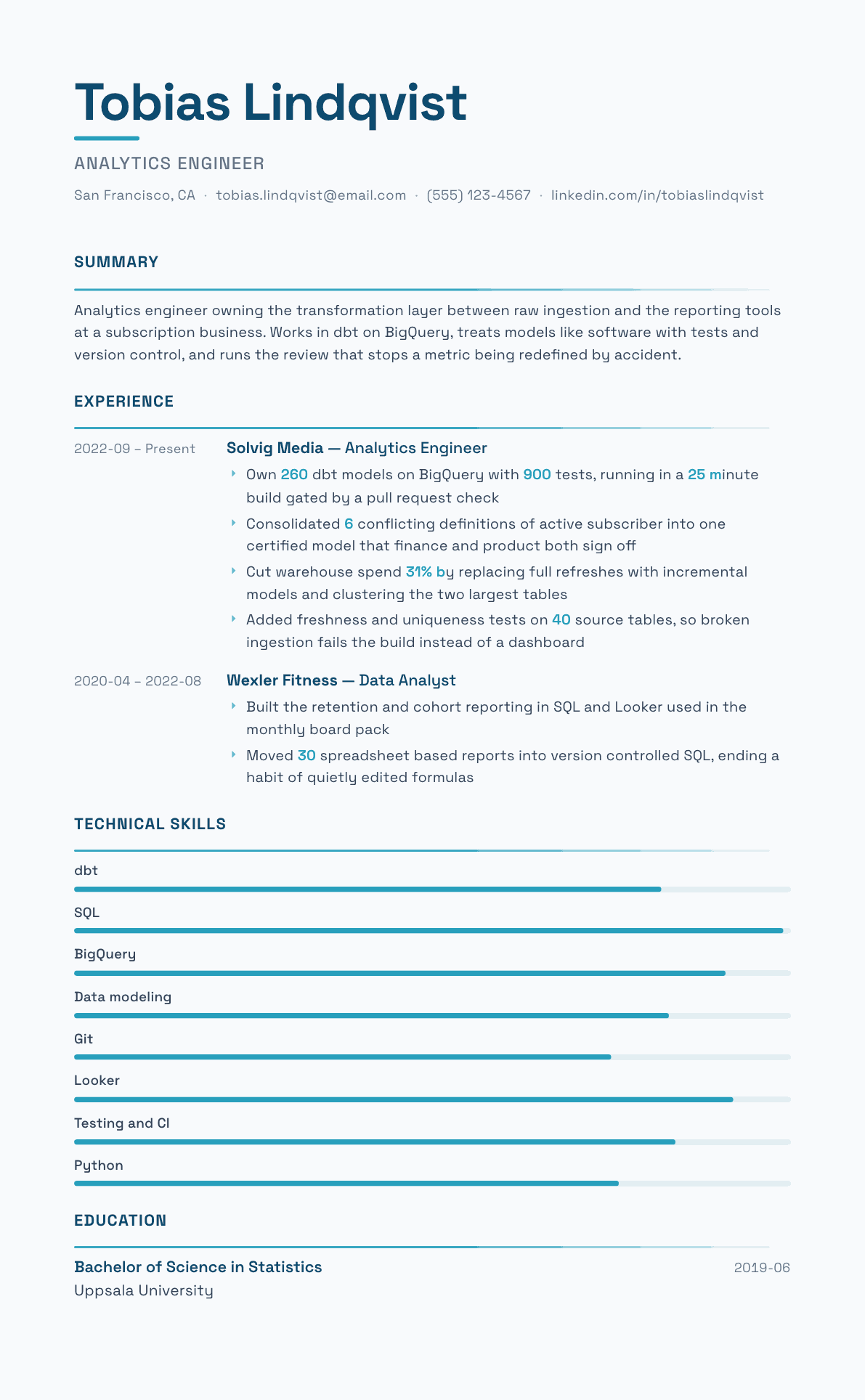
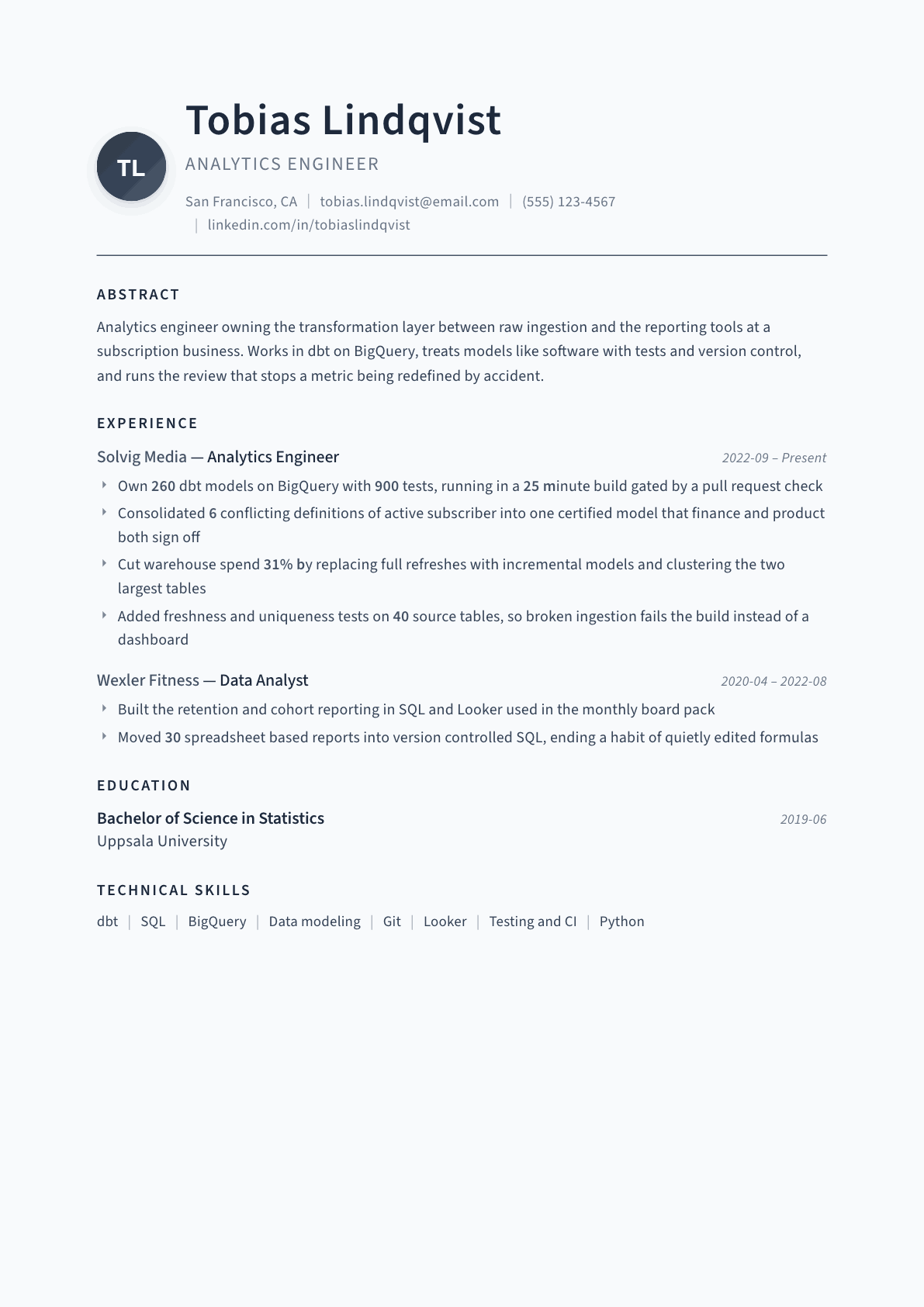
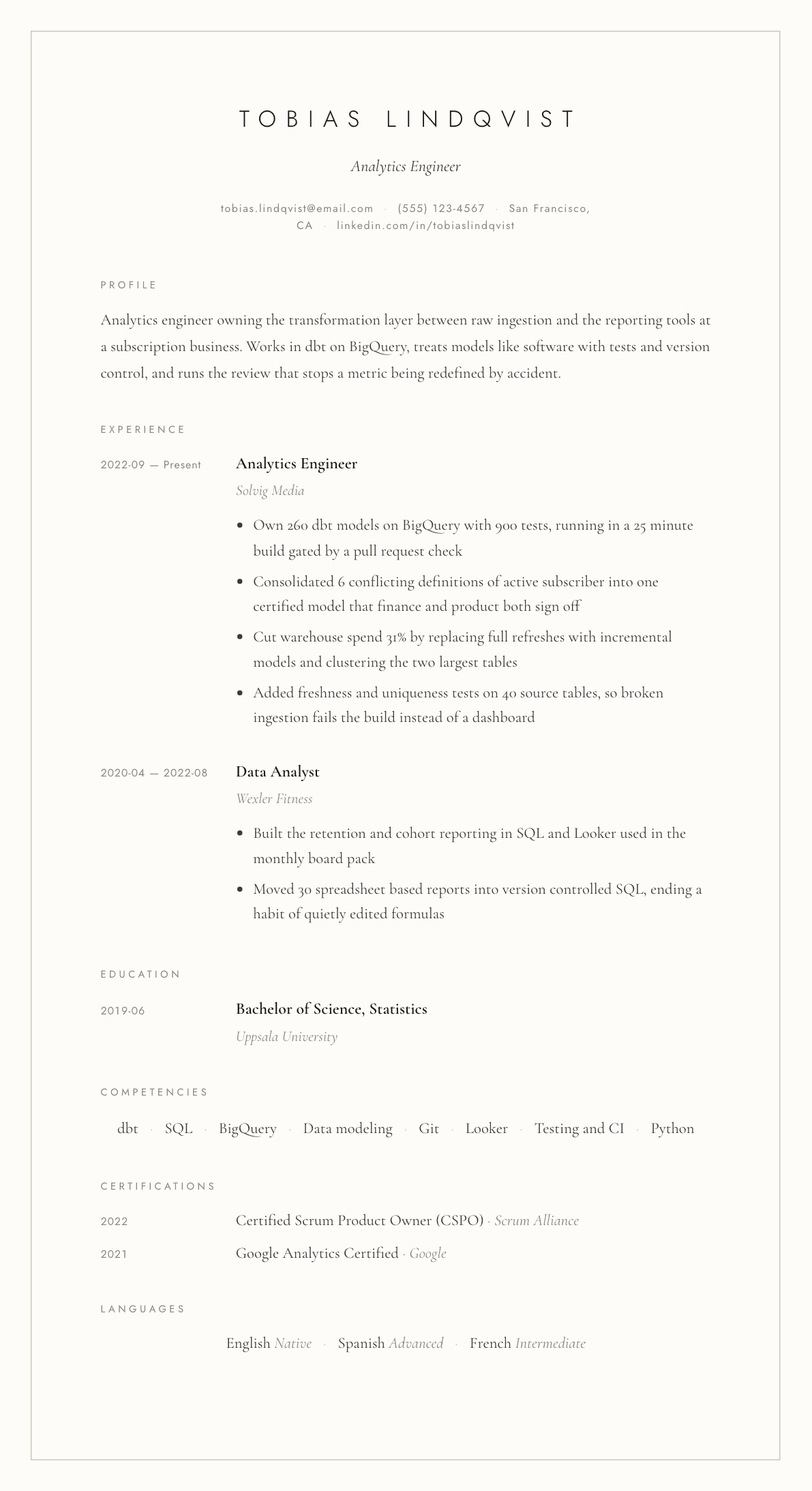
Example Analytics Engineer summary
Analytics engineer with five years turning raw ingested data into models the business trusts. Maintains a few hundred dbt models on BigQuery with tests running on every pull request, consolidated six competing definitions of an active subscriber into one certified model, and brought warehouse spend down by moving full refreshes to incremental builds. Treats data models as code with review and continuous integration.
Skills to list on a Analytics Engineer resume
- dbt
- SQL
- BigQuery
- Snowflake
- Dimensional modeling
- Git and pull requests
- Continuous integration
- Data testing
- Incremental models
- Looker
- Python
- Airflow
- Metric definition
- Warehouse cost tuning
What actually gets this resume read
- Show the size of the project you maintain: model count, test count, build time and how it is triggered.
- Prove software habits with version control, code review on models, continuous integration and staged environments.
- Describe one metric you standardized and who signed it off, since certified definitions are the core of the job.
- Include cost and runtime work, because warehouse spend is often the first thing a data lead is asked about.
- Separate analytics engineering from analysis: modeling and testing here, insight and reporting in a different bullet.
- Name the ingestion and reporting tools you sit between, so a reader can place you in a real data stack.
How to write a analytics engineer resume
Analytics engineer is a young title with a sharp definition. You sit between ingestion and reporting, you own the transformation layer, and you treat data models the way a software team treats code: version controlled, reviewed, tested and deployed through a pipeline. The hiring manager reading your resume is checking whether you actually work that way or whether you are an analyst who has heard of dbt.
The evidence she looks for is unglamorous. Test counts alongside model counts. A build that runs on a pull request and blocks the merge when it fails. A staging environment. One certified definition of a core metric that finance and product both accepted, with the argument that got them there. Those details are hard to fake and they separate this resume from a reporting one.
What follows covers how to size the project you maintain, how to show software practice without pretending to be a backend engineer, how to write about cost and runtime, and the questions analysts ask when they move into analytics engineering from either side.
Format: one to two pages with the stack stated plainly
Reverse chronological, one page under about five years. Put the stack under the summary in the order data flows: ingestion, warehouse, transformation, orchestration, reporting. Naming what sits on either side of you tells a reader instantly where your responsibility started and stopped, which is the most confusing thing about this role from the outside.
Give each role a project line before the bullets: model count, test count, build time, and how the build is triggered. That is the closest thing this job has to a scope statement.
- Header: name, city, phone, email, and a GitHub link if you have public modeling work.
- Order: summary, stack, experience with a project line, selected data projects, education, certifications.
- Keep any previous analyst roles, since domain knowledge is a genuine advantage in this job.
Summary: the layer you own and the trust you created
Three lines. Say which warehouse, which transformation framework, how large the project is, and one trust problem you solved. Trust is the currency here: a certified metric, a set of tests that catch broken ingestion before a dashboard does, or a documented model that ended a recurring argument about numbers.
If you came from analysis, keep one clause about the business domain you know. Analytics engineers who understand what the numbers mean are more useful than ones who only understand the pipeline, and hiring managers say so openly.
Experience: models are software, so write them that way
Show the engineering habits explicitly. Models in version control, changes through pull requests with a reviewer, a continuous integration job that builds and tests modified models, separate development and production targets, and a documented naming convention across staging, intermediate and mart layers. These are the details a hiring manager uses to tell a mature project from a folder of SQL files.
Give testing its own bullet. Uniqueness, not-null, relationship and freshness tests on sources, plus custom tests for business rules that matter. Then say what the tests caught, because a test suite that has never failed usefully is decoration.
Add the modeling substance: grain decisions, slowly changing dimensions, incremental strategies and the trade-off you took between a wide denormalized table and a strict star schema. That is the part an interviewer will push on hardest.
Metrics governance is the core of the job
The most valuable thing an analytics engineer produces is one agreed definition of the numbers a company argues about. Write it as a story: several conflicting definitions existed, you traced each to its source, you wrote the certified model, and named stakeholders signed it off. Say who signed, because agreement across finance and product is what makes the definition stick.
Mention documentation as a product, not an afterthought. Model descriptions, column definitions and a lineage view that a business user can open are all things a data team is measured on.
Cost, runtime and the keywords behind them
Warehouse spend is often the first question a data leader gets from finance, so a bullet about it lands well. Incremental models replacing full refreshes, clustering or partitioning on the largest tables, killing scheduled builds nobody used, and setting a warehouse size per job are all concrete and repeatable.
Postings use a narrow vocabulary: analytics engineering, dbt, data modeling, dimensional modeling, incremental models, data testing, continuous integration, semantic layer, data quality, and the warehouse name. Put those where they will be found and use the posting phrasing once inside a bullet where the work is shown.
Analytics Engineer resume summary examples
Moving over from analysis
Data analyst moving into analytics engineering, currently maintaining 60 dbt models on Snowflake with tests running in continuous integration. Moved 30 spreadsheet reports into version controlled SQL, and brings three years of commercial domain knowledge from a subscription business.
Three years in the role
Analytics engineer owning the transformation layer at a subscription business: 260 dbt models on BigQuery with 900 tests in a 25 minute build gated by a pull request check. Consolidated six conflicting definitions of active subscriber into one certified model that finance and product both sign off.
Lead analytics engineer
Lead analytics engineer setting modeling standards for three squads, mentoring four engineers and owning the semantic layer that every reporting tool reads from. Introduced staged environments and a review rule for model changes, and cut warehouse spend by a third with incremental builds and clustering.
Work experience bullets: before and after
Before: Built and maintained dbt models for the analytics team.
After: Own 260 dbt models on BigQuery with 900 tests, building in 25 minutes and gated by a pull request check so no model reaches production without a passing run and a reviewer.
Scale plus the gate proves the project is engineered rather than a collection of SQL files someone runs by hand.
Before: Standardized metric definitions across the business.
After: Traced six conflicting definitions of active subscriber back to their sources and replaced them with one certified model, signed off by both the finance controller and the product lead before release.
Naming the number of definitions and who agreed shows the political work that makes a metric actually stick.
Before: Reduced data warehouse costs.
After: Cut warehouse spend by 31% by replacing full refreshes with incremental models and clustering the two largest event tables, then set a monthly review so the saving did not drift back.
The technique and the follow-up review explain why the reduction held rather than being a one-off cleanup.
Before: Added tests to the data models.
After: Added freshness and uniqueness tests to 40 source tables so a broken ingestion fails the build instead of quietly reaching a dashboard, which caught two upstream outages before anyone reported a wrong number.
The failure mode prevented is more persuasive than the number of tests written.
Before: Moved reporting from spreadsheets into SQL.
After: Migrated 30 spreadsheet based reports into version controlled SQL models with documented column definitions, ending a habit of formulas being edited quietly between monthly cycles.
Naming the bad habit that ended shows the migration solved a trust problem, not only a tooling one.
Hard skills
- dbt
- SQL including window functions
- BigQuery and Snowflake
- Dimensional modeling
- Incremental model strategies
- Data testing and assertions
- Git and pull request review
- Continuous integration for data
- Airflow or another orchestrator
- Looker or another semantic layer
- Python for utilities
- Warehouse cost and query tuning
Soft skills
- Negotiating metric definitions
- Documentation discipline
- Reviewing other people models
- Translating business logic into rules
- Pushing back on one-off requests
Certifications worth listing
- dbt Analytics Engineering Certification (dbt Labs)
- SnowPro Core Certification (Snowflake)
- Google Cloud Professional Data Engineer (Google Cloud)
- Microsoft Certified: Azure Data Engineer Associate (Microsoft)
Mistakes that cost analytics engineer candidates the interview
- Listing dbt as a tool with no model count, test count or build detail, which reads as classroom exposure.
- Describing analysis findings instead of the transformation layer, which makes the resume look like an analyst one.
- Never mentioning version control, review or continuous integration, the three habits that define the role.
- Skipping the grain and incremental decisions, which is exactly where a technical interview will go.
- Claiming a cost saving without saying what changed in the models or the warehouse configuration.
- Leaving documentation and lineage off the page, when they are half of what makes a model trusted.
Analytics Engineer resume questions
What is the difference between an analytics engineer and a data engineer?
A data engineer owns ingestion, infrastructure and often streaming. An analytics engineer owns the transformation layer between raw data and reporting, working mostly in SQL with software practice around it. The overlap is real, so match your summary to whichever the posting describes.
Do I need dbt experience to be an analytics engineer?
Most postings ask for it, but the underlying skills are modeling, testing and version control. If you have done that work in another framework or in plain SQL with a build tool, say so explicitly and describe the equivalent mechanisms rather than leaving the reader to guess.
How do I show software engineering practice on a data resume?
Name the mechanisms: models in Git, changes through pull requests with a required reviewer, a continuous integration job that builds and tests modified models, separate development and production targets, and a release process. Those five details do more than any adjective.
Should an analytics engineer resume include dashboards?
Only briefly. One line showing you understand what the reporting layer needs from your models is useful. Beyond that, dashboards pull the page toward a reporting role and away from the transformation work these teams are hiring for.
How do I move from data analysis into analytics engineering?
Take one project and rebuild it properly: models in version control, tests, documentation and a scheduled build. Write that project as the top entry, keep your domain knowledge visible, and describe the metric definitions you have already had to defend with stakeholders.
Related resume examples
- Data Engineer Resume example
- Data Analyst Resume example
- Data Architect Resume example
- Business Intelligence Analyst Resume example
- Prompt Engineer Resume example
- Big Data Engineer Resume example