Big Data Engineer Resume Examples: the lines they read
Process Your Career with a Big Data Engineer Resume
By Mustafa Tarabya, founder of CVBooster · Published · Updated
Create an impactful big data engineer resume showcasing your expertise in distributed computing, data pipelines, and large-scale analytics platforms.
Sample resumes for a big data engineer
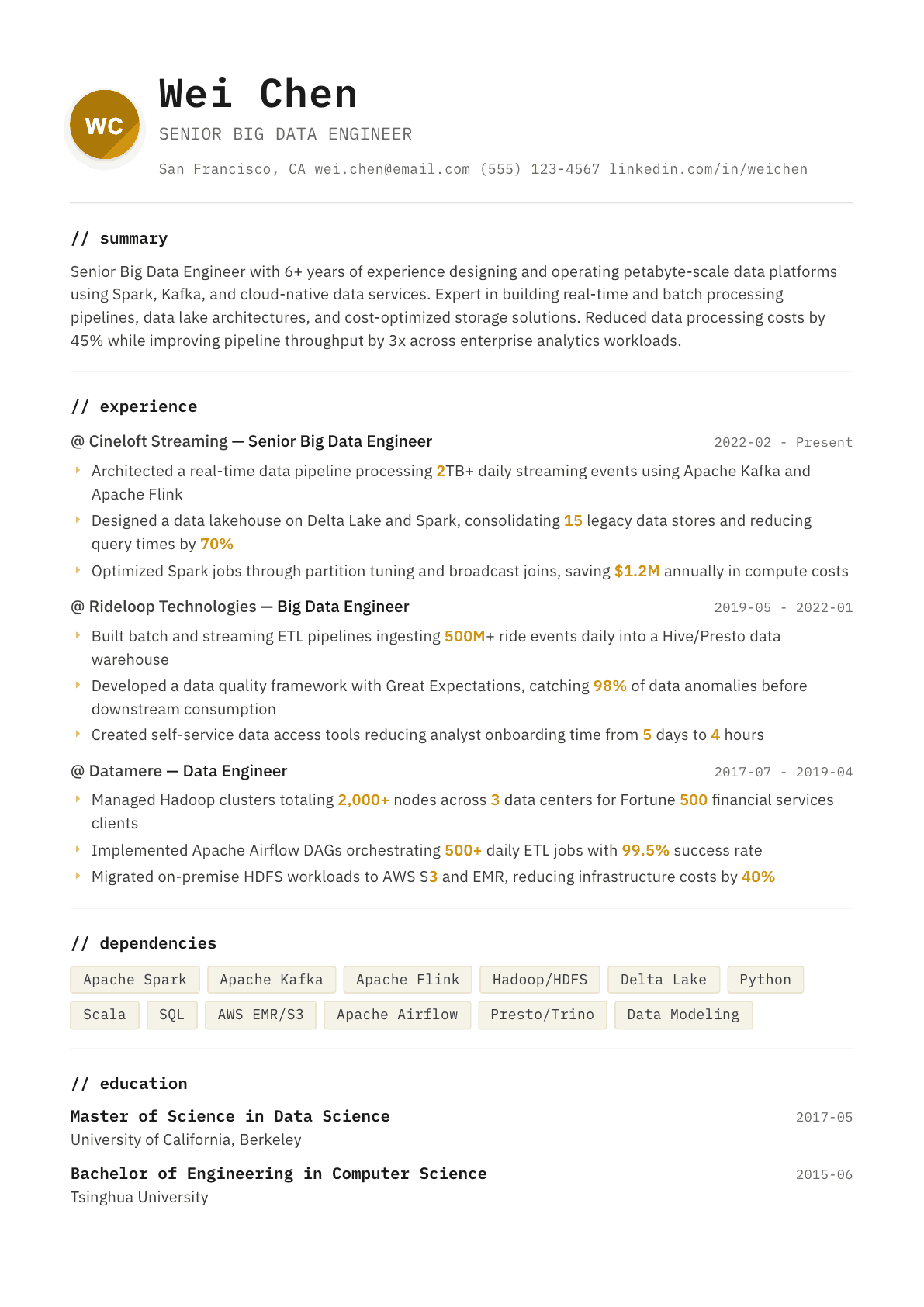
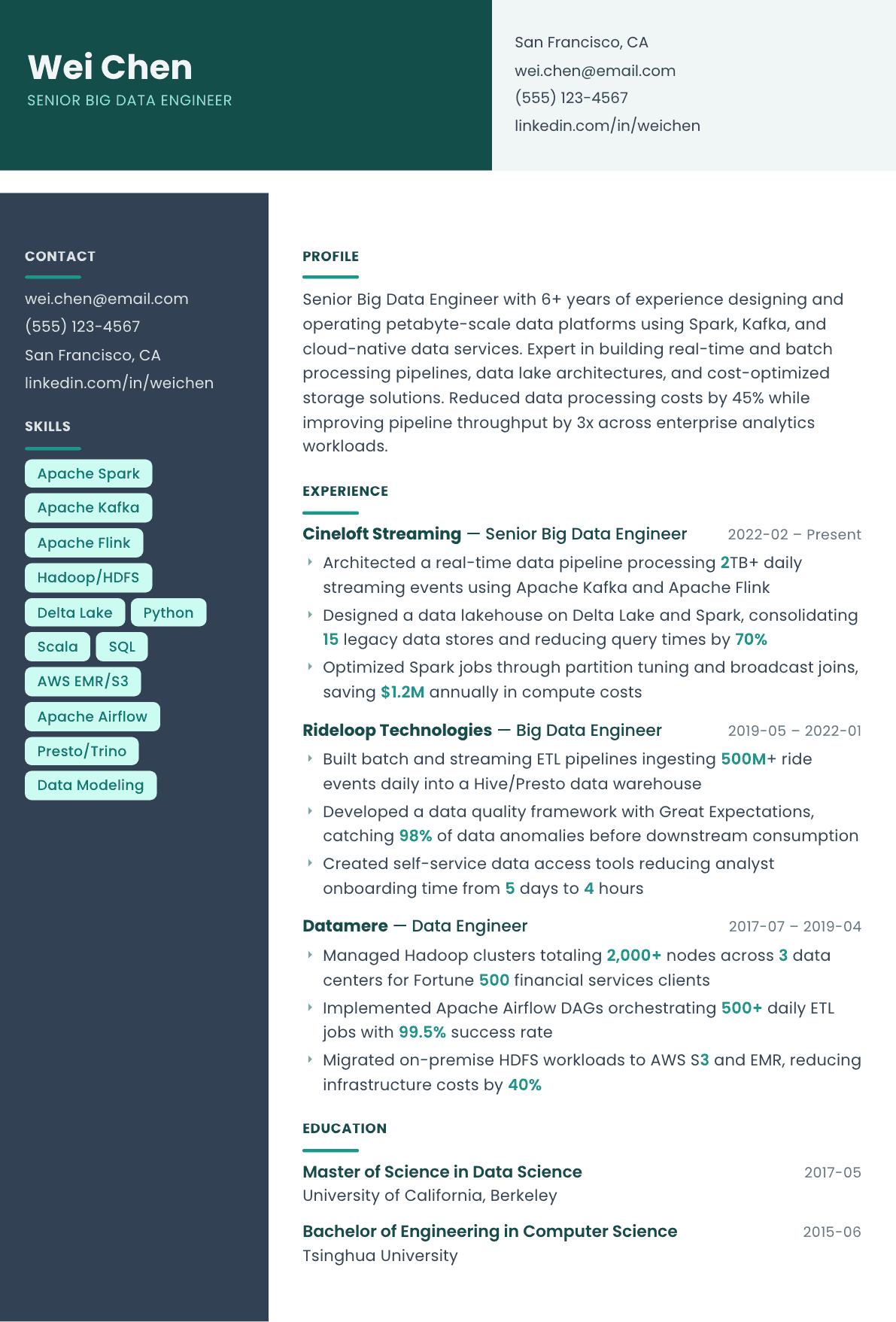
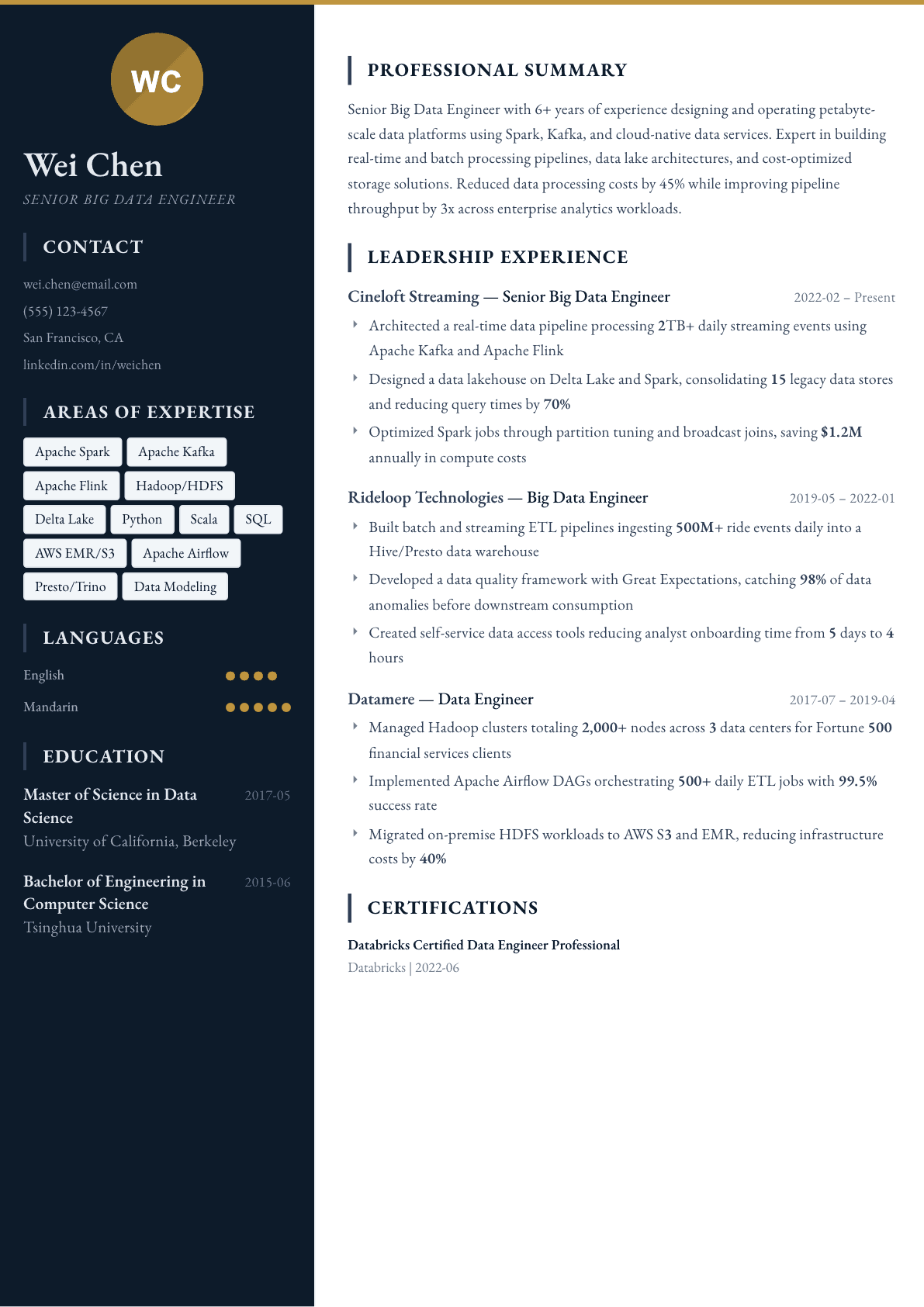
The same big data engineer content laid out in three CVBooster templates, so you can see what the finished document looks like before you write a word.
Example Big Data Engineer summary
Senior Big Data Engineer with 6 years of experience building petabyte-scale data platforms on Spark, Kafka, and cloud-native services. Designed real-time pipelines processing 2TB+ daily events and optimized Spark workloads saving $1.2M annually in compute costs. Expert in data lakehouse architectures, stream processing, and end-to-end data pipeline orchestration.
Skills to list on a Big Data Engineer resume
- Apache Spark
- Apache Kafka
- Apache Flink
- Hadoop/HDFS
- Delta Lake/Iceberg
- Python
- Scala
- SQL
- AWS/GCP Data Services
- Apache Airflow
- Presto/Trino
- Data Modeling
What actually gets this resume read
- Quantify data scale: terabytes processed, events per second, or number of daily pipeline runs.
- Specify big data technologies: Spark, Kafka, Flink, Hadoop, Delta Lake, Iceberg, or Hudi.
- Highlight cost optimization: compute savings, storage compression, or resource right-sizing wins.
- Include data quality and governance experience: Great Expectations, dbt tests, or data catalog tools.
- Show both batch and real-time processing expertise to demonstrate versatility.
How to write a big data engineer resume
Big data engineering resumes live or die on scale and cost. The engineer reading yours wants two numbers immediately: how much data moved through the pipelines you owned, and what that compute bill looked like before and after you touched it. A pipeline handling a few gigabytes a night and a pipeline absorbing terabytes of streaming events an hour are different disciplines wearing the same job title, and only the numbers separate them.
The second thing a data platform lead checks is whether you have operated pipelines rather than only written them. Skewed partitions, straggler tasks, small file problems, late-arriving events, schema drift from an upstream producer, a backfill that has to run without disturbing the daily job: these are the everyday realities of the role. A resume that never mentions one of them reads as someone who has built demo pipelines on clean data.
This guide covers the section order that works for a big data engineer, three summaries from junior pipeline developer to lead platform engineer, five rewritten bullets, and the questions data engineers ask when they need scale, cost and reliability to fit on the same two pages.
Format: platform block first, then pipelines with their volumes
One to two pages, reverse chronological, single column. Under the summary put a platform block in four lines: processing engines, storage and table formats, orchestration, and cloud services. Table format matters enough to be explicit, because Delta Lake, Apache Iceberg and Apache Hudi carry different operational behavior and teams hire against the one they run.
Then, inside each role, describe pipelines as named systems with volumes attached. Source, transformation engine, destination, cadence and daily volume. Four described pipelines beat a paragraph claiming end-to-end ownership of the data platform, because the reader can picture the first and cannot picture the second.
- Engines: Apache Spark, Apache Flink, and any Hadoop and MapReduce legacy you still support.
- Storage: object storage plus Delta Lake, Iceberg or Hudi, and the file format and compression.
- Orchestration: Apache Airflow, or the scheduler your employer runs, with DAG counts.
- Query and serving: Presto or Trino, a warehouse, and the consumers who depend on it.
Summary: volume, latency class, and the platform you built on
Say the data volume, whether the work is batch, streaming or both, and the cloud platform. Batch and streaming demand different instincts, and a hiring manager building a real-time system will screen out a candidate whose evidence is all nightly batch unless the streaming work is stated up front.
Add one cost or performance outcome. Cost control is a core expectation in this field because distributed compute spends money quickly, and an engineer who has reduced a cluster bill through partitioning, file compaction or instance choice is directly valuable in a way that is easy to state and easy to verify in an interview.
Experience: throughput, tuning, and the failures you handled
Quantify every pipeline: events per second or terabytes per day, the number of scheduled jobs you own, the service level you hold for data freshness, and the number of downstream consumers. Freshness commitments are particularly persuasive, because promising that a table lands by a given hour every day means you have handled retries, upstream lateness and backfills.
Spark tuning bullets should name the actual problem. Partition skew fixed by salting a join key, a broadcast join replacing a shuffle, file compaction ending a small file explosion, memory configuration corrected after repeated executor loss, or a caching decision that removed a repeated read. Generic optimization claims are ignored; a named pathology and its fix is remembered.
Streaming work needs its own treatment: windowing strategy, watermarks and how late events are handled, checkpointing and exactly-once or at-least-once semantics, consumer lag monitoring, and what your job does when the upstream topic floods after an outage. This is where a streaming engineer is separated from a batch engineer who has read the documentation.
Data quality, governance and the lakehouse layer
Data quality is now part of the job rather than an extra. Describe the checks you run and where they sit: row count and freshness assertions, schema contracts with upstream producers, null and range expectations, reconciliation against a source of truth, and what happens when a check fails. A pipeline that fails loudly instead of publishing wrong numbers is the mark of a mature engineer.
Governance and modeling close the section. Table layout and partitioning strategy, retention and compaction policies, lineage and catalog registration, access control on sensitive columns, and the modeling approach used in the serving layer. These are the parts of the platform a lead will ask you about when deciding whether you can own the lakehouse rather than only feed it.
- Quality tooling: the assertion framework used and the number of critical tables covered.
- Contracts: how schema changes from producers are detected before they break a job.
- Backfill: how a historical reprocess runs without disturbing the daily schedule.
- Access: column-level controls and how sensitive fields are masked or tokenized.
Cost engineering and the keywords a platform team searches
Write cost work as a mechanism plus a result. Right-sized clusters, spot or preemptible capacity with checkpointed recovery, autoscaling bounds, storage tiering, compression and file format changes, and query pruning through better partitioning are all concrete. Report the effect as a proportion of the previous spend rather than as an absolute figure, which keeps it defensible.
For search terms, use the vocabulary these postings share: Apache Spark, Kafka, Flink, Hadoop, Delta Lake, Airflow, ETL and ELT, data lake and lakehouse, data warehouse, distributed computing and data modeling. Attach each to a pipeline you built so the human read confirms what the automated match found.
Big Data Engineer resume summary examples
Junior data engineer
Data engineer with 2 years building batch pipelines in Spark and Python on cloud object storage. Owns 20 Airflow DAGs feeding an analytics warehouse, added freshness and row count checks across the ten most-used tables, and cut one nightly job runtime by half through partition pruning.
Six years in
Senior Big Data Engineer with 6 years building petabyte-scale platforms on Spark, Kafka and cloud-native services. Designed a real-time pipeline processing over 2 terabytes of daily streaming events, consolidated 15 legacy stores into a Delta Lake architecture, and reduced processing cost by 45%.
Lead platform engineer
Lead big data engineer with 11 years across streaming and batch platforms, owning the lakehouse for an analytics organization of 200 users. Sets partitioning, retention and quality standards, runs the Airflow and Spark platform, and mentors four engineers through design and on-call reviews.
Work experience bullets: before and after
Before: Built data pipelines using Spark and Airflow.
After: Built and operated 60 Airflow DAGs running Spark jobs that landed 3 terabytes a day into a Delta Lake warehouse, holding a freshness commitment of 6 a.m. for the 12 tables the finance team reported from.
Job count, daily volume and a freshness commitment show a pipeline that is operated rather than merely written.
Before: Worked on real-time data processing.
After: Architected a streaming pipeline on Kafka and Flink processing over 2 terabytes of daily events, using event-time windows with watermarks for late arrivals and checkpointed state so a broker failure resumed without duplicate output.
Windowing, watermarks and checkpoint recovery are the details that prove genuine streaming experience.
Before: Optimized Spark jobs to run faster.
After: Cut a daily aggregation job from 4 hours to 40 minutes by salting a skewed join key, switching a large dimension to a broadcast join, and compacting an input directory that had accumulated thousands of small files.
Naming the three pathologies and their fixes shows tuning expertise instead of a generic optimization claim.
Before: Reduced cloud data processing costs.
After: Cut cluster spend by 45% by moving batch workloads to preemptible instances with checkpointed recovery, right-sizing executor memory from real usage, and repartitioning three large tables so queries pruned most of the scan.
Three named mechanisms make a cost reduction attributable and repeatable rather than a lucky infrastructure change.
Before: Improved data quality across the platform.
After: Added assertion tests covering freshness, row counts and null rates on 40 critical tables, wired failures to halt downstream DAGs instead of publishing, and cut analyst-reported data incidents to near zero over two quarters.
The coverage, the failure behavior and the sustained outcome show a quality system rather than a set of checks.
Hard skills
- Apache Spark (batch and structured streaming)
- Apache Kafka
- Apache Flink
- Hadoop and HDFS
- Delta Lake, Iceberg and Hudi
- Apache Airflow orchestration
- Python and Scala
- Advanced SQL and query tuning
- Presto and Trino
- Cloud data services on AWS and GCP
- Dimensional and data vault modeling
- Data quality testing frameworks
- Partitioning, compaction and file layout
- Cost optimization for distributed compute
Soft skills
- Working with analysts and scientists
- Incident ownership
- Documentation of lineage
- Tradeoff reasoning on cost versus latency
- Upstream negotiation on schemas
- Mentoring
Certifications worth listing
- Databricks Certified Data Engineer Professional (Databricks)
- AWS Certified Data Engineer, Associate (Amazon Web Services)
- Google Cloud Professional Data Engineer (Google Cloud)
- Microsoft Certified: Azure Data Engineer Associate (Microsoft)
- Confluent Certified Developer for Apache Kafka (Confluent)
Mistakes that cost big data engineer candidates the interview
- Describing pipelines with no data volume, so the reader cannot tell a nightly extract from a high-throughput stream.
- Claiming Spark optimization without naming the pathology, such as skew, small files or executor memory pressure.
- Leaving cost out entirely, when compute spend is one of the main things a data platform lead is judged on.
- Listing both batch and streaming without evidence for the streaming half, which is easy to test in an interview.
- Ignoring data quality and schema contracts, which are the failures that actually reach the business.
- Naming a lakehouse table format without saying what you did with compaction, retention or partitioning.
Big Data Engineer resume questions
What is the difference between a data engineer and a big data engineer resume?
Scale and distributed systems detail. The big data file has to prove throughput, cluster tuning and cost control on engines such as Spark and Flink, while a general data engineering file can rest more on warehouse modeling and transformation tooling.
How do I quantify data volume honestly?
Use the measure your monitoring actually reported: terabytes landed per day, events per second at peak, rows processed per run, or table sizes. Give the peak and the typical figure when they differ widely, since a peak-only number invites a challenge.
Should I include cost savings figures?
Yes, expressed as a proportion of prior spend along with the mechanism that produced it. Proportions travel better than absolute amounts across employers of different sizes, and the mechanism is what convinces an interviewer the saving was engineering rather than a pricing change.
How much SQL detail belongs on a big data engineer resume?
Enough to show tuning depth rather than familiarity. Mention window functions, execution plan analysis, partition pruning and the query engine you tune against. SQL screens are common in this field, so anything you list should survive a live exercise.
Do I need both batch and streaming experience?
Not always, but claiming both without evidence is risky. If your streaming work is limited, say so and describe it accurately, such as consuming from Kafka into micro-batch jobs. Precision there reads better than an overstated claim an interviewer unpicks in ten minutes.
Related resume examples
- Data Engineer Resume example
- Platform Engineer Resume example
- Cloud Security Engineer Resume example
- ETL Developer Resume example
- Analytics Engineer Resume example
- Machine Learning Engineer Resume example