Prompt Engineer Resume Examples: the lines they read
Write a Prompt Engineer Resume That Proves Model Judgment
By Mustafa Tarabya, founder of CVBooster · Published · Updated
A prompt engineer resume built around evaluation sets, retrieval pipelines and model routing, with a sample resume and a full writing guide.
Sample resumes for a prompt engineer
The same prompt engineer content laid out in three CVBooster templates, so you can see what the finished document looks like before you write a word.
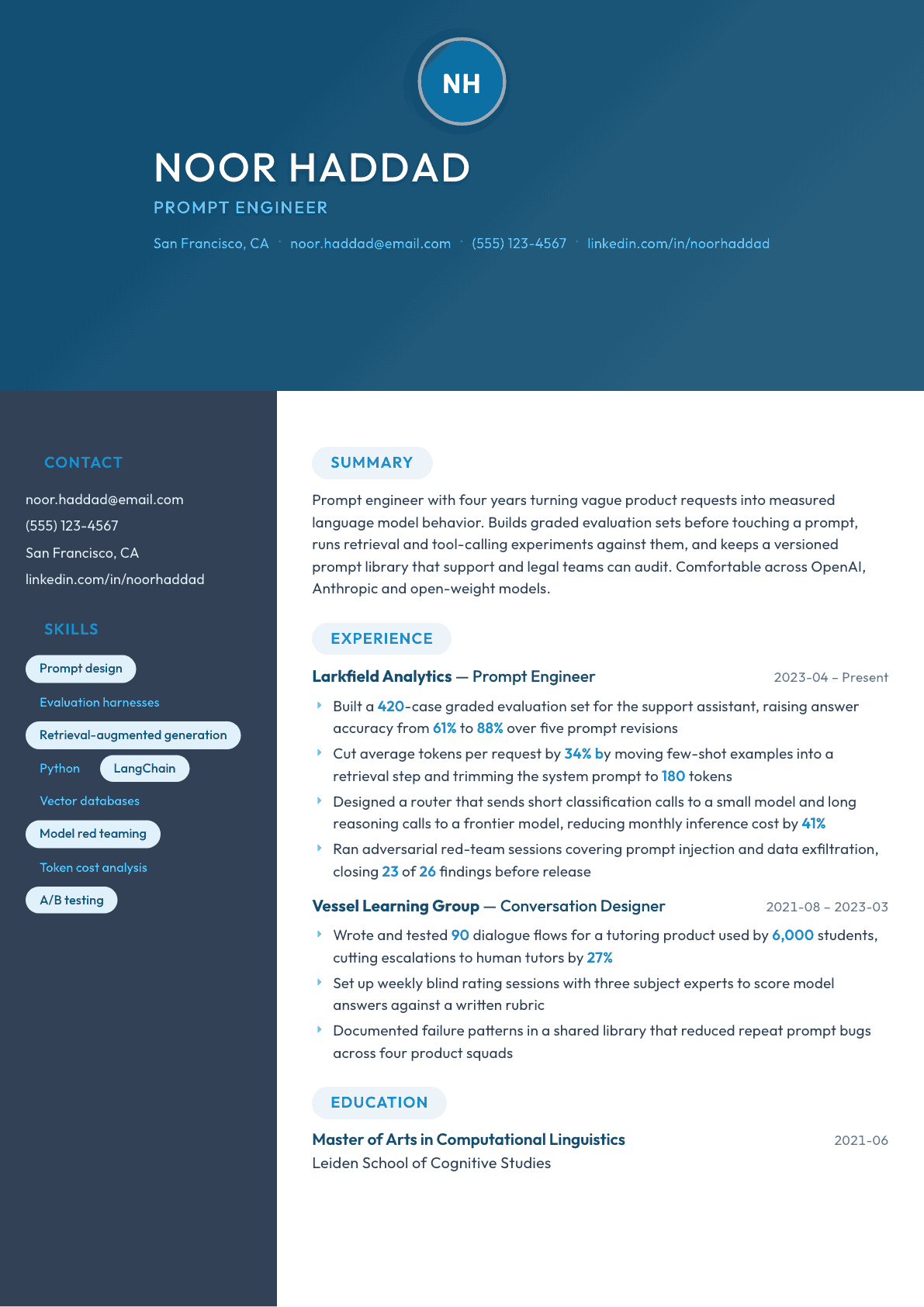
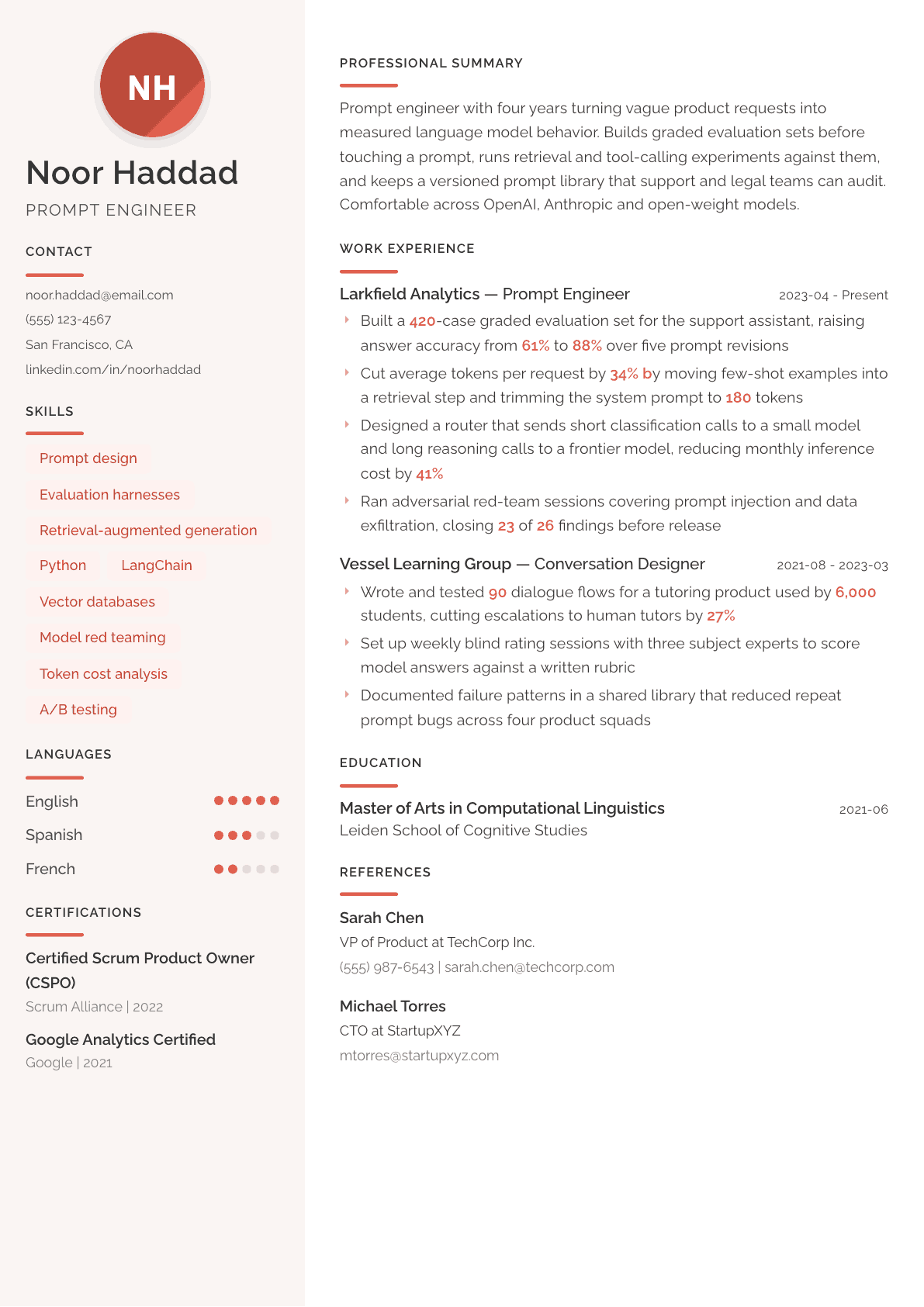
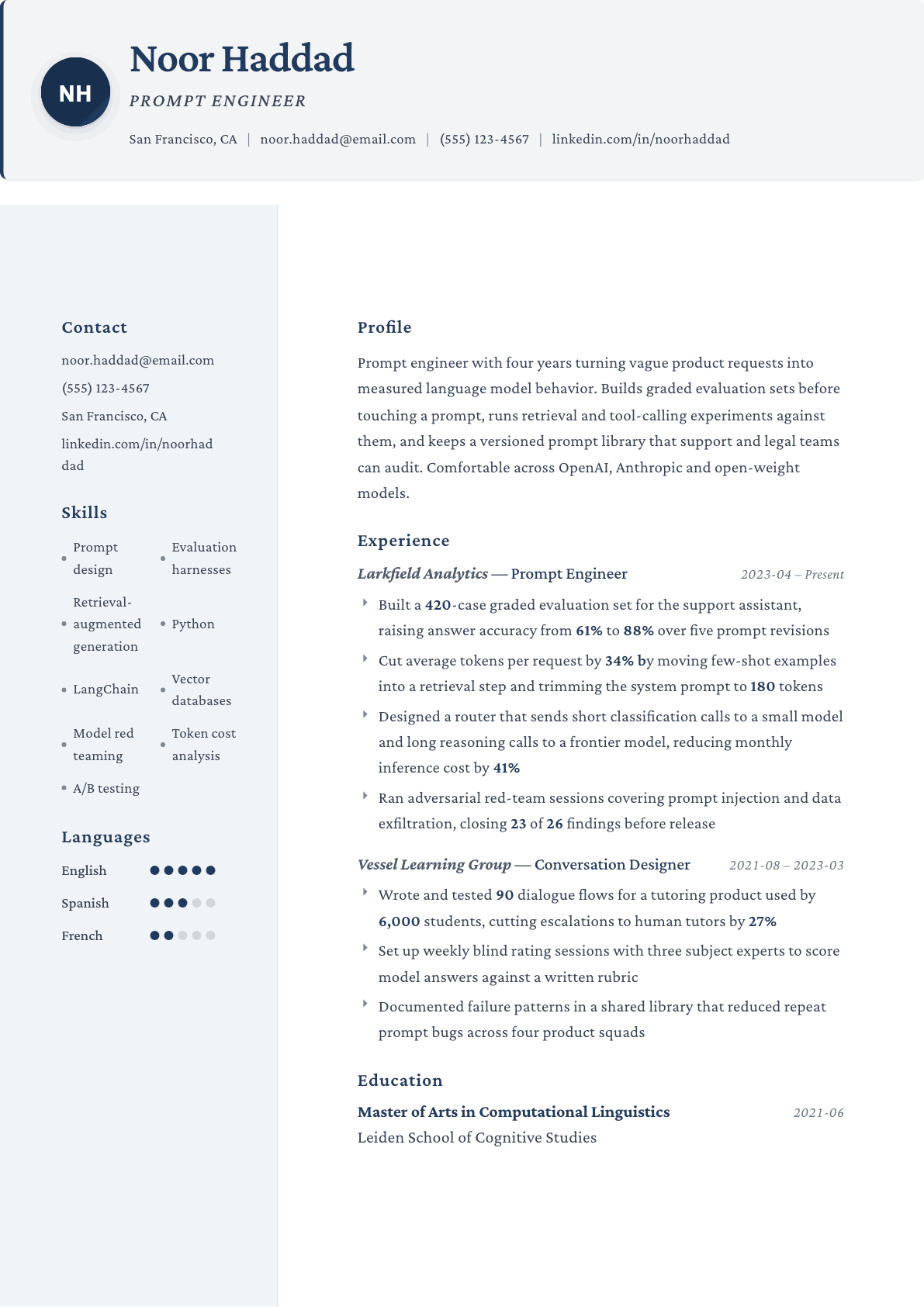
Example Prompt Engineer summary
Prompt engineer with four years of experience making language model behavior measurable. Builds graded evaluation sets first, then iterates on system prompts, retrieval and tool definitions against them. Raised support assistant accuracy from 61% to 88% while cutting tokens per request by a third. Experienced with adversarial testing for prompt injection and with routing traffic across small and frontier models to control cost.
Skills to list on a Prompt Engineer resume
- Prompt design
- Evaluation set construction
- Retrieval-augmented generation
- Embeddings and vector search
- Python
- LangChain
- Function and tool calling
- Fine-tuning and adapters
- Model red teaming
- Guardrails and output filtering
- Token and cost optimization
- A/B testing
- Annotation rubrics
- Prompt versioning
What actually gets this resume read
- Lead with the evaluation set you built, not the prompts you wrote, because measurement is what separates this role from casual chat use.
- Name the models and providers you have worked against, including open-weight ones, so recruiters can match your experience to their stack.
- Give every accuracy claim a baseline and a test set size, otherwise a hiring manager cannot tell a real gain from noise.
- Show retrieval work explicitly: chunking strategy, embedding model, reranking and how you measured grounding of the final answer.
- Include one bullet on safety work such as injection testing, refusal tuning or output filtering, since most teams now screen for it.
- Mention the cost and latency side of the job, because prompt choices decide the inference bill as much as they decide quality.
How to write a prompt engineer resume
The person screening a prompt engineer resume is usually an applied science lead or a product engineering manager who has already watched a demo fall apart in production. They are not impressed by a list of clever prompts. They want to see that you can define what correct means for a task, build a test set that measures it, and then change the system until the number moves.
That is why the strongest resumes in this field read more like a measurement resume than a writing one. Evaluation sets, rubrics, annotation agreement, retrieval quality, latency and cost per request are the currency. The prompt itself is the cheapest artifact you produce.
This guide covers the section order that suits the role, three example summaries at different career stages, before and after bullets that show the difference between describing prompts and describing outcomes, and the questions candidates ask most when they move into this job from writing, support or data work.
Format: one page, with an evaluation line high on the page
Use reverse-chronological order and keep the file to one page unless you have more than eight years of related experience. The role is new enough that many candidates arrive from adjacent backgrounds, so the top third of the page has to answer one question fast: has this person shipped a language model feature that real users touched?
Put a short technical block near the top listing model providers, frameworks, evaluation tooling and languages. Recruiters filter on provider names before they read a sentence.
- Header: name, title, city, email, and a link to a public evaluation repository or write-up if you have one.
- Order: summary, technical stack, experience, projects, education, certifications.
- Career changers move a projects section above experience and describe each project as a measured system, not a demo.
Summary: the domain, the models, and what you measured
Three lines. Name the product domain you worked in, the model families you have used in production, and the metric you moved. A prompt engineer who says they are creative and detail oriented has said nothing that separates them from the other applicants in the folder.
If you are moving in from linguistics, technical writing, support or analytics, name the transferable part directly. Building annotation rubrics, running blind rating sessions and analyzing failure patterns are all part of this job, and saying so is more persuasive than hiding the previous title.
Experience: evaluation first, prompts second
Open each role with the system you worked on and its traffic: an assistant handling support conversations, a document extraction pipeline, an agent calling internal tools. Then give the evaluation set. Its size, how the cases were graded, and who graded them tells a reader whether your accuracy claims mean anything.
The middle bullets should carry the engineering: retrieval design, chunking and reranking choices, tool and function definitions, structured output enforcement, model routing, caching. The last bullet should cover safety or cost, because both are now standard parts of the role.
Avoid bullets that only describe the act of prompting. Wrote prompts for the chatbot is invisible next to a bullet that names the baseline, the test set and the improvement.
- Name the model families and versions loosely, for example a frontier model and a small local model, and say why each was chosen.
- Give retrieval work its own bullet: embedding model, chunk strategy, reranker, and how grounding was checked.
- Include one bullet on adversarial testing such as injection attempts, jailbreak patterns or data leakage checks.
Skills: split the list so a reader can scan it
Group the technical block into model work, retrieval and data, evaluation, and engineering. A single run-on list of buzzwords slows the reader and hides what you are strongest at. Put Python first among languages, because almost every evaluation harness in this field is written in it.
Include the evaluation and tracing tools you have actually used. Naming a tracing platform tells an experienced reader that you have debugged a multi-step chain in production rather than in a notebook.
Keywords the screening filter is looking for
Postings for this role reuse a small vocabulary: retrieval augmented generation, evaluation, fine-tuning, function calling, embeddings, guardrails, latency, token cost, human in the loop. Mirror the exact wording of the posting once in your technical block and once inside a bullet where it is backed by something concrete. A keyword that appears only in a list reads as a claim rather than as experience.
Prompt Engineer resume summary examples
First role in the field
Linguistics graduate moving into applied language model work, with a personal project that grades a question answering pipeline against a 200-case hand-labeled set. Built the retrieval layer in Python with an open embedding model and documented every failure category. Looking for a first prompt engineering role on a product team.
Three years in
Prompt engineer with three years on a customer support assistant serving around 8,000 conversations a week. Built the graded evaluation set the team now uses for every release, raised answer accuracy from 64% to 86%, and cut tokens per request by a third by moving examples into retrieval.
Lead
Applied language model lead with seven years across search and support products. Owns the evaluation platform, the prompt library and the routing policy that splits traffic between a small model and a frontier model, holding quality steady while cutting inference cost by 40%. Mentors four engineers and runs quarterly red-team exercises.
Work experience bullets: before and after
Before: Wrote and improved prompts for the company chatbot.
After: Rewrote the support assistant system prompt and few-shot set against a 320-case graded evaluation, lifting answer accuracy from 64% to 86% across three releases.
The rewrite is only credible when the reader can see the test set, the baseline and the result.
Before: Used RAG to give the model company knowledge.
After: Rebuilt the retrieval layer with 400-token overlapping chunks, a cross-encoder reranker and citation checks, raising grounded-answer rate from 71% to 93% on the held-out set.
Naming the chunking, the reranker and the grounding metric shows retrieval engineering rather than a library import.
Before: Reduced costs by optimizing prompts.
After: Cut inference cost 41% by routing classification calls to a small model, caching stable system context, and trimming the base prompt from 900 to 180 tokens.
Three named mechanisms turn a savings claim into something a hiring manager can picture and repeat.
Before: Tested the model for safety issues.
After: Ran structured red-team sessions covering prompt injection, tool misuse and data exfiltration, filing 26 findings and closing 23 with input filters and stricter tool scopes.
Attack categories, finding counts and the fixes applied replace a vague safety claim with a record.
Before: Worked with subject matter experts on quality.
After: Ran weekly blind rating sessions with three clinical reviewers against a written rubric, reaching high inter-rater agreement before any prompt change was accepted.
The process detail proves the quality bar was defined by people other than the person writing the prompts.
Hard skills
- Prompt and system message design
- Evaluation set construction
- Rubric and annotation design
- Retrieval augmented generation
- Embeddings and vector search
- Reranking
- Function and tool calling
- Structured output enforcement
- Fine-tuning and adapters
- Model red teaming
- Guardrails and content filtering
- Python
- Token and latency analysis
- A/B testing
Soft skills
- Problem decomposition
- Writing clear specifications
- Working with domain experts
- Skeptical reading of results
- Explaining model limits to product teams
- Documentation discipline
Certifications worth listing
- Microsoft Certified: Azure AI Engineer Associate (Microsoft)
- Professional Machine Learning Engineer (Google Cloud)
- AWS Certified Machine Learning Engineer, Associate (Amazon Web Services)
Mistakes that cost prompt engineer candidates the interview
- Listing prompt techniques by name without a single measured result attached to any of them.
- Claiming an accuracy improvement with no baseline, no test set size and no description of how cases were graded.
- Filling the page with model provider logos and framework names while never describing a system that served real traffic.
- Leaving out cost and latency, which are the two constraints that decide whether a feature stays in production.
- Ignoring safety work entirely, so the reader assumes you have never handled an injection attempt or a leaked instruction.
- Pasting long prompt excerpts into the resume instead of the outcome those prompts produced.
Prompt Engineer resume questions
Do I need a machine learning degree to be a prompt engineer?
No. Teams hire from linguistics, support engineering, technical writing, analytics and software backgrounds. What they check is whether you can define a quality bar, build a test set, read the failures honestly, and write enough Python to run an evaluation loop without help.
Should I list specific model names on my resume?
Yes, but describe families and roles rather than exact version strings that age quickly. Say you ran a frontier model for reasoning and a small open-weight model for classification, and note the providers you have production experience with, since recruiters filter on those names.
How do I show prompt engineering work if my projects are private?
Describe the shape of the system and the measurement without exposing content: task type, traffic volume, evaluation set size, grading method and the metric change. If you need public proof, build one small evaluation harness on open data and publish the methodology.
Is a portfolio of prompts worth including?
A raw prompt collection adds little, because prompts are cheap and context dependent. A short public write-up that shows a task, an evaluation set, a set of failed attempts and the version that worked is far more persuasive and takes a reviewer two minutes to read.
What separates a mid-level prompt engineer from a senior one on paper?
Scope and ownership. A mid-level resume improves one feature against an existing evaluation set. A senior resume owns the evaluation platform, the routing and cost policy across several features, sets the safety review process, and shows other engineers using the tooling that person built.
Related resume examples
- Machine Learning Engineer Resume example
- NLP Engineer Resume example
- AI Engineer Resume example
- MLOps Engineer Resume example
- Analytics Engineer Resume example
- Cloud Engineer Resume example