Angular Developer Resume Examples: the lines they read
Write an Angular Developer Resume For Enterprise Front Ends
By Mustafa Tarabya, founder of CVBooster · Published · Updated
An Angular developer resume with RxJS and NgRx examples, upgrade experience keywords, sample bullets and a section by section writing guide.
Sample resumes for a angular developer
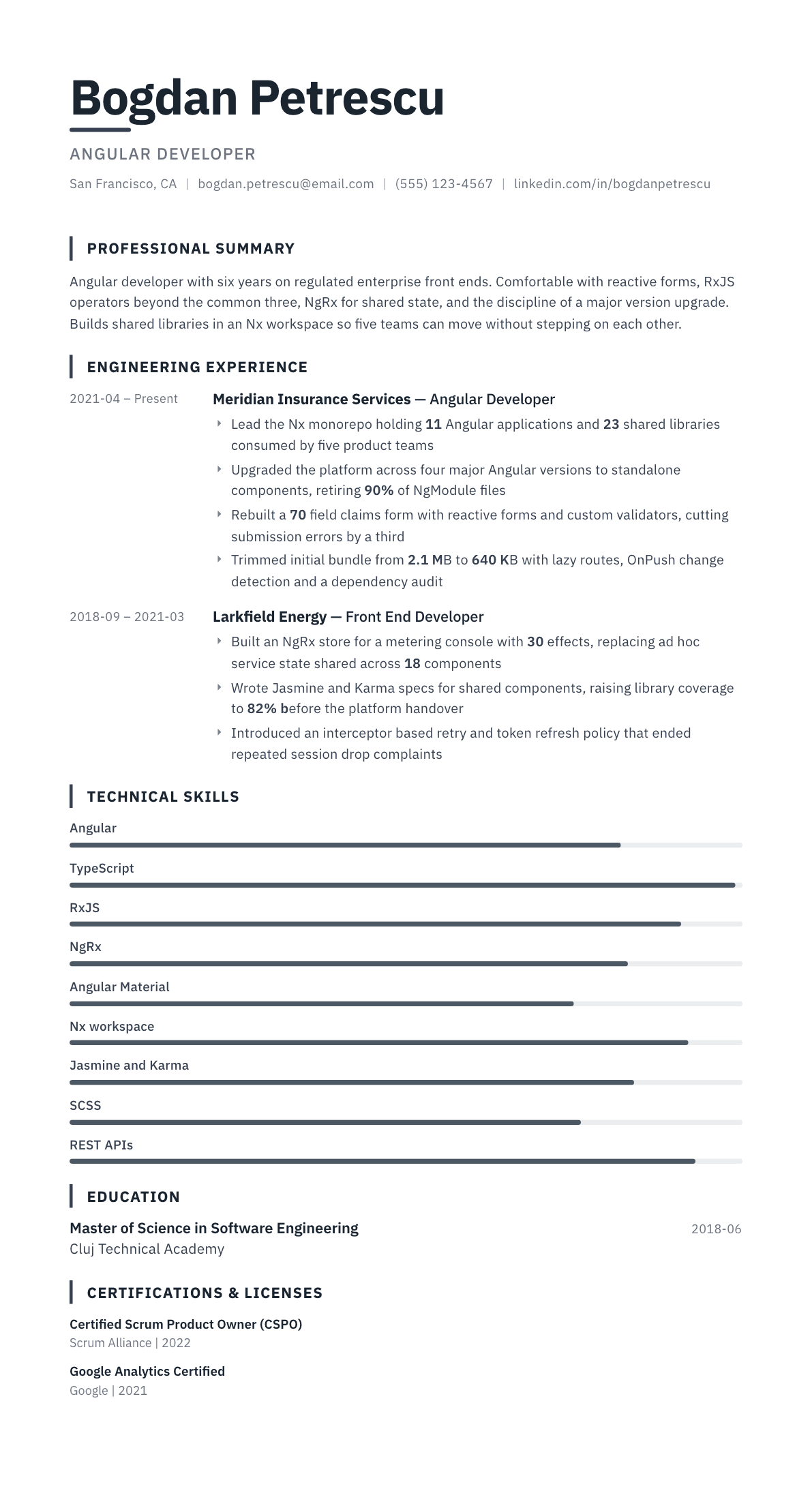
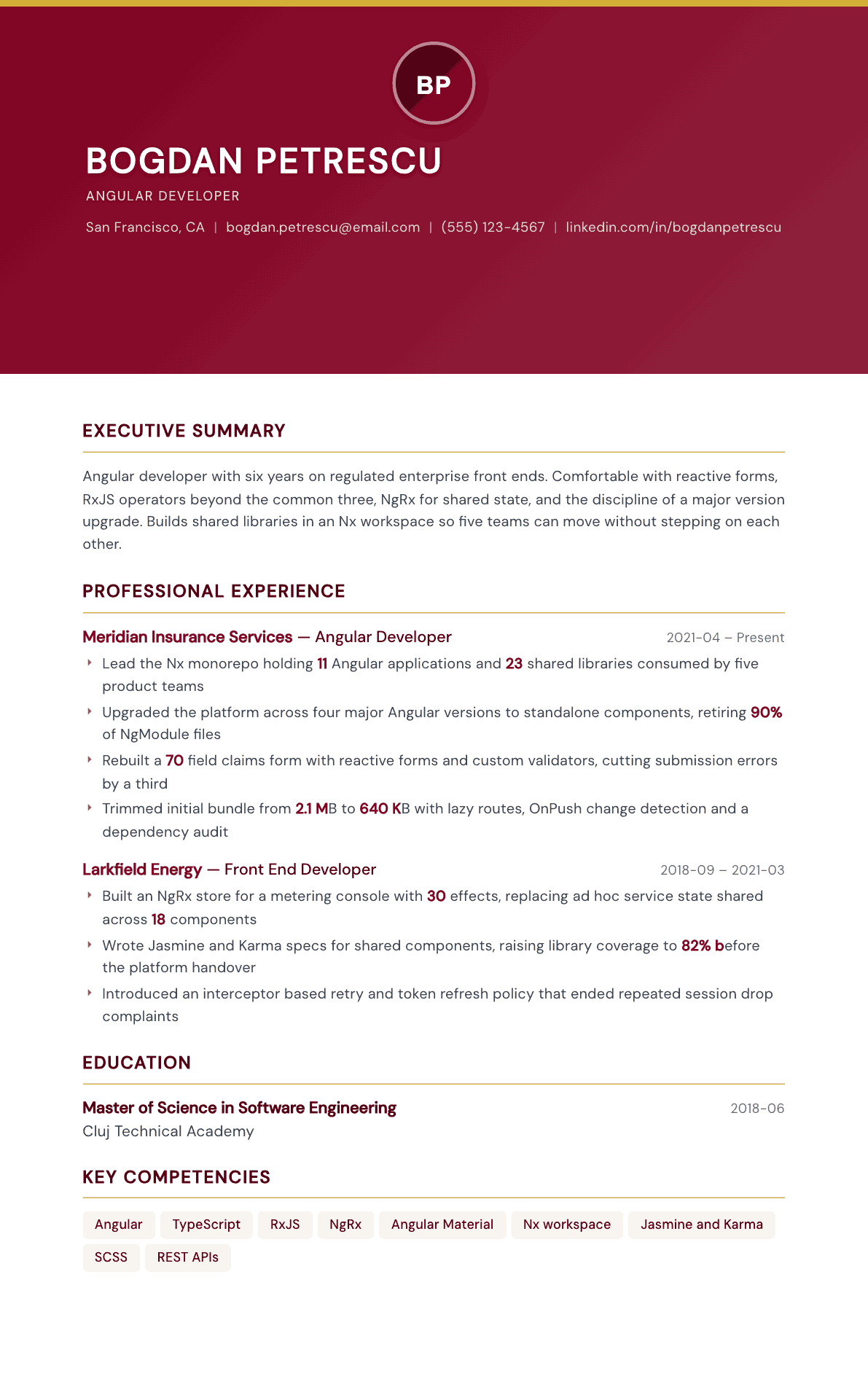
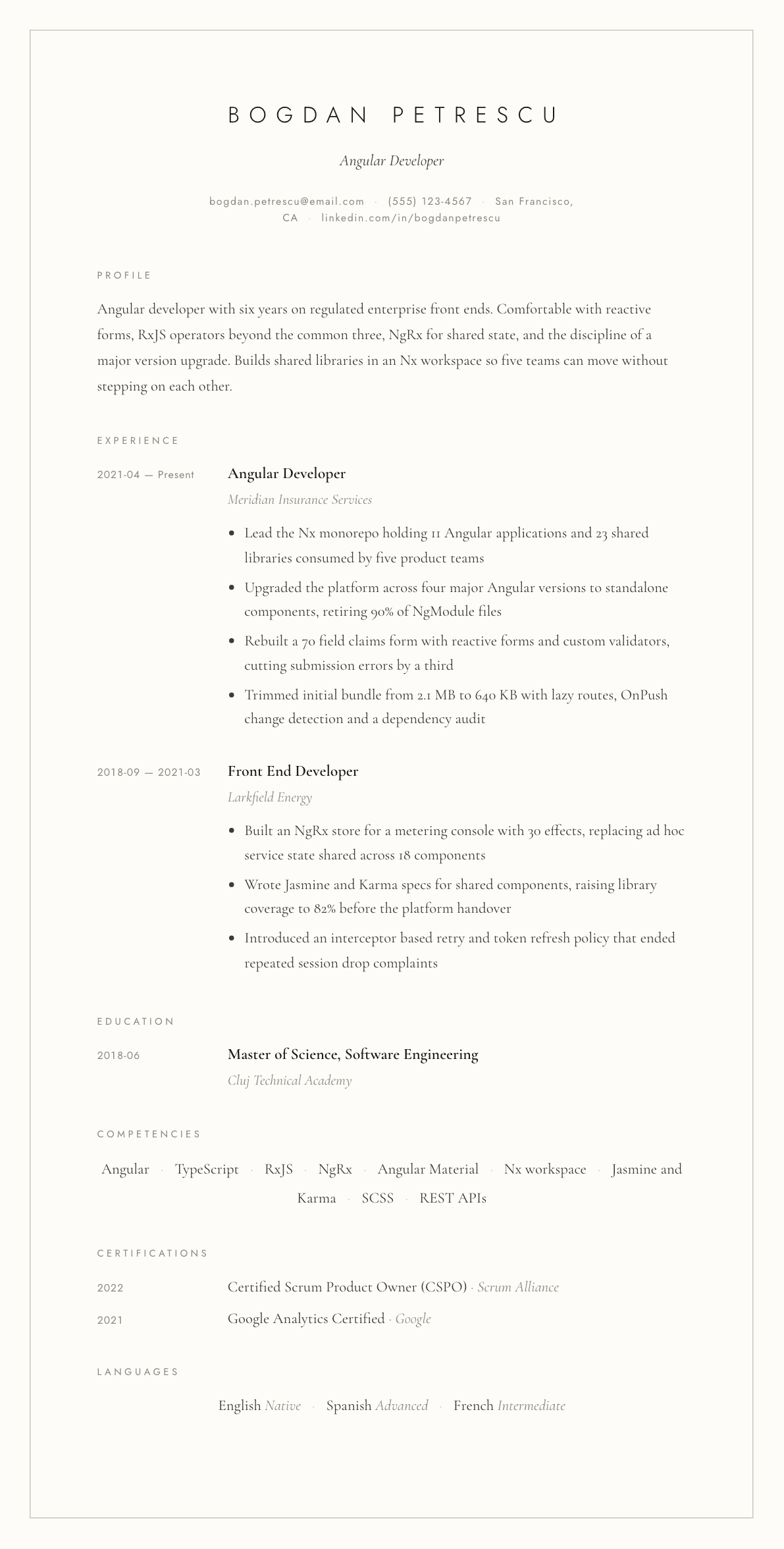
The same angular developer content laid out in three CVBooster templates, so you can see what the finished document looks like before you write a word.
Example Angular Developer summary
Angular developer with six years on insurance and utility front ends where forms, permissions and audit trails matter more than animation. Runs an Nx monorepo of eleven applications, maintains shared libraries other teams depend on, and has carried the codebase through four major version upgrades without a release freeze. Strong with RxJS, NgRx and reactive forms. Looking for a lead front end role in a regulated product.
Skills to list on a Angular Developer resume
- Angular
- TypeScript
- RxJS
- NgRx
- Reactive forms
- Angular Material
- Angular CLI
- Nx monorepo
- Jasmine
- Karma
- SCSS
- REST API integration
- Change detection tuning
- Web accessibility
What actually gets this resume read
- State which Angular generation you work in, because AngularJS and current Angular are separate skills to a screener.
- Show RxJS depth by naming operators and the problem they solved, not by listing RxJS as a single skill.
- Describe a major version upgrade if you have run one, including how many applications and libraries you moved.
- Name your state library, NgRx or a service based approach, and give the size of the store you maintained.
- Include change detection work: OnPush, trackBy, or zone considerations, since that is where enterprise Angular slows down.
- Mention Nx or a monorepo if you have used one, because large Angular employers screen specifically for that experience.
How to write a angular developer resume
Angular hiring concentrates in places most front end trends never reach: insurers, banks, energy utilities, hospital systems, public sector suppliers and the consultancies that serve them. The applications are long lived, form heavy and audited. That shapes what a reviewer wants from your resume. They are not looking for animation flair, they are looking for someone who can be trusted with a claims form that has seventy fields and a legal obligation behind it.
The second thing that shapes Angular hiring is version history. These codebases stay in service for years, so upgrade experience is a genuine differentiator. A developer who has moved a platform across major versions, retired NgModules for standalone components, or replaced a decade of patterns without a release freeze is solving the exact problem the hiring team has right now.
This guide covers how to lay out an Angular resume for that audience, how to show RxJS and state depth without a wall of operator names, three summaries by career stage, before and after bullets, and the questions Angular developers ask when they update their file.
Format: enterprise readable, one column, version stated early
Single column, standard headings, no sidebar. Enterprise applicant tracking systems are often older than the applications they support, and a two column layout is the most common reason a well written Angular resume arrives with its dates scrambled.
State your Angular generation in the summary or the first job line. AngularJS and current Angular are separate skills, and a reviewer who cannot tell which one you mean will assume the older one. If you have both, name both and say which you use now.
- Header: name, Angular developer or front end engineer, city, phone, email.
- Order: summary, technical skills, experience, education, certifications.
- First line of each job: the domain, the application count, and the users.
Summary: domain, scale, upgrade history, state approach
Four lines. Years, the industry, how many applications or libraries you maintain, whether you have led a major upgrade, and your state approach. Insurance, banking and healthcare are worth naming because domain familiarity shortens onboarding in regulated products.
One specific claim beats three general ones. Maintaining an Nx workspace with eleven applications and twenty three shared libraries tells a hiring manager more about your level than any adjective could.
Experience: forms, state, upgrades and change detection
Forms are the heart of most Angular products, so give them a bullet. Reactive forms with custom validators, cross field validation, dynamic form arrays and error handling that a caseworker can actually act on are real engineering, and the field count communicates the scale immediately.
For state, say what you used and how big it was. An NgRx store with thirty effects is a different animal from component level services with a shared subject. Both are legitimate; the reader needs to know which one you have operated and whether you understand why the project chose it.
Change detection deserves its own line. OnPush across a component tree, trackBy on large lists, pure pipes replacing method calls in templates, and running heavy work outside the Angular zone are the things that make an enterprise Angular application feel fast. Pair the technique with a bundle size or a timing figure.
RxJS: depth shown through problems, not operator lists
Listing twenty operators proves nothing. Describing a typeahead built with debounceTime and switchMap so late responses cannot overwrite fresh ones proves that you understand cancellation. Describing a retry policy with retryWhen and a backoff proves you have handled a flaky network.
Subscription management is the other tell. Mention takeUntilDestroyed, the async pipe, or whatever your project standardized on, and say what problem it ended. Memory leaks from unmanaged subscriptions are the most common defect in large Angular codebases, and a candidate who has hunted them is valuable.
Testing and tooling: what an enterprise team checks
Name your unit test setup and your end to end tool, and give a coverage figure if the project had a gate. Jasmine and Karma remain common in older estates, while newer projects often move to Jest, and Cypress or Playwright handle the journeys. Saying which one you used and why the project changed is a useful detail.
Tooling matters more here than in most front end roles. Angular CLI schematics, custom builders, an Nx workspace with affected builds, and a library publishing pipeline all indicate someone who can keep a large team productive rather than only writing components.
Angular Developer resume summary examples
First Angular position
Front end developer with eighteen months on an Angular internal portal, building reactive forms, guarded routes and a shared table component. Comfortable with TypeScript, RxJS basics, Angular Material and Jasmine specs. Looking to join a team where code review and standards are taken seriously.
Six years in
Angular developer with six years on insurance and utility front ends. Leads an Nx workspace of 11 applications and 23 shared libraries, rebuilt a 70 field claims form with reactive forms and custom validators, and trimmed the initial bundle from 2.1 MB to 640 KB with lazy routes and OnPush.
Front end lead
Senior Angular engineer with ten years in regulated products, currently lead for a front end group of six. Carried the platform through four major version upgrades to standalone components, set the shared library and testing standards, and works directly with compliance on audit and accessibility requirements.
Work experience bullets: before and after
Before: Built forms in Angular.
After: Rebuilt a 70 field claims intake form with reactive forms, cross field validators and inline error guidance, cutting submission errors by a third in the first quarter after release.
Field count, validation approach and an error outcome show the scale and the result of the work.
Before: Used RxJS in the application.
After: Built the policy search typeahead with debounceTime and switchMap so late responses cannot overwrite current results, and standardized subscription cleanup with takeUntilDestroyed.
Two concrete problems solved with named operators prove understanding that an operator list cannot.
Before: Improved application load time.
After: Trimmed the initial bundle from 2.1 MB to 640 KB through lazy loaded feature routes, OnPush change detection and removing three overlapping charting dependencies.
The before and after sizes plus three techniques make the improvement checkable.
Before: Upgraded Angular to a newer version.
After: Upgraded a platform of 11 applications across four major Angular versions to standalone components, retiring most NgModule files while feature releases continued every two weeks.
Scope, the end state and the fact that delivery never stopped are what a hiring manager is buying.
Before: Implemented NgRx for state.
After: Built an NgRx store with 30 effects for a metering console, replacing ad hoc service state that had been shared across 18 components and causing inconsistent readings.
Naming the problem the store solved makes the architecture decision look deliberate.
Hard skills
- Angular and the Angular CLI
- TypeScript
- RxJS and reactive patterns
- NgRx and component store
- Reactive and template driven forms
- Angular Material and the CDK
- Nx monorepo tooling
- Change detection and OnPush
- Jasmine, Karma and Jest
- Cypress or Playwright
- SCSS and design tokens
- REST integration with HttpClient interceptors
Soft skills
- Working inside compliance constraints
- Coordinating shared libraries across teams
- Explaining upgrade risk to stakeholders
- Reviewing large pull requests methodically
- Supporting analysts through requirement changes
Certifications worth listing
- Microsoft Certified: Azure Developer Associate (Microsoft)
- JSA Certified Associate JavaScript Programmer (JS Institute)
Mistakes that cost angular developer candidates the interview
- Writing Angular without a generation, leaving a screener to guess whether you mean the current framework or the original one.
- Listing fifteen RxJS operators with no example of a problem any of them solved.
- Ignoring forms entirely, when forms are the majority of the work in most Angular products.
- Omitting upgrade experience, which is the single most sought after Angular skill in long lived codebases.
- Using a two column template with icons, which older enterprise parsers routinely read out of order.
- Claiming NgRx experience for a project that used a single shared service with a behavior subject.
Angular Developer resume questions
Does AngularJS experience still count for an Angular role?
It counts as domain and migration context, not as current framework skill. List it separately and briefly. If you helped move an AngularJS application to modern Angular, that migration is the valuable part and deserves its own bullet.
How do I present NgRx if the project only used a little of it?
Be precise about the surface you touched: how many reducers, effects or selectors, and which feature they covered. Overstating store experience is easy to expose, since interviewers usually ask you to talk through one effect end to end.
Should I list Angular Material and other component libraries?
Yes, because enterprise teams standardize on them and screen for the name. Add the CDK if you have built on it directly, since custom overlays and virtual scrolling show deeper knowledge than using prebuilt components alone.
How important is monorepo experience on an Angular resume?
Very, for larger employers. Nx or a similar workspace is how organizations with several Angular applications keep shared code sane. If you have worked in one, name it, give the application and library counts, and mention affected build tooling.
What should an Angular developer say about testing?
Name the unit and end to end tools, give a coverage figure if a gate existed, and mention one hard thing you tested such as an interceptor, a guard or an effect. Enterprise Angular teams treat test discipline as a hiring criterion, not a bonus.
Related resume examples
- Frontend Developer Resume example
- Web Developer Resume example
- React Developer Resume example
- JavaScript Developer Resume example
- WordPress Developer Resume example
- Full-Stack Developer Resume example