WordPress Developer Resume Examples: what gets the call
Design a WordPress Developer Resume That Publishes Results
By Mustafa Tarabya, founder of CVBooster · Published · Updated
Build a professional WordPress developer resume showcasing theme development, plugin engineering, and WooCommerce expertise for CMS-focused roles.
Sample resumes for a wordpress developer
The same wordpress developer content laid out in three CVBooster templates, so you can see what the finished document looks like before you write a word.
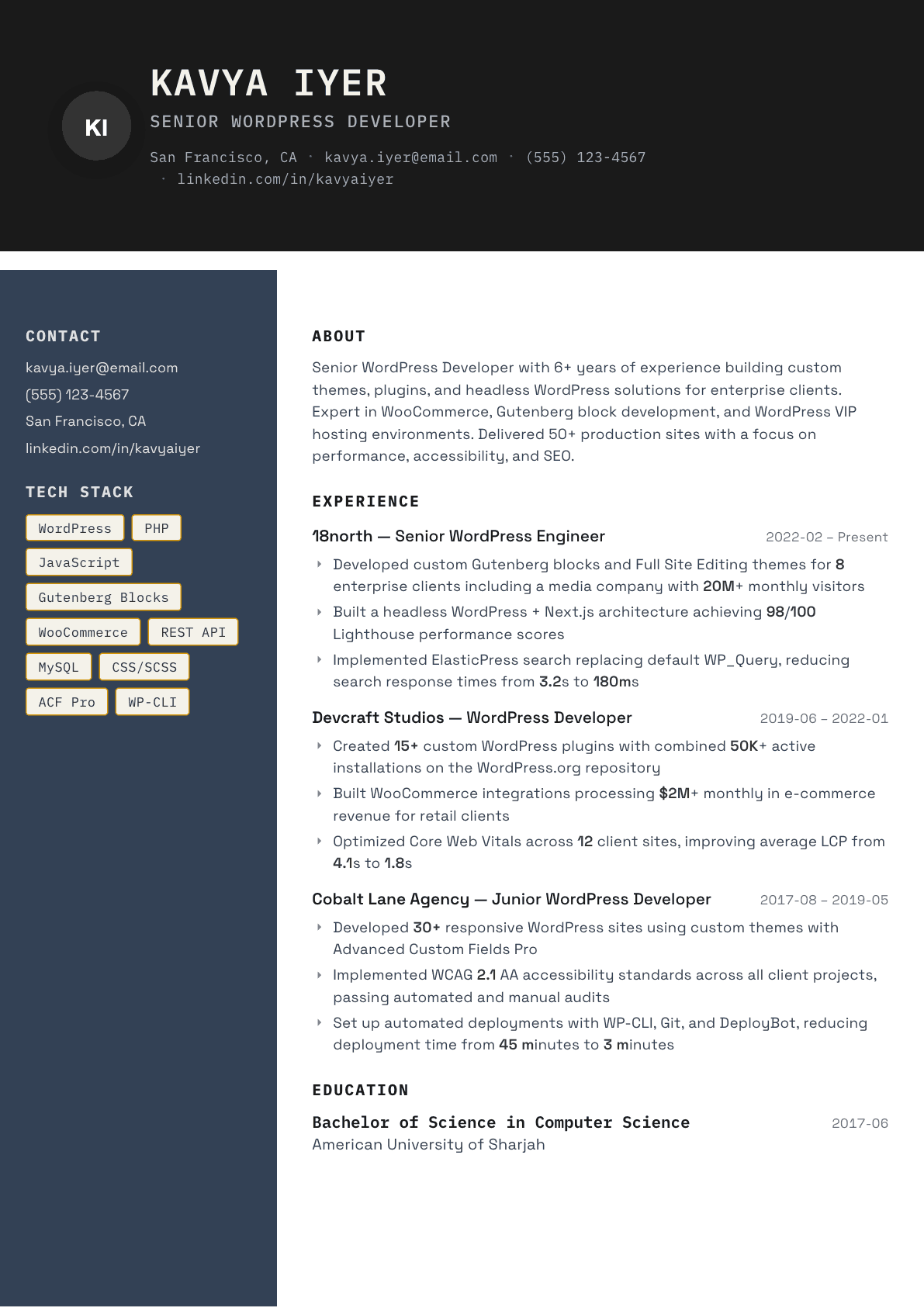
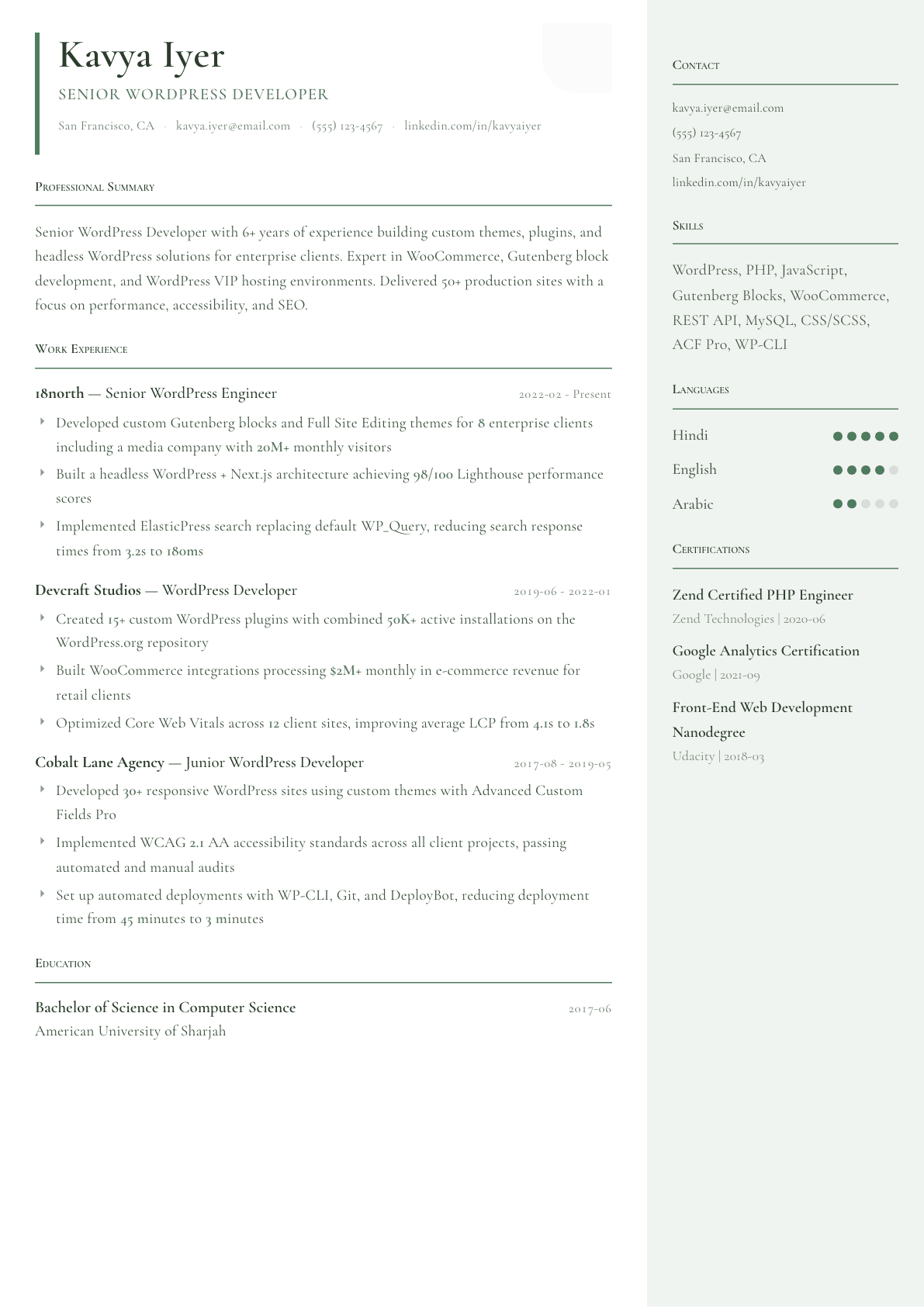
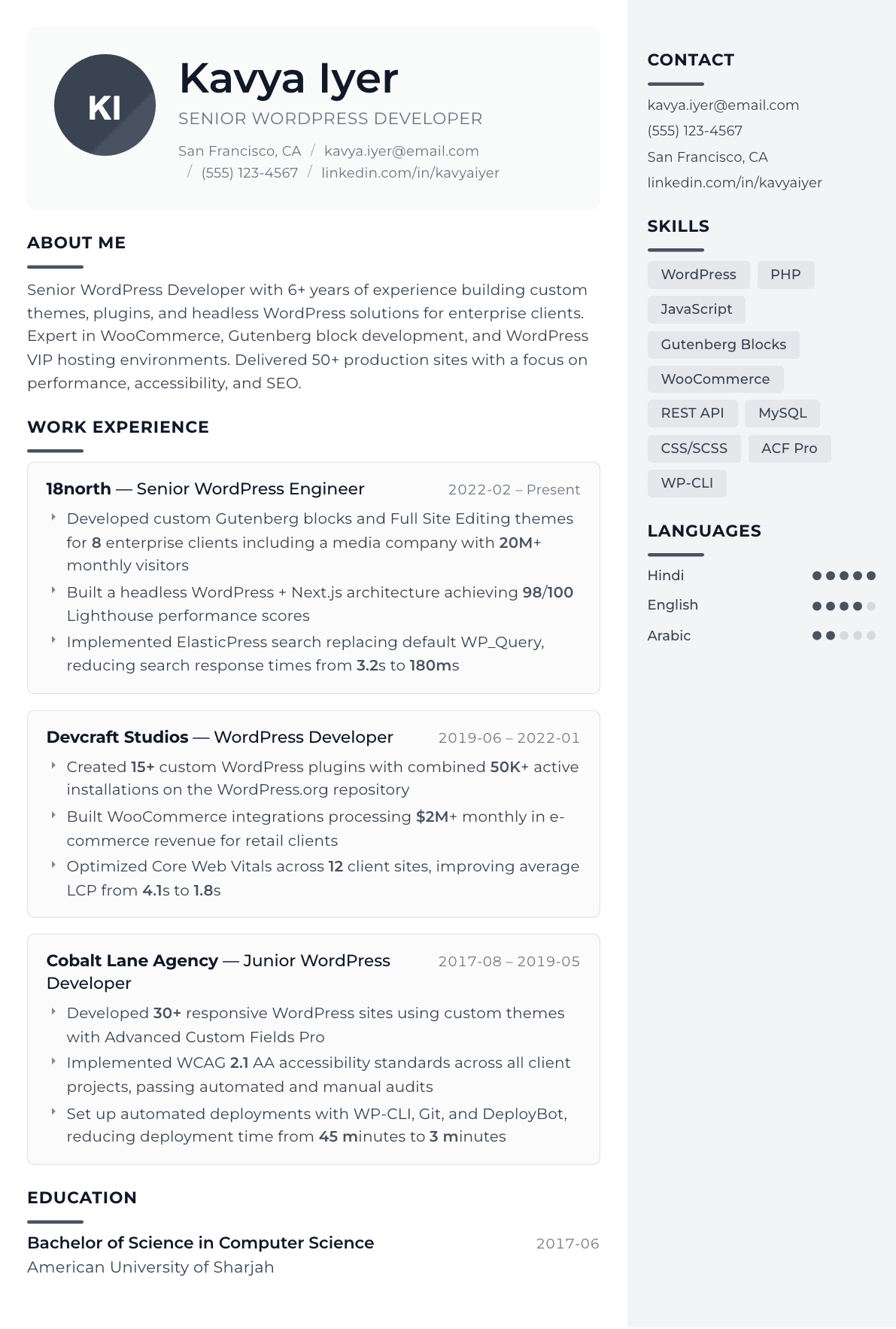
Example WordPress Developer summary
WordPress Developer with 6 years of experience building custom themes, plugins, and headless CMS solutions for enterprise clients. Delivered 50+ production sites with 98/100 Lighthouse scores. Expert in Gutenberg block development, WooCommerce, and WordPress VIP hosting environments.
Skills to list on a WordPress Developer resume
- WordPress
- PHP
- JavaScript
- Gutenberg Blocks
- WooCommerce
- REST API
- MySQL
- CSS/SCSS
- ACF Pro
- WP-CLI
- Next.js
- Accessibility
What actually gets this resume read
- Highlight Gutenberg block development and Full Site Editing experience, as these are the modern WordPress standard.
- Include WooCommerce and e-commerce metrics: revenue processed, products managed, and conversion improvements.
- Mention WordPress VIP, Pantheon, or WP Engine hosting experience for enterprise credibility.
- Show headless WordPress experience with Next.js, Gatsby, or Nuxt for modern decoupled architectures.
- Quantify performance improvements with Core Web Vitals metrics: LCP, FID, and CLS scores.
How to write a wordpress developer resume
WordPress hiring has a credibility problem that works in your favor if you know about it. The applicant pool contains a large number of people who install themes, configure page builders and call it development. Anyone hiring a WordPress developer has been burned by that at least once, so the whole screen is built around one question: can this person write PHP and JavaScript against the platform, or do they only assemble plugins.
The resume has to answer that in the first third of the page. Custom theme development, custom blocks, plugin authoring, hooks and filters, the database layer, and WP-CLI are the words that separate a developer from a site builder. So is any evidence that runs in public: a plugin in the repository, a contribution to core or a popular library, or a client site you can point at and explain.
This guide covers how to structure a WordPress developer resume, how to present theme, plugin and platform work convincingly, three summaries across career stages, before-and-after bullets, and the questions developers ask when moving from freelance site building into serious engineering roles.
Format: proof of code first, plugin list second
One page under six years, two after. Put links in the header to your code profile, any plugin you have published, and two or three live sites. If you have published to the plugin directory or contributed a patch upstream, that goes in the header line too, because it is the strongest available proof that you write real code against the platform.
Under the summary, group the stack: platform work covering block development, theme development and plugin architecture, then languages, then hosting and tooling, then the commerce and page building tools you actually know. Grouping matters because agencies and product companies filter on very different terms in this ecosystem.
- Header: name, title, location, email, code profile, published plugin or theme, two live sites.
- Order: summary, stack by category, experience, published work, education.
- Say early whether you build classic themes, block themes or headless front ends, since these are separate skill sets.
Experience: custom code, not configuration
Every role should show what you wrote rather than what you installed. Custom post types and taxonomies, meta boxes and custom fields, block registration and block variations, template hierarchy work, custom queries, REST API endpoints registered through the platform, hooks and filters you added for extensibility, and the migration scripts you ran through the command line.
Say what the sites were carrying. Monthly traffic, number of editors, number of locales, catalog size for commerce sites, and the hosting environment give the reader scale. Building a brochure site for a local business and maintaining a publishing platform with dozens of editors and heavy caching are different jobs that both get described as WordPress work.
Performance and security are where WordPress developers prove seniority. Object caching, page caching layers, database query optimization, avoiding uncached loops in templates, image handling, plugin auditing, capability checks, nonce use and sanitizing input are all specific to this platform and immediately readable to an experienced reviewer.
Blocks, themes and the modern editor
The editor shift has split the market. Some employers still run classic themes with custom fields, while others are building block themes with full site editing and a theme configuration file. A resume that names only one of these narrows your pool, so if you have both, say both and be specific about which projects used which.
Block development is worth its own bullets because it is genuine JavaScript work: registering blocks, writing the editor and save components, block attributes, block patterns, custom block styles and locking editor capabilities for client safety. Candidates who can write a custom block are a much smaller group than candidates who can build a page in the editor.
- Name whether the build was a classic theme, a block theme or headless with a decoupled front end.
- Show one custom block or one block pattern library you authored for editors to use.
- Mention the editorial guardrails you set, since clients breaking their own layouts is a real cost.
Commerce, multisite and the specialties that pay
WooCommerce experience is a distinct specialty and deserves separate treatment when you have it: custom product types, checkout modifications, payment gateway integrations, order workflows, subscription handling, tax and delivery rules, and performance work on large catalogs. Commerce postings screen for exactly these, not for general theme skill.
Multisite, headless front ends, complex migrations between platforms, and managed enterprise hosting environments are the other specialties that lift a WordPress developer out of the general pool. If you have run a migration of thousands of posts with redirect mapping intact, that is a stronger bullet than five theme builds.
Keywords WordPress postings reuse
The recurring vocabulary includes custom theme development, plugin development, Gutenberg and block editor, WooCommerce, PHP, JavaScript, custom post types, hooks and filters, REST API, WP-CLI, Advanced Custom Fields, headless WordPress, page speed and Core Web Vitals. Mirror the posting wording once in the stack block and once inside a bullet that shows the practice.
Read the posting for the tell about seriousness. A brief that mentions coding standards, version control, staging environments and automated deployment is looking for an engineer. One that lists a page builder and a theme marketplace is looking for a site builder. Lead with the matching half of your history.
WordPress Developer resume summary examples
First WordPress role
WordPress developer with a year of freelance work building four custom themes in PHP with Advanced Custom Fields, plus two custom blocks written in JavaScript. Comfortable with WP-CLI, staging deployments through Git, and basic performance work. Published one small utility plugin to the plugin directory.
Five years in
WordPress developer with five years in agency work, building custom themes, block libraries and WooCommerce integrations. Delivered 30 client sites, authored a booking plugin with 4,000 active installations, and cut average largest contentful paint across a maintained portfolio from 3.8s to 1.7s.
Lead WordPress engineer
Lead WordPress engineer with nine years across publishing and commerce platforms. Owns a multisite network of 20 properties serving 6 million monthly sessions, led a headless rebuild of the main front end, and set the coding standards and review process for a team of four developers.
Work experience bullets: before and after
Before: Built WordPress websites for clients using custom themes.
After: Built 12 custom themes in PHP with custom post types, taxonomies and template partials, replacing a page builder dependency that had been adding 900kb per page.
Naming the platform primitives and the dependency removed proves code work rather than assembly.
Before: Worked with the Gutenberg editor.
After: Developed nine custom blocks and a locked pattern library so editors could assemble campaign pages without breaking the layout, cutting design fix requests to near zero.
Custom blocks plus editorial guardrails show JavaScript development and an understanding of what clients actually break.
Before: Improved WordPress site performance.
After: Replaced 40 uncached meta queries with a single indexed lookup and added object caching, dropping average server response time from 1.9s to 220ms on a catalog of 8,000 products.
The diagnosis, the fix and the catalog size show platform-specific database knowledge, not a caching plugin install.
Before: Set up WooCommerce for online stores.
After: Extended WooCommerce with a custom product type and checkout field logic for a wholesale client, and integrated an inventory feed that synced 8,000 stock levels every fifteen minutes.
Extending commerce behavior in code is a different skill from configuring a store, and the integration proves it.
Before: Handled site migrations and updates.
After: Migrated 6,000 posts and their media from a legacy content management system using WP-CLI scripts, with a redirect map that preserved existing search rankings.
Scripted migration plus redirect mapping is senior work and shows care about what happens after launch.
Hard skills
- PHP
- JavaScript and React for block development
- Custom theme development
- Block themes and full site editing
- Plugin development
- Hooks, filters and the plugin API
- Custom post types and taxonomies
- WordPress REST API
- WooCommerce customization
- WP-CLI
- MySQL and query optimization
- Caching and Core Web Vitals
- Advanced Custom Fields
- Git and staging deployments
Soft skills
- Client requirement gathering
- Training editors and handover
- Estimating and scoping small builds
- Debugging inherited codebases
- Explaining technical limits without jargon
- Maintaining long-lived client relationships
Certifications worth listing
- PHP Certification (Zend)
- AWS Certified Developer, Associate (Amazon Web Services)
- Google Analytics Certification (Google)
Mistakes that cost wordpress developer candidates the interview
- Describing work in terms of themes and plugins installed, which reads as site assembly rather than development.
- Leaving PHP off the skills list or burying it, when it is the first thing an experienced reviewer looks for.
- Omitting any public code, when a small published plugin or an upstream patch settles the credibility question instantly.
- Never naming whether the builds were classic themes, block themes or headless, which are distinct skill sets.
- Skipping performance and security specifics such as caching, query optimization, nonces and sanitizing input.
- Listing dozens of client sites with no traffic, editor count or catalog size to show scale.
- Treating WooCommerce as a checkbox instead of describing the commerce behavior you extended in code.
WordPress Developer resume questions
How do I prove I am a WordPress developer and not a site builder?
Show code. A published plugin, a custom block, a theme built without a page builder, or a migration script run through the command line all answer the question immediately. One public repository does more than a page of descriptive bullets.
Should I list page builders on a WordPress developer resume?
List them briefly if the posting names one, since many agencies maintain sites built that way. Never lead with them. A resume where the builders sit above PHP and block development will be screened as a site building application.
Is headless WordPress worth mentioning?
Yes, when you have actually built one. Say which front end framework consumed the API, how content was fetched and cached, and how previews and editorial workflow were handled, because those are the parts that make headless projects difficult.
How many client sites should I list?
Give a total count in the role context line, then describe two or three in detail with traffic, complexity and your specific contribution. A long list of names tells a reviewer nothing about the difficulty of any single build.
Do I need WooCommerce experience for most WordPress jobs?
Not for publishing or marketing site roles, but it opens a large share of the market and commands better rates. If you have any commerce work, describe the behavior you customized rather than saying you have used the plugin.
Related resume examples
- PHP Developer Resume example
- Frontend Developer Resume example
- Web Developer Resume example
- Shopify Developer Resume example
- Full-Stack Developer Resume example
- Angular Developer Resume example