Full-Stack Developer Resume Examples: what gets the call
Full Stack Software Developer Resume That Covers Every Layer
By Mustafa Tarabya, founder of CVBooster · Published · Updated
Full stack software developer resume guide: the title to use, skills grouped by layer, junior to senior summaries, and bullets that prove end-to-end work.
Sample resumes for a full-stack developer
The same full-stack developer content laid out in three CVBooster templates, so you can see what the finished document looks like before you write a word.
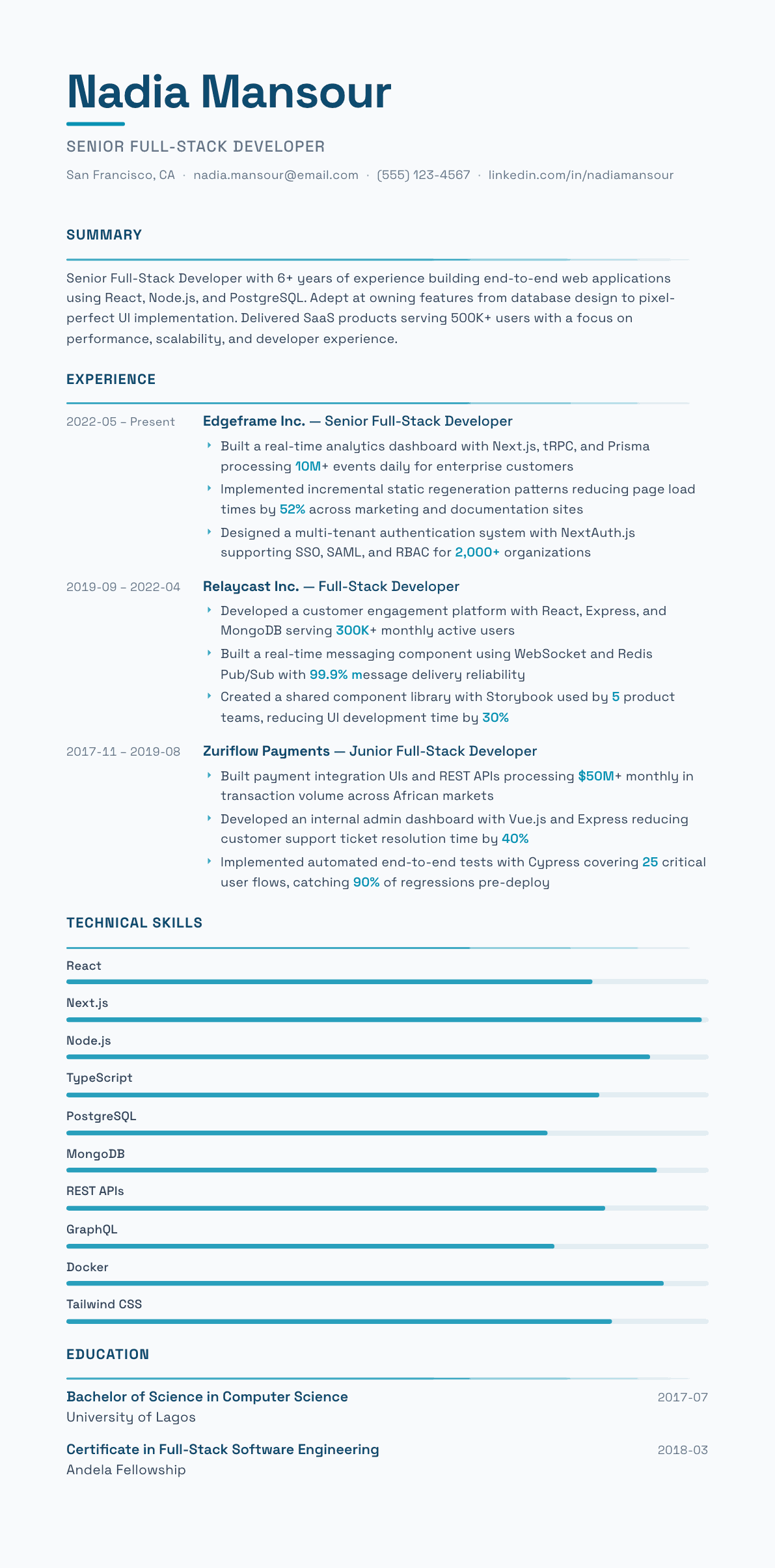
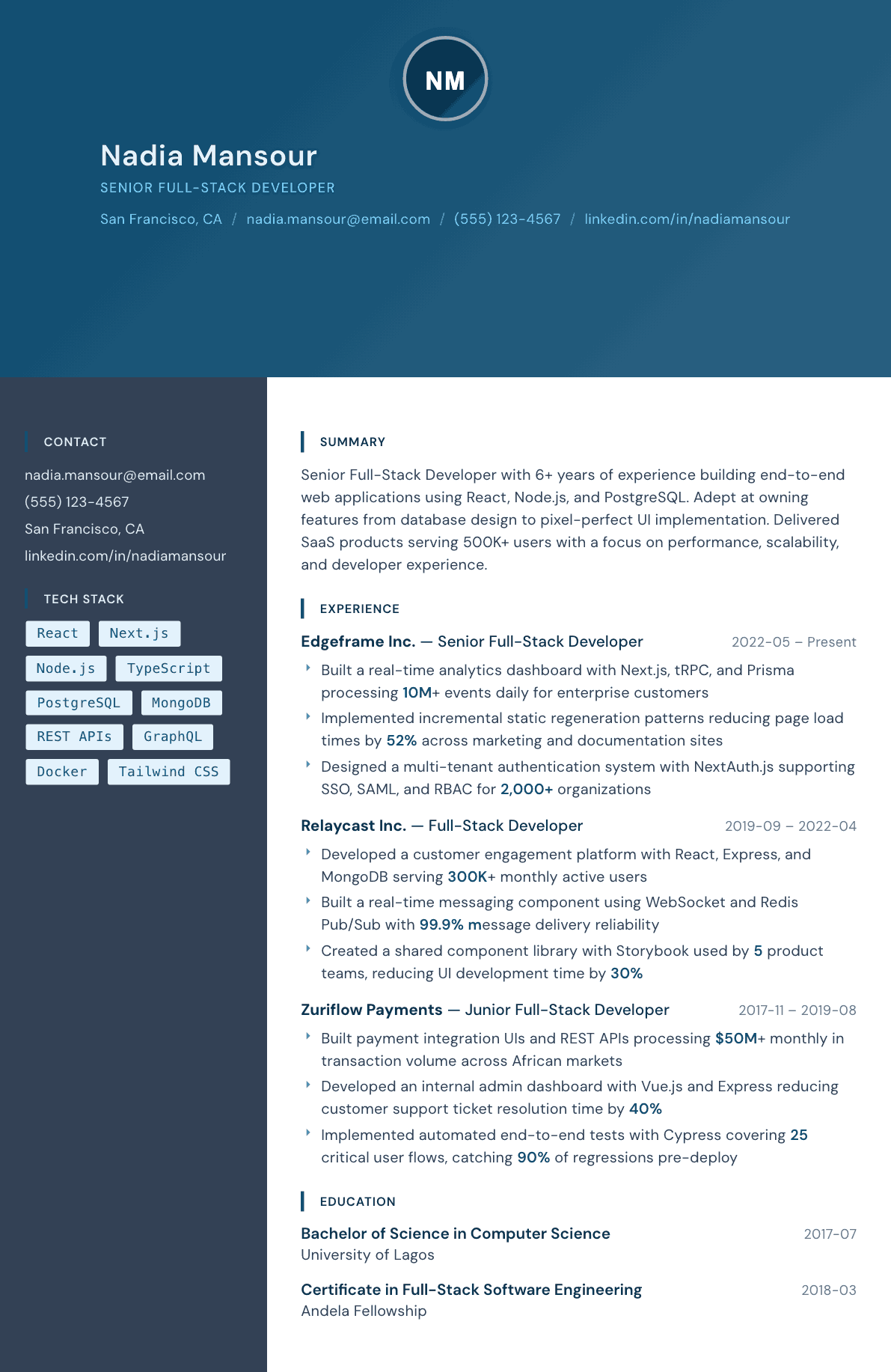
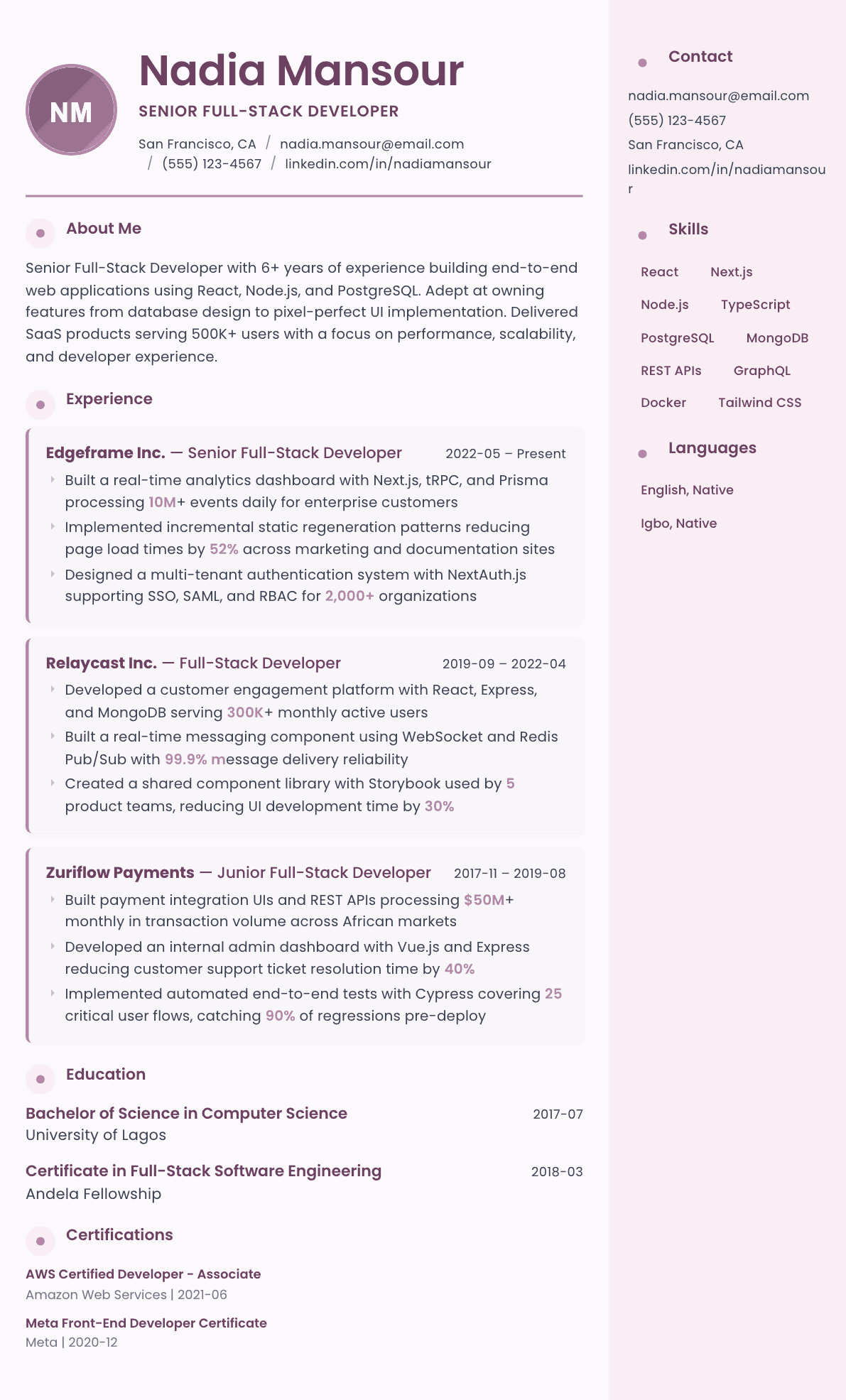
Example Full-Stack Developer summary
Full-Stack Developer with 6 years of experience building end-to-end web applications with React, Node.js, and PostgreSQL. Delivered SaaS products serving 500K+ users with 52% faster page loads and 99.9% uptime. Expert in TypeScript, Next.js, and cloud-native architectures, with a shared component library used by five product teams.
Skills to list on a Full-Stack Developer resume
- React
- Next.js
- Node.js
- TypeScript
- PostgreSQL
- MongoDB
- REST APIs
- GraphQL
- Docker
- Tailwind CSS
- Redis
- AWS
What actually gets this resume read
- Balance frontend and backend skills equally in your resume to demonstrate true full-stack capability.
- Show end-to-end ownership: from database schema design to UI implementation and deployment.
- Quantify user-facing metrics: page load times, user counts, transaction volumes, and conversion improvements.
- Include both SQL and NoSQL database experience, as full-stack roles typically require both.
- Mention DevOps skills like Docker, CI/CD, and cloud deployments to show you can own the entire stack.
How to write a full-stack developer resume
The full-stack developer title covers two very different candidates, and the person screening resumes is trying to tell them apart. One has genuinely owned features from the database schema through the API to the interface, and can be trusted with a whole slice of a product. The other writes interfaces and once changed an endpoint. The second candidate is not useless, but a team hiring full stack needs the first, and a vague resume gets sorted into the second group by default.
The way to prove the first is to write about ownership boundaries. Which part of the system did you design, who called your endpoints, what happened when the data model turned out wrong, how the thing got deployed, and who got paged when it broke. Frameworks tell a reader almost nothing here, because everyone lists the same five.
This guide covers the layout that survives an applicant tracking system, how to describe end-to-end ownership at each level, summaries for a junior, a mid-level and a senior full-stack developer, rewritten bullets, and the mistakes that make a broad resume read as shallow.
Format: one page to about eight years, single column, links that load
Reverse chronological, one column, no icons or skill rating bars. Rating your own React knowledge at four stars out of five gives a reviewer nothing, and the space would carry a real bullet instead.
Group the skills section by layer, because a full-stack resume is otherwise an undifferentiated wall: language, frontend, backend, data stores, infrastructure and deployment, testing. A backend-leaning manager reads the data and infrastructure rows first, a product-leaning one reads the frontend row, and grouping lets both find their answer without reading everything.
- Header: name, city, email, repository link, and one deployed application.
- Order: summary, skills by layer, experience, projects, education.
- Bootcamp and self-taught candidates lead with one substantial project that has a database, authentication, tests and a live deployment.
Summary: the stack, the product, and the depth claim
Three lines at most. Name the stack you are strongest in, the kind of product you built with it, and the honest center of gravity. A full-stack developer who is stronger on the backend should say so, because pretending to be equally deep everywhere is exposed within ten minutes of a technical screen.
Give the reader a scale anchor: users, requests, records, tenants, or transactions. Building a multi-tenant application for a handful of enterprise customers is a different craft from a consumer product with heavy read traffic, and the summary is where that lands.
Experience: write the feature end to end
The strongest full-stack bullet follows one feature down through the layers. Say the data model choice, the endpoint or job that made it work, the interface state you had to handle, and the result. That single shape proves the claim in the job title better than any list of technologies.
Include the parts most candidates leave out: the schema migration you ran on a live table, the background job that stopped the request from timing out, the caching layer you added and what you invalidated, the rate limit, the retry, the idempotency key on a payment. These are what a senior reviewer scans for because they are learned only by being on call.
Name the delivery path too. Continuous integration, containers, the environment your code runs on, feature flags, and how a release gets rolled back. A full-stack developer who cannot describe how their code reaches production is a frontend developer with database access.
Data, APIs and the decisions worth a bullet
Say which database and why. A relational store with a normalized schema, a document store chosen for shape flexibility, a cache in front of a slow query, and a queue for work that should not block a request are all decisions, and each one gives an interviewer something to ask about that you will enjoy answering.
Do the same for the interface between layers. REST with versioned endpoints, GraphQL with a schema shared across clients, a typed client generated from the contract, or a websocket channel for live updates. Say who consumed your API: a mobile client, another team, an external partner. Internal or external consumers raise the stakes and reviewers notice.
- Give query optimization work a before and after in milliseconds, and name the index or the rewrite that did it.
- Say what you monitored after release: error rate, latency percentile, or a business event you instrumented.
- Mention authentication and authorization work plainly, including session handling, single sign-on and role checks.
Full stack software developer resume: picking the title
The same job is posted as full stack developer, full stack software developer, full stack software engineer and sometimes just software engineer with a note about frontend and backend work. Recruiters search for the words in their own posting, so the title line at the top of your resume and the first words of your summary should use the posting's wording, as long as it is an honest description of what you did.
Your past job titles are a different matter. Keep the title your employer gave you, and if it was narrower than the work, add a short clarifier in the same line, such as Software Engineer (full stack). Changing a past title to match a posting is the kind of detail a background check finds, and it costs more than the keyword gains.
- Resume headline: the posting's exact title, for example Full Stack Software Developer.
- Past roles: the official title, with the scope in brackets if the title undersells it.
- Summary: one sentence that names both layers you worked in and the product they served.
Keywords a full-stack posting repeats
These postings recycle a standard vocabulary: React or a comparable framework, Node.js, Python, TypeScript, REST, GraphQL, PostgreSQL, Docker, cloud platform, continuous integration, agile, and end-to-end ownership. Mirror the wording of the posting once in the grouped skills and once inside a bullet where it sits on real work. Repeating a technology you last used briefly is the fastest way to fail a technical screen you would otherwise have passed.
Full-Stack Developer resume summary examples
Junior full-stack developer
Full-stack developer with a year of Node.js and React on an internal operations tool, plus a deployed side project with a PostgreSQL schema, authentication and a test suite. Comfortable writing an endpoint, the query behind it and the interface that consumes it without handing any layer off.
Five years in
Full-stack developer with five years building a subscription product in TypeScript, Node.js and PostgreSQL, stronger on the backend. Owns billing and the account model end to end, moved the slowest report from 9 seconds to under 1, and runs the deployment path on containers with feature flags.
Senior full-stack developer
Senior full-stack developer with ten years across consumer and business-to-business products, leading a split of a monolith into three services without a customer-visible outage. Sets the API contract other teams build against, owns the on-call runbook, and mentors three engineers through design review.
Work experience bullets: before and after
Before: Developed web applications using React and Node.js.
After: Built the invoicing feature end to end for a subscription product, designing the PostgreSQL schema, the idempotent billing endpoint and the React interface, used monthly by twelve thousand business accounts.
Following one feature through every layer is what the full-stack claim actually means, and the reader can now believe it.
Before: Optimized database performance.
After: Cut the slowest dashboard query from 8.4 seconds to 240 milliseconds by adding a composite index, replacing three sequential lookups with a single join and caching the aggregate for five minutes.
Before and after timings plus the actual technique let an interviewer judge the engineering instead of trusting the adjective.
Before: Worked on the API.
After: Designed a versioned REST API consumed by our web client, an iOS app and two partner integrations, adding request signing and per-key rate limits after an abusive integration caused an outage.
Naming the consumers and the incident that shaped the design shows ownership beyond writing handlers.
Before: Helped deploy the application.
After: Moved deployments from a manual release to a containerized pipeline with automated tests, staged rollout and one-command rollback, taking release time from an afternoon to under 15 minutes.
The specific change and the time saved show you improved how the team works, not just what it built.
Before: Fixed bugs reported by users.
After: Traced intermittent checkout failures to a race between two background jobs writing the same order row, added a database-level lock and a retry, and cut support tickets on failed payments by 90%.
A named root cause and the fix that followed prove debugging skill across the stack rather than ticket volume.
Hard skills
- TypeScript and JavaScript
- React and component architecture
- Node.js and Express
- Python or another backend language
- REST API design
- GraphQL schemas
- PostgreSQL and schema design
- Redis and caching
- Message queues and background jobs
- Docker and containers
- Cloud platform deployment
- Continuous integration pipelines
- Automated and end-to-end testing
- Observability and error tracking
Soft skills
- Feature ownership
- Working directly with product
- Estimating honestly
- Code review across layers
- On-call composure
- Mentoring
Mistakes that cost full-stack developer candidates the interview
- Claiming full stack when every bullet is interface work with one line about calling an endpoint, which an interviewer detects in the first ten minutes.
- Listing every technology ever touched so the list reads as broad and thin, when the job wants proof of depth somewhere.
- Never naming a database decision, when schema and query choices are where full-stack ability is really tested.
- Leaving out deployment and monitoring entirely, so the reader assumes someone else ran the code you wrote.
- Using skill rating bars or star ratings, which reviewers ignore and which cost space a real result could occupy.
- Writing the same resume for a startup that wants one person to own a product and a large company hiring for one service, when the emphasis should shift between breadth and depth.
Full-Stack Developer resume questions
Should my resume say full stack software developer or full stack engineer?
Use the wording of the posting in your headline and summary, because that is what the recruiter searches for, and keep your past job titles as your employers gave them. Senior postings use both titles, and either is credible, as long as the resume names the layer you are deepest in.
How do I show depth when the title implies breadth?
Pick two or three bullets that go all the way down: a schema migration on live data, a query rewrite with timings, or an API design with real consumers. Depth shown in a few places is more convincing than breadth claimed everywhere.
Should I list frontend and backend skills separately?
Yes. Group them by layer along with data stores, infrastructure and testing. Grouped lists let a backend-leaning and a product-leaning reviewer each find what they care about without reading the entire block.
What project convinces a hiring manager if I am self-taught?
One application with real users, or at least real complexity: authentication, a normalized database, a background job, tests and a live deployment you maintain. Explain a decision you would now make differently and the reader treats you as an engineer.
How much infrastructure knowledge do I need to show?
Enough to get your own work into production and diagnose it there. Containers, a deployment pipeline, environment configuration, logs and basic alerting are the expected floor, and anything past that is a bonus rather than a requirement.
Related resume examples
- Frontend Developer Resume example
- Backend Developer Resume example
- Software Engineer Resume example
- PHP Developer Resume example
- Blockchain Developer Resume example
- Ruby Developer Resume example