JavaScript Developer Resume Examples: what gets the call
Create a JavaScript Developer Resume Hiring Teams Read Twice
By Mustafa Tarabya, founder of CVBooster · Published · Updated
A JavaScript developer resume with browser performance examples, framework keywords, sample bullets and a section by section writing guide.
Sample resumes for a javascript developer
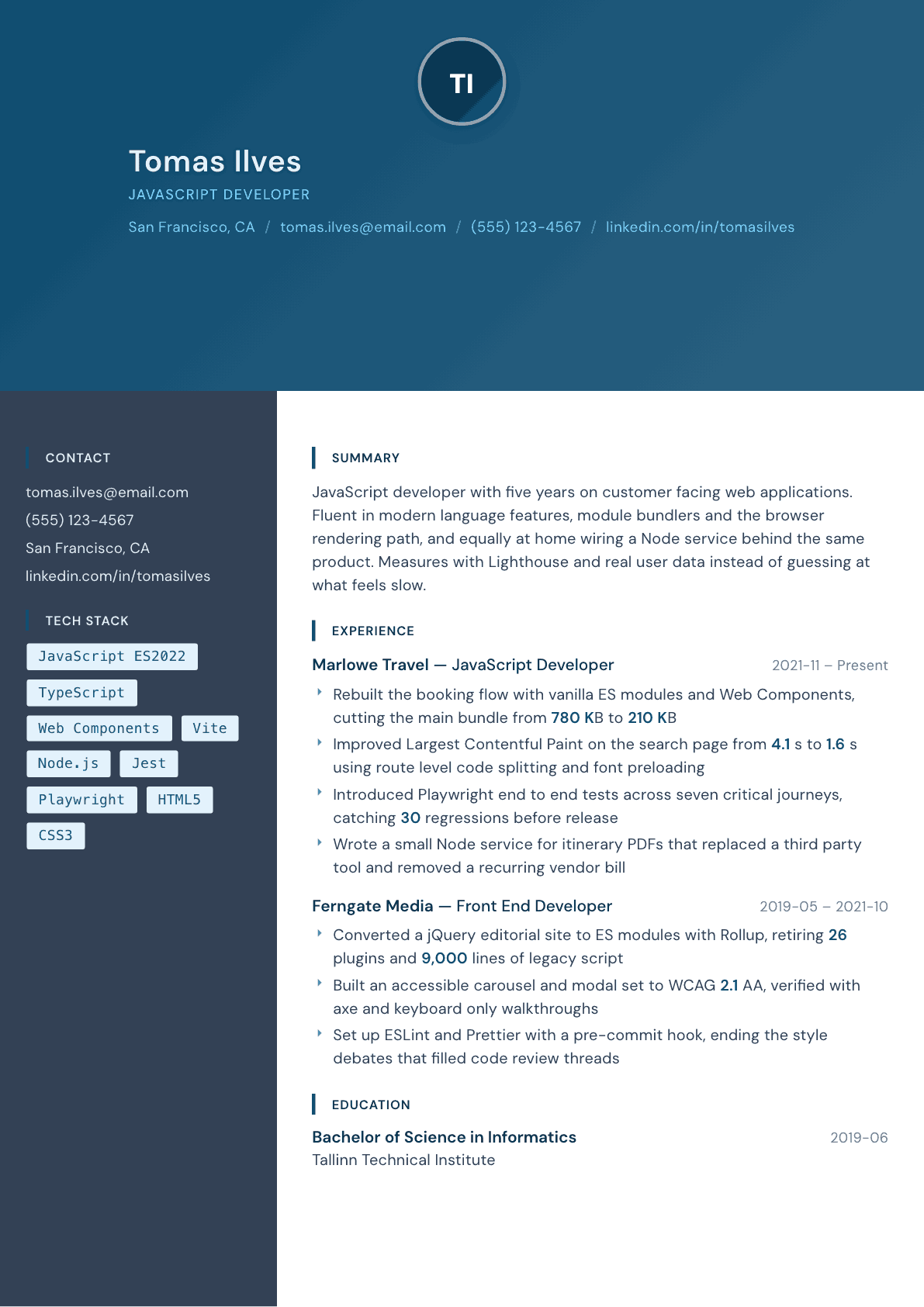
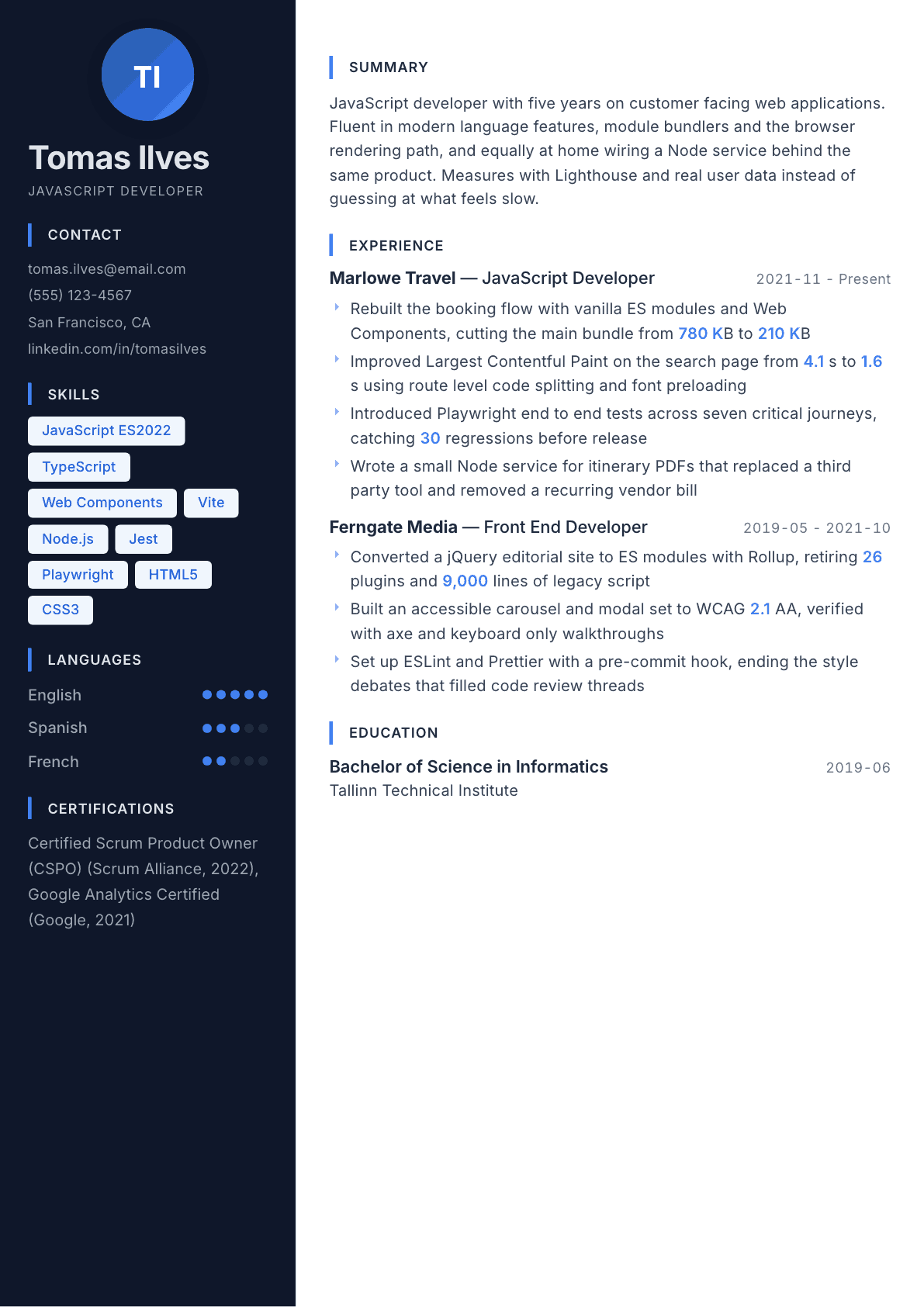
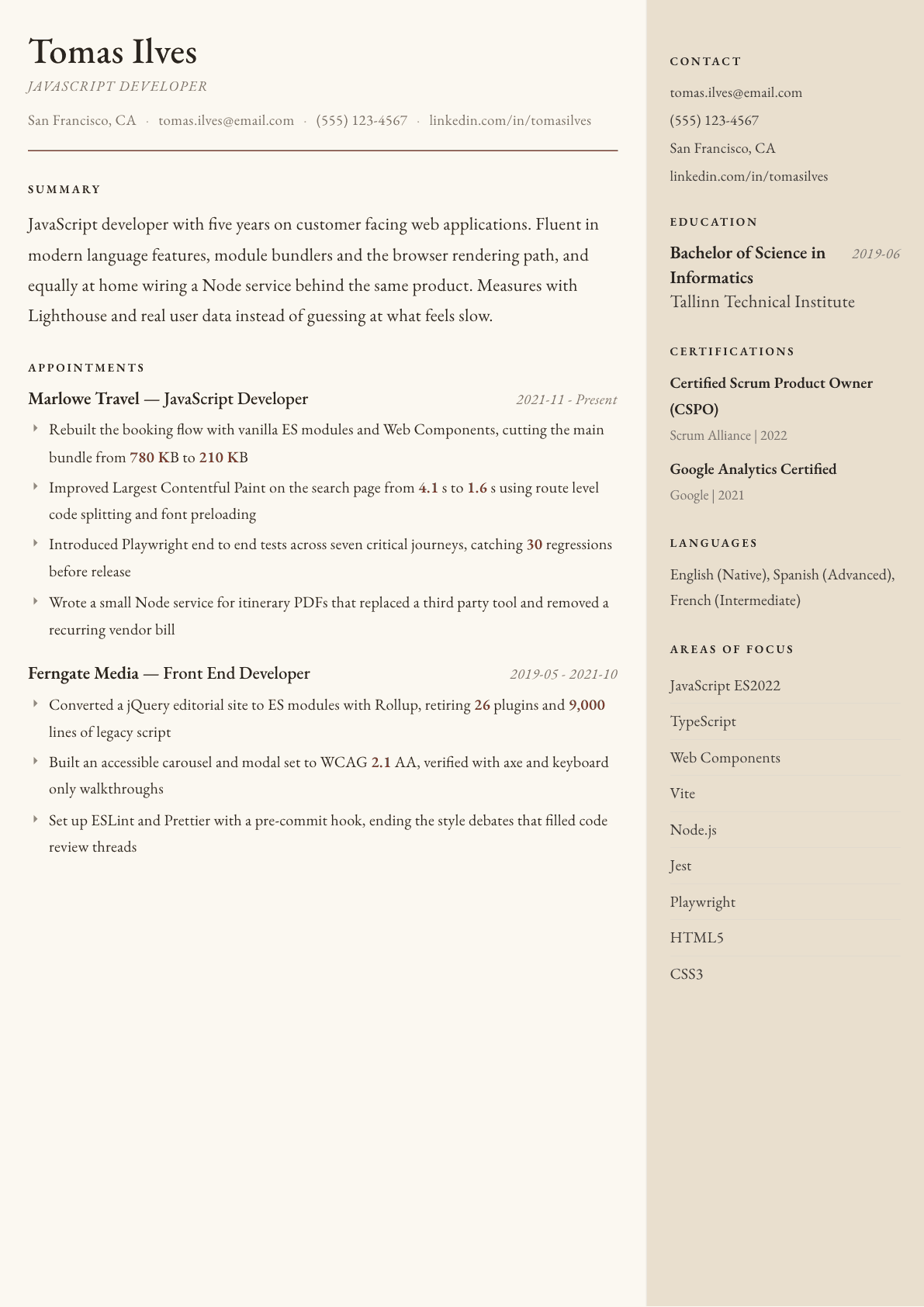
The same javascript developer content laid out in three CVBooster templates, so you can see what the finished document looks like before you write a word.
Example JavaScript Developer summary
JavaScript developer with five years building and maintaining production web applications for travel and media clients. Strong on the language itself: modules, closures, event loop behavior and memory profiling, plus the tooling around it in Vite and Jest. Took a booking flow from a four second load to under two by splitting routes and trimming dependencies. Looking for a product team that treats front end performance as a feature.
Skills to list on a JavaScript Developer resume
- JavaScript
- TypeScript
- ES modules
- DOM APIs
- Web Components
- Node.js
- webpack
- Vite
- Jest
- Playwright
- HTML5
- CSS3
- REST and fetch
- Web accessibility
- Browser performance
What actually gets this resume read
- Decide whether you are applying as a browser specialist or a full stack generalist, then order your bullets to match.
- Name the language features you rely on, such as modules, generators or async iterators, rather than writing modern JavaScript.
- Include one measurable browser performance result with the technique that produced it, not just the score that improved.
- List your bundler and test runner by name, because screens for this role filter on Vite, webpack, Jest and Playwright.
- Mention accessibility work with the standard and the tool used to verify it, since many postings now require evidence.
- Keep framework names out of the summary if the posting is framework agnostic, and put them in the skills block instead.
How to write a javascript developer resume
A JavaScript developer resume has a positioning problem before it has a writing problem. The title covers everything from a browser specialist who knows the rendering path in detail to a full stack engineer who spends most of the week in Node. The reader decides which one you are in about eight seconds, and if the page does not decide for them, they guess wrong.
The other difficulty is that JavaScript resumes tend to be lists of frameworks. React, Vue, Next, Svelte, Express, and nothing about the language itself. Interviewers respond to that by asking about closures, the event loop, prototypes and memory, precisely because the framework list told them nothing about whether the candidate understands what is underneath.
This guide sets out how to choose a position, what to write in each section so both the parser and the engineer are satisfied, three example summaries, before and after bullets drawn from real front end work, and answers to the questions that come up most.
Format: decide browser, server or full stack, then commit
One column, reverse chronological, one page under six years. The header should carry the title you are applying for rather than a generic one. A candidate applying to a browser heavy role and calling themselves a full stack developer loses the match on the first line.
Below the header, a compact skills block split into language, browser platform, frameworks, tooling and testing. Keep framework names out of the summary when the posting is framework agnostic, and let the skills block carry them.
- Header: name, target title, city, phone, email, portfolio link if the portfolio is live and fast.
- Order: summary, skills, experience, selected projects if early career, education.
- One line per job describing the product and its audience before the bullets start.
Summary: language depth first, framework second
Lead with years and the kind of product, then one line that shows you know the language rather than only its ecosystem. Mentioning modules, the event loop, or memory profiling in the summary signals a different level than listing four frameworks does.
If you are applying to a team that has already chosen its stack, name that stack once. If the posting is deliberately open about frameworks, which is common at agencies and platform teams, use the space for the browser platform instead: accessibility, performance, and cross browser behavior.
Experience: what you built, how big, how fast
Each job needs the product, the audience and the size. A booking flow used by paying customers, an internal console used by 200 staff, and a marketing site are three different engineering problems, and only you can tell the reader which one you were solving.
Then write bullets that carry a technique. Route level code splitting, font preloading, request waterfall removal, virtualized lists, debounced input handlers, intersection observers for lazy media. Each of these tells an interviewer that you have measured something and acted on the measurement.
Include one bullet on testing and one on collaboration. Playwright or Cypress journeys, visual regression, or the review process you helped set. Front end teams break most often at the seams between designers, back end contracts and browsers, and evidence that you work well at those seams matters.
Skills: the language, the platform, and the tooling around both
Separate the language from the libraries. Under language, name the features you rely on: modules, destructuring, generators, async iterators, proxies if you have used them honestly. Under platform, name the browser APIs: fetch, IntersectionObserver, Web Components, service workers, the storage APIs.
Tooling deserves its own group because screens filter on it. Bundlers, package managers, linters and test runners are the vocabulary of the daily job, and a resume without them reads as if the work happened somewhere abstract.
- Language: modern JavaScript, TypeScript, module systems, asynchronous patterns.
- Platform: DOM APIs, fetch, Web Components, service workers, browser storage.
- Tooling: Vite, webpack, Rollup, npm and pnpm, ESLint, Prettier.
- Testing: Jest or Vitest, Playwright or Cypress, axe for accessibility checks.
Performance and accessibility: the two things you can prove
Front end work is unusually measurable, and most candidates waste that advantage. Core Web Vitals, bundle size, time to interactive and dropped frames are numbers you can put on a page. Pair each with the technique that produced it so the reader learns your method rather than your luck.
Accessibility is the second measurable area, and it now appears in procurement requirements for public sector and enterprise work. Name the standard level you worked to, the tooling you verified with, and whether you tested with a keyboard and a screen reader rather than only an automated checker.
JavaScript Developer resume summary examples
First developer job
Front end developer with a year of agency experience building marketing sites and a bootcamp background in modern JavaScript. Comfortable with modules, fetch and the DOM without a framework, plus Vite, ESLint and Jest. Built an accessible component set verified with axe and keyboard testing.
Five years in
JavaScript developer with five years on customer facing travel and media products. Rebuilt a booking flow with ES modules and Web Components, cutting the main bundle from 780 KB to 210 KB and Largest Contentful Paint from 4.1 s to 1.6 s. Also writes the Node services behind the same screens.
Lead front end engineer
Senior JavaScript engineer with ten years across commerce and publishing, leading a front end group of five. Owns the shared component platform, the performance budget enforced in the pipeline, and the accessibility standard the organization commits to in client contracts. Still writes production code weekly.
Work experience bullets: before and after
Before: Reduced the size of the JavaScript bundle.
After: Cut the main bundle from 780 KB to 210 KB by splitting routes, replacing a date library with native formatting, and removing 26 unused jQuery plugins.
Three named reductions and the numbers on both sides make the result reproducible rather than assertive.
Before: Improved page load speed.
After: Improved Largest Contentful Paint on the search page from 4.1 s to 1.6 s using route level code splitting, font preloading, and removing a render blocking third party tag.
Naming the metric and the three techniques shows measurement drove the work.
Before: Made the site accessible.
After: Brought the carousel, modal and navigation components to WCAG 2.1 AA, verified with axe plus keyboard and screen reader walkthroughs on two browsers.
A standard level and a verification method turn an unprovable claim into a checkable one.
Before: Added automated tests.
After: Added Playwright coverage for seven critical journeys including checkout and password reset, catching 30 regressions before release over the first two quarters.
Which journeys and what the tests caught explains the value, where a tool name alone does not.
Before: Modernized legacy front end code.
After: Converted a jQuery editorial site to ES modules bundled with Rollup, retiring a large plugin layer and moving the team to a single dependency management approach.
The starting point, the target and the organizational outcome give the migration a shape.
Hard skills
- Modern JavaScript and ES modules
- TypeScript
- DOM and browser APIs
- Asynchronous patterns and the event loop
- Web Components
- Node.js fundamentals
- Vite, webpack and Rollup
- Jest and Vitest
- Playwright and Cypress
- HTML5 and CSS3
- Web accessibility to WCAG
- Core Web Vitals and browser profiling
Soft skills
- Working from designs without pixel arguments
- Negotiating API contracts with backend teams
- Explaining performance tradeoffs to product owners
- Reviewing front end code kindly and precisely
- Debugging across browsers and devices
Certifications worth listing
- JSE Certified Entry-Level JavaScript Programmer (JS Institute)
- JSA Certified Associate JavaScript Programmer (JS Institute)
- CIW JavaScript Specialist (CIW)
Mistakes that cost javascript developer candidates the interview
- Listing eight frameworks and nothing about the language, which guarantees the interview opens with a closure question you did not prepare for.
- Using a title that does not match the posting, so a browser focused role reads your file as a generalist application.
- Claiming performance improvements without the metric or the technique, which an experienced interviewer will simply skip past.
- Linking a portfolio that loads slowly, since a slow portfolio is the strongest possible counter argument to a front end resume.
- Treating accessibility as a checkbox rather than naming the level and the verification method used.
- Hiding Node or tooling work at the bottom when the posting is full stack, which loses a keyword match you already earned.
JavaScript Developer resume questions
Should a JavaScript resume list TypeScript separately?
Yes, and prominently if you use it daily. Most teams treat TypeScript as the default and screen for it explicitly, so a resume that only implies it through project descriptions will lose matches it deserved to win.
How do I show language depth rather than framework familiarity?
Write at least two bullets where the framework is not the subject: a memory leak you traced, a scheduling problem you solved with the event loop in mind, or a utility you built with plain modules that replaced a dependency.
Is a portfolio site necessary for a JavaScript developer?
It is not necessary, but it is influential when it exists and is good. Reviewers open it, check how fast it loads, and inspect the markup. If you cannot make it fast and accessible, a clean code profile link serves you better.
How far back should I list old front end work?
Ten years is a sensible limit, and anything involving tools no team uses today can be compressed into a single line. Old work is only worth space where it shows scale or a migration you led that is still relevant.
What if my experience is mostly in one framework?
Say so and lean on the transferable parts: state, rendering, routing, testing and performance. Teams hire across frameworks more readily than candidates expect, provided the resume proves the underlying browser and language knowledge is real.
Related resume examples
- Frontend Developer Resume example
- Web Developer Resume example
- React Developer Resume example
- Node.js Developer Resume example
- Angular Developer Resume example
- Blockchain Developer Resume example