Assembly Line Worker Resume Examples: what gets the call
An Assembly Line Worker Resume That Passes the First Screen
By Mustafa Tarabya, founder of CVBooster · Published · Updated
Assembly line worker resume example with takt time, station and quality keywords, plus a guide to writing pace, accuracy and attendance.
Sample resumes for a assembly line worker
The same assembly line worker content laid out in three CVBooster templates, so you can see what the finished document looks like before you write a word.
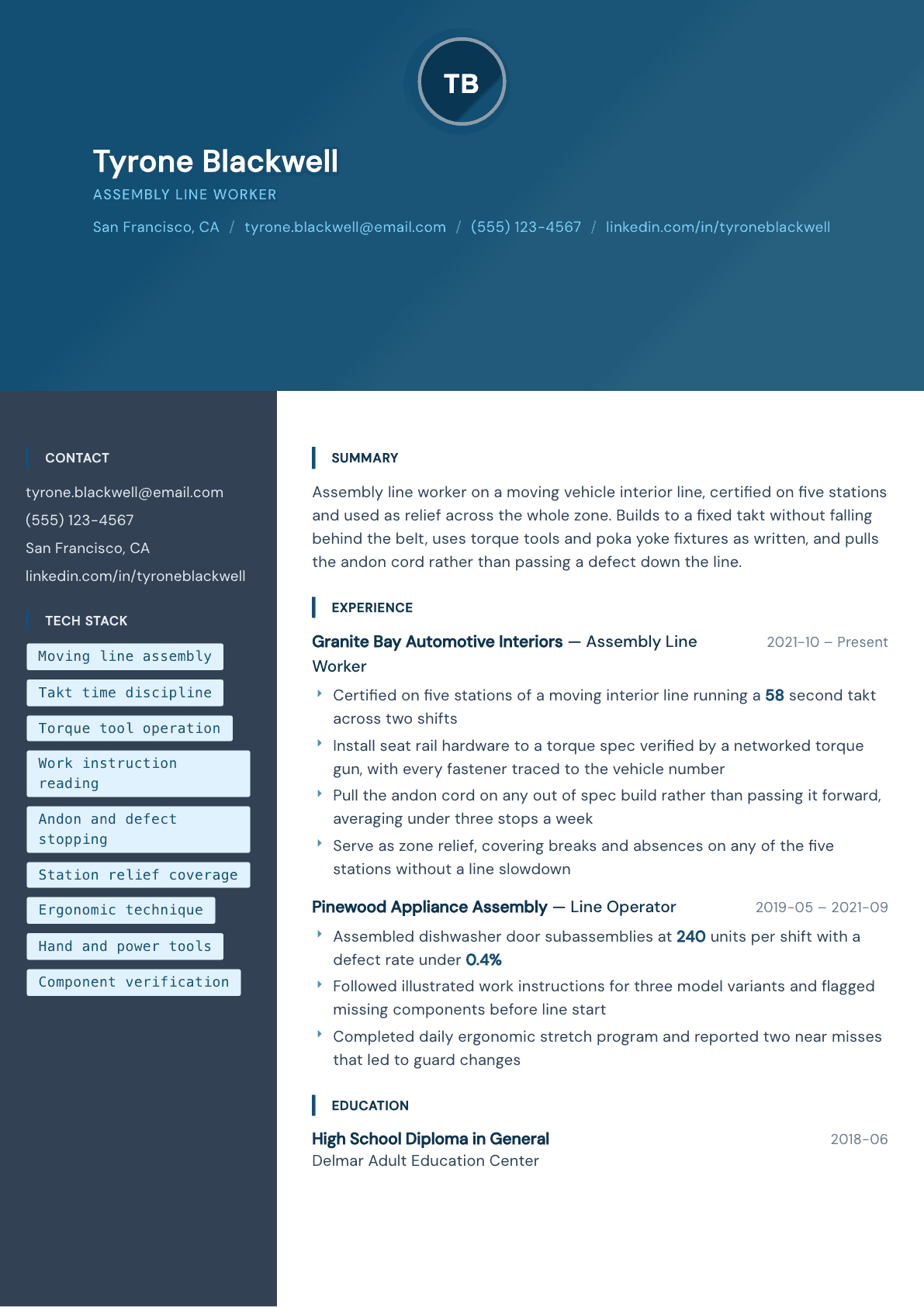
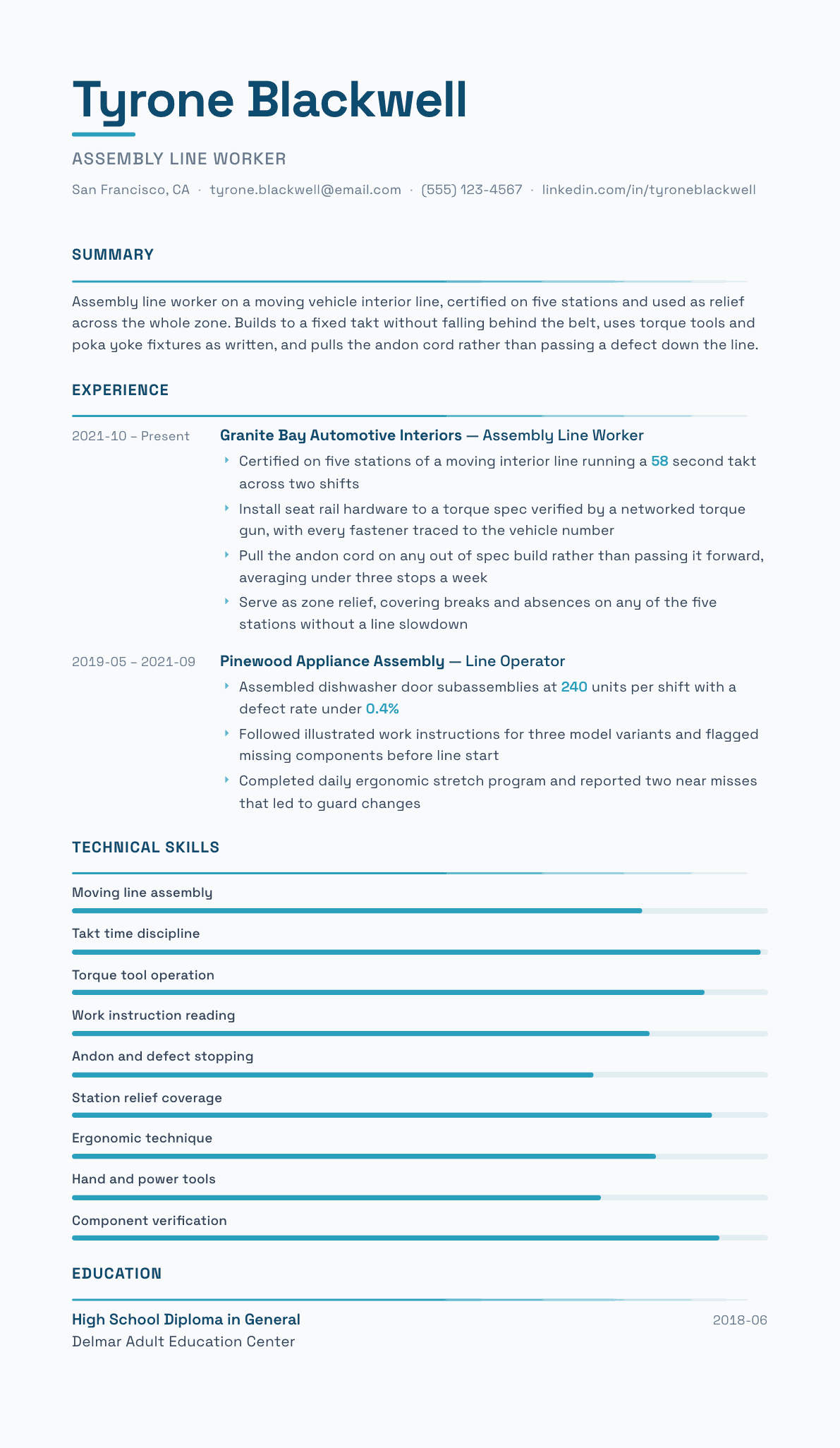
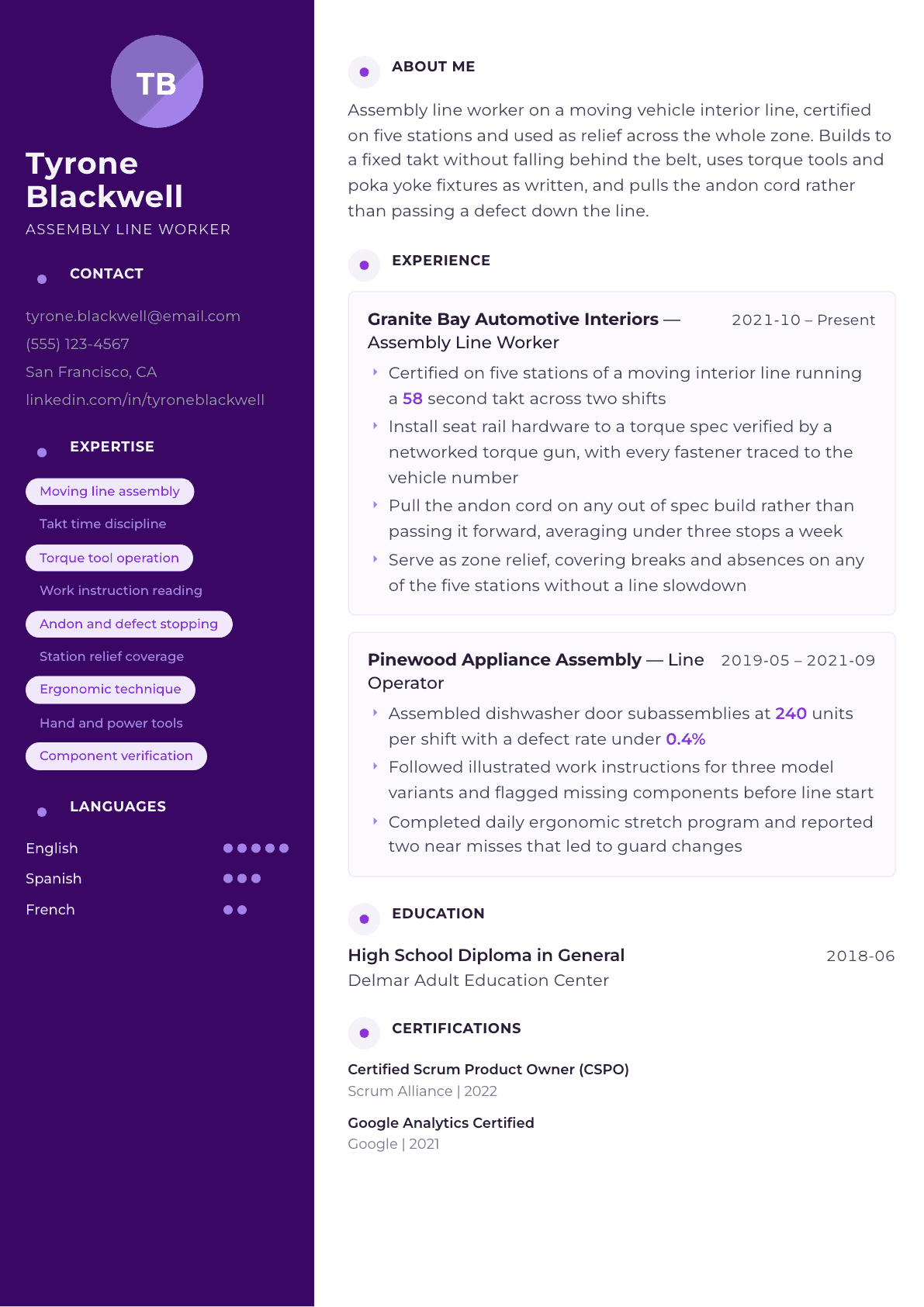
Example Assembly Line Worker summary
Assembly line worker certified on five stations of a moving interior line running a takt under one minute. Installs hardware to torque specs traced to each unit, follows illustrated work instructions across model variants, and pulls the andon cord instead of passing a defect down the belt. Used as zone relief for breaks and absences, with strong attendance across two shifts and regular overtime.
Skills to list on a Assembly Line Worker resume
- Moving line assembly
- Takt time discipline
- Torque tool operation
- Illustrated work instructions
- Poka yoke fixtures
- Andon response
- In line visual inspection
- Station cross certification
- Component staging
- Ergonomics and lifting technique
- Hand and pneumatic tools
- Defect reporting
- Line startup checks
- Overtime and shift flexibility
What actually gets this resume read
- State the takt time or line speed you worked to, because that single number tells a supervisor your pace.
- Count the stations you are certified on, since relief coverage is what makes a line worker valuable.
- Name the tools you are trusted with, especially torque guns, rivet tools, presses and networked fastening systems.
- Explain what you do with a defect, because stopping the line correctly is a skill managers screen for.
- Mention the product you built, since interiors, appliances and electronics assembly are different jobs.
- Put attendance, shift flexibility and overtime willingness on the page, because line staffing depends on them.
How to write a assembly line worker resume
An assembly line worker resume is judged against a belt that does not stop. The plant is not asking whether you can do the task once, it is asking whether you can do it correctly every 58 seconds for ten hours, catch the one build in a thousand that is wrong, and be at the station on time the next day. Everything you write should serve that question.
The screen is quick and often automated. A recruiter filters on shift availability, physical requirements and any station or equipment keyword the plant uses. The zone supervisor who reads it afterward is looking for takt experience, station certifications and whether you understand what happens when a defect passes you.
This guide explains how to write line experience with the numbers the plant already tracks, how to describe repetitive assembly work so it does not read as interchangeable, and how to handle the attendance and overtime questions that decide most line hiring.
Format: one page, scannable, availability stated once and clearly
One page, reverse chronological, no design flourishes. Line hiring runs at volume, and your resume competes with a stack rather than with three other finalists. A clean page with real numbers reads faster than a designed page with none, and speed is what gets you into the interview batch.
Put availability in the contact block: the shifts you accept, whether you can start on nights, and whether you take mandatory overtime. Line staffing is built around a fixed number of bodies at fixed stations, so a candidate who removes the scheduling doubt is easier to hire than one who is slightly more experienced.
- Contact block plus one availability line covering shift, weekends and overtime.
- Sections: summary, line experience, stations and equipment, safety training, education.
- Name the product family you built, since vehicle interiors, appliances and electronics are read as different backgrounds.
Summary: takt, stations, and what you do with a defect
Lead with the line type and its speed. Working a moving line at a fixed takt is a different job from building at a bench where you set your own pace, and a supervisor wants to know which one you have done. Follow with your station count, then with the defect behavior.
That last part matters more than most candidates think. A line worker who pulls the andon rather than passing a bad build forward is protecting the plant from a containment exercise later, and saying so in the summary marks you as someone who understands the cost of the line, not just the task.
Experience: station, tool, tolerance, and what you catch
Anchor each job with the line, the product, the takt and the shift. Then write bullets around the specific build content. Installing seat rail hardware to a torque spec verified by a networked gun and traced to the unit number is a real sentence about real work. Assembled parts according to instructions is not.
Bring in the error proofing. Poka yoke fixtures, torque guns that will not release until the count is right, scanners that verify the part number against the build order: naming these shows you have worked on a controlled line rather than a bench, and plants running them want workers who already respect them.
Then add the relief and coverage line. Being certified on five stations and used as zone relief for breaks and absences is the difference between one more body and a person the supervisor builds his day around. Give the number of stations rather than saying you were cross trained.
- Give the takt time or units per shift, whichever your line used.
- Name your tools by type: networked torque gun, rivet tool, press, heat staker, hand crimper.
- State the station count you are certified on and whether you cover relief.
- Describe your defect response as an action, such as pulling the andon and holding the unit.
Physical and safety realities: address them directly
Line postings state lifting limits, standing hours and repetitive motion requirements because those are the conditions people quit over. Answering them on the page is not weakness, it is efficiency. A short line noting comfort with ten hour standing shifts and regular lifting to the posted limit removes a doubt the reader would otherwise carry into the interview.
Cover the safety layer in the same breath. Daily stretch programs, near miss reporting, guard checks and correct use of cut resistant gloves and hearing protection are all worth a mention, and a near miss you reported that led to a guard change is one of the strongest bullets an hourly worker can write.
Keywords: use the plant's vocabulary, not a generic one
Line plants share a vocabulary, and the applicant tracking system is matching against it: takt time, andon, poka yoke, standard work, first piece check, torque spec, work instruction, line balance, station certification and cross training. Use the exact words from the posting once in your skills block and once inside a bullet where they are demonstrated.
Do not stuff a keyword block at the bottom. The supervisor reads the page right after the software does, and a list of terms with nothing behind them reads worse than a shorter, honest resume.
Assembly Line Worker resume summary examples
New to the line
Hands on worker from a warehouse and small engine repair background, comfortable with tools, written instructions and a measured pace. Available for nights, weekends and mandatory overtime, cleared on pallet jack, and completed OSHA 10. Looking for a first assembly line seat with station cross training available.
Two years on a moving line
Assembly line worker certified on five stations of a moving interior line running a 58 second takt. Installs hardware to torque specs traced to each vehicle number, pulls the andon rather than passing a defect forward, and serves as zone relief for breaks and absences without slowing the belt.
Senior line worker and trainer
Senior line worker with seven years across appliance and automotive assembly, certified across two complete zones and used as the standing relief for both. Trains new hires on their first station, ran a workstation layout change that removed a reach from the cycle, and holds a clean safety and attendance record.
Work experience bullets: before and after
Before: Assembled products on a fast moving production line.
After: Built at a 58 second takt on a moving vehicle interior line across two shifts, certified on five stations within the zone.
A real takt figure and a station count replace an adjective with facts a supervisor can compare to his own line.
Before: Used tools to put parts together.
After: Installed seat rail hardware to a torque spec verified by a networked torque gun, with every fastener traced to the vehicle number.
Naming the tool, the spec and the traceability shows you have worked on a controlled line rather than a bench.
Before: Checked parts for defects.
After: Pulled the andon cord on any out of spec build rather than passing it forward, averaging under three stops a week across the year.
The action plus the stop rate proves both quality judgment and restraint, which is what plants want from andon authority.
Before: Covered for other workers when they were absent.
After: Served as zone relief across all five certified stations, covering breaks and absences without a line slowdown or a rate loss.
Coverage is only valuable if the line keeps its rate, so saying that is what makes the bullet land.
Before: Followed safety procedures at work.
After: Completed the daily stretch program and reported two near misses that led to permanent guard changes at the station.
A reported near miss with an outcome is concrete evidence of a safety habit rather than a statement of compliance.
Hard skills
- Moving line assembly
- Takt time discipline
- Networked torque tool operation
- Illustrated work instruction reading
- Poka yoke fixture use
- Andon and line stop authority
- First piece and in line checks
- Station cross certification
- Component staging and verification
- Hand and pneumatic tool use
- Ergonomic lifting technique
- Defect reporting and containment
Soft skills
- Consistency across a full shift
- Attendance reliability
- Composure when the belt runs
- Peer training
- Team pace awareness
Certifications worth listing
- OSHA 10-Hour General Industry (OSHA Outreach Training Program)
- Certified Production Technician 4.0 (CPT 4.0) (Manufacturing Skill Standards Council)
Mistakes that cost assembly line worker candidates the interview
- Writing that you assembled products without naming the product, the line speed or a single tool you used.
- Ignoring takt time, which is the one number that tells a zone supervisor how you will handle his line.
- Leaving overtime and shift flexibility off the page when line staffing is built around exactly those answers.
- Treating station coverage as a footnote rather than the main reason a relief certified worker gets hired.
- Padding with generic teamwork phrases instead of the andon, torque and inspection detail that proves the work.
- Skipping the physical requirements the posting lists, which leaves the reader guessing about the obvious.
Assembly Line Worker resume questions
What is takt time and why should it be on my resume?
Takt time is the fixed number of seconds each station gets per unit so the line meets demand. Putting yours on the page tells a supervisor your working pace instantly, and it proves you worked a paced line rather than a self directed bench.
How do I list stations I was certified on?
Give the count and, where the names are meaningful outside the plant, the station types. Certified on five stations covering door trim, seat rail and headliner install says far more than trained on multiple assembly operations.
Does an assembly line worker resume need a summary section?
Yes, a three sentence one. It is the only part guaranteed to be read, so it should carry the line type, the takt, the station count and your availability. Skills and duty lists can wait until the reader is already interested.
Should I mention that I left a line job because of the physical strain?
Not on the resume. Explain gaps briefly in the interview if asked, and keep the page focused on what you can do now, including the shift lengths and lifting requirements you are genuinely comfortable meeting.
Will listing union membership help or hurt?
It is neutral at most plants and useful at unionized ones where seniority and job classification language is familiar. If you list it, keep it to one line in a memberships block rather than making it part of your professional summary.
Related resume examples
- Assembler Resume example
- Production Worker Resume example
- Production Associate Resume example
- Machine Operator Resume example
- Production Operator Resume example
- Manufacturing Associate Resume example