Electronics Engineer Resume Examples: what gets the call
Build an Electronics Engineer Resume Around Boards You Brought Up
By Mustafa Tarabya, founder of CVBooster · Published · Updated
Electronics engineer resume example with schematic capture, PCB layout, bench debug, compliance testing, keywords and a writing guide.
Sample resumes for a electronics engineer
The same electronics engineer content laid out in three CVBooster templates, so you can see what the finished document looks like before you write a word.
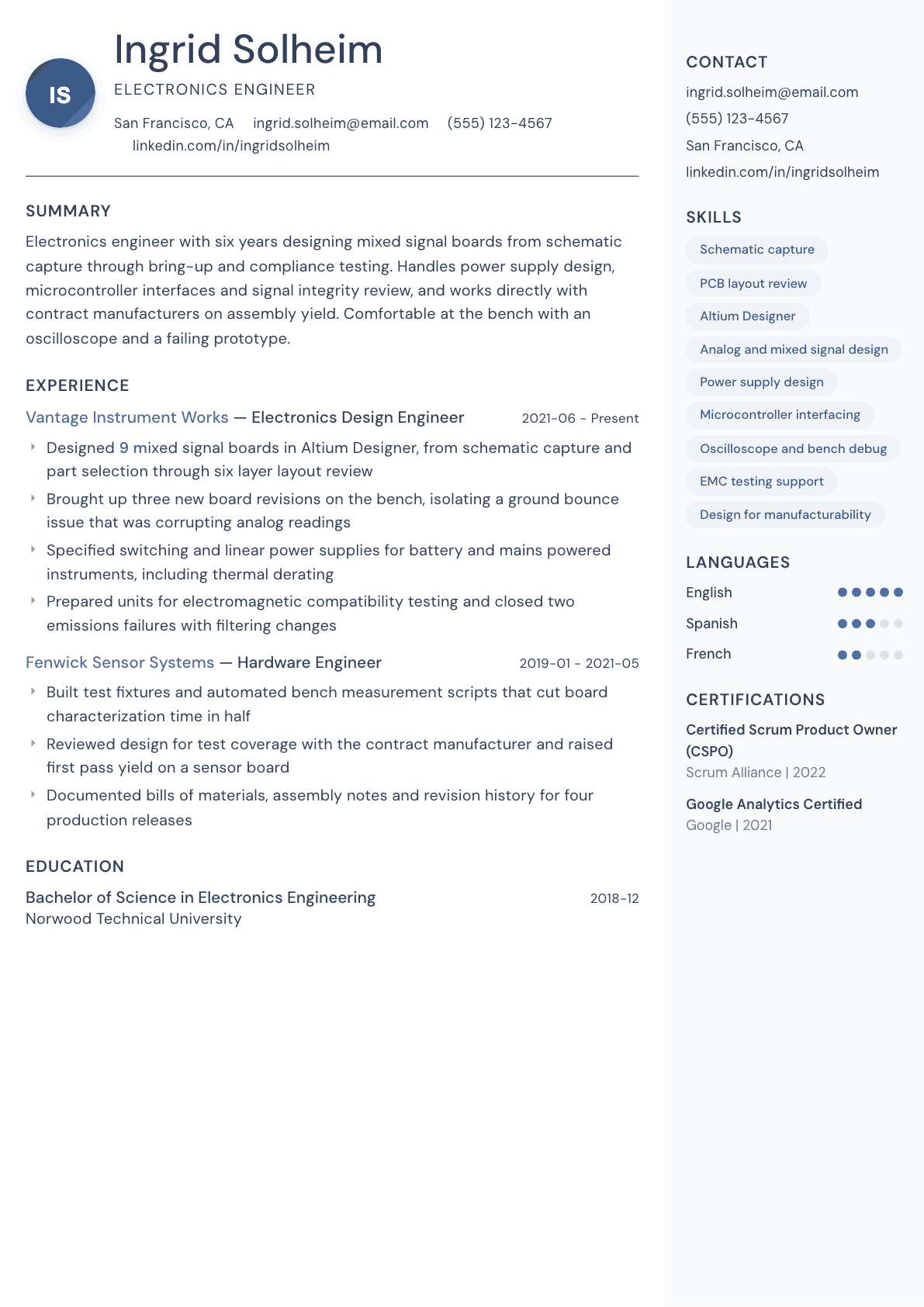
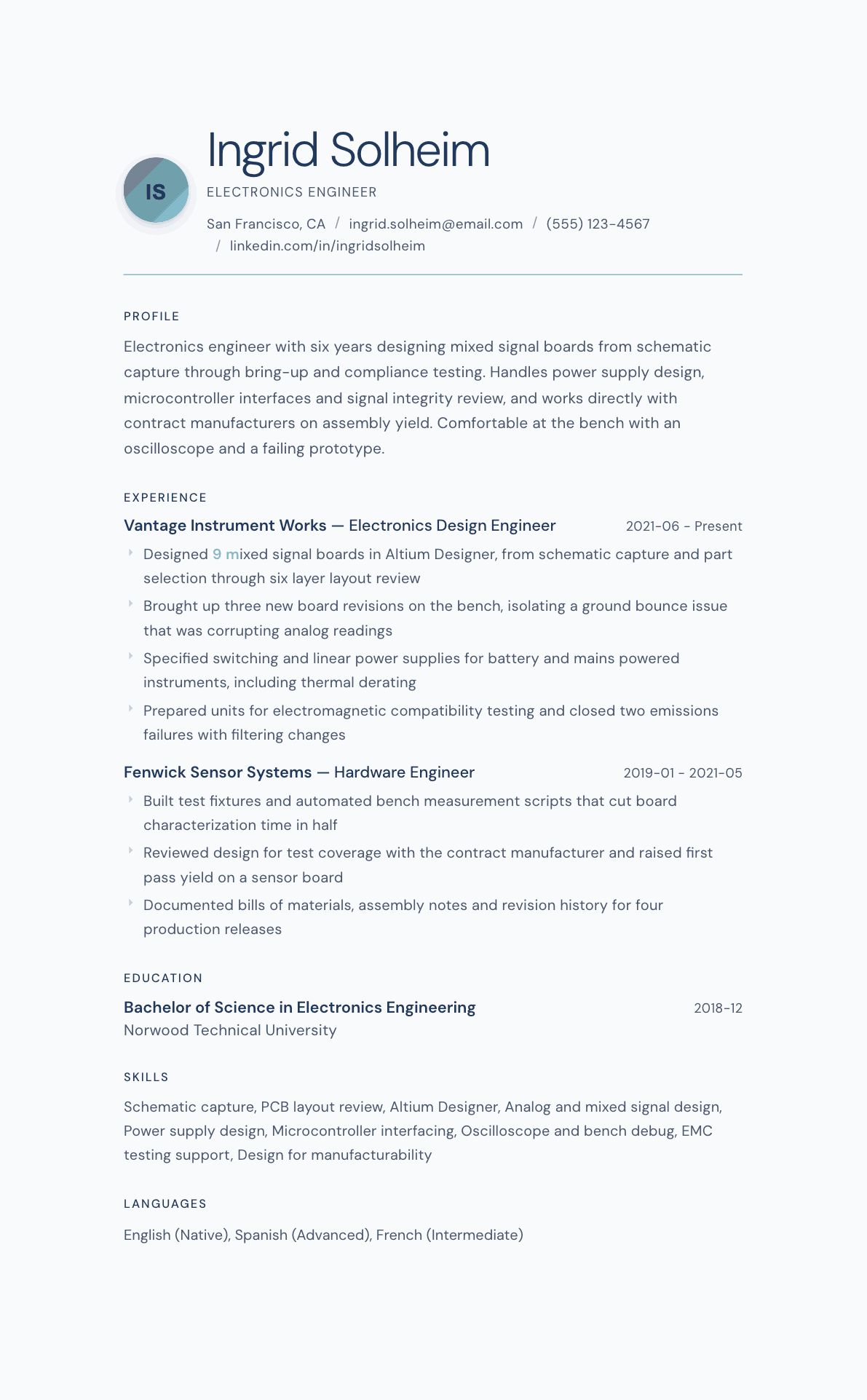
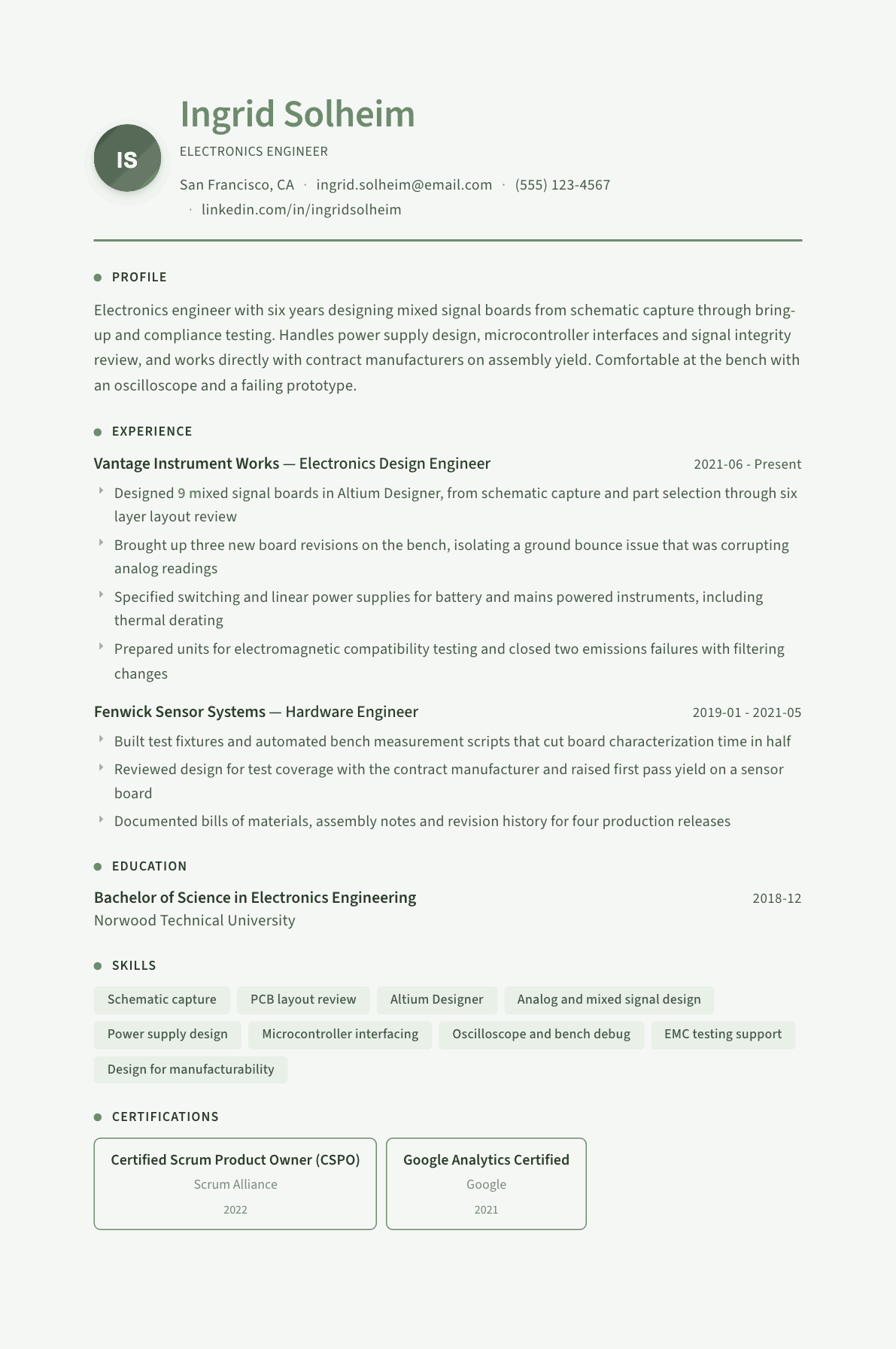
Example Electronics Engineer summary
Electronics engineer with six years designing analog and mixed signal boards from schematic capture through production release. Owns part selection, layout review, power supply design and bench bring-up, and has closed emissions failures during compliance testing. Works directly with contract manufacturers on test coverage and assembly yield, and writes the scripts that automate board characterization.
Skills to list on a Electronics Engineer resume
- Schematic capture
- PCB layout and review
- Altium Designer
- KiCad
- Analog circuit design
- Mixed signal design
- Switching power supply design
- Microcontroller interfacing
- Signal integrity
- Oscilloscope and spectrum analyzer
- Board bring-up and debug
- EMC and emissions testing
- Design for test
- Design for manufacturability
- Component selection and sourcing
- Python test automation
What actually gets this resume read
- Count the boards you designed and how many revisions you personally brought up on the bench.
- Name your electronic design automation tool, layer counts and the signal types you worked with.
- Describe debug work concretely: the symptom, the instrument you used, and the root cause you found.
- Include compliance testing experience, since a board that fails emissions can stall a whole product.
- Show manufacturing awareness through first pass yield, test coverage and direct contract manufacturer interaction.
- Mention firmware or scripting you wrote for test, because hardware roles increasingly expect it.
How to write a electronics engineer resume
Hardware managers read an electronics engineer resume looking for evidence that a board you designed came back from assembly and you made it work. Design capture is the easy half. Bring-up is where the job actually lives: the supply that will not start, the analog channel with noise on it, the part that runs hot in a corner case, the unit that fails an emissions scan a week before a launch date.
The second signal is manufacturability. A design that works on one prototype and fails at scale costs a company far more than a slow schematic. Managers look for evidence of part sourcing judgment, test coverage, yield awareness and real conversations with a contract manufacturer.
This guide covers how to organize an electronics engineer resume around designed boards, how to describe debug work so it reads as engineering rather than tinkering, what to say about compliance testing, and the questions that come up when moving between hardware, firmware and test roles.
Format: a board list is more useful than a duties list
One page for the first few years, two once you have several products behind you. Under each employer, list the boards or products you designed with the circuit class, the layer count and where you took them: prototype, qualification, production release.
Keep the layout plain. Hardware teams often use applicant tracking systems that mangle columns, and a manager scanning for a part family name will not fight the formatting to find it.
- Header: name, city, phone, email, and a portfolio or repository link if you have publishable work.
- Sections: summary, technical skills, experience with board lists, projects, education.
- New graduates put a projects section above experience and describe a board they laid out and brought up.
Summary: circuit domain, product class, and how far you take a design
Three lines. Name the circuit domains you are strong in, analog, mixed signal, power, digital, radio frequency, the product class you have designed for, and the stage you carry a board to. An electronics engineer who has released boards into volume production is a different candidate from one who has built laboratory prototypes, and both are hireable for different roles.
Be honest about layout. Some engineers capture the schematic and hand layout to a specialist. Others route their own boards. Say which, because the interview will establish it in minutes and the expectation gap is expensive on both sides.
Design work: circuits, parts and constraints
Describe the circuits you have designed rather than the categories. Switching regulators and their compensation, low noise analog front ends, sensor conditioning, motor drive stages, isolation barriers, communication interfaces and microcontroller support circuitry are all specific enough to be checked.
Then add the constraints you designed against: power budget, thermal limits, noise floor, battery runtime, cost target, safety isolation or an operating temperature range. Constraints are what make design engineering hard, and naming them shows you understand that.
Part selection deserves a mention on its own. Sourcing risk, second source availability, lifecycle status and package choice are decisions that follow a product for years, and hardware managers who have been burned by an obsolete part will notice that you thought about it.
Bring-up and debug: the section that wins interviews
Write debug stories as short cause and effect chains. Symptom, measurement, instrument, root cause, fix. A bullet that says an analog reading drifted under load, that you traced it with a differential probe to ground return current through the sensor path, and that you cut the problem by splitting the return, tells a manager more about you than any skills list can.
Name your instruments and how you use them: oscilloscope with the trigger setup that caught the fault, spectrum analyzer, network analyzer, logic analyzer, thermal camera, source measure unit, electronic load. An electronics engineer who is fluent at the bench is immediately productive.
Compliance, manufacturing and test
Compliance experience is scarce and valued. Say which testing you have prepared units for, whether you attended the sessions, and what you changed when something failed. Filtering, shielding, layout return paths and cable treatment are the usual fixes, and describing one shows genuine involvement.
On manufacturing, describe the handoff: assembly documentation, bill of materials management, design for test coverage, in-circuit and functional test fixtures, first article review and yield follow-up with the contract manufacturer. Test automation written in a scripting language counts here and is worth its own line.
Electronics Engineer resume summary examples
New graduate
Electronics engineering graduate who designed, laid out and brought up a four layer sensor board for a capstone project, including a switching supply, an analog front end and a microcontroller interface. Comfortable with oscilloscope debug, soldering rework and writing Python test scripts.
Five years in
Electronics engineer with five years designing mixed signal boards from schematic capture through production release. Owns power supply design, part selection and layout review, brings up new revisions at the bench, and has closed emissions failures during compliance testing with filtering changes.
Lead hardware engineer
Lead electronics engineer with eleven years across instrumentation and industrial products, responsible for hardware architecture, design reviews and supplier strategy. Has taken 20 boards into volume production, mentors two engineers, and owns the test and yield relationship with two contract manufacturers.
Work experience bullets: before and after
Before: Designed circuit boards using Altium.
After: Designed 9 mixed signal boards in Altium Designer, from schematic capture and part selection through six layer stackup definition and layout review.
Board count and the depth of layout involvement show ownership instead of time inside the tool.
Before: Debugged hardware issues.
After: Traced intermittent analog readings on a new revision to ground bounce through a shared return path, confirmed it with a differential probe and fixed it by splitting the analog and digital returns.
The measurement, the root cause and the fix make the debug verifiable rather than a claim of troubleshooting.
Before: Selected components for designs.
After: Selected regulators, sensors and connectors with second source availability and lifecycle status checked, avoiding a redesign when one converter family was discontinued.
Sourcing criteria plus the redesign avoided show commercial judgment that hardware managers rarely see.
Before: Helped with EMC testing.
After: Prepared units for radiated emissions testing, attended two sessions, and closed a failure at a switching harmonic by adding input filtering and reworking the cable shield termination.
Naming the failure and the specific remedy proves attendance and technical contribution, not observation.
Before: Wrote test scripts.
After: Built a Python bench automation suite driving a source measure unit and electronic load, cutting board characterization from a full day to under two hours.
The instruments driven and the time saved turn a scripting note into a measurable engineering result.
Hard skills
- Schematic capture
- PCB layout and stackup definition
- Altium Designer
- KiCad
- Analog circuit design
- Mixed signal design
- Switching power supply design
- Microcontroller interfacing
- Signal and power integrity
- Oscilloscope and spectrum analyzer work
- Board bring-up and rework
- EMC and emissions troubleshooting
- Design for test and manufacturability
- Python bench automation
Soft skills
- Structured debugging
- Design review participation
- Supplier communication
- Documentation habits
- Cross-team work with firmware
- Calm under launch pressure
Certifications worth listing
- IPC Certified Interconnect Designer (CID) (IPC)
- IPC-A-610 Certified Specialist (IPC)
- Certified LabVIEW Associate Developer (National Instruments)
- iNARTE EMC Engineer (iNARTE)
- Fundamentals of Engineering (FE) (National Council of Examiners for Engineering and Surveying)
Mistakes that cost electronics engineer candidates the interview
- Listing design tools without ever naming a board you designed or a revision you brought up yourself.
- Describing debug as troubleshooting rather than giving the symptom, the measurement and the root cause.
- Being vague about layout ownership, which sets up a mismatch the technical screen will find.
- Omitting compliance testing, even though an emissions failure is one of the costliest hardware surprises.
- Ignoring manufacturing entirely, so a manager cannot tell whether your designs have ever been built at volume.
- Padding the skills list with instruments you have seen but never used to reach a conclusion.
- Hiding firmware and scripting work, when most electronics engineer postings now expect some of it.
Electronics Engineer resume questions
Should an electronics engineer do their own PCB layout?
It depends on the company. Larger teams keep dedicated layout designers, smaller ones expect the engineer to route the board. Say which you have done, and if you only review layout, describe the constraints you specify and the checks you run.
How do I show hardware projects when everything is confidential?
Describe the circuit and the engineering problem without the product identity. A battery powered instrument with a low noise analog front end and a four day runtime target communicates the technical content while naming nothing.
Do I need firmware experience to get a hardware role?
Not always, but it helps in almost every posting. Being able to write enough embedded code to exercise a peripheral during bring-up, and enough scripting to automate a bench measurement, removes a dependency the team would otherwise carry.
What projects impress hiring managers for a first electronics job?
A board you designed, ordered, assembled and made work, with a written account of what went wrong. Managers care far more about a modest project you debugged to completion than an ambitious one that never came off the bench.
How much detail should I give about component selection?
Enough to show the criteria. Mentioning that you checked lifecycle status, second sources, package tolerance and thermal derating tells a manager you have been through a shortage or an obsolescence event, which is a mark of experience.
Related resume examples
- Electrical Engineer Resume example
- Firmware Engineer Resume example
- Hardware Engineer Resume example
- Embedded Systems Engineer Resume example
- RF Engineer Resume example
- Electrical Engineering Technician Resume example