AWS Engineer Resume Examples: free ATS score and gap list
Write an AWS Engineer Resume That Names the Services You Run
By Mustafa Tarabya, founder of CVBooster · Published · Updated
An AWS engineer resume built around real service experience, account structure, cost control and automation, with a sample resume and a writing guide.
Sample resumes for a aws engineer
The same aws engineer content laid out in three CVBooster templates, so you can see what the finished document looks like before you write a word.
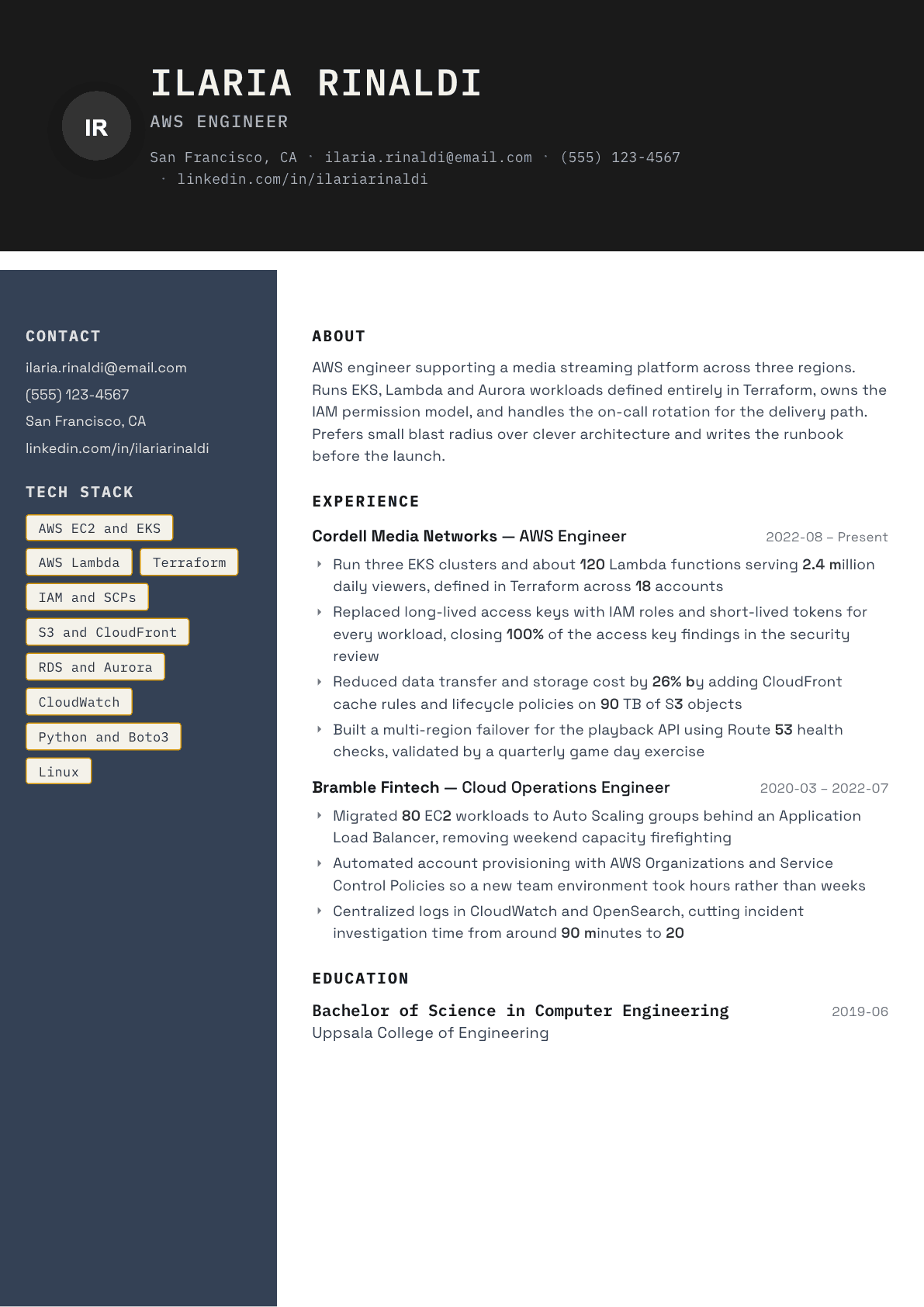
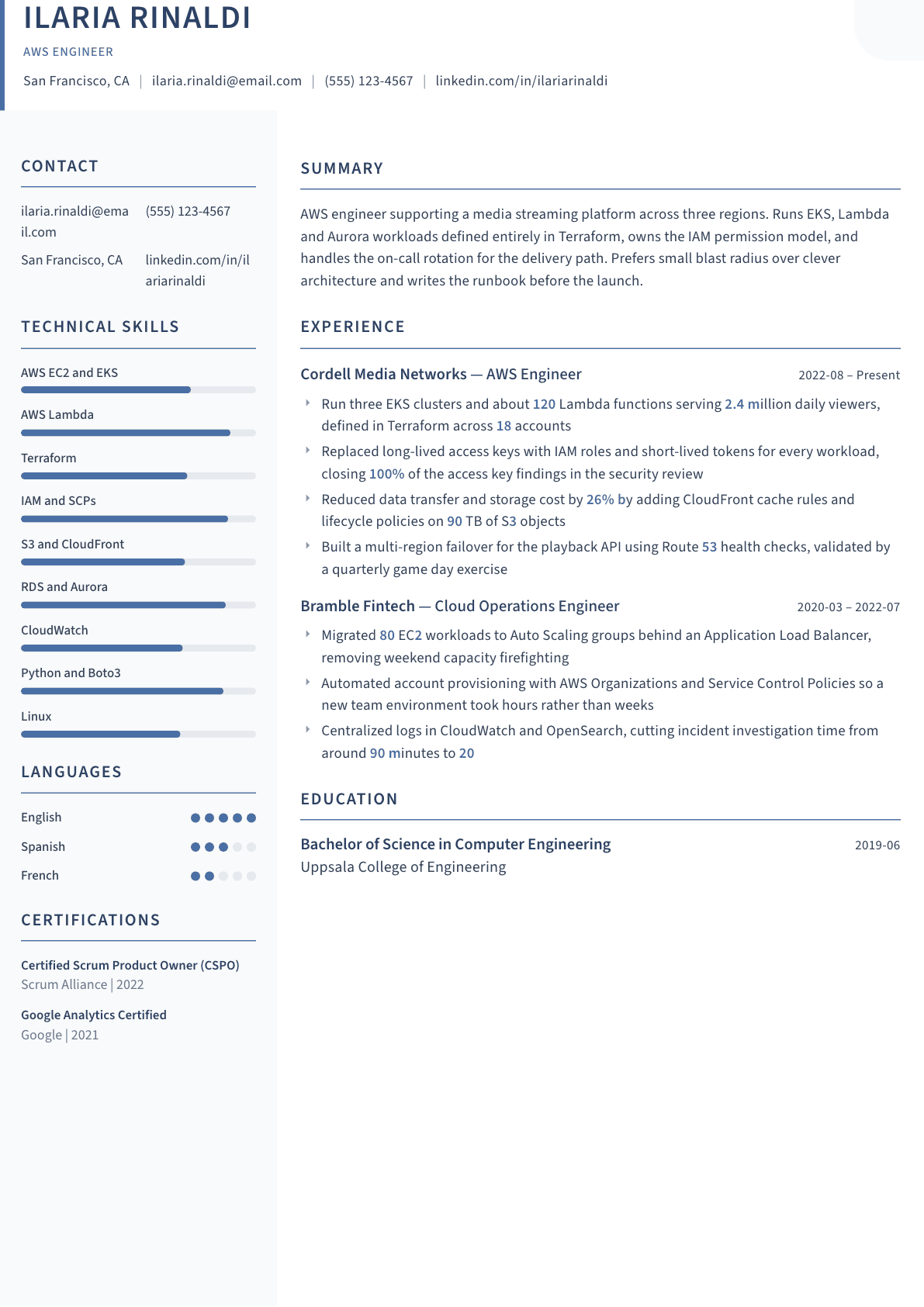
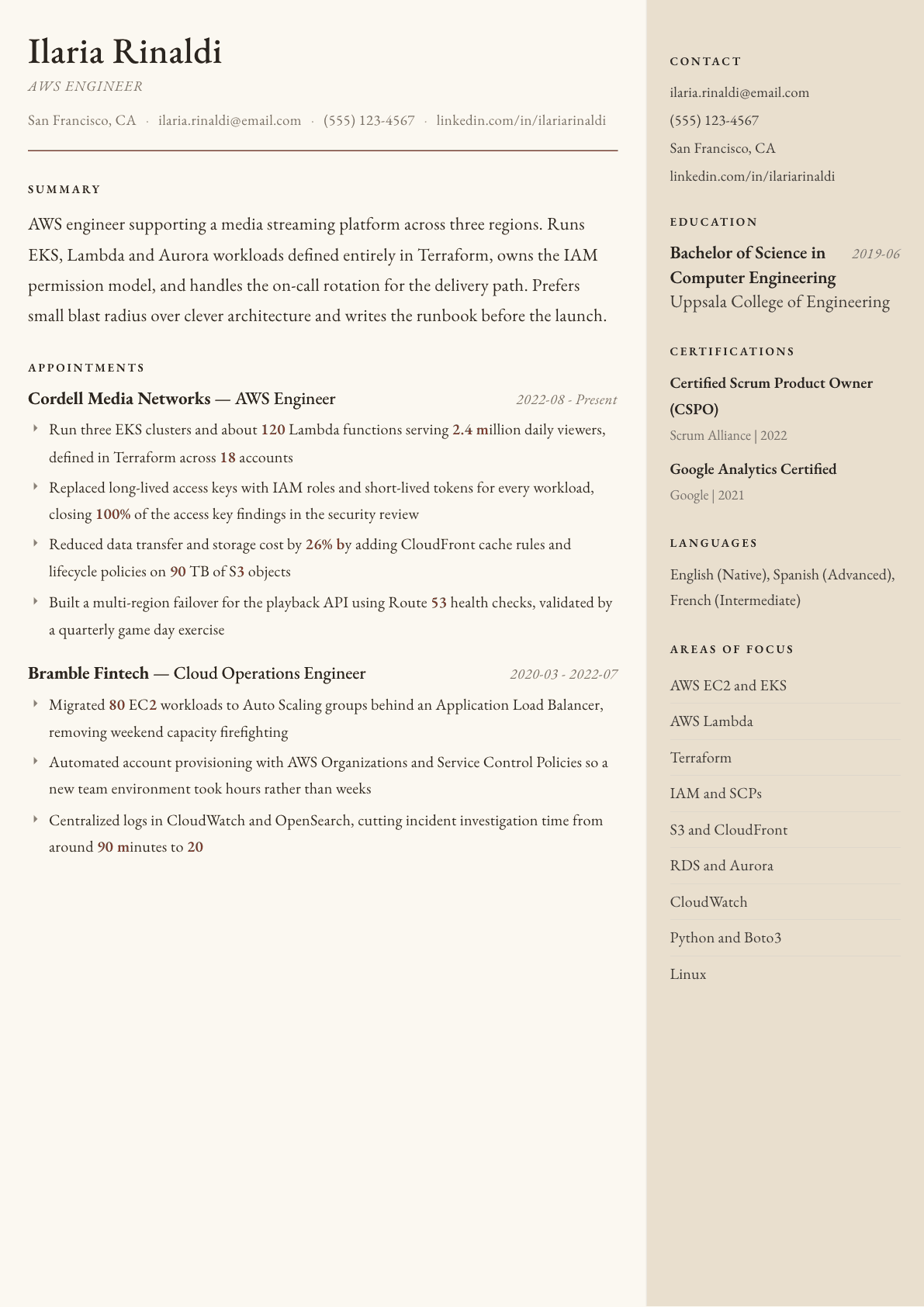
Example AWS Engineer summary
AWS engineer with six years operating production workloads on EKS, Lambda, Aurora and S3 across multiple regions. Defines every resource in Terraform, governs eighteen accounts through Organizations and Service Control Policies, and replaced static access keys with short-lived roles across the estate. Cut delivery and storage cost by 26% through cache and lifecycle changes, and proves multi-region failover in quarterly game day exercises.
Skills to list on a AWS Engineer resume
- Amazon EC2
- Amazon EKS
- AWS Lambda
- Amazon S3 and CloudFront
- Amazon RDS and Aurora
- AWS IAM
- AWS Organizations
- Terraform
- CloudFormation
- VPC networking
- CloudWatch and OpenSearch
- Python and Boto3
- CI/CD pipelines
- Cost and usage analysis
- Linux administration
What actually gets this resume read
- List the AWS services you have run in production and leave out the ones you only read about in a certification guide.
- Give the account and region structure early, because operating one account differs completely from governing twenty.
- Show IAM work in detail, since permission design is the part of AWS most teams find hardest to hire for.
- Attach cost savings to the mechanism you used, such as lifecycle policies, savings plans, right-sizing or cache tuning.
- Put your infrastructure as code tool in every relevant bullet so nobody assumes you built the estate by hand in the console.
- Name the certification and its level exactly, for example Solutions Architect Associate, rather than writing AWS certified.
How to write a aws engineer resume
An AWS engineer resume is read by someone who already knows the platform, which changes everything about how you write it. They can tell the difference between a service you have operated at load and a service you memorized for an exam, and they usually spot it in the first bullet. Precision protects you here: name what you ran, at what size, and what broke.
Account structure is the fastest way to show seniority. Working inside a single account is a legitimate job, but governing a dozen or more under an organization, with policy boundaries, centralized logging and a permission model, is a different one. State which you have done, because it sets the level the rest of the resume is read against.
This guide gives the section order that works for AWS roles, three summaries by career stage, before and after bullets built from the phrasing candidates default to, and answers to the questions that come up when your best work is under a client confidentiality agreement.
Format: technical block first, then evidence
Use a single column and reverse-chronological order. Directly under the summary, place a service block grouped by function: compute, storage, data, networking, identity, delivery and observability. Grouping shows a reader how you think about the platform, and it takes less space than a flat list of the same names.
Two pages is acceptable once you have several years of production work. Do not spend the extra page on service names, spend it on outcomes.
- Header: name, title, location, email, and certification level in full.
- Order: summary, service block, experience, certifications, education, projects.
- Mark services you have run in production separately from ones you have only used in a lab.
Summary: workload, scale, account structure
Say what the platform serves, how much traffic or data it handles, and how the accounts are arranged. An engineer running three container clusters and a hundred functions for a streaming product across eighteen accounts is instantly placeable, and that placement is the whole purpose of the summary.
If you carry the pager, mention it. Operational ownership separates the people who build environments from the people who keep them alive, and most teams are hiring for the second.
Experience: identity, cost, delivery and failure
After the scope line, cover four things across your bullets. How permissions are granted, how the estate is deployed, how spend is controlled, and how the system behaves when something fails. Those four topics fill nearly every technical interview for this role.
Identity work deserves its own bullet because it is the hardest area to hire for. Replacing long-lived access keys with roles and short-lived credentials, scoping policies to least privilege, and enforcing boundaries through service control policies are all concrete, verifiable achievements.
For failure, write about a tested mechanism. Route health checks that were exercised in a game day, a multi-region failover that ran, an incident where a cause was identified and a guardrail added. Architecture that has never been stressed convinces nobody who has operated the platform.
- Scope: accounts, regions, clusters, functions, databases, and daily traffic.
- Automation: the infrastructure as code tool and how much of the estate it covers.
- Cost: the lever pulled, cache rules, lifecycle policies, commitments or right-sizing, plus the result.
Certifications: exact level, current date
Write the credential in full, including the level, because filters match on those exact strings and a shortened form can be missed. Associate and professional level credentials are read very differently, so never blur the two.
Keep them current. An expired professional certification presented without a date reads as an attempt to look stronger than the record supports, and technical interviewers do check.
Keywords that recur in AWS postings
Expect the same phrases repeatedly: infrastructure as code, least privilege, high availability, auto scaling, event driven, serverless, containers, observability, cost and usage, well architected, and the service names themselves. Use the exact posting wording in the service block and again inside a bullet where a number backs it up.
AWS Engineer resume summary examples
First cloud role
Support engineer with two years of Linux and scripting experience, now building on AWS. Deployed a personal application on EC2 behind a load balancer with Terraform, automated backups to object storage, and holds the Solutions Architect Associate credential. Seeking a junior AWS engineer position with production exposure.
Four years in
AWS engineer running two container clusters and around 80 serverless functions for a payments product across two regions, defined entirely in Terraform. Replaced static access keys with short-lived roles across every workload and cut storage and delivery cost by 26% through lifecycle and cache policy changes.
Senior engineer
Senior AWS engineer with eight years operating multi-account estates for media and fintech platforms. Governs 18 accounts through Organizations and service control policies, owns the permission model and the delivery pipeline, and validates multi-region failover for the playback path in quarterly game day exercises.
Work experience bullets: before and after
Before: Worked with EC2, S3, Lambda and RDS.
After: Ran three EKS clusters and about 120 Lambda functions serving 2.4 million daily viewers, with Aurora and S3 behind them, all defined in Terraform.
The workload size turns a service list into evidence that those services carried real traffic.
Before: Improved AWS security posture.
After: Replaced long-lived access keys with IAM roles and short-lived tokens for every workload, closing all outstanding access key findings in the annual security review.
A named mechanism and a closed finding set make a security claim checkable.
Before: Reduced AWS bills each month.
After: Cut delivery and storage cost 26% by tightening CloudFront cache rules and applying lifecycle policies across 90 TB of object storage.
The reader learns which levers you understand, which is more useful than the saving alone.
Before: Built infrastructure using Terraform.
After: Wrote Terraform modules covering networking, cluster and database provisioning for 18 accounts, so a new team environment took hours instead of weeks.
Coverage and delivery time show the code became infrastructure standard rather than a side experiment.
Before: Set up monitoring and logging.
After: Centralized logs in CloudWatch and OpenSearch with per-service dashboards, cutting average incident investigation from around 90 minutes to 20.
An investigation time before and after makes observability work visible as an operational gain.
Hard skills
- Amazon EC2 and Auto Scaling
- Amazon EKS and ECS
- AWS Lambda and event-driven design
- Amazon S3 and CloudFront
- Amazon RDS and Aurora
- AWS IAM and permission boundaries
- AWS Organizations and control policies
- Terraform
- CloudFormation
- VPC, subnets and transit routing
- CloudWatch and OpenSearch
- Python and Boto3
- CI/CD with pipeline tooling
- Cost and usage analysis
Soft skills
- Designing for small blast radius
- Runbook and game day preparation
- Cross-team architecture review
- On-call ownership
- Explaining trade-offs to product managers
- Careful change communication
Certifications worth listing
- AWS Certified Solutions Architect, Associate (Amazon Web Services)
- AWS Certified Solutions Architect, Professional (Amazon Web Services)
- AWS Certified DevOps Engineer, Professional (Amazon Web Services)
- AWS Certified Security, Specialty (Amazon Web Services)
- HashiCorp Certified: Terraform Associate (HashiCorp)
Mistakes that cost aws engineer candidates the interview
- Listing thirty service names with no traffic, data volume or account context attached to any of them.
- Describing an estate built entirely through the web console, which signals work that cannot be reproduced.
- Skipping permission design, the single area where experienced AWS interviewers dig deepest.
- Quoting a saving without the lever behind it, leaving the reader unsure whether anything was engineered.
- Presenting untested failover as a proven capability, which collapses the moment the interviewer asks about the last drill.
- Writing certified in AWS instead of the exact credential and level that filters are matching against.
AWS Engineer resume questions
How do I describe AWS work covered by a client agreement?
Describe the shape without the name. Say a streaming platform or a regional insurer, give the workload type, the account count and the traffic order of magnitude, and keep the technical detail. Employers accept anonymized clients as long as the engineering detail is specific.
Does an associate certification still help experienced engineers?
It helps mainly as a filter at the application stage. Once you have several years of production work, the professional and specialty credentials carry more weight, and hands-on evidence in your bullets will outweigh any certification during the technical interview.
Should I include a personal project on an AWS resume?
Yes when you are early in your career and it is operated rather than merely deployed. Infrastructure defined in code, a pipeline, alerts and a monthly cost figure show the working habits of the role. Remove the project once you have production experience to replace it.
How do I show serverless experience convincingly?
Give function counts, invocation volume, the event sources involved and how you handled cold starts, retries and dead letter queues. Those operational details separate engineers who have run event driven systems from those who wrote one function in a tutorial.
Is Terraform or CloudFormation better to list?
List what you actually use, and both if that is true. Terraform appears in more postings, while CloudFormation and its higher level toolkits remain common in AWS-native shops. Naming the tool matters less than showing how much of the estate it covers.
Related resume examples
- Cloud Architect Resume example
- DevOps Engineer Resume example
- Cloud Engineer Resume example
- Azure Engineer Resume example
- Infrastructure Engineer Resume example
- Platform Engineer Resume example