API Developer Resume Examples: free ATS score and gap list
Write an API Developer Resume That Shows Real Interface Design
By Mustafa Tarabya, founder of CVBooster · Published · Updated
An API developer resume example with contract design, versioning and latency detail, plus a writing guide for every section a reviewer reads.
Sample resumes for a api developer
The same api developer content laid out in three CVBooster templates, so you can see what the finished document looks like before you write a word.
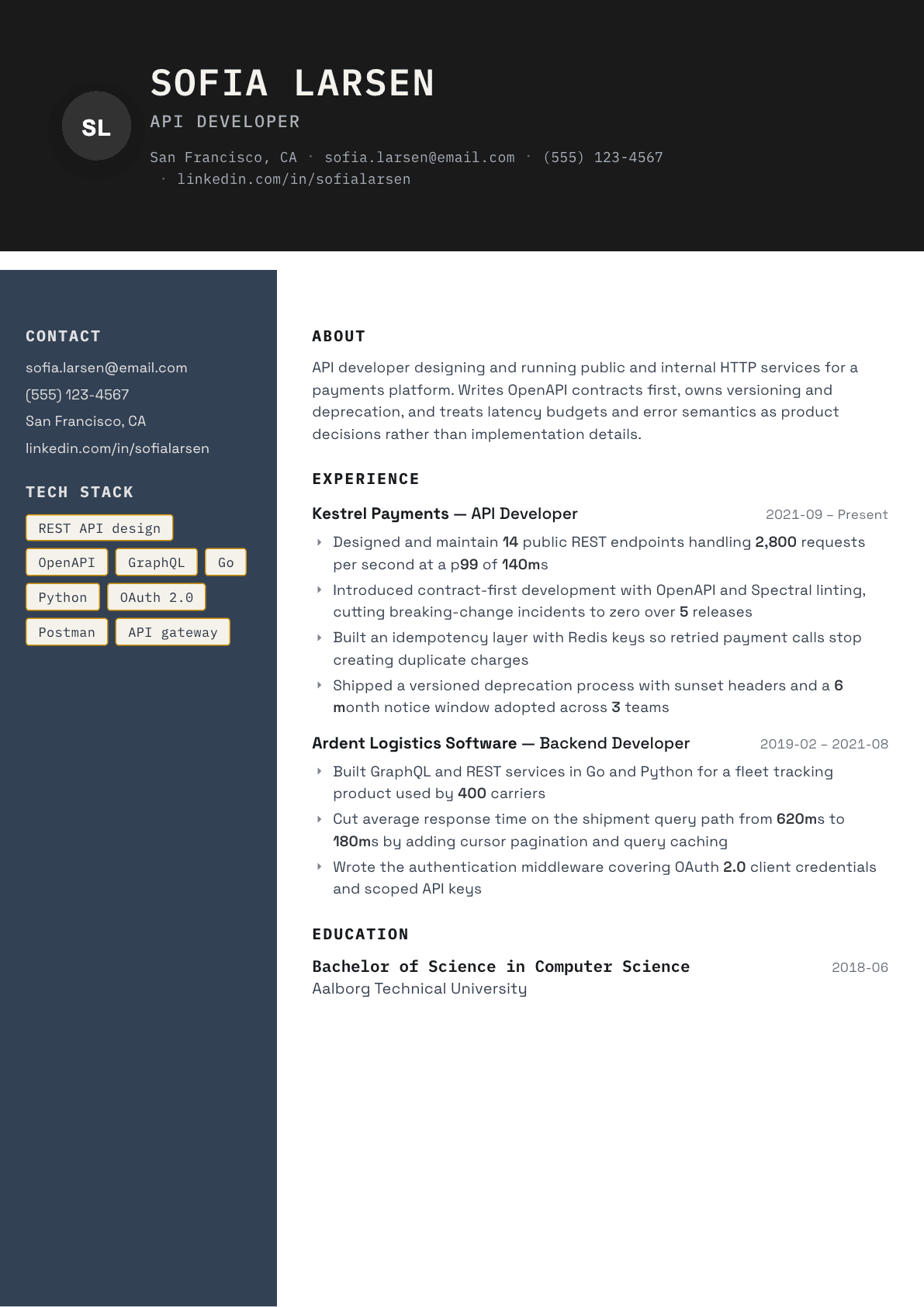
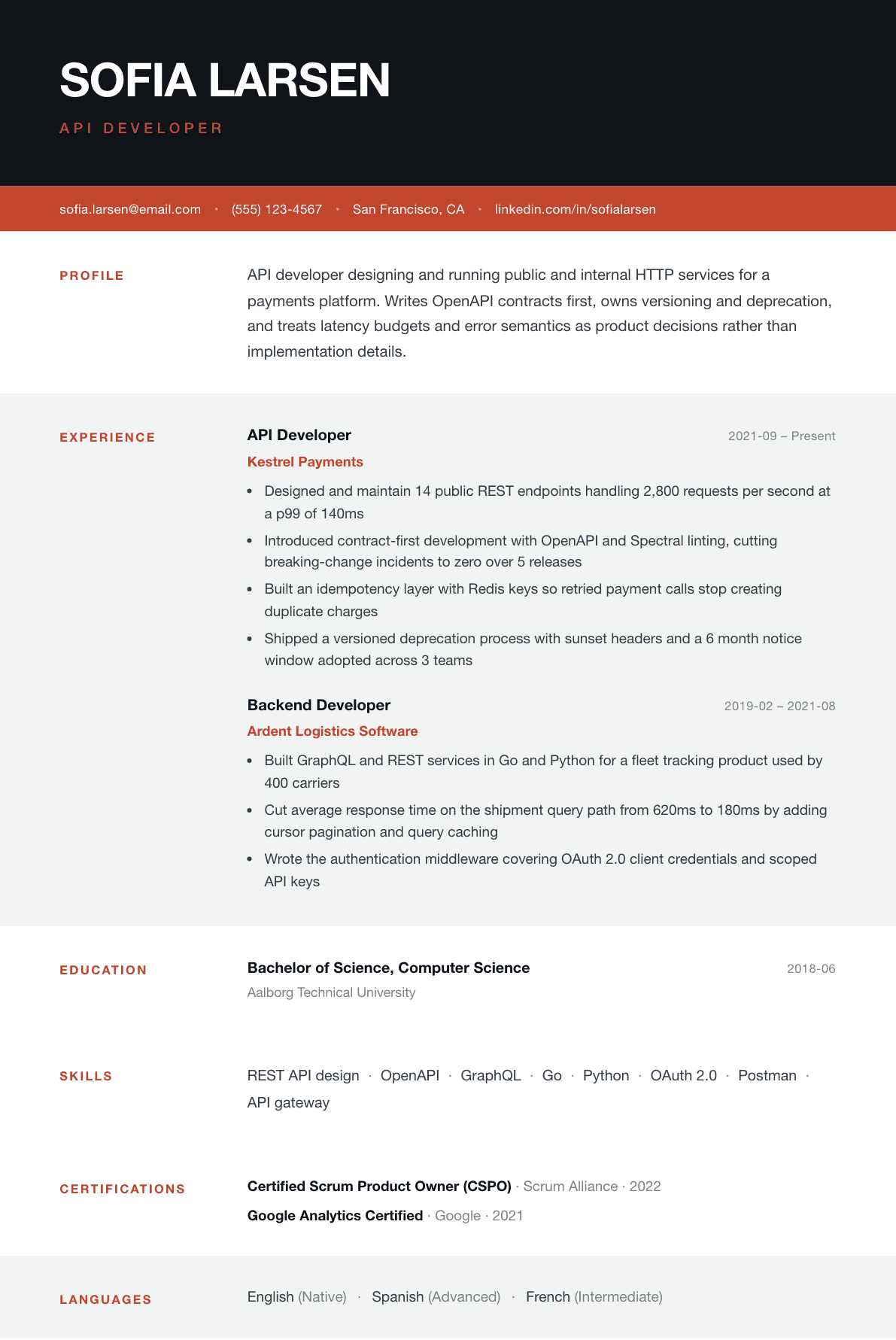
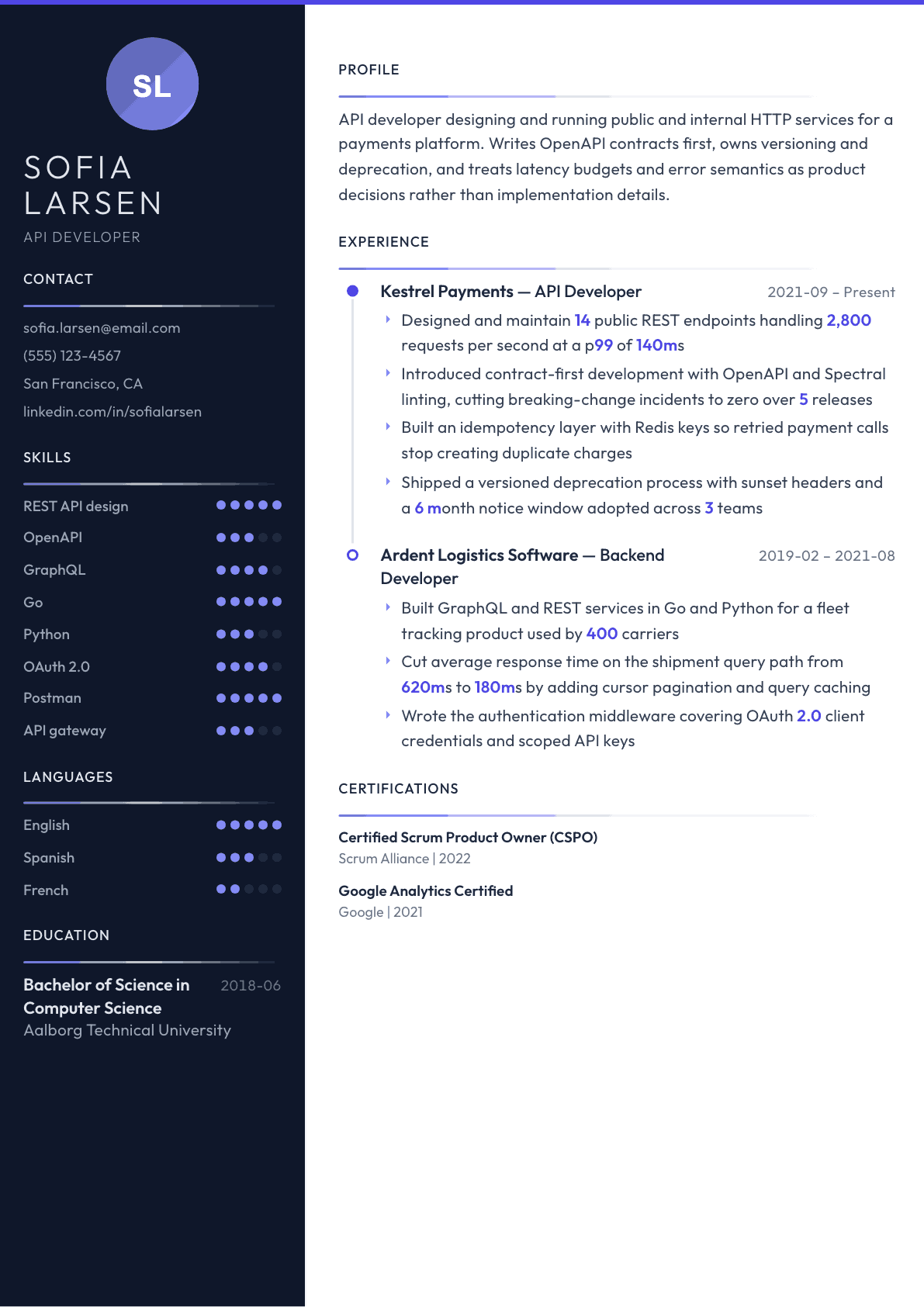
Example API Developer summary
API developer with six years designing HTTP and GraphQL services in payments and logistics. Works contract first with OpenAPI, owns versioning and deprecation policy, and runs endpoints serving 2,800 requests per second at a p99 of 140ms. Built the idempotency and OAuth 2.0 layers now used across three teams. Looking for a platform role where the public API is treated as the product.
Skills to list on a API Developer resume
- REST API design
- GraphQL
- OpenAPI
- gRPC
- Go
- Python
- Node.js
- OAuth 2.0
- API versioning
- Rate limiting
- Idempotency
- API gateway
- PostgreSQL
- Redis
- OpenTelemetry
- Postman
- CI/CD
What actually gets this resume read
- Lead with the contract, not the language: reviewers want to see that you design interfaces before you write handlers.
- Give traffic and latency numbers for the services you own, since throughput and p99 are the shared vocabulary here.
- Name your authentication and authorization model explicitly, whether OAuth 2.0, mutual TLS, signed requests or scoped keys.
- Show how you handle versioning and deprecation, because that is the part junior candidates always leave out.
- Mention documentation and developer experience work: an API developer who writes good reference docs is rare.
- List the gateway and observability stack by name, such as Kong, Envoy, Datadog or OpenTelemetry.
How to write a api developer resume
An API developer resume is read by someone who has lived through a bad interface. Maybe a public endpoint that changed shape without warning and broke three customer integrations, or an internal service whose error codes meant nothing, or a pagination scheme that fell apart at scale. She is scanning your resume for evidence that you think about contracts, compatibility and failure modes before you think about handlers and frameworks.
That is the difference between this role and a general backend job. Backend developers are hired to build systems. API developers are hired because the interface itself is the product, whether the consumer is a paying customer, a partner, or forty internal teams. The resume has to show design decisions, not only implementation: how you version, how you deprecate, how you communicate errors, how you keep latency inside a budget, and how you document the thing so a stranger can integrate without emailing you.
This guide covers the format, the summary, experience bullets that carry interface design, the skills section, and the questions developers ask when they move from generic backend work into API-focused roles.
Format: one page to about eight years, technical profile at the top
Single column, reverse chronological, one page unless you have a long record of owned services. Under your name, add three lines of technical profile: the protocols and styles you work in, the languages, and the platform. A reviewer should learn in that block whether you are a REST and GraphQL person on a managed cloud or a gRPC person inside a service mesh.
Skip the diagram, the skill bars and the two-column layout. Engineering resumes are parsed by tracking systems and then read fast by a lead who wants the stack, the scale and the ownership. Anything that slows either reader down costs you.
- Header: name, title, city, email, GitHub, and a link to public API documentation you wrote if it exists.
- Order: profile, skills, experience, projects if early, education, certifications.
- Under each job, one scope line: what services you owned, their traffic, and who consumed them.
Summary: what you own, who consumes it, and at what scale
Three or four lines. Name the domain, the number of services or endpoints you own, the consumer type, and a throughput and latency figure. Public developer-facing APIs, partner integrations and internal platform services are three different jobs with different pressures, and a reviewer wants to know which one you have done before she reaches the experience section.
Then name your design stance in one clause. Contract first with OpenAPI, or schema first in GraphQL, or protobuf definitions reviewed before implementation. That single phrase tells an interviewer you have opinions about interface design, which is exactly what she is trying to test for.
Experience: design decisions, traffic, and how you handled change
Start each role with a scope line naming the services, the traffic, and the consumers. Then write bullets that show the four things this role is judged on: contract design, compatibility over time, correctness under failure, and performance.
Contract design bullets should name the artifact. An OpenAPI specification kept in the repository, a linting rule set that blocks breaking changes in continuous integration, a review process where the schema is approved before code is written. These are the details that distinguish someone who designs interfaces from someone who adds routes to an existing service.
Compatibility bullets are where most candidates go quiet, and where senior signals live. Describe your versioning scheme, how you communicated deprecation, what notice window consumers got, and whether anything broke. A developer who has run a real deprecation with sunset headers and a migration guide is immediately more valuable than one who has only added endpoints.
Correctness bullets cover the unglamorous parts consumers feel most: idempotency keys so a retried write does not double charge, consistent error envelopes with actionable codes, rate limiting with clear headers, pagination that survives a growing dataset, and webhook delivery with retries. Pick the ones you built and say what problem each one ended.
Performance bullets need real numbers. Requests per second, p95 or p99 latency, payload size, cache hit ratio, and the specific change that moved them. Say what you measured with, because naming an observability stack proves you were responsible for the service in production rather than only in a pull request.
- Scope line: services owned, traffic, consumer type, and whether the API was public.
- One bullet on contract or schema design with the artifact named.
- One bullet on versioning or deprecation with the notice window.
- One bullet on authentication and authorization, one on latency with before and after.
Skills: protocols, languages, platform, and the developer experience layer
Group the list into four. Protocols and styles: REST, GraphQL, gRPC, webhooks, event streaming. Languages and frameworks: whichever you would take an interview in. Platform: gateway, service mesh, message broker, database, cache. Developer experience: OpenAPI, schema linting, reference documentation, sandbox environments, client library generation.
That fourth group is the one most candidates omit and the one that most distinguishes an API developer. If you have written reference documentation, generated client libraries, or run a sandbox for partner integrations, put it on the page in plain words. Very few people do it, and the teams hiring for public APIs are looking for it directly.
Keywords the posting will contain
API postings reuse a tight vocabulary: REST, GraphQL, gRPC, OpenAPI or Swagger, API gateway, rate limiting, idempotency, pagination, webhooks, OAuth 2.0, JSON Web Tokens, versioning, backward compatibility, service level objectives, latency, and observability. Use the exact terms once each in a place where they attach to your own work. A tracking system counts them, and a human immediately checks whether the surrounding sentence is real.
API Developer resume summary examples
Two years backend
Backend developer with two years building REST services in Python for an internal logistics tool, moving toward API-focused work. Wrote the OpenAPI specification the two consuming teams now build against, added cursor pagination to the shipment endpoints, and cut the slowest query path from 620ms to 180ms.
Owns a public API
API developer owning fourteen public REST endpoints on a payments platform, serving 2,800 requests per second at a p99 of 140ms. Works contract first with OpenAPI and schema linting in continuous integration, and built the Redis-backed idempotency layer that ended duplicate charge reports from retried calls.
Platform lead
Staff engineer leading API platform work across three product teams, responsible for the gateway, the versioning policy and the deprecation process now used company wide. Designed the migration from a monolithic REST surface to versioned gRPC internal services while keeping the external contract stable for every existing partner.
Work experience bullets: before and after
Before: Built REST APIs for the payments product.
After: Designed and maintain fourteen public REST endpoints for card and transfer flows, serving 2,800 requests per second at a p99 of 140ms.
Endpoint count, domain, throughput and tail latency turn a generic claim into a measurable ownership statement.
Before: Used OpenAPI for documentation.
After: Moved the team to contract-first development with OpenAPI specifications reviewed before implementation and Spectral linting in continuous integration, which blocked breaking changes at the pull request.
It shows a process that prevents defects rather than a file that documents them afterward.
Before: Handled API versioning.
After: Introduced a versioning and deprecation policy with sunset headers, a six month notice window and per-consumer usage reports, retiring two legacy versions with no partner outage.
The mechanism, the notice period and the clean outcome are exactly what a hiring lead wants to see survived.
Before: Fixed duplicate transaction issues.
After: Built an idempotency layer keyed on client-supplied request identifiers in Redis, so retried payment calls return the original result instead of creating a second charge.
It explains the failure mode and the design that ended it, which is a correctness argument rather than a bug fix.
Before: Improved API performance.
After: Cut average shipment query response from 620ms to 180ms by replacing offset pagination with cursors and caching carrier lookups behind a short expiry.
Two named techniques and the latency change let a reviewer judge whether the improvement was real engineering.
Hard skills
- REST API design
- GraphQL schema design
- gRPC and protocol buffers
- OpenAPI specifications
- API versioning and deprecation
- OAuth 2.0 and JSON Web Tokens
- Rate limiting and quotas
- Idempotency and retry semantics
- API gateway configuration
- PostgreSQL and Redis
- OpenTelemetry and distributed tracing
- Continuous integration and contract testing
Soft skills
- Writing reference documentation
- Consumer communication during change
- Design review facilitation
- Judgment on backward compatibility
- Incident communication
Certifications worth listing
- AWS Certified Developer Associate (Amazon Web Services)
- Google Cloud Professional Cloud Developer (Google Cloud)
- Microsoft Certified: Azure Developer Associate (Microsoft)
- Certified Kubernetes Application Developer (CKAD) (Cloud Native Computing Foundation)
Mistakes that cost api developer candidates the interview
- Listing frameworks and languages while saying nothing about how the interfaces themselves were designed.
- Omitting traffic and latency figures, which leaves a reviewer unable to tell a hobby service from a production one.
- Never mentioning versioning or deprecation, the two topics every senior interview for this role will reach.
- Treating documentation as an afterthought when developer experience is a large part of the job on public APIs.
- Claiming GraphQL and gRPC experience based on a tutorial rather than a service someone else depended on.
- Describing authentication vaguely instead of naming the flow, the token format and the scope model you implemented.
API Developer resume questions
What is the difference between an API developer and a backend developer?
A backend developer is measured on the system behind the interface. An API developer is measured on the interface itself: its contract, its stability across versions, its error semantics and its documentation. The resume should therefore lead with design decisions rather than only with services built.
Should I put API documentation work on my resume?
Yes, and give it a full bullet. Reference documentation, quickstart guides, sandbox environments and generated client libraries are the reasons an integration succeeds without support tickets. Few candidates mention this work, so it stands out immediately on a public API team.
What numbers should an API developer include?
Requests per second, p95 or p99 latency, error rate, number of endpoints or services owned, and the count of internal or external consumers. Add cache hit rates or payload size reductions when you were the one who moved them.
Do I need GraphQL experience for API developer roles?
Not universally. Most postings still center on REST, with GraphQL appearing where a client team needs flexible querying and gRPC where internal service performance matters. List honestly what you have run in production, since interviewers probe schema design and the resolver performance traps quickly.
How do I show API security experience without overclaiming?
Name the concrete pieces you implemented: the OAuth 2.0 grant type, token validation, scope design, rate limits per client, input validation and secret rotation. That is more convincing than the word security and it survives follow-up questions in a technical screen.
Related resume examples
- Backend Developer Resume example
- Software Engineer Resume example
- Python Developer Resume example
- Technical Account Manager Resume example
- Node.js Developer Resume example
- Full-Stack Developer Resume example