Python Developer Resume Examples: the lines they read
Build a Python Developer Resume That Shows Real Range
By Mustafa Tarabya, founder of CVBooster · Published · Updated
A Python software developer resume written out in full, with Django and FastAPI examples, data tooling keywords and a guide to every section.
Sample resumes for a python developer
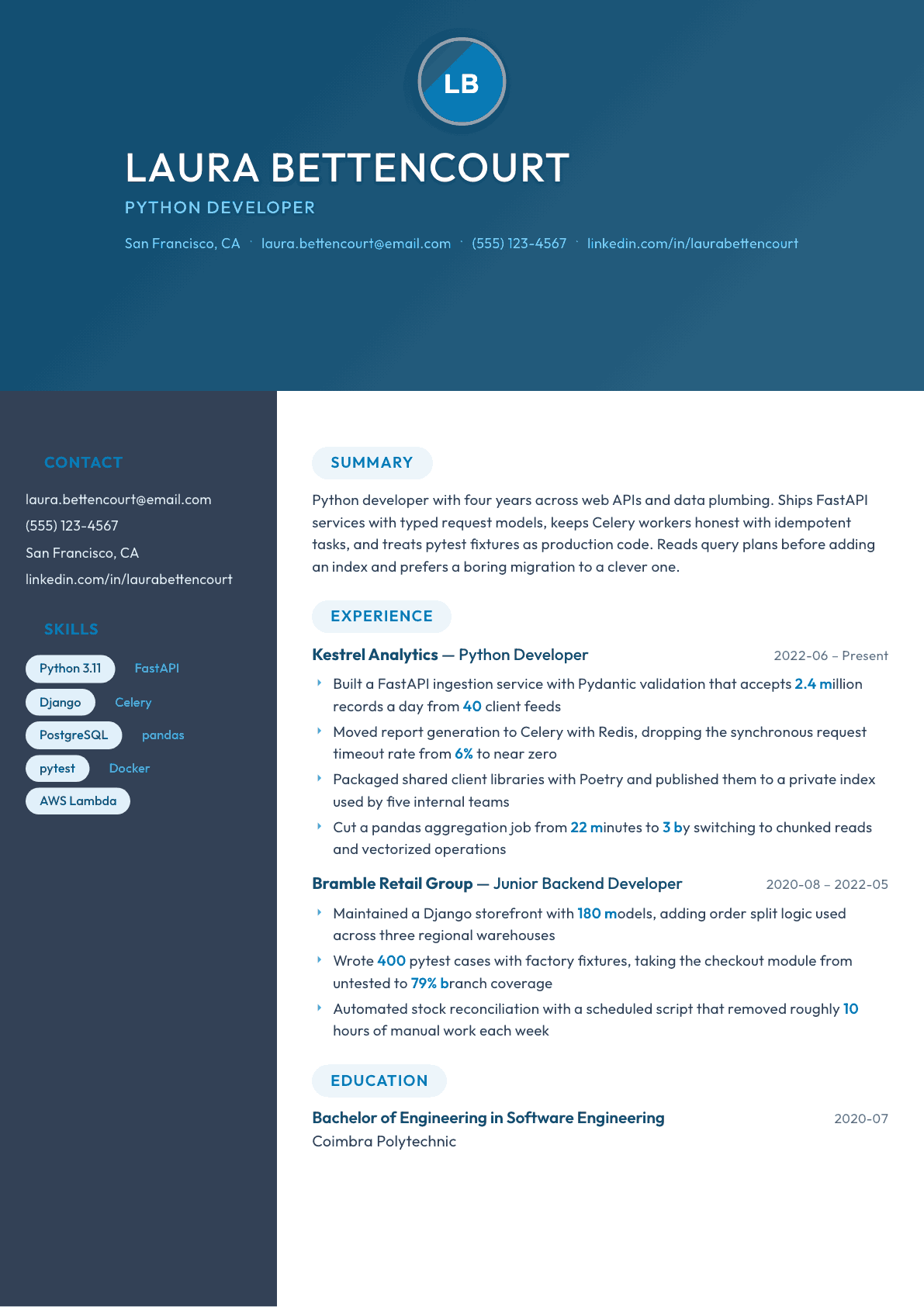
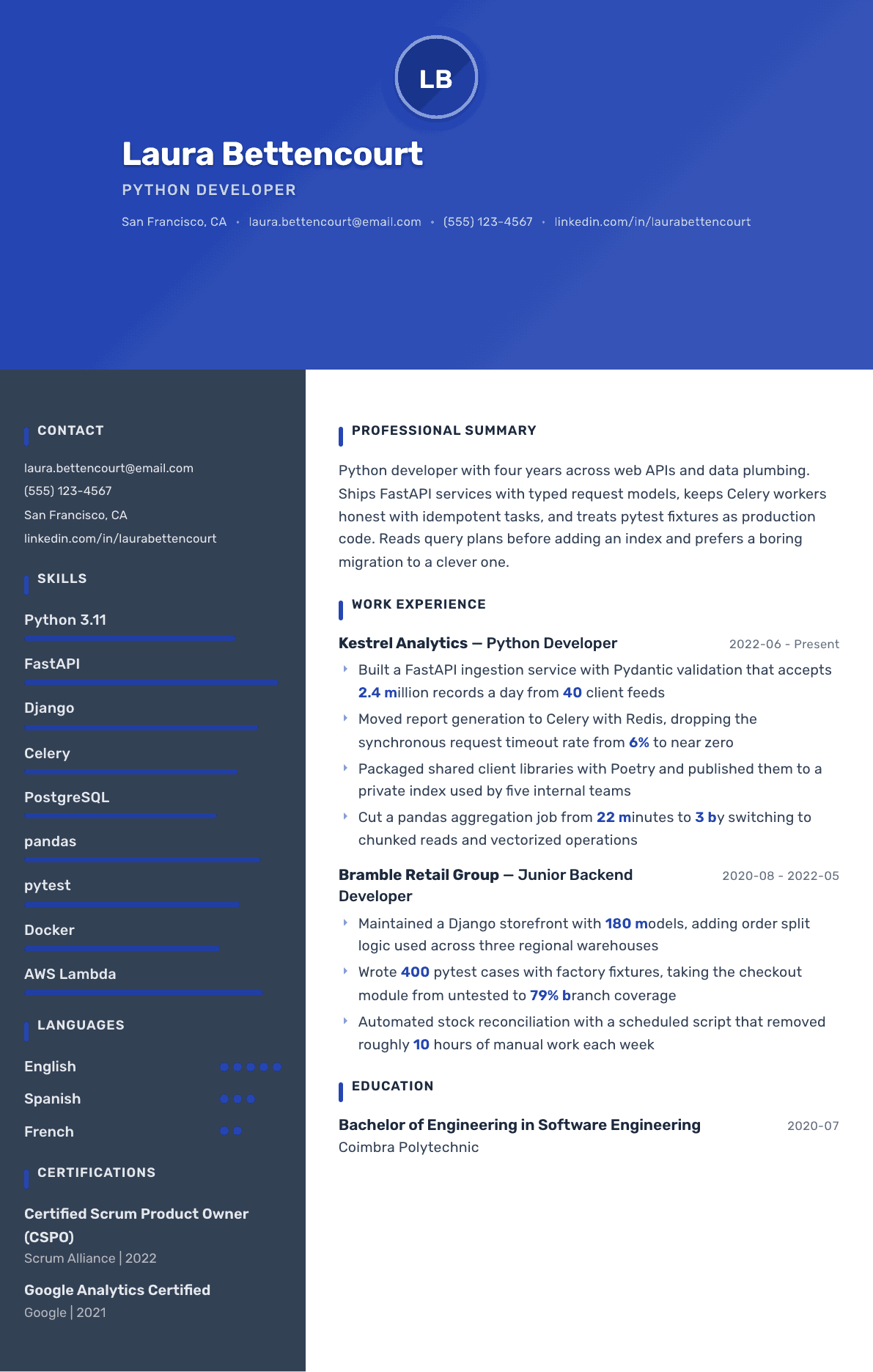
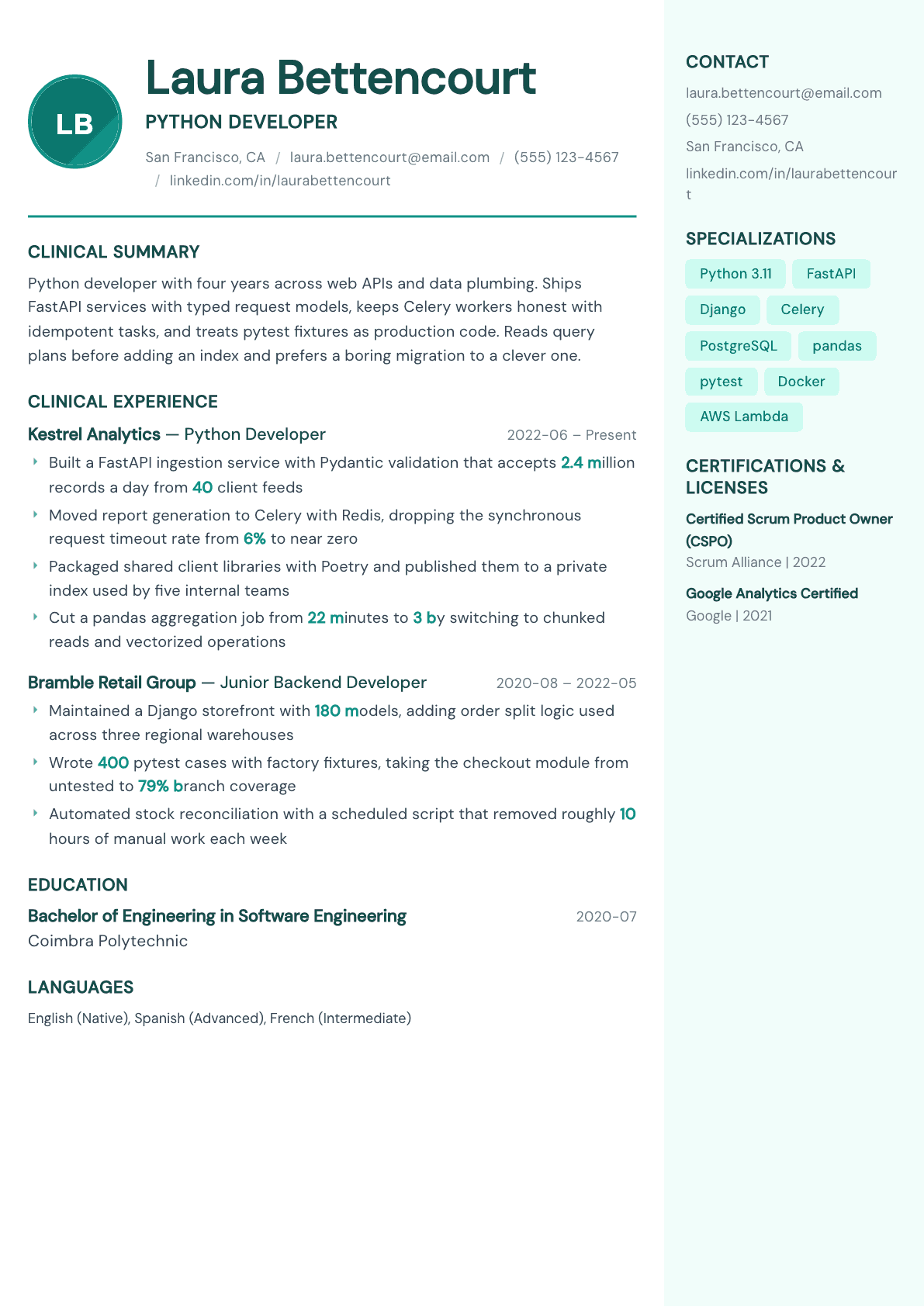
The same python developer content laid out in three CVBooster templates, so you can see what the finished document looks like before you write a word.
Example Python Developer summary
Python developer with four years building APIs and batch pipelines for analytics products. Comfortable in Django when the domain is rich and FastAPI when the contract matters more than the admin. Runs Celery workers, writes pytest suites that catch regressions before review, and keeps type hints and ruff checks in the pipeline. Seeking a backend role where data volume and correctness both count.
Skills to list on a Python Developer resume
- Python
- Django
- FastAPI
- Flask
- SQLAlchemy
- Celery
- pandas
- NumPy
- pytest
- asyncio
- PostgreSQL
- Redis
- Docker
- AWS
- REST API design
- Git
What actually gets this resume read
- Split your Python work into web, data and automation, because those are three different hiring pools with different screens.
- Name the framework and the version family: Django with the ORM, FastAPI with Pydantic, or Flask with SQLAlchemy.
- Mention typing, linting and formatting tools such as mypy, ruff and black, since teams ask about code discipline.
- Quantify data work by rows, files or run time rather than by the library name alone, which every applicant lists.
- Show one asynchronous or concurrency story: Celery, asyncio, or multiprocessing, and say what problem forced the choice.
- Keep notebook work out of the experience section unless the notebook itself was the deliverable for a stakeholder.
How to write a python developer resume
Python appears in three separate job markets that share a language and almost nothing else. There is web and API work in Django and FastAPI, there is data and pipeline work in pandas, Airflow and warehouse tooling, and there is automation and scripting inside operations teams. A resume that tries to look equally strong in all three usually reads as strong in none, because the hiring manager for each one is scanning for a different half of the page.
Pick the market you are applying into, then order the resume so that market sees itself first. The other work still belongs on the page, further down, where it reads as range rather than as confusion. A backend manager who sees a FastAPI service with typed models at the top will happily read about your Airflow work afterward.
What follows is the format that survives applicant tracking parsing, how to write each section for Python work specifically, a Python software developer resume written out in full, three summaries at different stages, rewritten bullets, and the questions Python candidates raise most often.
Format: choose your track before you choose your template
Reverse chronological, one column, no icons in place of words. Keep it to one page below five years of experience. Put a short technical skills block above the experience section so the keyword pass finds the framework names without depending on your bullets.
Group the skills block by purpose rather than alphabetically. Web, data, testing, infrastructure. A reader hiring for a Django team should be able to locate Django, the ORM and the test runner in one glance.
- Header: name, target title, location, phone, email, and a code profile link when the repositories are presentable.
- Order for web roles: summary, skills, experience, projects if early career, education.
- Order for data roles: move pipeline and warehouse tooling to the front of the skills block.
Summary: the track, the framework, the scale, the discipline
Three or four lines. Name the years, the track, the primary framework and one habit that signals engineering discipline rather than scripting. Type hints checked by mypy, a pytest suite that runs in the pipeline, or migrations that are reviewed like code all do that work in a few words.
Avoid opening with the word passionate. The reader has seen it on every Python resume in the pile, and it displaces the sentence that could have named FastAPI, Pydantic and the volume of traffic your service handled.
Experience: name the framework, the data, and the run time
For web and API work, give the framework, what the service does, and its size in requests, users or integrations. Then show one design decision. Choosing FastAPI for a contract heavy internal API and Django for a domain with a rich admin is exactly the kind of judgment a lead engineer is testing for.
For data work, the units are rows, files, sources and run time. A job that reads 40 client feeds and lands 2.4 million records a day is a real system. A bullet that says built ETL pipelines with pandas is a category. Include the failure handling too: retries, idempotency, backfills, and what happens when a source sends malformed input.
For any track, one bullet should cover testing or correctness. Python gives you enough rope to build something fast and fragile, so managers look hard for evidence that you do not.
Skills: libraries you would defend, not every import you have used
Name the Python major version, the frameworks, the data layer, the task runner and the test stack. Add the code quality tools you actually run, such as mypy, ruff or black, because they are a cheap and honest signal about how you work in a shared codebase.
Leave out libraries you touched once. Listing TensorFlow because of a tutorial invites a machine learning question in an interview for a Django role, and there is no version of that conversation that helps you.
- Web: Django, Django REST Framework, FastAPI, Flask, Pydantic, SQLAlchemy.
- Async and background work: asyncio, Celery, Redis, RQ.
- Data: pandas, NumPy, Polars, Airflow, dbt when you have used it properly.
- Quality: pytest, coverage, mypy, ruff, pre-commit.
Projects and open source: worth the space only when they are real
A published package with users, a contribution merged into a library people depend on, or a service you built and still run all earn a place. A tutorial to do list application does not, and it makes an otherwise solid resume look thin.
When you include a project, write it like a job: what it does, who uses it, what you chose and why. Two lines on a package installed by other teams beats a paragraph on something nobody has run except you.
Python software developer resume example, written out
A Python software developer resume and a Python developer resume are the same document; software is the word larger companies put in the job title. Here is a complete one for a backend engineer in her fifth year, written as plain text so the order is visible. The person and companies are invented.
Header: Priya Raman, Python Software Developer, city, phone, email, GitHub and LinkedIn links. Summary: Backend engineer with five years building Python web services in Django and FastAPI for a payments product, owning three services from design to on call, with typed code, tests in pytest and deployments through a CI pipeline to containers on a cloud platform.
Skills line: Python, Django, FastAPI, SQLAlchemy, PostgreSQL, Redis, Celery, pytest, Docker, a cloud platform named by product, Git. Education: BS in Computer Science.
- Software Engineer, a payments company, three years: built the refunds API in FastAPI with Pydantic models, replacing a batch job that ran overnight with requests answered in real time.
- Moved the reporting queries off the primary database onto a read replica and added caching for the slowest endpoints, which ended the timeouts support had been logging every month end.
- Wrote the integration test suite for the merchant onboarding service and made it a required check before merge.
- Earlier: Junior Python Engineer, a logistics startup, two years: Django admin tools for dispatchers and a scheduled Celery job that reconciles carrier invoices.
Python Developer resume summary examples
Career starter
Software engineering graduate with a six month placement building Django views and REST endpoints against PostgreSQL, plus a published package for parsing bank statement exports with pytest coverage above 80%. Comfortable with Git, Docker and code review. Seeking a junior Python role on a product team.
Four years in
Python developer with four years across FastAPI services and pandas pipelines for an analytics product. Built the ingestion service that validates 2.4 million records a day from 40 client feeds, and moved report generation onto Celery so request timeouts fell from 6% to almost none. Types checked, tests in the pipeline.
Senior backend engineer
Senior Python engineer with nine years on Django and FastAPI platforms, currently owning the API layer for a subscription business and mentoring three developers. Led the split of a large Django project into three deployable services, and set the pytest and mypy standards the whole team now works to.
Work experience bullets: before and after
Before: Built REST APIs with Python.
After: Built a FastAPI ingestion service with Pydantic validation and typed responses, accepting 2.4 million records a day from 40 client feeds with schema errors rejected at the edge.
The framework, the validation approach and the daily volume make the same claim checkable.
Before: Used Celery for background tasks.
After: Moved report generation to Celery workers backed by Redis with idempotent task keys, taking synchronous request timeouts from 6% of report calls to near zero.
Idempotency and the timeout figure show you understood the failure mode, not just the library.
Before: Optimized a slow data job.
After: Cut a pandas aggregation from 22 minutes to 3 by reading the source in chunks, replacing row wise apply calls with vectorized operations, and indexing on the join key.
Three named techniques and a run time turn a vague optimization into evidence of how you think.
Before: Wrote tests for the checkout flow.
After: Wrote 400 pytest cases with factory fixtures and a frozen clock for the checkout module, taking branch coverage from nothing to 79% and catching two currency rounding bugs before release.
Fixtures, a deterministic clock and the bugs found prove the tests were useful rather than decorative.
Before: Automated manual reporting work.
After: Automated weekly stock reconciliation with a scheduled Python job that reads three warehouse exports, flags mismatches over a tolerance, and emails a summary to operations.
Naming the inputs, the rule and the recipient makes the automation a system rather than a script.
Hard skills
- Python 3 and type hints
- Django and Django REST Framework
- FastAPI and Pydantic
- Flask
- SQLAlchemy and the Django ORM
- Celery and Redis
- asyncio
- pandas and NumPy
- pytest and coverage
- mypy and ruff
- PostgreSQL
- Docker and containerized deployment
- REST API design
Soft skills
- Reading a codebase before changing it
- Scoping data work realistically
- Documenting endpoints for other teams
- Debugging from logs rather than guesswork
- Pairing with analysts and non engineers
- Reviewing migrations carefully
Certifications worth listing
- PCEP Certified Entry-Level Python Programmer (Python Institute)
- PCAP Certified Associate in Python Programming (Python Institute)
- AWS Certified Developer, Associate (Amazon Web Services)
- Microsoft Certified: Azure Developer Associate (Microsoft)
Mistakes that cost python developer candidates the interview
- Mixing web, data and automation work into one undifferentiated list, so neither hiring manager sees the half they wanted.
- Listing a machine learning library from a tutorial, which invites interview questions your experience cannot support.
- Describing pipelines without rows, sources or run time, leaving the reader unable to judge the size of anything.
- Skipping the framework name in bullets, so a Django posting screen never matches a resume built on Django work.
- Presenting notebook analysis as engineering experience when no one else ever ran the notebook.
- Omitting testing and typing tools, which makes a strong Python resume read as a scripting resume.
Python Developer resume questions
Should I write one Python resume or several?
Keep one master document and cut a version per track. The web version leads with Django or FastAPI and service volume, the data version leads with pipelines, sources and run time. The underlying facts stay identical, only the order and the summary change.
Do I need to show my GitHub as a Python developer?
Only when the repositories are worth opening. A package other people install, a merged contribution to a library, or a service with a readable README all help. A folder of course exercises works against you, so leave the link off in that case.
How do I present Django and FastAPI experience together?
Show both and say which you reach for when. Explaining that you keep Django where the admin and the ORM earn their weight and choose FastAPI for typed service contracts reads as judgment, which is exactly what a senior screen is looking for.
Is a Python certification worth listing?
The Python Institute credentials can help a career changer show baseline competence when there is no work history to point at. Once you have two or three years of production experience, a cloud certification adds more than another language certificate does.
How much detail belongs in a data pipeline bullet?
Give the source count, the volume, the schedule and the run time, then one sentence on failure handling. Backfills, retries and how bad input is quarantined tell an interviewer more about your maturity than the name of the orchestration tool does.
Related resume examples
- Backend Developer Resume example
- Data Engineer Resume example
- API Developer Resume example
- Software Engineer Resume example
- Full-Stack Developer Resume example
- Node.js Developer Resume example