Golang Developer Resume Examples: the lines they read
Engineer a Golang Developer Resume That Performs at Scale
By Mustafa Tarabya, founder of CVBooster · Published · Updated
Create a high-performance Golang developer resume featuring concurrency patterns, distributed systems experience, and cloud-native expertise.
Sample resumes for a golang developer
The same golang developer content laid out in three CVBooster templates, so you can see what the finished document looks like before you write a word.
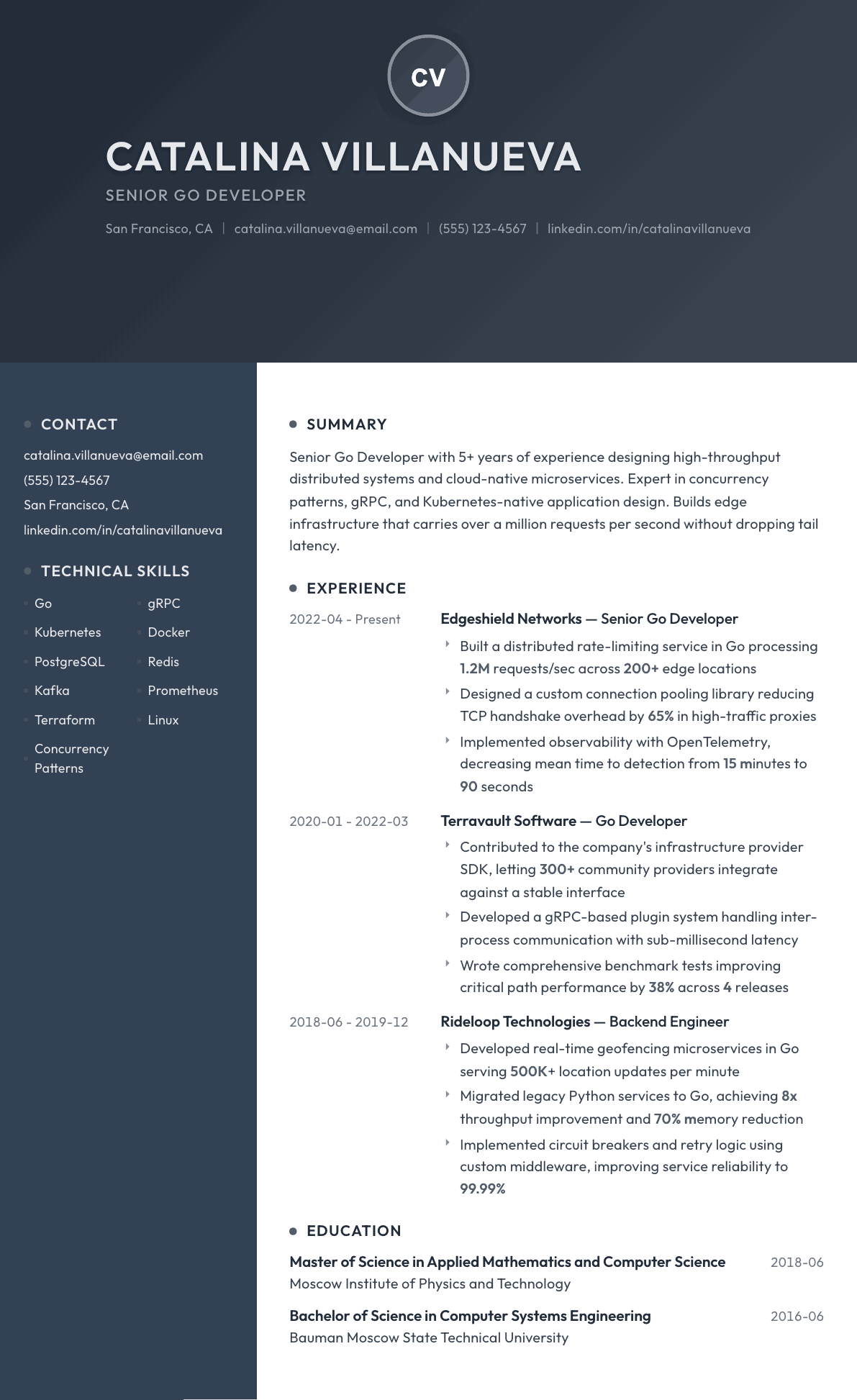
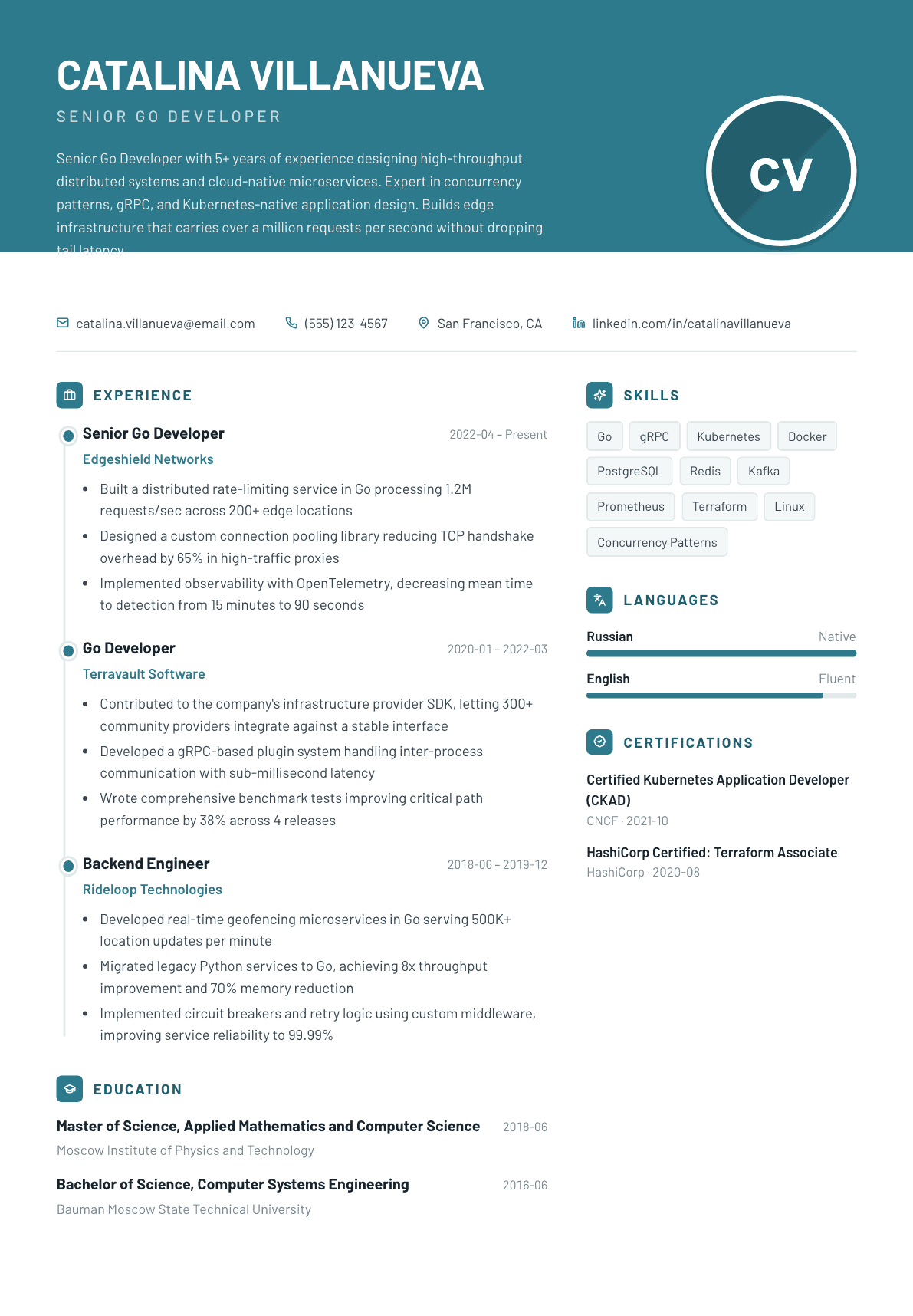
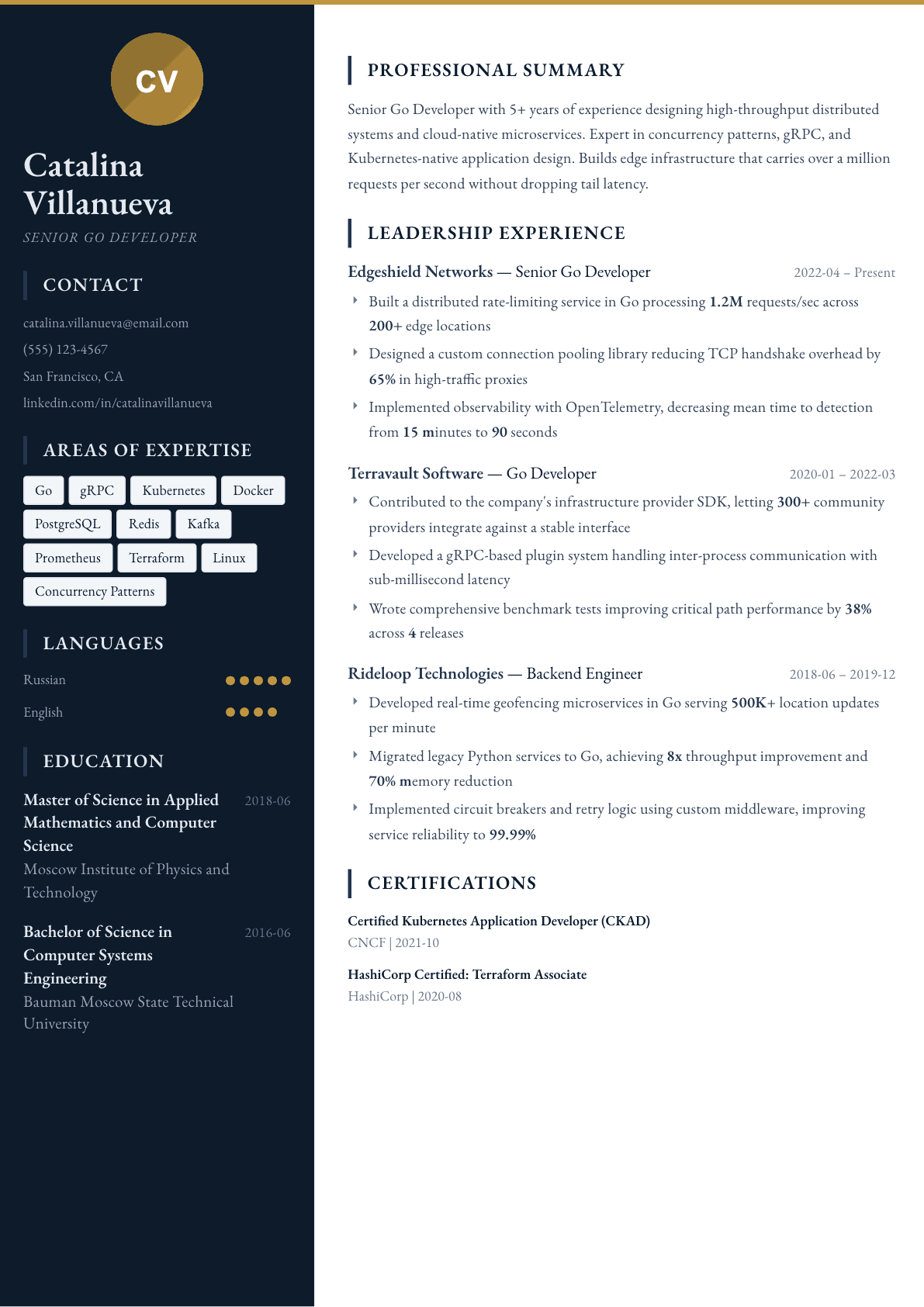
Example Golang Developer summary
Go Developer with 5 years building distributed systems that carry millions of requests per second. Wrote a rate-limiting service running across 200+ edge locations and a gRPC plugin system with sub-millisecond latency. Strong in concurrency patterns, Kubernetes-native design, and OpenTelemetry observability.
Skills to list on a Golang Developer resume
- Go
- gRPC
- Protocol Buffers
- Kubernetes
- Docker
- PostgreSQL
- Redis
- Kafka
- Prometheus
- Grafana
- Terraform
- Linux
What actually gets this resume read
- Highlight concurrency expertise: goroutines, channels, sync primitives, and race condition prevention.
- Quantify throughput and latency metrics to demonstrate the performance advantages of your Go services.
- Mention experience with Go tooling: go test, pprof, race detector, and linting with golangci-lint.
- Include cloud-native ecosystem skills: Kubernetes, Docker, Prometheus, gRPC, and protobuf.
- Show migration experience from other languages to Go, emphasizing performance and reliability gains.
How to write a golang developer resume
Teams that hire a Golang developer have usually chosen the language for a reason: they run services that must handle heavy concurrent load with predictable latency and a small operational footprint. The engineer reading your resume is checking whether you understand that reason, or whether you simply wrote your usual code in a new syntax. Those two candidates look identical in a skills list and completely different in a bullet.
The tell is what you write about. A resume that leans on goroutines and channels as buzzwords reads junior. A resume that talks about context cancellation, backpressure, connection pooling, allocation pressure, and what the profiler said reads like someone who has run Go in production at load.
This guide covers the layout backend hiring managers expect, how to write about concurrency and performance so a Go reviewer trusts it, summaries for three career stages, before and after bullets, and the questions that come up when engineers move into Go from another language.
Format: one page, single column, no decorative anything
Reverse chronological, plain, one column. Go teams skew toward infrastructure and platform work, and the reviewers there are unusually impatient with resume decoration. Two pages are acceptable once you have roughly eight years of backend experience and multiple systems worth describing.
Put a link to a public repository in the header if you have Go code worth reading. Reviewers in this ecosystem do open repositories, and a small, well-tested library with a clear readme and a benchmark file is worth more than a long list of technologies.
- Header: name, city, email, repository link.
- Order: summary, experience, skills grouped by language, data stores, infrastructure and observability, then education.
- Engineers new to Go keep their prior backend experience in full and add a Go projects section rather than rewriting history.
Summary: the systems, the load, and how long in Go
Say what kind of systems you build in Go, the traffic or data scale, and how long you have written it professionally. Backend, platform, infrastructure tooling, command line tools and data pipelines are different Go jobs and a reader needs the category immediately.
Be honest about the Go timeline when you are converting from another language. A backend engineer with eight years of experience and eighteen months in Go should say exactly that, then let the depth of the Go bullets carry the rest. Overstating it is caught in the first code discussion.
Concurrency: write about the hard part, not the syntax
Anyone can start a goroutine. What a Go reviewer is looking for is evidence that you have handled the consequences: canceling work with context when the caller goes away, bounding concurrency with a worker pool or a semaphore instead of an unbounded fan-out, avoiding goroutine leaks, choosing a mutex over a channel where it is simpler, and detecting races with the built-in detector.
Backpressure is the single best word to have on a Go resume, because it shows you have thought about what happens when the downstream is slower than the inbound rate. Queue depth, timeouts, retries with a budget, and circuit breaking all belong in the same family and all read as production experience.
Performance, services and the operational surface
Give latency in percentiles rather than averages, because the ninety-ninth percentile is what a Go team is actually protecting. Say throughput per instance, memory footprint, and what changed after your work: fewer allocations, a shorter garbage collection pause, less time in a lock, a smaller container image, faster startup.
Name the surface your service exposes and the tooling around it. HTTP with the standard library or a router, gRPC with protocol buffers, a message consumer on Kafka or NATS, a database layer against PostgreSQL, and the observability stack you instrumented with. Reviewers also value build and deployment detail: static binaries, small container images, and how a release is rolled back.
- Say which profiling you used, such as CPU and heap profiles or the execution tracer, and what it revealed.
- Mention testing style: table-driven tests, benchmarks with the standard tooling, fuzzing, and integration tests against a real database.
- Note any code generation you own, such as protocol buffer definitions or generated clients other teams depend on.
Keywords a Golang posting repeats
These postings recycle a predictable set: Go, goroutines, channels, gRPC, protocol buffers, REST, microservices, Kubernetes, Docker, PostgreSQL, Kafka, distributed systems, observability, and cloud platform names. Mirror the posting wording once in the skills grouping and once inside a bullet where it is attached to a real service. A single line naming the Go tooling you use daily, including modules, vet, the race detector and a linter, quietly signals maturity that a keyword list cannot.
Golang Developer resume summary examples
Junior backend engineer
Backend engineer with a year of Go on internal HTTP services, writing table-driven tests and instrumenting handlers with metrics and structured logs. Maintains a small open-source Go library with benchmarks, and comfortable reading standard library source when the documentation runs out.
Four years in Go
Go developer with four years building gRPC services on Kubernetes for a payments platform handling roughly 9,000 requests a second at peak. Rewrote the settlement worker to bound concurrency and respect context cancellation, cutting the ninety-ninth percentile latency from 800 to 120 milliseconds.
Senior or staff engineer
Senior engineer with twelve years in backend systems and seven writing Go, owning a service platform of fourteen services across three teams. Sets the shared library and observability standard, runs the on-call review, and has cut cluster capacity by a third through allocation and pooling work.
Work experience bullets: before and after
Before: Built microservices in Go.
After: Built and owned four Go gRPC services behind an internal API gateway, each with protocol buffer contracts, structured logging, metrics and a runbook the on-call rotation actually uses.
Naming the contract, the instrumentation and the runbook shows service ownership rather than just writing handlers.
Before: Used goroutines to improve performance.
After: Replaced an unbounded fan-out with a worker pool of 32 goroutines fed by a buffered channel and canceled through context, which ended the memory spikes that had been restarting the pod under load.
Bounded concurrency and cancellation are the parts a reviewer checks for, and the failure it fixed proves it happened in production.
Before: Made the service faster.
After: Cut ninety-ninth percentile latency from 640 to 90 milliseconds by pooling database connections, reusing byte buffers found through a heap profile and removing a lock held across a network call.
A percentile, a profiler and three named techniques let a Go engineer verify the claim in an interview.
Before: Wrote tests for Go code.
After: Brought the payments package to full branch coverage with table-driven tests, added benchmarks that gate merges on allocation regressions, and ran the race detector in the pull request pipeline.
Benchmarks gating merges and the race detector in continuous integration are Go-specific habits that mark an experienced engineer.
Before: Worked with Kafka and databases.
After: Wrote a Kafka consumer in Go with an at-least-once delivery guarantee, idempotent writes into PostgreSQL and a dead letter topic, processing about 40 million events a day without duplicate ledger entries.
Delivery semantics and idempotency are the details that separate a working consumer from a correct one.
Hard skills
- Go and the standard library
- Goroutines, channels and sync primitives
- Context propagation and cancellation
- gRPC and protocol buffers
- HTTP service design
- PostgreSQL and query tuning
- Kafka or NATS messaging
- Redis and caching
- Profiling and benchmarking
- Docker and Kubernetes
- Observability with metrics, logs and traces
- Table-driven testing and fuzzing
- Continuous integration pipelines
- Terraform or comparable infrastructure code
Soft skills
- Design documents
- Code review
- On-call ownership
- Simplicity over cleverness
- Cross-team API negotiation
- Mentoring engineers new to Go
Mistakes that cost golang developer candidates the interview
- Naming goroutines and channels as achievements, which reads as syntax familiarity rather than production concurrency experience.
- Giving average latency instead of a percentile, when the tail is the number every Go team is actually defending.
- Hiding that Go is recent. Stating the real timeline and showing depth in the Go bullets is stronger than a claim that collapses under questioning.
- Skipping the operational side. A Go service without deployment, metrics and on-call detail looks like code that never left a laptop.
- Listing a dozen languages so the reader cannot tell whether Go is your working language or one you tried.
- Never mentioning testing style, when table-driven tests, benchmarks and the race detector are quick signals of a mature Go engineer.
Golang Developer resume questions
How do I move into a Golang role from another language?
Keep your backend experience in full and add real Go artifacts: a service you rewrote, an internal tool, or a maintained open-source package with tests and benchmarks. Reviewers hire the systems experience and check that the Go is genuine.
Do open-source contributions matter for Go developers?
More than in most ecosystems, because so much Go infrastructure is public. A merged fix in a widely used package, or your own small library with clear documentation and benchmarks, gives a reviewer code they can read before the interview.
Should I list frameworks on a Go resume?
Name the router, the database layer and the messaging client you use, but do not build the resume around them. Go culture leans on the standard library, and heavy framework emphasis can suggest you learned the wrappers rather than the language.
What performance numbers belong on a Golang resume?
Tail latency in percentiles, throughput per instance, memory footprint, allocation counts from a benchmark, and container startup time. Give the before and after together so the reader can size the improvement instead of trusting an adjective.
Is Kubernetes experience expected for Go roles?
Very often, because Go is the language of that ecosystem and many teams run their services on it. You do not need to be an operator, but you should be able to describe how your service is deployed, configured and rolled back.
Related resume examples
- Backend Developer Resume example
- Site Reliability Engineer Resume example
- Platform Engineer Resume example
- API Developer Resume example
- DevOps Engineer Resume example
- Kubernetes Engineer Resume example