Battery Engineer Resume Examples: the lines they read
Write a Battery Engineer Resume for Cell and Pack Roles
By Mustafa Tarabya, founder of CVBooster · Published · Updated
Battery engineer resume examples with cell testing, pack integration and safety bullets, plus ATS keywords and a full writing guide.
Sample resumes for a battery engineer
The same battery engineer content laid out in three CVBooster templates, so you can see what the finished document looks like before you write a word.
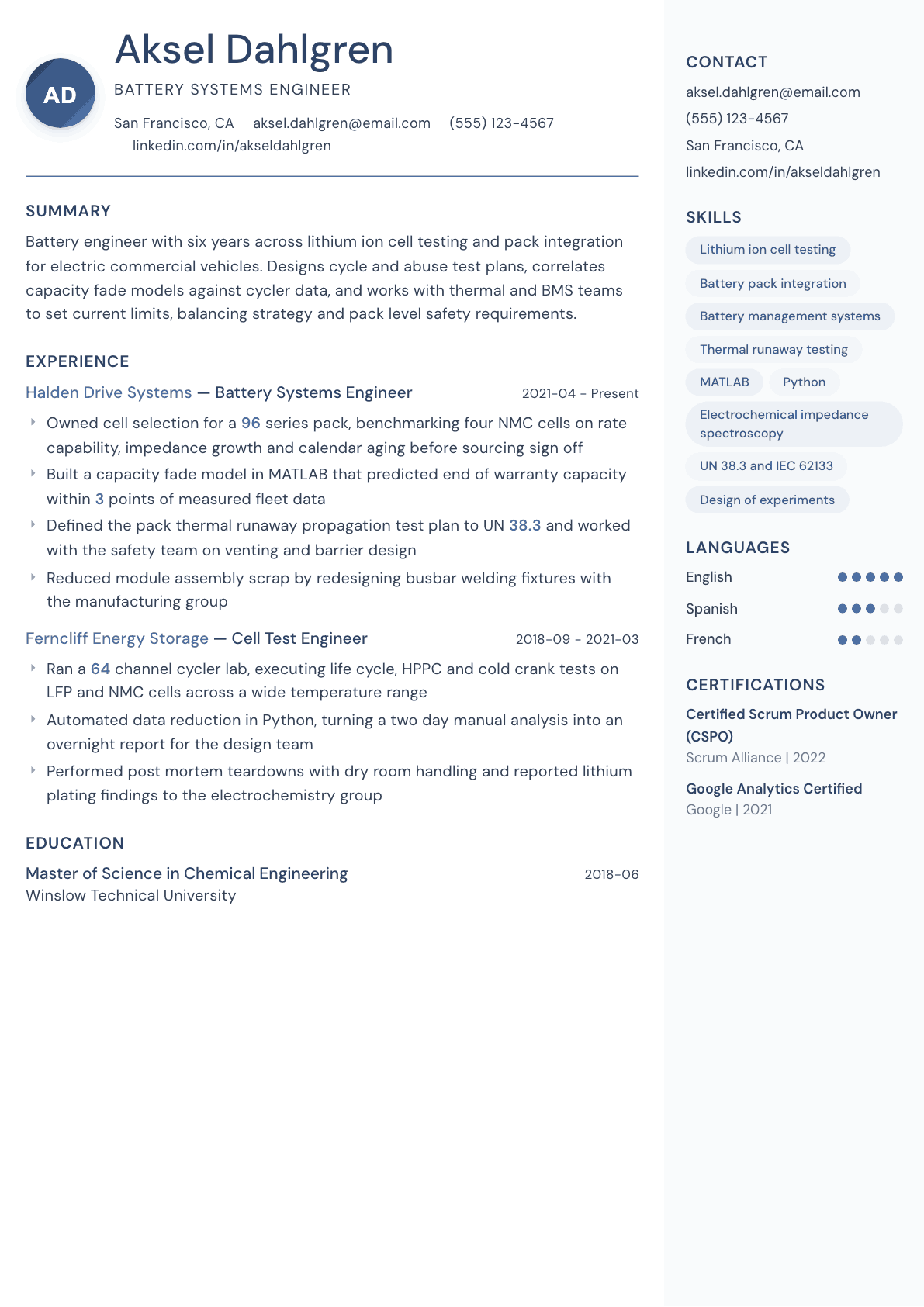
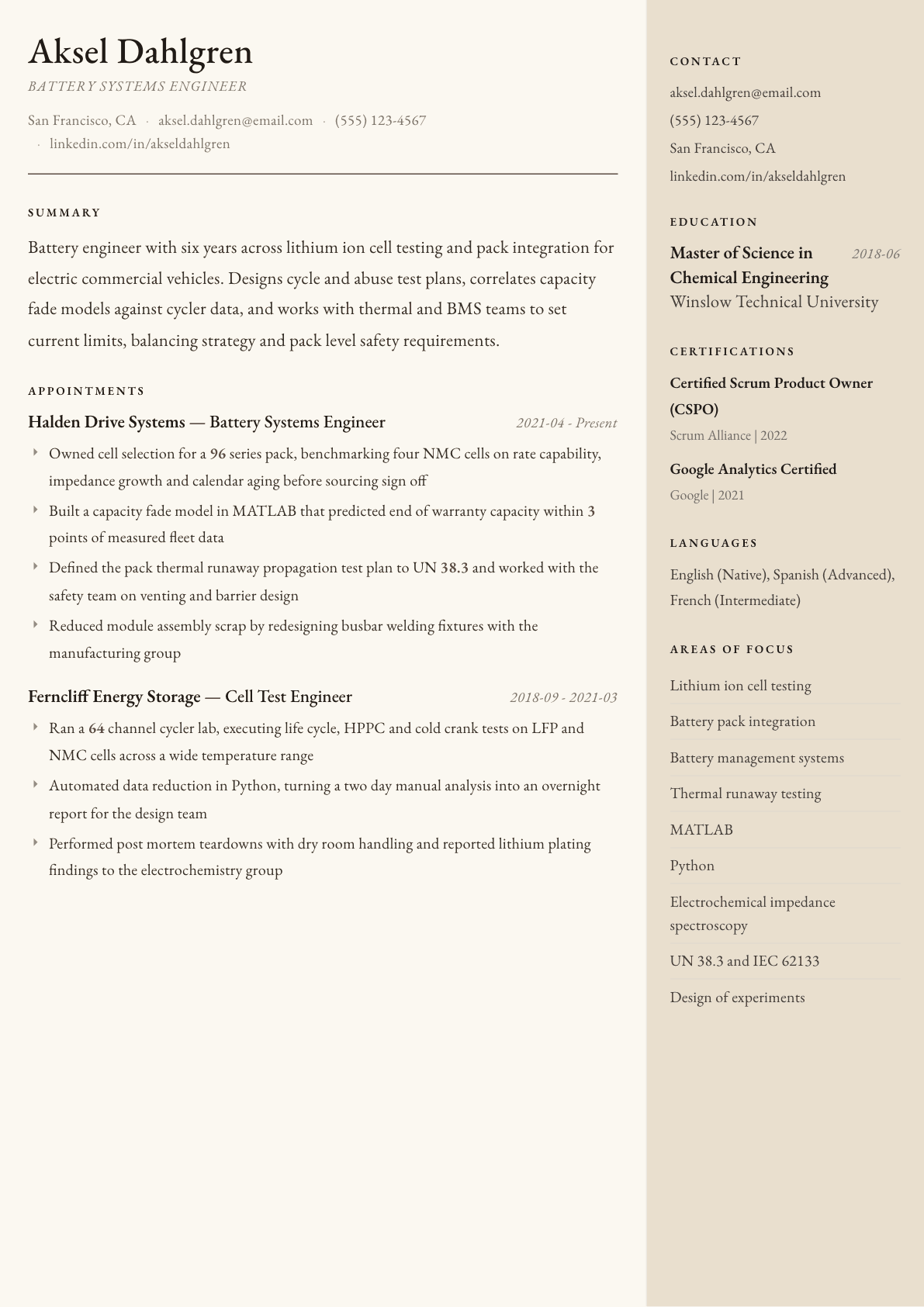
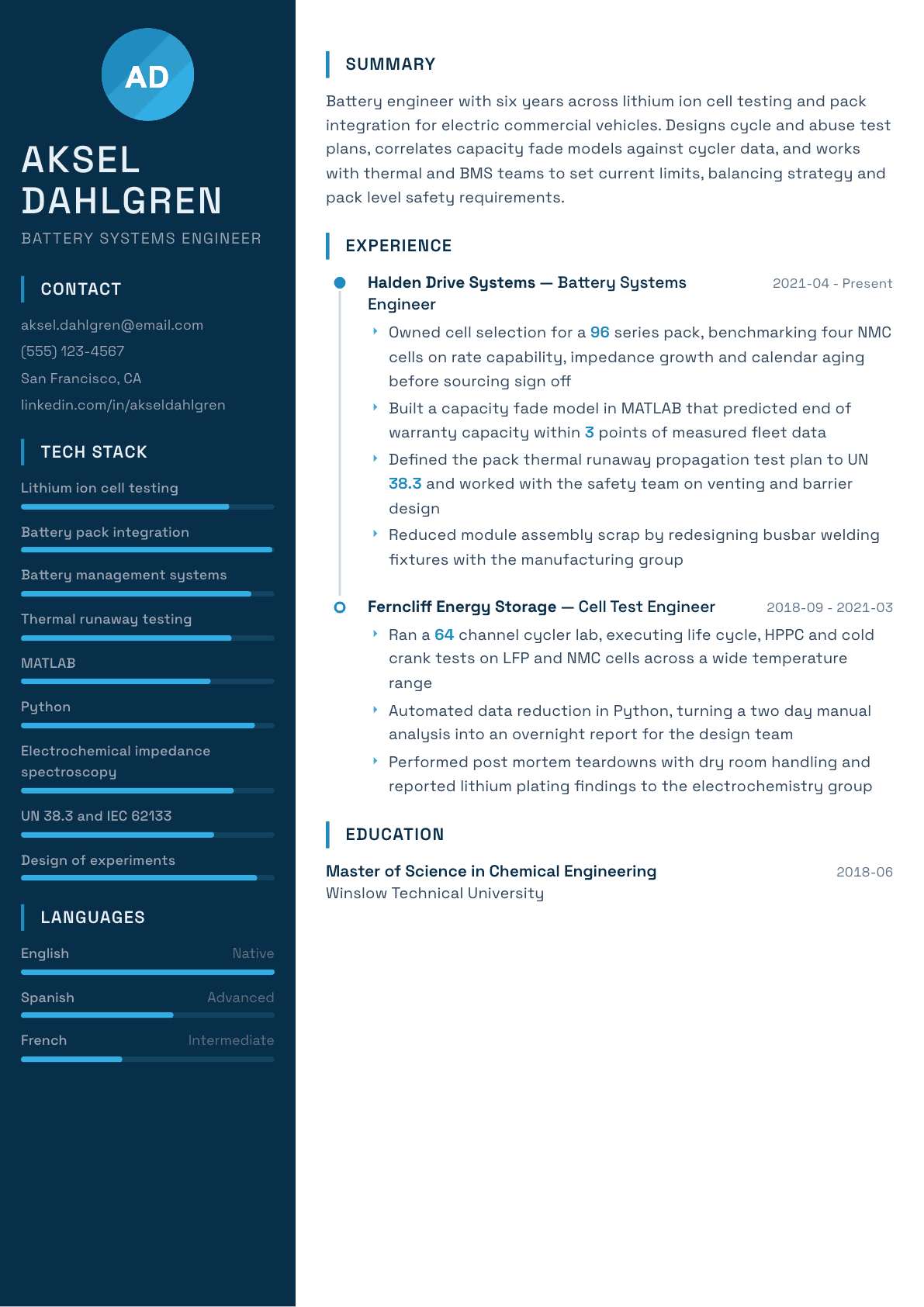
Example Battery Engineer summary
Battery engineer with six years spanning cell test labs and pack integration for electric commercial vehicles. Benchmarks cells on rate capability and aging, builds fade models that hold against fleet data, and defines propagation and abuse testing with the safety team. Cut module assembly scrap by reworking busbar welding fixtures with manufacturing. Master of Science in chemical engineering, comfortable in MATLAB, Python and a dry room.
Skills to list on a Battery Engineer resume
- Lithium ion cell testing
- Cell benchmarking
- Battery pack integration
- Battery management systems
- State of charge estimation
- Capacity fade modeling
- Electrochemical impedance spectroscopy
- Thermal runaway and abuse testing
- UN 38.3
- IEC 62133
- MATLAB
- Python
- Design of experiments
- Dry room and teardown analysis
- Busbar and module assembly
What actually gets this resume read
- Say whether you work at cell, module or pack level, because the three hire from different candidate pools.
- Name the chemistries you have tested, such as NMC, LFP, NCA or solid state prototypes, and the formats.
- Quantify test scale: channel count, cycle counts, temperature range and the duration of the aging campaigns.
- Show the safety and standards work explicitly, from UN 38.3 transport testing to propagation and abuse tests.
- Mention the modeling tools and the correlation you achieved, since a battery team buys prediction accuracy.
- Include the interface work with BMS, thermal and manufacturing teams, as pack roles are integration roles.
How to write a battery engineer resume
Battery teams are small, and the person reading your resume is usually the engineer you would sit next to. He wants to place you on one of three levels within a few lines: cell, module or pack. A cell engineer argues about electrode design, impedance growth and aging mechanisms. A pack engineer argues about busbars, contactors, coolant paths and current limits. The two roles share vocabulary and almost nothing else, and a battery engineer resume that never declares its level makes both readers hesitate.
The second thing that reader checks is whether you have generated data or only consumed it. Cycler channels, temperature ranges, campaign duration, teardown work in a dry room and abuse testing are the evidence that you have handled cells rather than read reports about them. Modeling counts too, but only when you say what the model was correlated against.
This guide covers how to declare cell, module or pack scope, how to write test and safety bullets with real conditions in them, which standards to name, and the questions that come up when someone moves between consumer, automotive and stationary storage work.
Format: plain single column, level declared in the title line
Reverse chronological and single column. Automotive and energy storage employers parse at volume, and a two column layout with graphics loses dates and section boundaries. Put the level in your title line: battery cell test engineer, battery module engineer, battery systems engineer. That one word saves the reader a paragraph of inference.
Keep it to one page under about four years and two pages after that. The second page is best used for a test and equipment block, since a battery hiring manager reads equipment lists the way a software manager reads a language list.
- Header: name, city and state, phone, email, and the level you work at.
- Sections in this order: summary, technical skills, experience, test and equipment block, education.
- Graduates lead with education and an electrochemistry or thermal project described by its measurements.
Summary: chemistry, format, level and the application
Four lines. Name the chemistries you have tested, the cell formats, the level you work at, and the application, because a commercial vehicle pack, a consumer device and a grid storage container impose different constraints on the same cell. Add one result that shows you produce evidence rather than opinions.
If you are crossing applications, say so and name what transfers. Cycle life testing, impedance analysis and safety validation carry across; volume, duty cycle and warranty expectations do not, and a reader trusts a candidate who separates the two.
Experience: test conditions, models, and safety work
Open each job with the lab or program scope: channel count, temperature chamber capacity, the chemistries on test, and the size of the pack you supported. A sixty four channel lab and a four channel bench produce different engineers, and only you can tell the reader which one you came from.
Test bullets need conditions, not just names. A cycle life campaign has a rate, a depth of discharge, a temperature and a duration. A pulse power characterization has a pulse length. A cold crank test has a temperature and a load. Without conditions, a test bullet is a label. With them, an interviewer immediately has something to ask you about.
Modeling bullets need a correlation. Say what the capacity fade or thermal model predicted, what it was checked against, and how close it landed. A model that matched fleet data at end of warranty is worth more on this page than a list of the software you used to build it.
Safety and standards work deserves its own bullet. Transport testing, propagation testing, venting and barrier design, and the abuse matrix you contributed to are the parts of the job that carry legal weight, and hiring managers look for them explicitly.
Standards, tools and the interfaces you own
Name standards by number where you have worked to them, such as UN 38.3 for transport and IEC 62133 for portable cell safety, and say what you did under each one: authored the test plan, ran the tests, or reviewed the report. Add the abuse and propagation testing you supported even when it was to a customer specification rather than a published standard.
For tools, separate the analysis stack from the equipment. MATLAB, Python and the cycler software you script against belong in one line; cyclers, impedance analyzers, chambers, calorimeters and dry room handling belong in another. Then add the interfaces, because pack work is integration work: battery management system behavior, current and temperature limits, balancing strategy, thermal design and the manufacturing side of module assembly.
- Chemistries and formats: cylindrical, prismatic or pouch, and the cell families you have tested.
- Test capability: channel count, current range, temperature range and campaign duration.
- Standards worked to, with your role in each.
- Interfaces owned with management system, thermal and manufacturing teams.
Mistakes that cost this resume a call back
The most common failure is writing about the program instead of about your part in it. A pack that reached a customer proves nothing about you unless the resume says which subsystem, which decision and which measurement were yours. Battery programs have long timelines and large teams, so a reader is actively looking for the boundary of your ownership.
The second failure is abstraction. Words like validation, integration and optimization can describe anything. Replace each one with the test you ran, the part you specified, or the parameter you changed.
Battery Engineer resume summary examples
New graduate
Chemical engineering graduate with laboratory experience in coin cell assembly, cycling and electrochemical impedance measurement on nickel rich cathode samples. Comfortable with glovebox handling, potentiostat operation and data reduction in Python. Seeking a cell test engineer position in an electric vehicle or storage program.
Six years in
Battery engineer with six years across cell testing and pack integration for electric commercial vehicles. Benchmarked four cells for a 96 series pack on rate capability and calendar aging, and built a capacity fade model that predicted end of warranty capacity within three points of measured fleet data.
Pack systems lead
Battery systems lead with twelve years spanning cell sourcing, module design and pack safety validation. Owns cell selection criteria, the abuse and propagation test strategy, and the current limit negotiation between management system, thermal and structural teams. Has taken three pack programs from concept through production sign off.
Work experience bullets: before and after
Before: Tested lithium ion cells in the lab.
After: Ran a 64 channel cycler lab through life cycle, hybrid pulse power and cold crank campaigns on iron phosphate and nickel manganese cobalt cells across a wide temperature range.
Channel count, test types and chemistries let a reader judge the scale and breadth of the lab you actually ran.
Before: Helped select cells for a new pack.
After: Owned cell selection for a 96 series pack, benchmarking four candidate cells on rate capability, impedance growth and calendar aging before sourcing sign off.
Naming the pack configuration and the three comparison criteria shows a technical decision rather than an opinion.
Before: Built models of battery aging.
After: Built a capacity fade model in MATLAB and correlated it against two years of returned fleet data, predicting end of warranty capacity within 3 points of measurement.
The correlation target and the accuracy figure prove the model was validated instead of merely constructed.
Before: Worked on battery safety requirements.
After: Defined the pack thermal runaway propagation test plan against transport and abuse requirements, then worked with the safety team on vent path and barrier design after the first cell trigger test.
The plan, the standard basis and the design change together show ownership of the safety loop rather than attendance at it.
Before: Improved manufacturing of the modules.
After: Reduced module assembly scrap by redesigning the busbar welding fixtures with manufacturing engineering after teardown showed inconsistent weld nugget placement.
The evidence from teardown and the specific fixture change make the improvement traceable to your analysis.
Hard skills
- Lithium ion cell testing
- Cell benchmarking and selection
- Battery pack integration
- Battery management system interfaces
- State of charge and state of health estimation
- Capacity fade modeling
- Electrochemical impedance spectroscopy
- Thermal runaway and abuse testing
- UN 38.3 transport testing
- IEC 62133 safety testing
- MATLAB
- Python for test data reduction
- Design of experiments
- Dry room handling and cell teardown
- Busbar and module assembly processes
Soft skills
- Patience with long test campaigns
- Safety discipline around energized cells
- Negotiating limits across teams
- Clear test reporting
- Supplier technical dialogue
Mistakes that cost battery engineer candidates the interview
- Never stating whether you work at cell, module or pack level, which leaves every reader guessing about the wrong job.
- Listing test names with no conditions, so a cycle life campaign could mean anything from a week to two years.
- Presenting models without a correlation, which reads as simulation for its own sake to an engineer who has been burned by one.
- Taking credit for the program instead of your subsystem, on projects that obviously involved dozens of engineers.
- Omitting safety and standards work entirely, when that is the part of the role with the most external scrutiny.
- Naming chemistries but not formats, when cylindrical, prismatic and pouch cells change nearly every mechanical decision.
- Filling the skills block with abstractions like validation and optimization instead of equipment and measurements.
Battery Engineer resume questions
Is there a standard certification for battery engineers?
There is no single recognized credential the way welding or quality has one, so employers judge this role almost entirely on test experience, standards work and modeling correlation. Put your effort into making those visible rather than hunting for a certificate to add.
How do I show cell level knowledge if I work on packs?
Point at the cell decisions you influenced: benchmarking criteria, impedance and aging data you read, teardown findings you acted on, and the current limits you set from cell capability. That shows electrochemical literacy without claiming a cell design background you do not have.
Should I include confidential program details?
No. Describe the configuration, the test conditions and the mechanism without naming the customer or the product. Series count, chemistry, test type and the nature of a failure are technical facts that carry your value while keeping a former employer comfortable.
How much software should a battery engineer resume show?
Enough to prove you handle your own data. Scripting for cycler output reduction, model building, and comfort with a statistics workflow are expected now, and an engineer who waits for someone else to process a test file is slower than the campaign requires.
What if my experience is in stationary storage and the job is automotive?
Say the transfer explicitly in the summary. Testing, safety validation and management system interfaces carry directly, while duty cycle, vibration, thermal envelope and mass targets do not. Naming the difference yourself reads as judgment rather than as a gap.
Related resume examples
- Chemical Engineer Resume example
- Materials Engineer Resume example
- Automotive Engineer Resume example
- Validation Engineer Resume example
- Fire Protection Engineer Resume example
- Agricultural Engineer Resume example