ETL Developer Resume Examples: free ATS score and gap list
Build an ETL Developer Resume Around Pipelines That Stay Up
By Mustafa Tarabya, founder of CVBooster · Published · Updated
ETL developer resume examples, pipeline and orchestration wording, the tool keywords recruiters filter on, and a full writing guide.
Sample resumes for a etl developer
The same etl developer content laid out in three CVBooster templates, so you can see what the finished document looks like before you write a word.
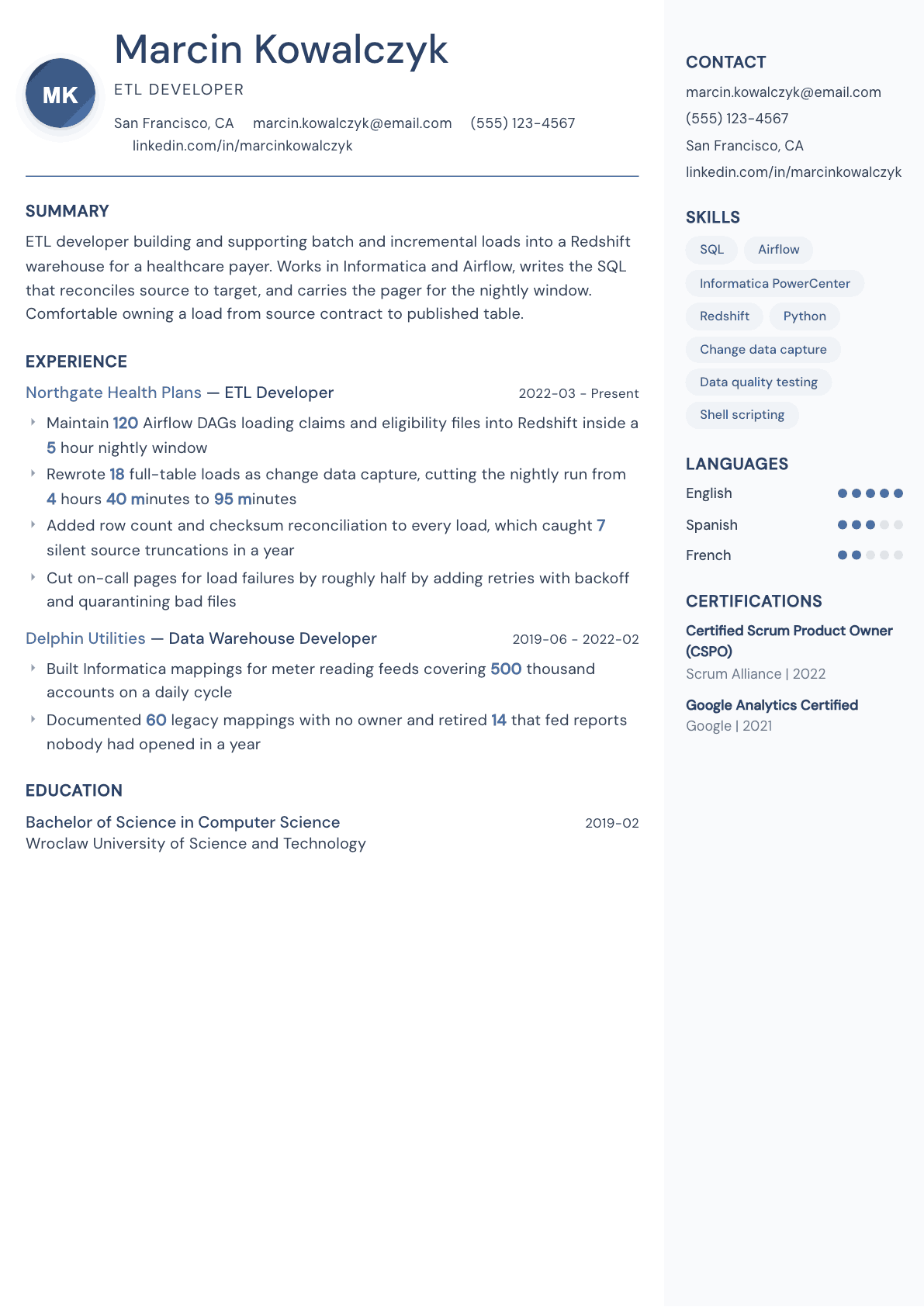
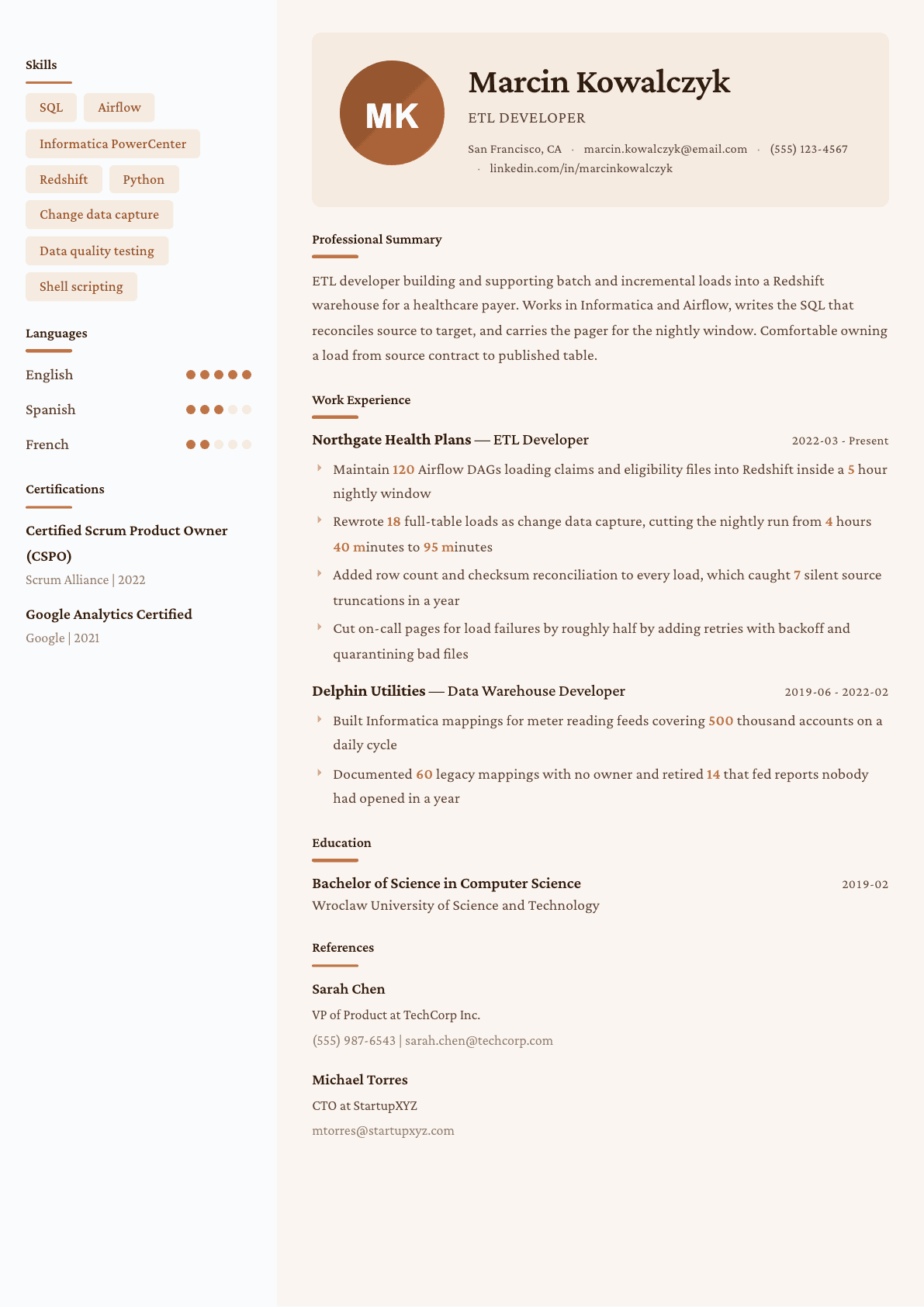
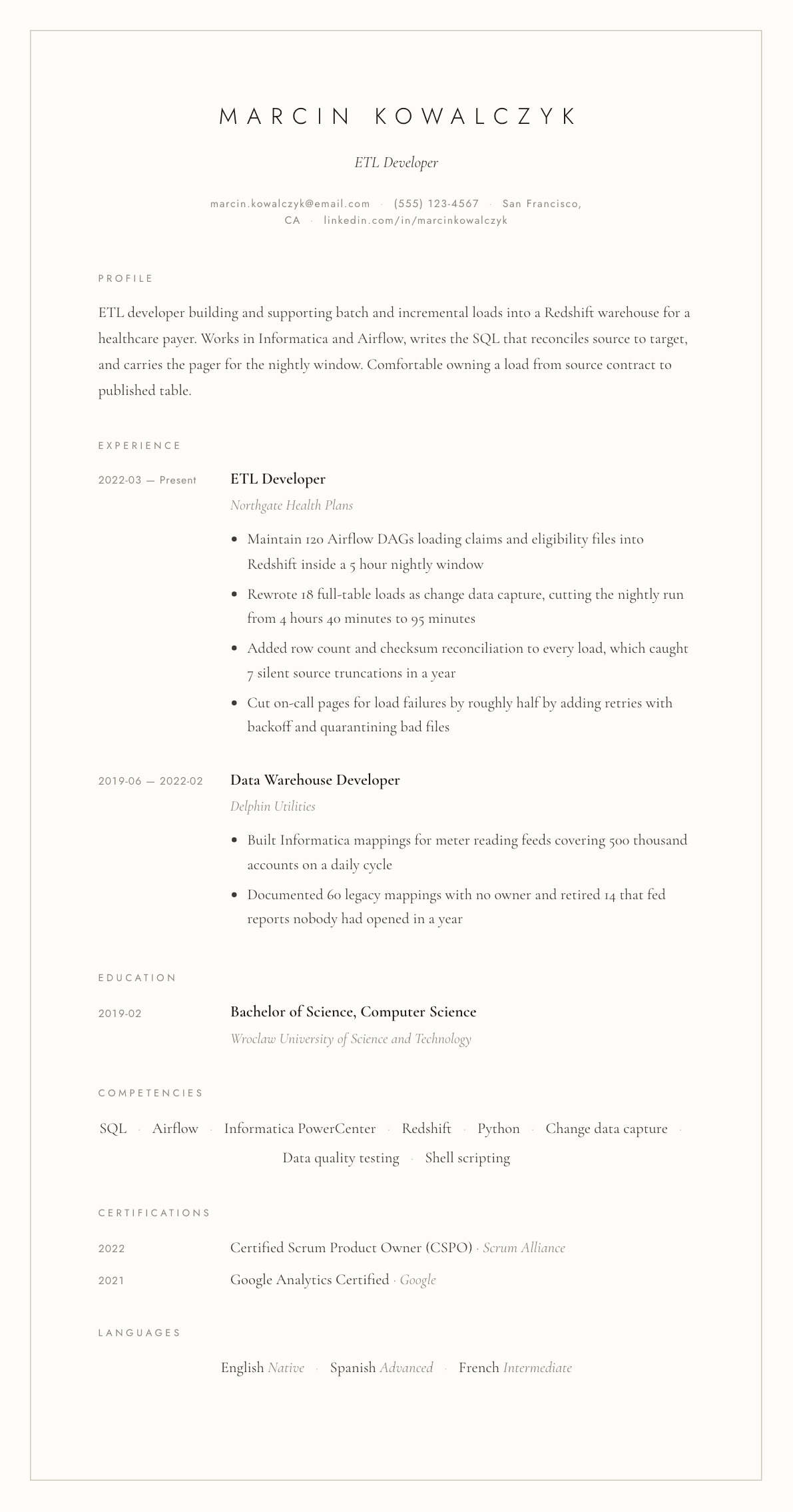
Example ETL Developer summary
ETL developer with six years building batch and incremental loads for healthcare and utility data. Runs a hundred and twenty Airflow pipelines inside a five hour nightly window, rewrote a set of full-table loads as change data capture to bring the run well under time, and added reconciliation checks that catch silent source truncation. Carries the pager for the batch window.
Skills to list on a ETL Developer resume
- SQL
- Apache Airflow
- Informatica PowerCenter
- Talend
- SSIS
- Python
- Change data capture
- Incremental loading
- Data quality checks
- Redshift
- Snowflake
- Shell scripting
- Job scheduling
- Performance tuning
What actually gets this resume read
- Name every tool by product, because postings filter on Informatica, Talend, SSIS, Airflow and dbt by name.
- Give each pipeline a shape: source type, volume, cadence, target, and the window it has to finish inside.
- Show reliability work such as retries, idempotent loads, reconciliation checks and quarantine of bad records.
- Include the tuning story with a before and after runtime, since load windows are what managers worry about.
- Mention the modeling you load into, whether staging to star schema, data vault or a normalized operational store.
- Put support duties on the page: on-call for the batch window, incident notes and how you reduced repeat failures.
How to write a etl developer resume
An ETL developer is hired to make a batch window finish and stay finished. The manager reading your resume has a nightly run that overruns, a set of loads that fail silently, or a legacy tool nobody left in the company understands. She is scanning for two things: the exact products you have worked in, and evidence that pipelines you built kept running after you handed them over.
This is one of the few technical roles where the tool name really is a filter. Informatica, Talend, SSIS, DataStage, Airflow and dbt shops all recruit from different pools, and a resume that says data integration tools without naming any of them gets screened out by a keyword pass before a person ever reads it.
This guide covers how to describe a pipeline so its shape is obvious, which reliability work belongs on the page, how to write the tuning story that managers care about most, and how to move between the older enterprise tools and the modern orchestration stack without losing credibility either way.
Format: one or two pages with a tools block at the top
Reverse chronological. One page under about six years, two after. Put a tools block immediately under the summary, split into integration tools, orchestration, databases and languages. This is not decoration: it is where an applicant tracking system finds the product names the posting asked for, and where a technical screener looks first.
Under each role, add a one-line environment note before the bullets: the source systems, the target platform, the load cadence and the size of the window. That single line does what three vague bullets cannot.
- Header: name, city, phone, email, and a profile link.
- Order: summary, tools and platforms, experience with an environment line, education, certifications.
- Name the database platforms by product, since tuning on Redshift and tuning on Oracle are different skills.
Summary: the stack, the volume, and the window
Three lines. Say how long you have built loads, in which tools, into which warehouse platform, for which kind of data. Then name the operational constraint you work inside, such as a five hour nightly window or a fifteen minute micro-batch. Managers hire for the constraint, so putting it in the summary means the rest of the page gets read.
If you are moving from an older enterprise tool to a modern stack, say it directly and show the overlap: the modeling, the reconciliation habits and the incremental logic transfer even when the interface does not.
Experience: give every pipeline a shape
A pipeline bullet needs five facts to be useful: what the source is, how much data, how often, where it lands, and what has to be true when it finishes. Loading claims and eligibility files into a warehouse inside a five hour window is a sentence a manager can picture. Developed and maintained ETL processes is not.
Show the modeling you load into. Staging into a star schema, populating satellites in a data vault, or landing raw then transforming with change data capture are different jobs, and a reader wants to know which one you did.
Include the parts that are not building: supporting the batch, carrying the pager, handling reruns, and communicating with the source system owners when a file arrives late or malformed. Support duties are half of this role and almost nobody writes them down.
Reliability is the differentiator
Anyone can build a load. The value is in loads that fail loudly and recover cleanly. Write about idempotent design so a rerun does not double count, retries with backoff, quarantine of bad records instead of a whole failed file, row count and checksum reconciliation between source and target, and alerts that reach a person rather than a mailbox nobody reads.
Pair each of those with what it caught. A reconciliation check that found a silent source truncation is a much stronger bullet than the existence of the check.
The tuning story, and the keywords behind it
Every ETL developer should have one runtime bullet with a before and after: full loads rewritten as incremental, a join rewritten, partition pruning enabled, parallelism raised, or an index strategy changed. Say which change did the work, because a manager will ask.
Postings recycle the same terms: extract transform load, data pipeline, incremental load, change data capture, slowly changing dimensions, staging area, data quality, job scheduling, error handling and performance tuning. Use the posting phrasing once in the summary and once where the work is described, and keep product names in the tools block.
ETL Developer resume summary examples
Two years in
ETL developer with two years building SSIS packages and SQL loads for a retail data warehouse. Handles daily sales and stock feeds from 12 stores into a star schema, has rewritten four full loads as incremental, and supports the overnight batch on a shared rotation with two colleagues.
Six years, mixed stack
ETL developer maintaining 120 Airflow pipelines and a set of legacy Informatica mappings loading claims data into Redshift inside a five hour window. Rewrote 18 full-table loads as change data capture and added reconciliation to every load, which surfaced seven silent source truncations in a year.
Lead integration developer
Lead ETL developer setting the load patterns and error handling standards for a team of five across banking data integration. Designed the reusable framework for incremental loads and quarantine handling now used by every new pipeline, and led the move from a scheduler to orchestrated dependency-aware runs.
Work experience bullets: before and after
Before: Developed and maintained ETL processes for the data warehouse.
After: Maintain 120 Airflow pipelines loading claims and eligibility files from 14 source systems into Redshift, all completing inside a five hour nightly window.
Counts, sources, target and the window let a manager judge the scale against her own estate immediately.
Before: Improved performance of slow-running jobs.
After: Rewrote 18 full-table loads as change data capture with partitioned staging, cutting the nightly run from 4 hours 40 minutes to 95 minutes without adding warehouse capacity.
Naming the technique and holding capacity constant makes the improvement attributable to the work rather than hardware.
Before: Handled errors and data quality issues.
After: Added row count and checksum reconciliation between source and target on every load, which caught seven silent source truncations in a year that had previously reached reports unnoticed.
The control plus what it caught proves data quality work had a real effect on trust in the numbers.
Before: Provided support for production ETL jobs.
After: Cut on-call pages for load failures by roughly half by making reruns idempotent, adding retries with backoff, and quarantining malformed files instead of failing the whole batch.
Three specific design changes explain how support load dropped, which is the outcome an operations manager buys.
Before: Documented existing ETL mappings.
After: Documented 60 legacy Informatica mappings that had no named owner, then retired 14 that fed reports with no access recorded in over a year.
Retirement turns a documentation exercise into a reduction of the estate the team has to support.
Hard skills
- SQL and query tuning
- Informatica PowerCenter
- Talend and SSIS
- Apache Airflow
- Python for data processing
- Change data capture
- Incremental and delta loading
- Slowly changing dimensions
- Data quality and reconciliation
- Redshift, Snowflake and Oracle
- Shell scripting and job scheduling
- Error handling and reprocessing
Soft skills
- Working with source system owners
- Calm incident handling
- Clear runbook writing
- Attention to reconciliation detail
- Handover and knowledge transfer
Certifications worth listing
- SnowPro Core Certification (Snowflake)
- Microsoft Certified: Azure Data Engineer Associate (Microsoft)
- AWS Certified Data Engineer, Associate (Amazon Web Services)
- Talend Data Integration Certified Developer (Talend)
Mistakes that cost etl developer candidates the interview
- Writing data integration tools instead of naming Informatica, Talend, SSIS, Airflow or whichever product you used.
- Describing pipelines without volume, cadence or the load window, which hides whether the work was hard.
- Leaving out support duties, when carrying the batch and handling reruns is half the job being hired for.
- Claiming a runtime improvement with no explanation of the change that produced it.
- Ignoring reconciliation and error handling, which are the first things a manager asks about in interview.
- Listing every database you have connected to once, which dilutes the platforms you can genuinely tune.
ETL Developer resume questions
Does an ETL developer resume need to name specific tools?
Yes, and it is the single most important thing on the page. Postings screen on Informatica, Talend, SSIS, DataStage, Airflow and dbt by name. Put them in a tools block near the top and repeat the relevant one inside the bullets where you used it.
How do I move from a legacy ETL tool to a modern data stack?
Lead with the parts that transfer: incremental design, reconciliation, slowly changing dimensions and load window management. Then show any hands-on work in the newer stack, even a personal project with Airflow or dbt, so a reader sees the direction is already underway.
What numbers belong on an ETL developer resume?
Pipeline counts, row or file volumes, load frequency, runtime before and after tuning, the length of the batch window, and how often loads fail. Avoid company revenue figures, which no ETL developer can honestly attribute to a pipeline.
Should I mention on-call and production support?
Yes. Managers hiring for this role are often hiring because the batch is fragile. Say you carried the pager, how you reduced repeat failures, and what you changed in the design so the same incident stopped recurring.
Is ETL developer the same as data engineer on a resume?
They overlap but the emphasis differs. ETL work centers scheduled loads, integration tools and batch reliability. Data engineering usually adds streaming, infrastructure and software practice. If you are targeting both, keep two versions and change the summary and tools order.
Related resume examples
- Data Engineer Resume example
- Database Administrator Resume example
- Data Architect Resume example
- Analytics Engineer Resume example
- Big Data Engineer Resume example
- SQL Developer Resume example