Blockchain Developer Resume Examples: what gets the call
Mine Opportunities with a Blockchain Developer Resume
By Mustafa Tarabya, founder of CVBooster · Published · Updated
Build a blockchain developer resume that showcases your smart contract, DeFi, and Web3 development expertise.
Sample resumes for a blockchain developer
The same blockchain developer content laid out in three CVBooster templates, so you can see what the finished document looks like before you write a word.
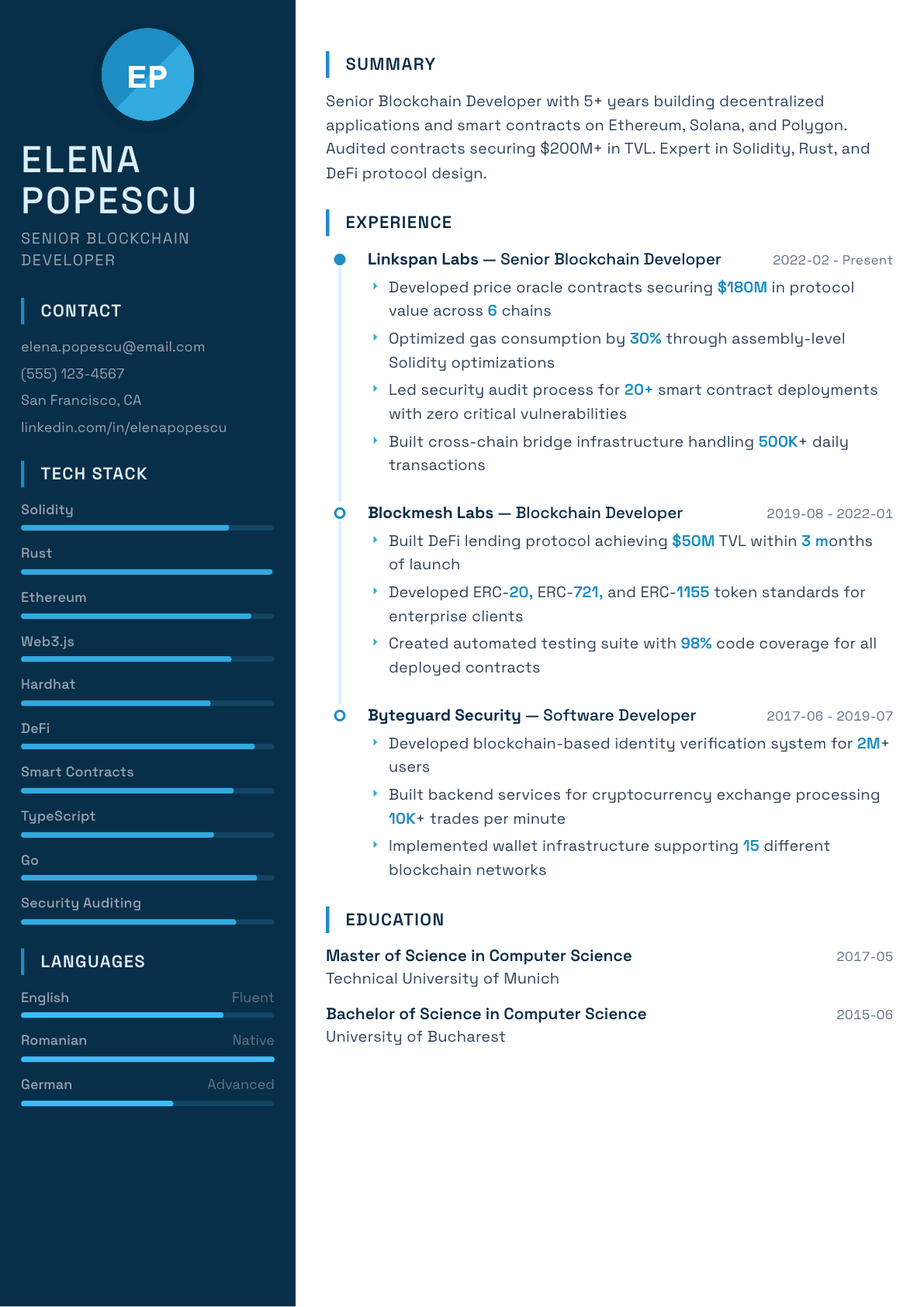
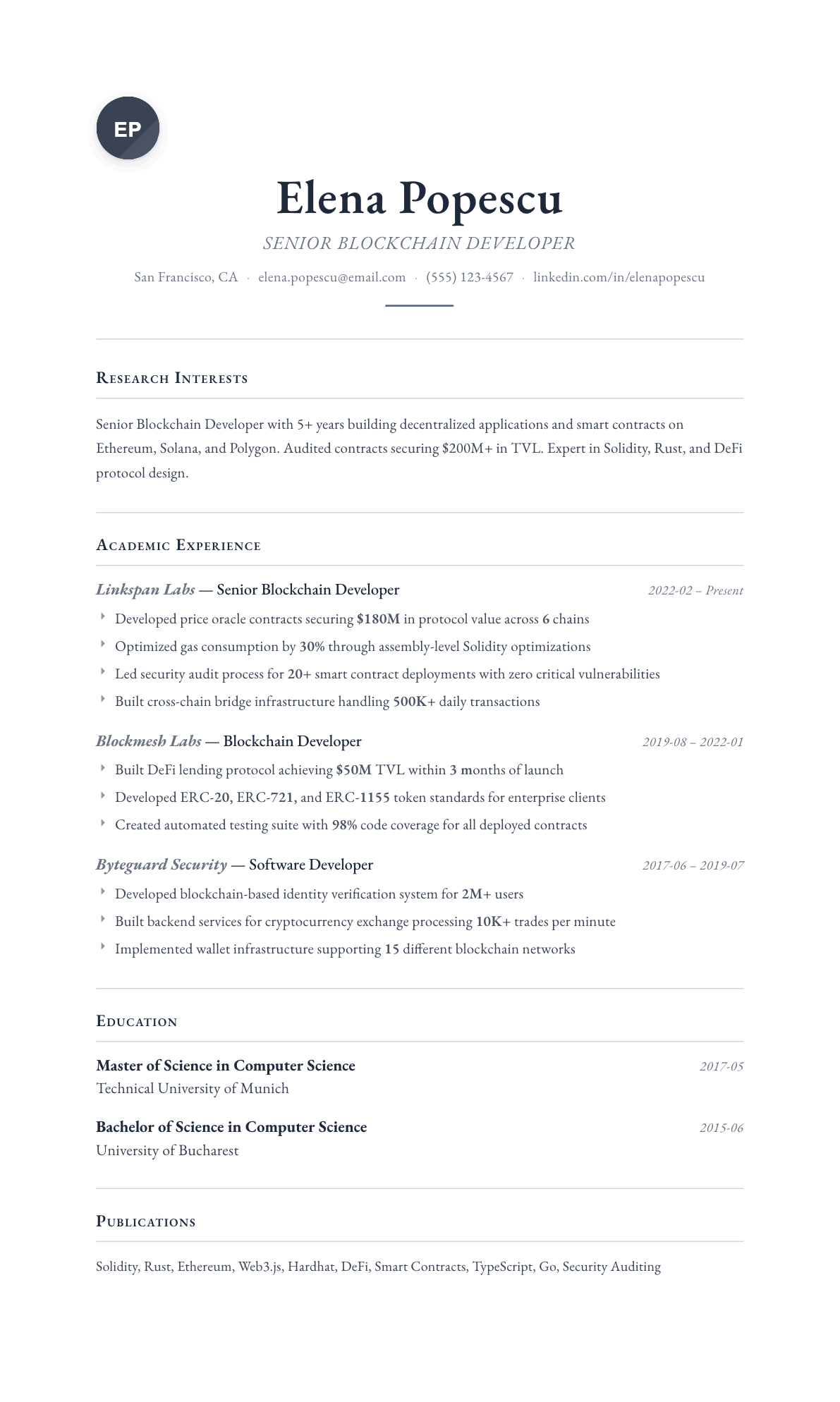
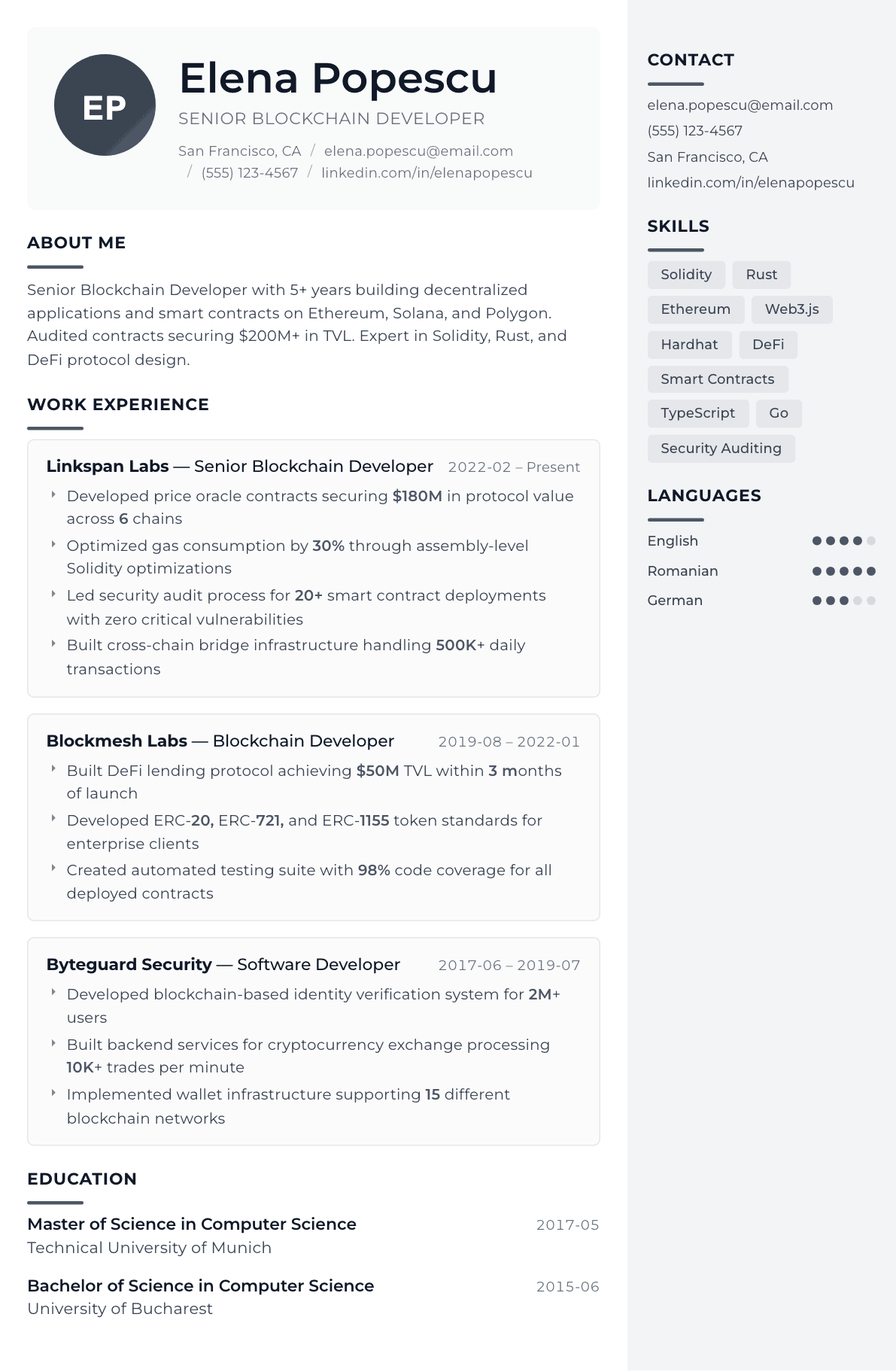
Example Blockchain Developer summary
Senior Blockchain Developer with 5 years building DeFi protocols and smart contracts on Ethereum and Solana. Expert in Solidity with contracts securing $200M+ in total value locked and zero critical vulnerabilities.
Skills to list on a Blockchain Developer resume
- Solidity
- Rust
- Ethereum
- Web3.js
- Hardhat
- Foundry
- DeFi
- Smart Contracts
- TypeScript
- Go
- Security Auditing
- NFTs
- Cross-chain
- IPFS
What actually gets this resume read
- Highlight TVL secured and transaction volumes.
- List specific blockchain platforms and protocols.
- Include smart contract audit experience.
- Show both Solidity and Rust expertise if applicable.
- Mention open-source contributions to Web3 projects.
How to write a blockchain developer resume
A blockchain developer resume is judged on one question that no other engineering resume has to answer: has this person written code that held other people money without losing it. Protocol teams hire slowly and read carefully, because a bug in a deployed contract cannot be patched the way a web service can. The reader is usually a lead engineer who will open your verified contracts on a block explorer before the interview.
That changes what belongs on the page. Named chains, named standards, named audit outcomes and a public address or repository carry more weight than a list of frameworks. A resume that says "experienced in Web3 technologies" tells a protocol lead nothing about whether you understand storage layout, reentrancy or upgrade safety.
This guide covers the sections in the order a protocol team reads them, with summaries for a self-taught developer moving in from web work, a mid-level Solidity engineer and a lead who owns a deployed protocol, plus the before-and-after bullets that separate the two piles.
Format: one page, with a links line that actually resolves
Keep it to one page until you have five years of protocol work. Reverse chronological, single column, no icons. The one addition this field expects that most engineering resumes do not have is a links line directly under your contact details: GitHub, and where the work is public, a verified contract on a block explorer or a protocol documentation page you wrote.
Recruiters at exchanges and infrastructure companies still run applicant tracking systems, so keep the chain names and standard names as plain text. Writing ERC-721 as an image or inside a graphic removes it from the parse.
- Header: name, title, location or time zone, email, GitHub, and one public artifact.
- Order: summary, skills, experience, protocols and deployments, education.
- Time zone matters more here than in most roles because protocol teams are distributed and on-call rotations cross regions.
Summary: chains, language, and what your code custodies
Two or three lines. Name the chains you have deployed to, the language you write contracts in, the category of protocol you have worked on, and the security work you have been through. A lending protocol, a bridge, an NFT marketplace and an oracle network need different instincts, so saying which one you have built is the fastest signal you can send.
If you are moving in from backend or frontend work, say it plainly and anchor it: name the audited testnet deployments, the capture-the-flag work, or the open-source pull requests merged into a protocol repository. A career changer who names real artifacts beats one who claims general enthusiasm for decentralized systems.
Experience: the protocol, the surface, and the security process
For each role, give the protocol category and the stack in the line under the job title: EVM or Solana, Solidity or Rust with Anchor, Foundry or Hardhat, and the chains the contracts live on. Then write bullets about the parts of the system you owned, not the parts your team shipped around you.
The strongest bullets in this field describe a design decision and its consequence. Storage packing that cut deployment cost, a pull-payment pattern that removed a reentrancy surface, a UUPS upgrade path with a timelock and a multisig, an invariant that Echidna fuzzed for millions of runs. Say what you chose and what it prevented.
Audits deserve their own bullet wherever you have them. Name the process, not the marketing: how many findings came back, what severity, and what you changed. An engineer who describes fixing a high-severity finding reads as more trustworthy than one who claims a flawless record.
Skills: separate contract work from the surrounding stack
Group the list. Contract languages and tooling first: Solidity, Vyper, Rust with Anchor, Foundry, Hardhat, OpenZeppelin libraries. Then security tooling: Slither, Mythril, Echidna, formal verification if you have used it. Then the off-chain half: ethers.js or viem, subgraphs on The Graph, indexers, node providers, IPFS or Arweave for storage.
Name the standards you have implemented rather than the word standards: ERC-20, ERC-721, ERC-1155, ERC-4626 vaults, ERC-4337 account abstraction. Recruiters search on those strings and engineers read them as a map of what you have actually built.
Deployments and open source: the section this field rewards
Add a short section listing protocols you have contributed to, contracts you have deployed to a public network, and merged pull requests in well-known repositories. Two lines each: what it does, what you wrote, whether it is live on mainnet or a testnet. This is the closest thing the field has to a portfolio, and hiring leads read it before the experience section.
Be exact about mainnet versus testnet. Overstating a testnet deployment is the fastest way to lose a technical interview, because the reader can check.
Blockchain Developer resume summary examples
Moving in from web development
Backend engineer with 3 years in TypeScript, now writing Solidity full time. Built and deployed an ERC-4626 vault and a staking contract to Sepolia with full Foundry test coverage and Slither clean, and merged 4 pull requests into an open-source DeFi tooling repository.
Three years of protocol work
Solidity engineer with 3 years on EVM lending protocols across Ethereum mainnet, Arbitrum and Base. Owns the collateral and liquidation modules, wrote the invariant suite that runs on every pull request, and closed 2 high-severity findings from an external audit ahead of launch.
Protocol lead
Lead blockchain developer with 7 years across EVM and Solana, currently owning a cross-chain bridge in production. Designed the UUPS upgrade path behind a timelock and a Safe multisig, ran two external audits and a public contest, and cut per-transfer gas 31% through storage layout redesign.
Work experience bullets: before and after
Before: Developed smart contracts using Solidity.
After: Wrote and deployed the collateral manager for a lending protocol on Arbitrum, 900 lines of Solidity behind a UUPS proxy with a 48-hour timelock and a 4-of-7 Safe multisig on the admin role.
The chain, the module, the upgrade pattern and the admin controls tell a protocol lead exactly what you have owned.
Before: Optimized gas usage in smart contracts.
After: Cut mint cost 27% by packing three storage variables into one slot and replacing a loop over an array with a bitmap, verified with Foundry gas snapshots on every pull request.
Naming the technique and the measurement method proves the saving is real rather than a guess.
Before: Worked with auditors on contract security.
After: Prepared the audit scope and threat model for an external review of the staking contracts, then closed 1 high and 5 medium findings, including a reentrancy path in the reward claim, before mainnet launch.
Severity counts and a named vulnerability class show you understand the findings rather than just forwarding them.
Before: Built a testing suite for our contracts.
After: Built the invariant suite in Foundry covering solvency and share-price monotonicity, fuzzed to 10M runs in CI, which caught a rounding bug in the withdrawal path before it reached testnet.
Invariants and a caught bug demonstrate the security mindset the role is hired for, not just coverage.
Before: Created a dApp front end integrated with the blockchain.
After: Built the claim interface in React with viem and wagmi, added a subgraph on The Graph for reward history, and gated writes behind simulated calls so users never sign a transaction that would revert.
The off-chain detail shows product judgment and knowledge of how users actually lose money on a bad interface.
Hard skills
- Solidity
- Rust and Anchor
- Foundry
- Hardhat
- EVM internals and gas optimization
- OpenZeppelin contracts
- ERC-20, ERC-721 and ERC-1155
- Upgradeable proxies and timelocks
- Slither and Echidna
- ethers.js and viem
- The Graph subgraphs
- IPFS
- Layer 2 deployment
- Oracle integration
Soft skills
- Adversarial thinking
- Threat modeling
- Writing for public documentation
- Reviewing other people contracts
- Incident communication
- Working across time zones
Certifications worth listing
- Certified Blockchain Solution Architect (Blockchain Council)
- Certified Ethereum Developer (Blockchain Council)
- Certified Blockchain Developer (Blockchain Training Alliance)
Mistakes that cost blockchain developer candidates the interview
- Listing chains you have only read about. A blockchain developer interview usually starts with a question about a chain you named, and the gap shows in one minute.
- Claiming a mainnet deployment for something that only ever ran on a testnet or a local fork.
- Leaving out the security tooling. A contract engineer who never mentions static analysis or fuzzing reads as untested.
- Filling the page with token price and market commentary instead of engineering. Protocol teams hire builders, not analysts.
- Using a graphic-heavy template. The standard names that recruiters search for stop being text and drop out of the parse.
- Hiding the GitHub link at the bottom. In this field the code is the credential, so it belongs in the header.
- Describing a team launch in the first person when your part was the front end. Reviewers check commits.
Blockchain Developer resume questions
Do I need a computer science degree to get a blockchain developer job?
No. Protocol teams hire on demonstrated contract work far more than on degrees. What replaces it is public code: audited or fuzz-tested contracts, merged pull requests in protocol repositories, and results in public audit contests that anyone can verify.
Should I put my wallet address or contract addresses on my resume?
Put contract addresses for work you are free to disclose, ideally verified on a block explorer so the source is readable. Leave your personal wallet address off. It exposes your holdings and adds nothing a reviewer needs.
How do I show blockchain experience if all my work was under a non-disclosure agreement?
Describe the protocol category, the chain, the modules you owned and the security process without naming the employer product. Then add public artifacts you built on your own time so the reviewer still has something concrete to open.
Is Solidity enough, or do I need Rust as well?
Solidity alone supports a full career on EVM chains and the layer 2 networks around them. Rust widens the search to Solana and Polkadot ecosystems. List the second language only once you have deployed something in it, not from tutorials.
How should I handle a gap after a protocol shut down?
State it plainly in the experience entry with the end date and one clause on what happened to the project. Then use the gap productively on the page: audit contest results, open-source contributions or a deployed personal protocol fill it better than an explanation.
Related resume examples
- Full-Stack Developer Resume example
- Software Engineer Resume example
- Security Engineer Resume example
- JavaScript Developer Resume example
- Backend Developer Resume example
- Golang Developer Resume example