Security Consultant Resume Examples: what gets the call
Write a Security Consultant Resume That Wins the Engagement
By Mustafa Tarabya, founder of CVBooster · Published · Updated
Security consultant resume example with risk assessment keywords, client outcomes and a guide to writing surveys, standards work and design reviews.
Sample resumes for a security consultant
The same security consultant content laid out in three CVBooster templates, so you can see what the finished document looks like before you write a word.
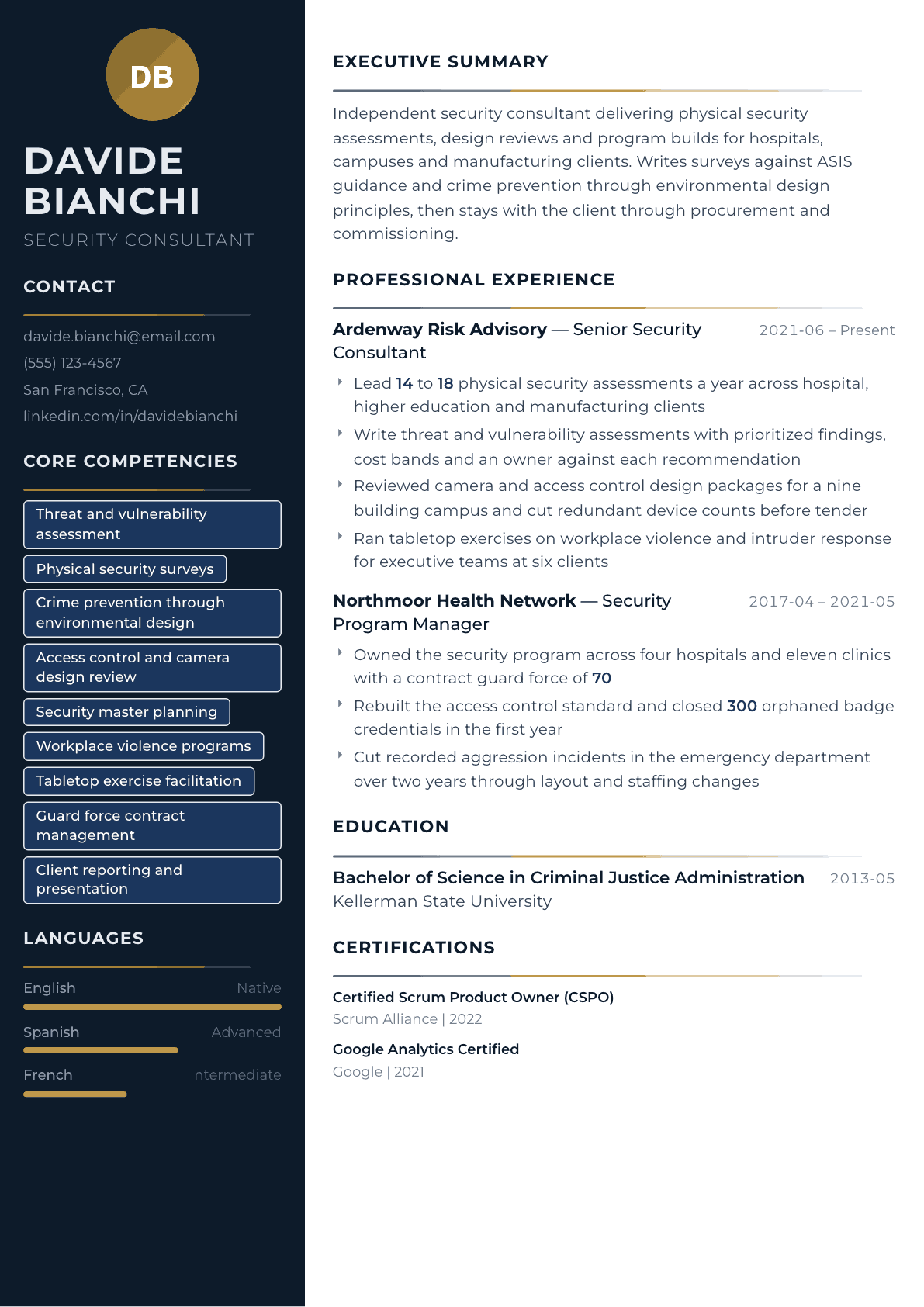
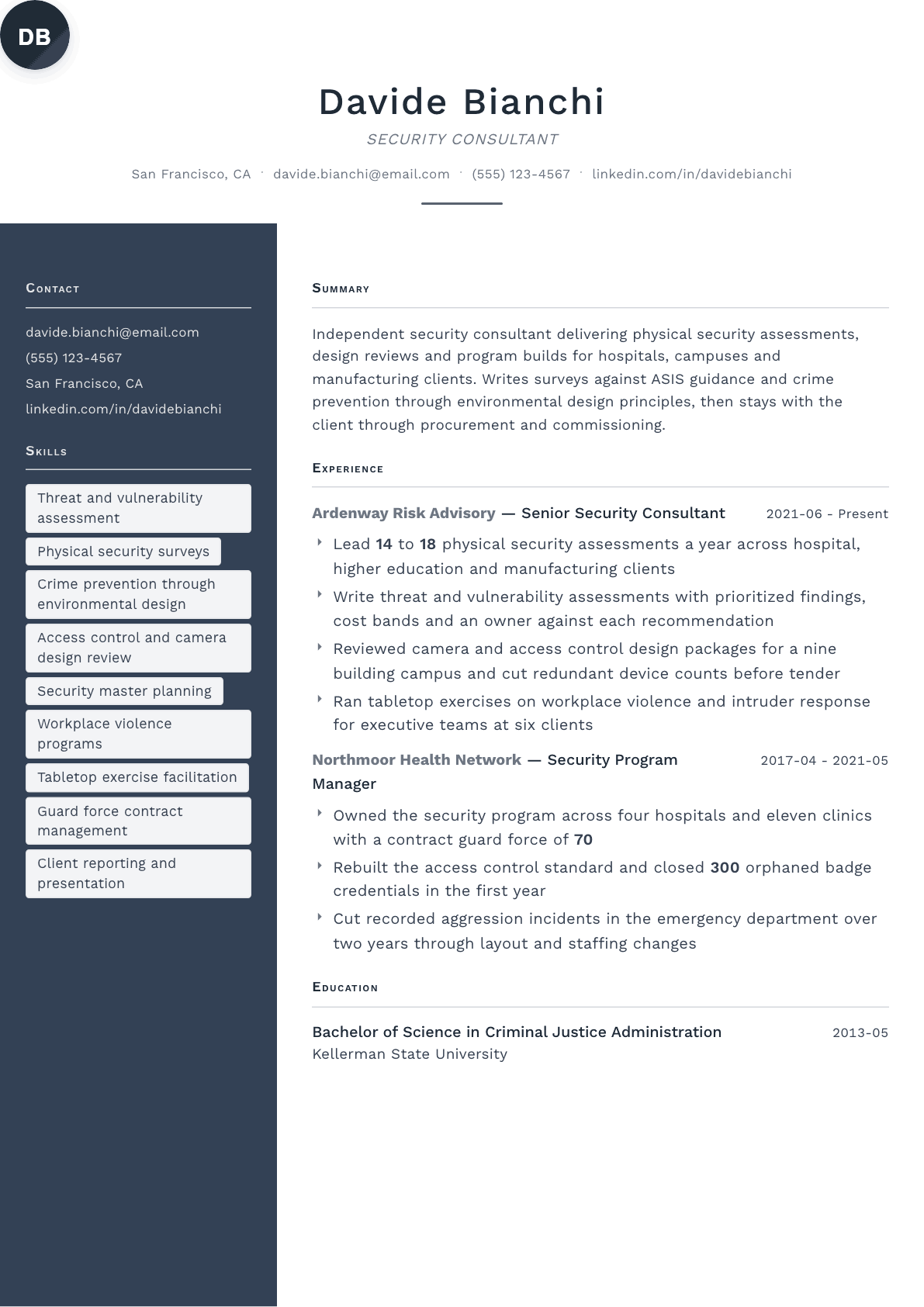
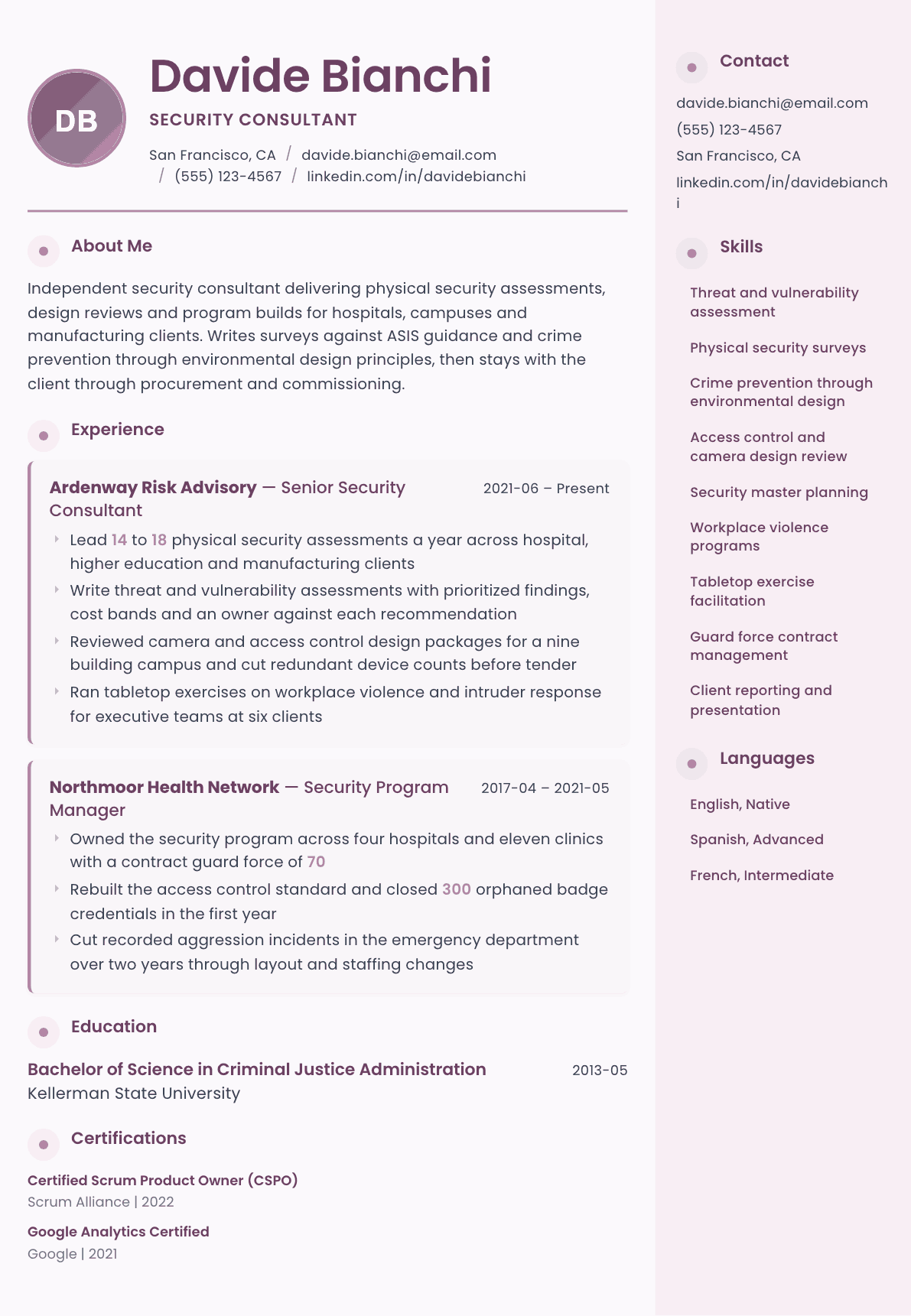
Example Security Consultant summary
Security consultant delivering physical security assessments, design reviews and program builds across hospital, campus and industrial clients. Writes threat and vulnerability reports with prioritized findings, cost bands and an accountable owner on every line, then follows the work through procurement and acceptance testing. Facilitates workplace violence tabletop exercises for executive teams and rebuilds access control standards that stop drifting the month after handover.
Skills to list on a Security Consultant resume
- Threat and vulnerability assessment
- Physical security survey
- Security master planning
- Crime prevention through environmental design
- Access control system design review
- Video surveillance design review
- Workplace violence prevention
- Emergency and crisis planning
- Tabletop exercise facilitation
- Guard force procurement
- Policy and standard writing
- Executive briefing
- Risk register and prioritization
- Commissioning and acceptance testing
What actually gets this resume read
- Lead with the sectors you have advised, because a hospital buyer and a plant manager read for different scars.
- Say how many assessments you deliver a year and what a typical deliverable looks like when it lands.
- Show that your recommendations carry cost bands and named owners, not a list of things somebody should fix.
- Name the standards and design frameworks you write against so a client knows the report will survive review.
- Prove you stay past the report, through procurement, commissioning or the retest that closes the findings.
- Put your certifications and the issuing body up front, since consulting buyers screen on credentials early.
How to write a security consultant resume
Hiring a security consultant is an act of trust before it is a purchase. A hospital chief operating officer or a plant director is about to let a stranger walk his site, write down everything that is wrong with it, and put a number next to each item that his board will read. He is screening your resume for whether that document will help him or embarrass him.
The consultants who get hired are the ones whose resumes show a deliverable, not a duty list. A survey with prioritized findings, cost bands and an accountable owner against each line is a product. A page that says you provided expert security advice to clients is a business card.
This guide covers how to structure a consulting resume, how to write client work without breaching confidentiality, summaries for someone crossing over from operations through to a principal consultant, before and after bullets, and the questions practitioners ask when they leave a corporate security seat for advisory work.
Format: sectors, deliverables and credentials before any history
Consulting resumes work best with a short capability block before the job history. Name the sectors you have advised, the deliverables you produce, and the standards you write against. A buyer decides in the first fifteen seconds whether you have seen a building like his, and the job history alone rarely answers that quickly.
Credentials sit next to that block rather than at the bottom. Advisory buyers screen on certifications early because a report signed by a credentialed practitioner is easier to defend internally, and procurement teams sometimes require the letters before a proposal can be scored at all.
- Capability block: sectors advised, deliverable types produced, and the standards and design guidance you write against.
- Engagement scale line: assessments delivered a year, largest site or portfolio covered, and typical engagement length.
- Credential block: professional security certifications with the issuing body, plus any state consulting or investigator license.
- Practice line: whether you work independently, inside a firm, or as an owner representative through design and construction.
Writing client work without naming clients you cannot name
Most consulting work sits under a confidentiality clause, and breaking one on a resume ends the conversation. Describe the client by type and scale instead: a nine building university campus, a two hundred bed acute care hospital, a food manufacturing site running three shifts. That gives a buyer the comparison he needs without exposing anything.
Then describe the engagement in the shape it actually took: what you were asked, what you assessed, what you recommended, what happened. The fourth part is where most consulting resumes stop short. A finding that got funded, a design change made before tender, or a retest that closed the gaps is the proof that your reports move.
Assessments, design review and the work that follows the report
Break your assessment work into the types buyers recognize: threat and vulnerability assessments, physical security surveys, security master plans, and design reviews of camera, access control and barrier packages. Say which you lead alone and which you deliver inside a team, because a firm hiring a senior consultant needs to know who can run an engagement without supervision.
Design review is worth calling out because it saves clients real money before anything is bought. If you have reviewed a device schedule and removed redundant cameras, corrected a door hardware specification, or caught a reader placement that would have broken egress compliance, write it down. Those are the stories a buyer repeats to his colleagues.
Then show the work after the report. Procurement support, tender evaluation, commissioning witness testing and post occupancy retests all prove you do not disappear once the invoice clears. Consultants who stay through delivery command better rates and everybody in the market knows it.
Programs, exercises and the human side of the practice
Physical hardening is only part of a security program. Workplace violence prevention, threat assessment teams, emergency and crisis planning, guard force specification and post order writing are all consulting deliverables, and they attract different buyers from the ones who commission a camera design. Show whichever you have built, with the size of the organization it served.
Tabletop exercises deserve their own line. Facilitating a room of executives through an intruder or workplace violence scenario is a distinct skill, and a consultant who has done it repeatedly will be trusted with the board presentation too. Give the number of exercises you have run and the level of the participants.
Skills, keywords and how advisory postings screen
Advisory postings and procurement scoring sheets reuse the same vocabulary: risk assessment, vulnerability assessment, security master plan, crime prevention through environmental design, physical protection systems, guard force optimization, policy development, business continuity. Mirror the terms exactly, then evidence at least four of them inside your engagement bullets.
Do not forget the commercial skills. Proposal writing, scoping and pricing an engagement, managing a subcontractor, and presenting findings to a board are consulting skills as much as security ones. A firm hiring you wants someone who can win work as well as do it, and an independent practice cannot survive without those lines being true.
Security Consultant resume summary examples
Moving from operations to advisory
Corporate security manager moving into consulting after seven years running a multi site program with a contract guard force. Has written access control standards, rebuilt post orders and led two physical security surveys with external consultants. Completed a physical security professional credential in 2024.
Senior consultant
Security consultant delivering 14 to 18 physical security assessments a year across hospital, higher education and manufacturing clients. Writes threat and vulnerability reports with prioritized findings, cost bands and a named owner on every recommendation, then supports procurement and acceptance testing through delivery.
Practice lead
Principal consultant leading a four person advisory practice covering security master planning, design review and program builds. Owns client relationships across healthcare and industrial portfolios, facilitates executive tabletop exercises, and has served as owner representative on campus projects through commissioning.
Work experience bullets: before and after
Before: Provided security consulting services to a range of clients.
After: Delivered 16 physical security assessments a year across acute care hospitals, a nine building campus and three manufacturing sites, each closing with a prioritized findings register.
Volume and client types let a buyer judge whether you have seen a site like his without naming anyone.
Before: Wrote security assessment reports for clients.
After: Wrote threat and vulnerability assessments carrying prioritized findings, cost bands and a named accountable owner per recommendation, with 41 of 58 findings funded in the following budget cycle.
The report structure plus a funding outcome proves the document was used rather than filed.
Before: Reviewed security system designs.
After: Reviewed the camera and access control package for a nine building campus before tender, removing redundant devices and correcting reader placements that conflicted with egress hardware.
A specific design correction is a story a buyer can picture happening on his own project.
Before: Helped clients prepare for emergencies.
After: Facilitated six executive tabletop exercises on intruder and workplace violence scenarios, producing an action list per client and retesting two of them the following year.
Exercise count, audience level and a retest turn a soft deliverable into measurable practice.
Before: Managed the security program at a healthcare organization.
After: Owned the security program across four hospitals and eleven clinics with a contract guard force of 70, rebuilding the access control standard and closing 300 orphaned badge credentials in the first year.
Portfolio scale and a cleanup number show operator credibility, which is what advisory buyers pay for.
Hard skills
- Threat and vulnerability assessment
- Physical security survey
- Security master planning
- Crime prevention through environmental design
- Access control system design review
- Video surveillance design review
- Guard force specification and post orders
- Workplace violence prevention programs
- Emergency and crisis planning
- Tabletop exercise facilitation
- Risk register development
- Commissioning and acceptance testing
- Proposal writing and engagement scoping
Soft skills
- Telling a client something he does not want to hear
- Walking a site without disrupting the operation
- Translating security findings into board language
- Holding a scope when a client keeps adding to it
- Building trust with a guard force being assessed
Certifications worth listing
- Certified Protection Professional (CPP) (ASIS International)
- Physical Security Professional (PSP) (ASIS International)
- Professional Certified Investigator (PCI) (ASIS International)
Mistakes that cost security consultant candidates the interview
- Listing duties instead of deliverables, so a buyer never learns what actually lands at the end of an engagement.
- Naming confidential clients rather than describing them by type, scale and sector.
- Ending every engagement bullet at the report with no sign that a finding was funded or a gap closed.
- Leaving certifications at the foot of the page when procurement scoring reads them first.
- Writing risk assessment as a claim without naming the standards or design guidance the work followed.
- Omitting commercial skills entirely, which makes an independent practice look implausible to a firm.
Security Consultant resume questions
How do I describe client work under a confidentiality agreement?
Describe the client by sector, scale and configuration rather than by name, then be specific about the work itself. A two hundred bed hospital or a three shift food plant gives a buyer a real comparison, and no reasonable client objects to that level of description.
Can I move into security consulting from a corporate security role?
Yes, and operator history is one of the strongest assets in advisory work. Rewrite your program experience as engagements: the standard you built, the assessment you led, the guard contract you specified, and the program you handed over, each with the scale of the organization it served.
Which certifications matter most for a security consultant?
The professional certifications from the recognized industry bodies carry the most weight with buyers and procurement teams, and a design or physical security credential helps when the work is technical. List the issuing body every time, because a credential without its source is not scoreable.
Should I put engagement values on my resume?
Describe scale without quoting fees. Site count, portfolio size, project value bands where the client has published them, and engagement length all convey scope while keeping commercial terms private, which is what a prospective employer or client actually needs to judge you.
How long should a consulting resume be?
Two pages is normal once you have several years of engagements, because the capability block, credentials and sector history all need room. Keep the third page for a separate engagement list if a client asks for one, and never let the main document sprawl past two.
Related resume examples
- Risk Manager Resume example
- Compliance Officer Resume example
- Security Manager Resume example
- Security Director Resume example
- Fire Inspector Resume example
- Emergency Management Specialist Resume example