Executive Protection Agent Resume Examples: free score
Write an Executive Protection Agent Resume Without Breaking Confidentiality
By Mustafa Tarabya, founder of CVBooster · Published · Updated
Executive protection agent resume example and guide covering advance work, motorcade roles, protectee discretion and medical readiness.
Sample resumes for a executive protection agent
The same executive protection agent content laid out in three CVBooster templates, so you can see what the finished document looks like before you write a word.
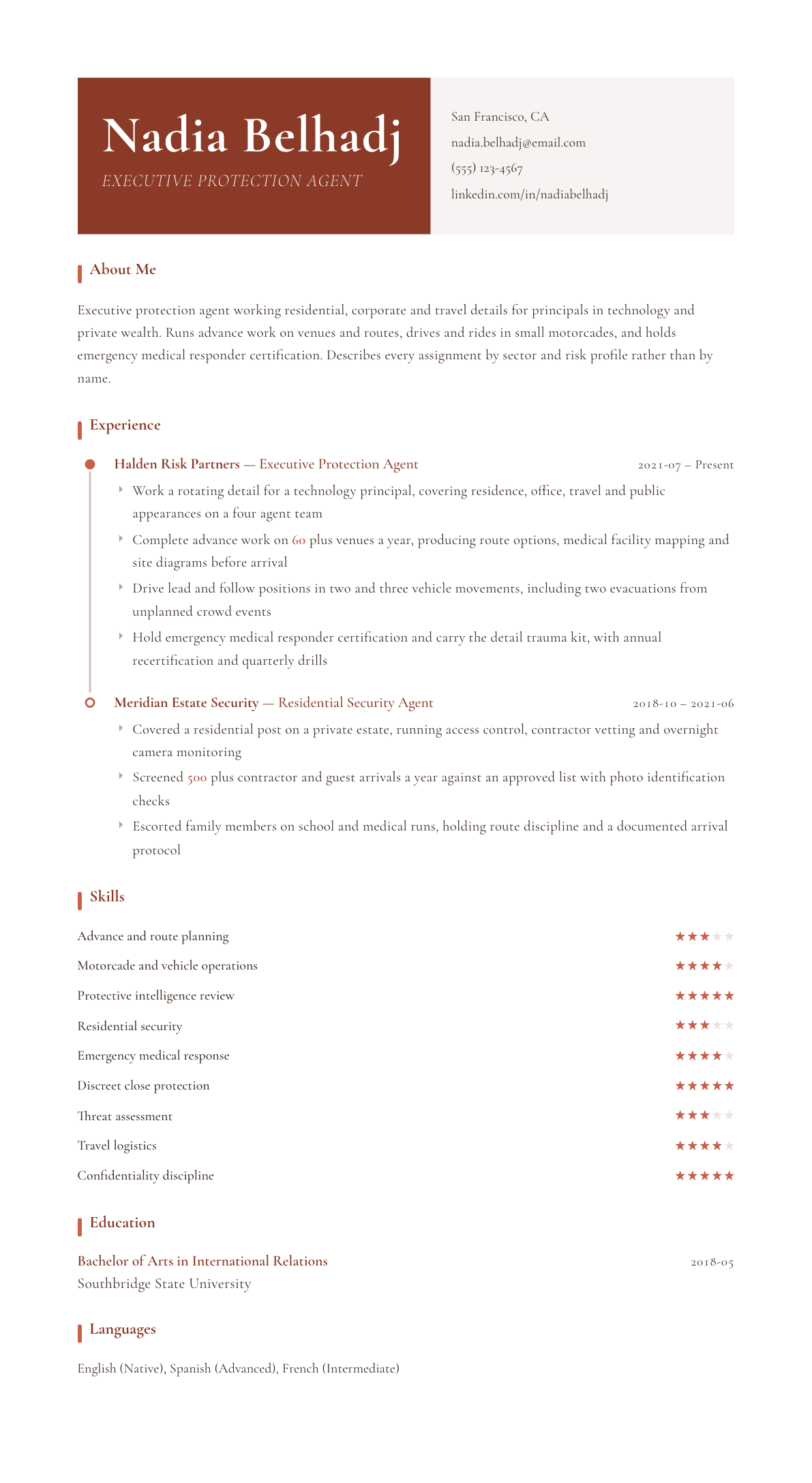
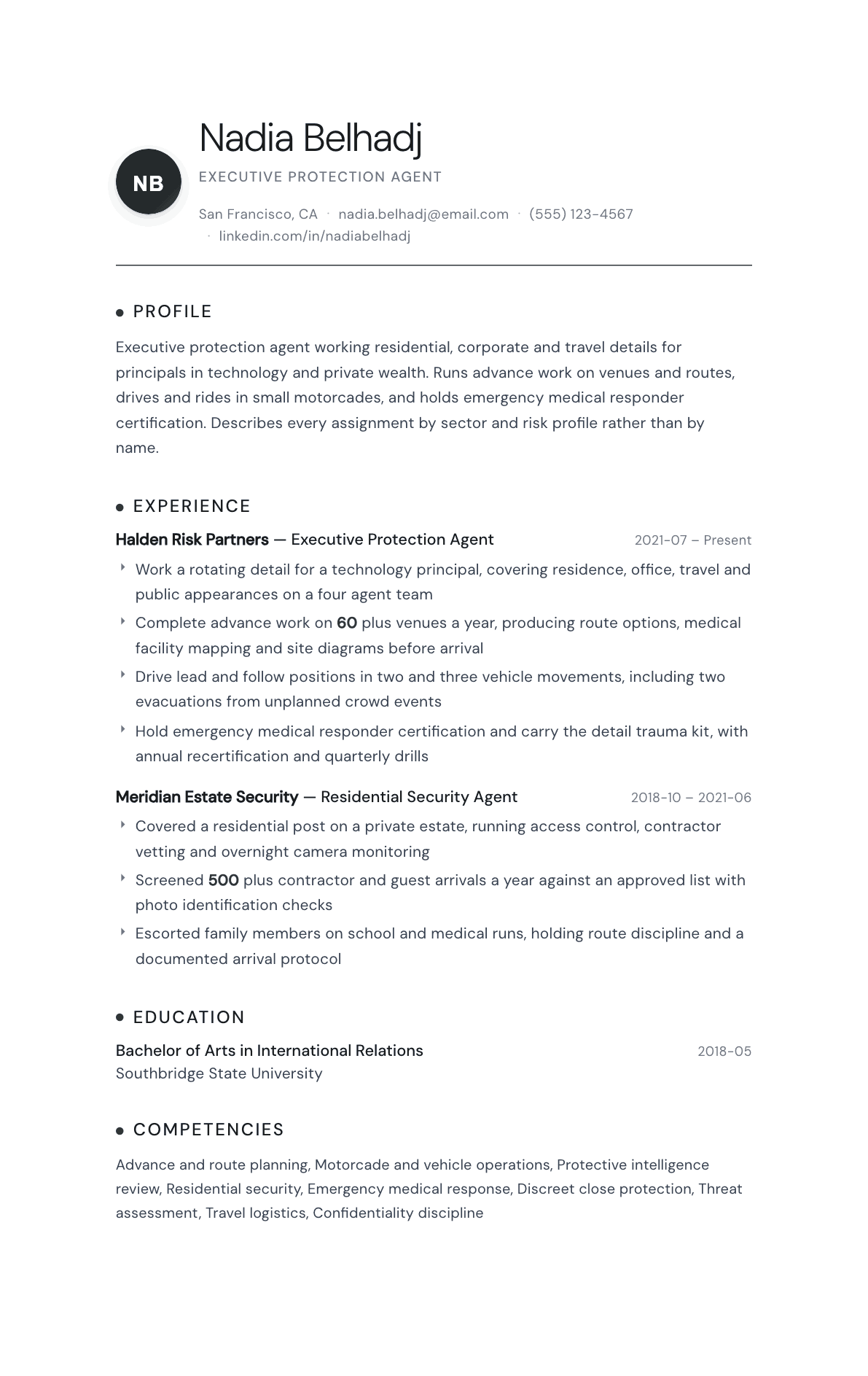
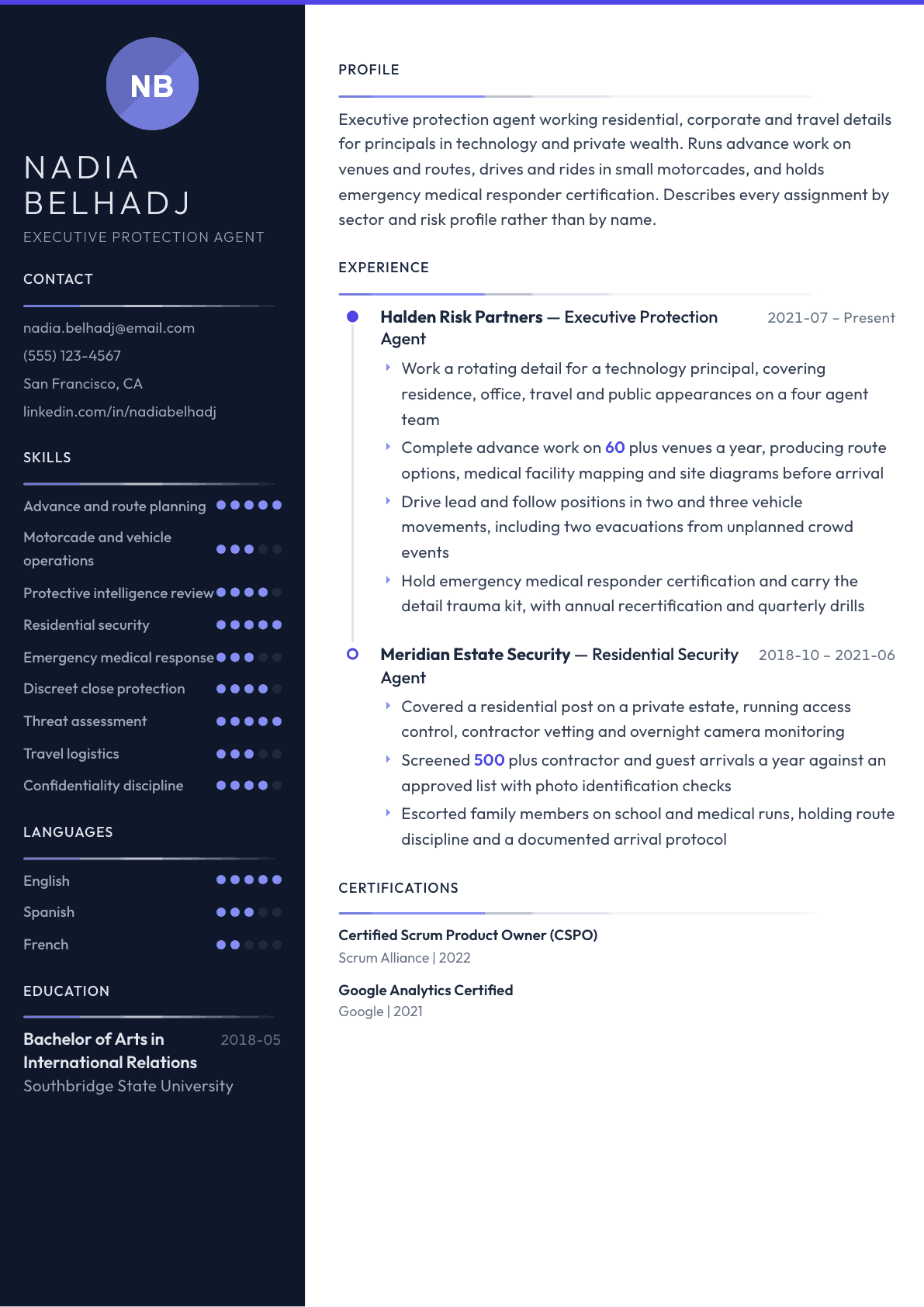
Example Executive Protection Agent summary
Executive protection agent with seven years across residential, corporate and travel details for technology and private wealth principals. Runs advance work on venues and routes, drives lead and follow positions in small motorcades, and holds emergency medical responder certification with quarterly team drills. Describes assignments by sector and risk profile only, and has moved principals safely through two unplanned crowd events.
Skills to list on a Executive Protection Agent resume
- Advance work and site surveys
- Route planning and alternates
- Motorcade formation driving
- Evasive and defensive driving
- Protective intelligence monitoring
- Threat and vulnerability assessment
- Residential and estate security
- Travel and logistics coordination
- Emergency medical response and trauma care
- Crowd management around a principal
- Secure communications discipline
- Household staff vetting
- Airport and private aviation movements
- Incident and after action reporting
- Confidentiality and non-disclosure discipline
What actually gets this resume read
- Describe principals by sector and risk profile, never by name, because breaking confidentiality on a resume ends the interview.
- Separate advance work from detail work, since firms staff those functions differently and hire for one at a time.
- Name your driving training and the vehicle positions you have run, because motorcade competence cannot be assumed.
- Put your medical certification on the page, since a detail without a medically trained agent is a gap firms will not accept.
- Give the countries or regions you have worked details in, along with any language ability you can actually use.
- Show your firearms status and jurisdiction honestly, because carry authority varies and misstating it is disqualifying.
- Include residential and estate work if you have it, since many long term assignments start at the house, not the road.
How to write a executive protection agent resume
Executive protection hiring is a referral business with a paper trail attached. A detail leader or protective services director will often already know something about you before your resume arrives, and the page has one job: confirm that you are professionally serious, medically capable, discreet, and easy to insert into an existing detail without teaching you the basics.
Two failure modes dominate. The first is the tactical resume, heavy with courses, weapons and photographs of training, which tells a detail leader the applicant is interested in the aesthetic rather than the work. The second is the confidential resume, so vague about principals and assignments that nobody can tell what the candidate has actually done. The right page sits between them: specific about function, silent about identity.
This guide covers how to describe details without naming a principal, how to separate advance work from detail work, what medical and driving credentials belong on the page, and how to write residential and travel assignments so a firm can put you into a rotation with confidence.
Format: function first, principals described by sector only
One page, occasionally two once you have run details in several regions. The organizing principle is function, not employer. Under each assignment, name the firm or the family office structure, then describe the principal only by sector and risk profile: a technology founder, a private wealth family, a public health care executive, a media figure with an active online following.
Never name a principal, an address, a route or a date pattern. A resume that leaks any of those tells the reader exactly how you would treat their client, and no amount of experience recovers from it. Firms specifically test for this in the interview by asking about your last detail and watching what you volunteer.
- Assignment block: firm or family office, detail type, team size, coverage model and duration.
- Principal line: sector and risk profile only, with the exposure driver such as public appearances or media attention.
- Function line: advance, detail agent, driver, residential, or a mix, with the proportion of your time in each.
- Credential block: medical certification, driving training, firearms authority by jurisdiction, and languages you can actually work in.
- Travel line: regions worked, whether you handled logistics yourself and any private aviation movements.
Summary: detail types, functions, medical, discretion
Three lines. Say what kinds of details you have worked, which functions you cover, that you hold a current medical certification, and that you describe assignments by sector only. That last point is worth stating on the page, because it signals confidentiality discipline before the reader has to test for it.
If you have real advance experience, put it in the first line. Firms are far shorter of agents who can produce a usable advance package than of agents who can stand a post, and an applicant who can do both is scheduled more easily.
Experience: advance work, movements, residential coverage
Advance work is the most misrepresented function in this field, so write it concretely. A real advance produces something: route options with timings, an arrival and departure plan, a site diagram with access and egress marked, nearest appropriate medical facilities with drive times, a local emergency contact and a communication plan. Say how many advances a year and what your package contained.
Movement work should name the formations and positions you have held. Lead vehicle, principal vehicle, follow, walking positions around a principal in a crowd, arrival and departure choreography at a venue with press present. Name your driving training and whether you have current evaluated time behind the wheel, because motorcade competence is assumed and rarely verified until it fails.
Residential and estate coverage is where many long term assignments actually live, and it deserves proper treatment. Access control at the gate, contractor and household staff vetting, delivery handling, camera and alarm monitoring, and the family movement routines that need to look ordinary while still being controlled. Give volumes for screenings and arrivals.
Two other functions belong on the page if you carry them. Protective intelligence, meaning monitoring for concerning communications and escalating them, and travel logistics, meaning that you booked, sequenced and de-conflicted the movement rather than following a plan somebody else wrote.
Medical, driving and the credentials that decide a rotation
A detail without a medically capable agent is a gap the client is paying for and not receiving. Put your medical certification level on the page with the currency date, say whether you carry the team trauma kit, and describe the drill cadence. Agents who train medical quarterly get scheduled ahead of agents who certified once.
Firearms authority has to be stated accurately and by jurisdiction. Carry permissions vary widely, and misrepresenting where you can carry is a disqualifying error rather than an ambitious one. If a detail is unarmed, say so, because a great many corporate details are and the firm needs agents comfortable working that way.
- Medical certification level, issuing registry, currency and the drill cadence you maintain.
- Driving training completed, the positions you have driven and any evaluated recurrent training.
- Firearms authority by jurisdiction, stated plainly, including where you work unarmed.
- Languages with the level you can genuinely operate at, not the level you studied to.
- Background, clearance or vetting status where a firm can verify it.
Skills and keywords a protection firm screens on
Protection postings repeat a specific vocabulary: advance, route planning, motorcade, arrival and departure, protective intelligence, threat assessment, residential security, duty of care, low profile, close protection. Use those exactly, since detail leaders and family office staff both scan for them.
Low profile deserves emphasis. Most corporate and private wealth work requires an agent who blends into a restaurant, a school pickup or a board meeting without reading as security. If your history is in that register rather than in a visible protective posture, say so directly, because it is a preference many clients state explicitly.
Executive Protection Agent resume summary examples
New to protection
Protective services agent with three years of residential estate security and a completed close protection course, now covering school and medical movements for a private family. Holds emergency medical responder certification current since 2024 and evaluated protective driving training. Describes assignments by sector only.
Four years on details
Executive protection agent working residence, office, travel and public appearance coverage for a technology principal on a four agent team. Completes 60 plus venue advances a year with route options and medical facility mapping, drives lead and follow positions, and carries the detail trauma kit.
Detail leader
Detail leader with ten years across private wealth, technology and media principals, running a six agent rotation with residential, travel and event coverage. Owns advance standards and the emergency action plan, has moved principals through two unplanned crowd events, and works low profile across three regions.
Work experience bullets: before and after
Before: Provided close protection for high profile clients.
After: Worked a rotating detail for a technology principal covering residence, office, travel and public appearances on a four agent team, with a low profile posture at every venue including school and family movements.
Sector, coverage model, team size and posture describe the work fully without identifying anyone.
Before: Conducted advance work before the client arrived.
After: Completed more than 60 venue advances a year, producing primary and alternate routes with timings, site diagrams marking access and egress, nearest trauma center with drive time, and a local emergency contact list.
Naming what the advance package actually contained proves the function rather than claiming the title.
Before: Drove the client to appointments.
After: Drove lead and follow positions in two and three vehicle movements, including two departures accelerated when an unplanned crowd formed at a venue exit, with both movements completed without contact.
Positions driven plus two real deviations from plan show motorcade judgment instead of chauffeur duty.
Before: Was trained in first aid for emergencies.
After: Hold emergency medical responder certification with annual recertification, carry the detail trauma kit on every movement, and run quarterly medical drills with the team covering hemorrhage control and airway management.
Certification level, equipment responsibility and drill cadence turn a training line into a live team capability.
Before: Controlled access at the client residence.
After: Ran the residential post for a private estate, screening more than 500 contractor and guest arrivals a year against an approved list with photo identification, and vetting household staff before their first shift.
Arrival volume, the verification method and staff vetting show residential work as a controlled program.
Hard skills
- Advance work and site surveys
- Route planning with primary and alternate options
- Motorcade formation and position driving
- Evaluated protective and defensive driving
- Protective intelligence monitoring and escalation
- Threat and vulnerability assessment
- Residential and estate security operations
- Household staff and contractor vetting
- Travel logistics and itinerary de-confliction
- Airport and private aviation movements
- Emergency medical response and trauma care
- Crowd management around a principal
- Secure communications and radio discipline
- Incident and after action reporting
Soft skills
- Being present all day without the principal noticing you are working
- Reading a room quickly enough to move before anything is obvious
- Absolute discretion about what you see inside a family
- Getting along with household staff who did not ask for security
- Staying alert on the fourth quiet week of an assignment
Certifications worth listing
- Emergency Medical Responder (National Registry of Emergency Medical Technicians)
- Certified Protection Professional (CPP) (ASIS International)
- Certified Protection Officer (CPO) (International Foundation for Protection Officers)
Mistakes that cost executive protection agent candidates the interview
- Naming a principal, an address or a routine, which ends the application immediately at any serious firm.
- Building the page around courses and weapons rather than around advances completed and details worked.
- Being so vague about assignments that a detail leader cannot tell what function you actually performed.
- Leaving medical certification off the page when a medically capable agent is what fills a rotation gap.
- Overstating firearms authority or implying carry permission in jurisdictions where you do not hold it.
- Ignoring residential and estate work, which is where a large share of long term assignments actually sit.
- Claiming advance experience without describing the package produced, which an interviewer will ask for line by line.
Executive Protection Agent resume questions
How do I describe my principals without breaking confidentiality?
Use sector and risk profile only: a technology founder with regular public appearances, a private wealth family with school age children, a media figure with an active online following. That gives a detail leader everything needed to assess your exposure while identifying nobody.
Do I need a firearm to work executive protection?
Not for a great deal of corporate and private wealth work, which is deliberately unarmed and low profile. State your authority accurately by jurisdiction and note that you are comfortable working unarmed, because many clients specifically require it and some venues make it impossible anyway.
How much does medical training matter on this resume?
A great deal, because on most details the nearest capable responder for several minutes is the agent standing next to the principal. Put your certification level, currency and drill cadence on the page, and mention the trauma kit if you carry and maintain it.
What if my background is military or law enforcement rather than protection?
Translate it into protective functions. Convoy work becomes movement operations, route reconnaissance becomes advance work, dignitary visits become protective assignments. Then add a recognized close protection course and any medical certification, since those are the two credentials firms check first.
Should I include photographs or a portfolio?
No. Images of you at work compromise a principal and photographs from training read as marketing. The page should be plain text, the references should come from people who have worked details with you, and the discretion you show on paper is itself the sample of your judgment.
Related resume examples
- Bodyguard Resume example
- Private Investigator Resume example
- Armed Security Guard Resume example
- Security Consultant Resume example
- Security Guard Resume example
- Infantry Resume example