Border Patrol Agent Resume Examples: what gets the call
Write a Border Patrol Agent Resume Built for Federal Hiring
By Mustafa Tarabya, founder of CVBooster · Published · Updated
Border patrol agent resume example, keyword list and guide covering line watch, tracking, apprehension reporting and the federal application format.
Sample resumes for a border patrol agent
The same border patrol agent content laid out in three CVBooster templates, so you can see what the finished document looks like before you write a word.
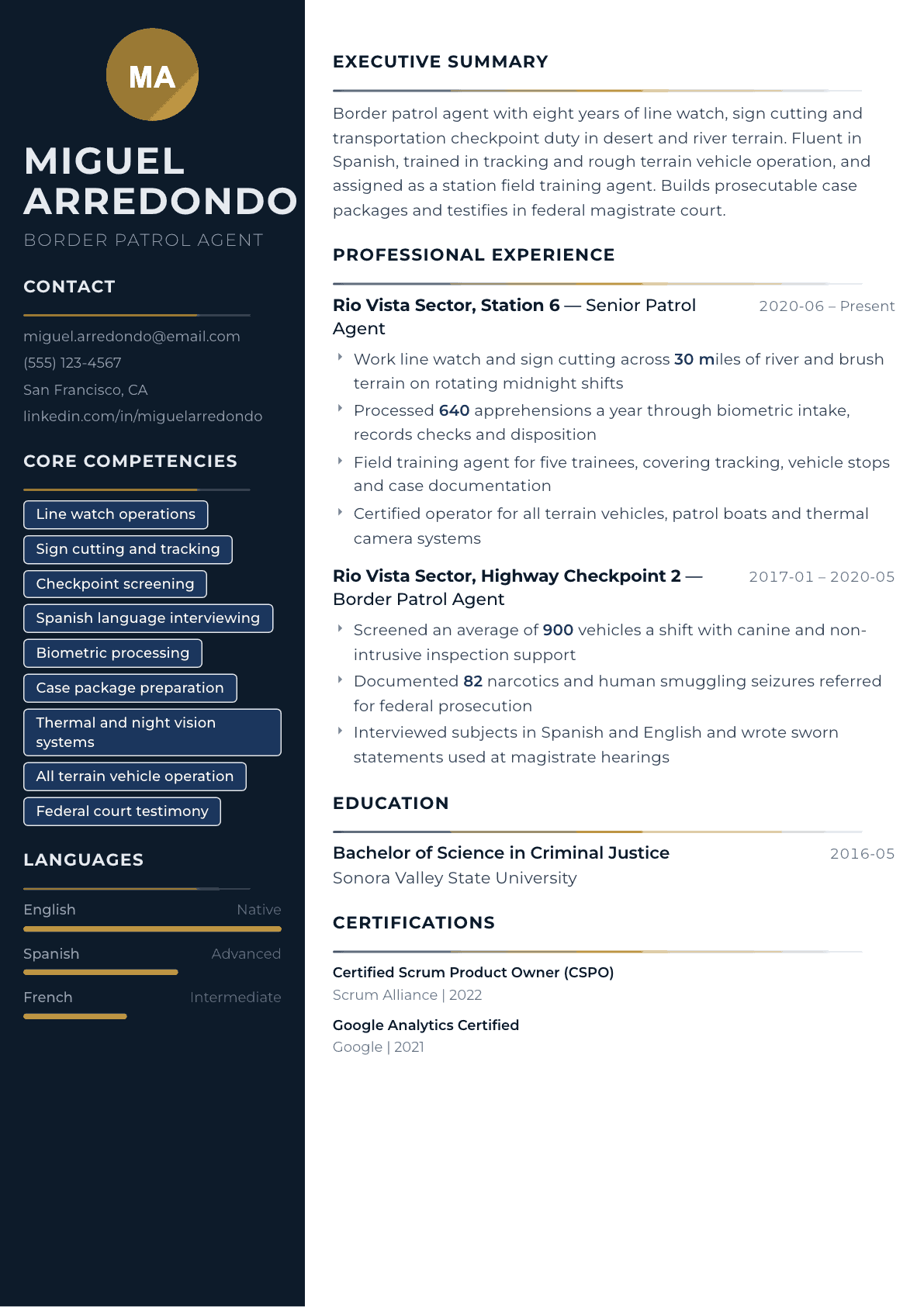
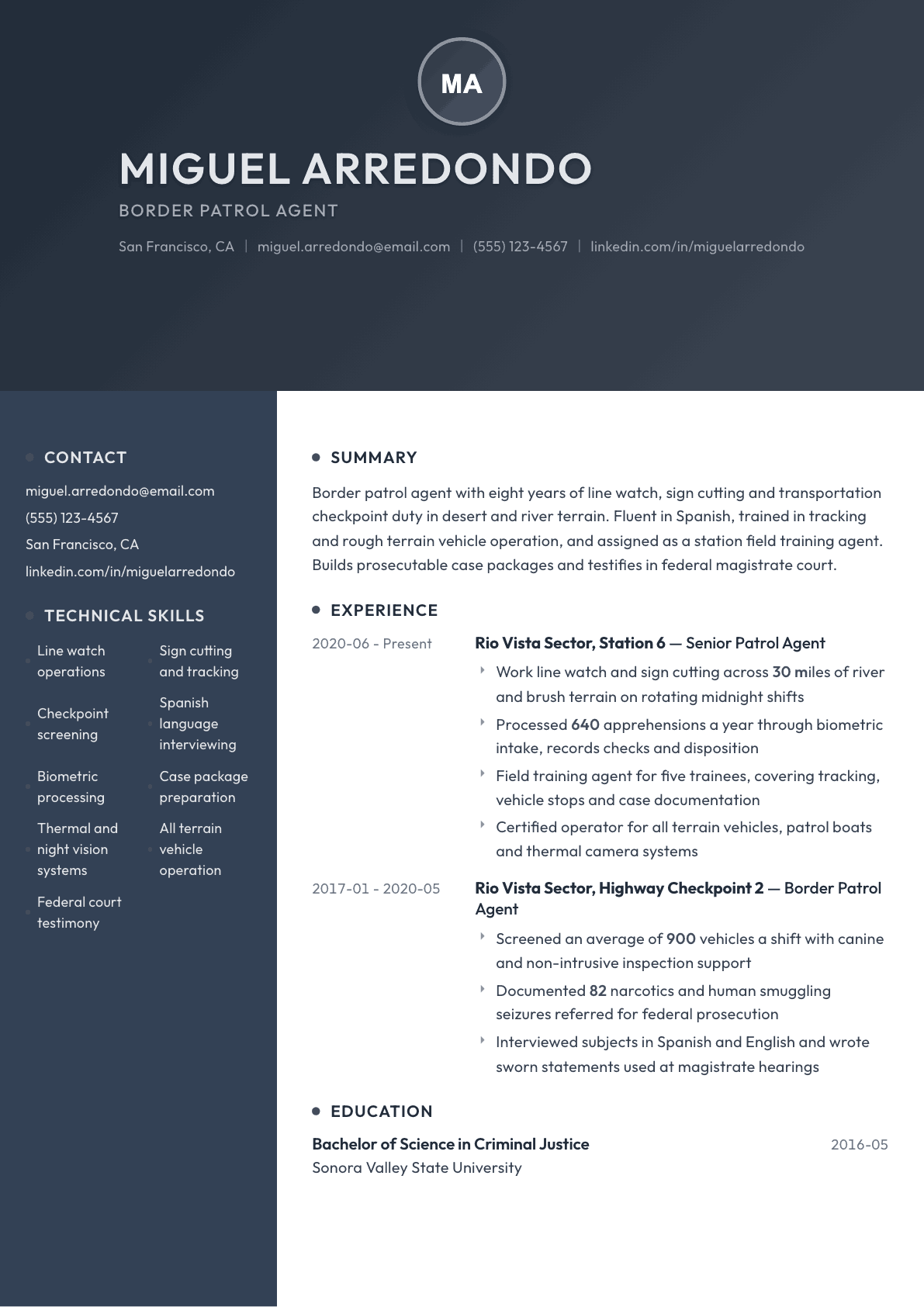
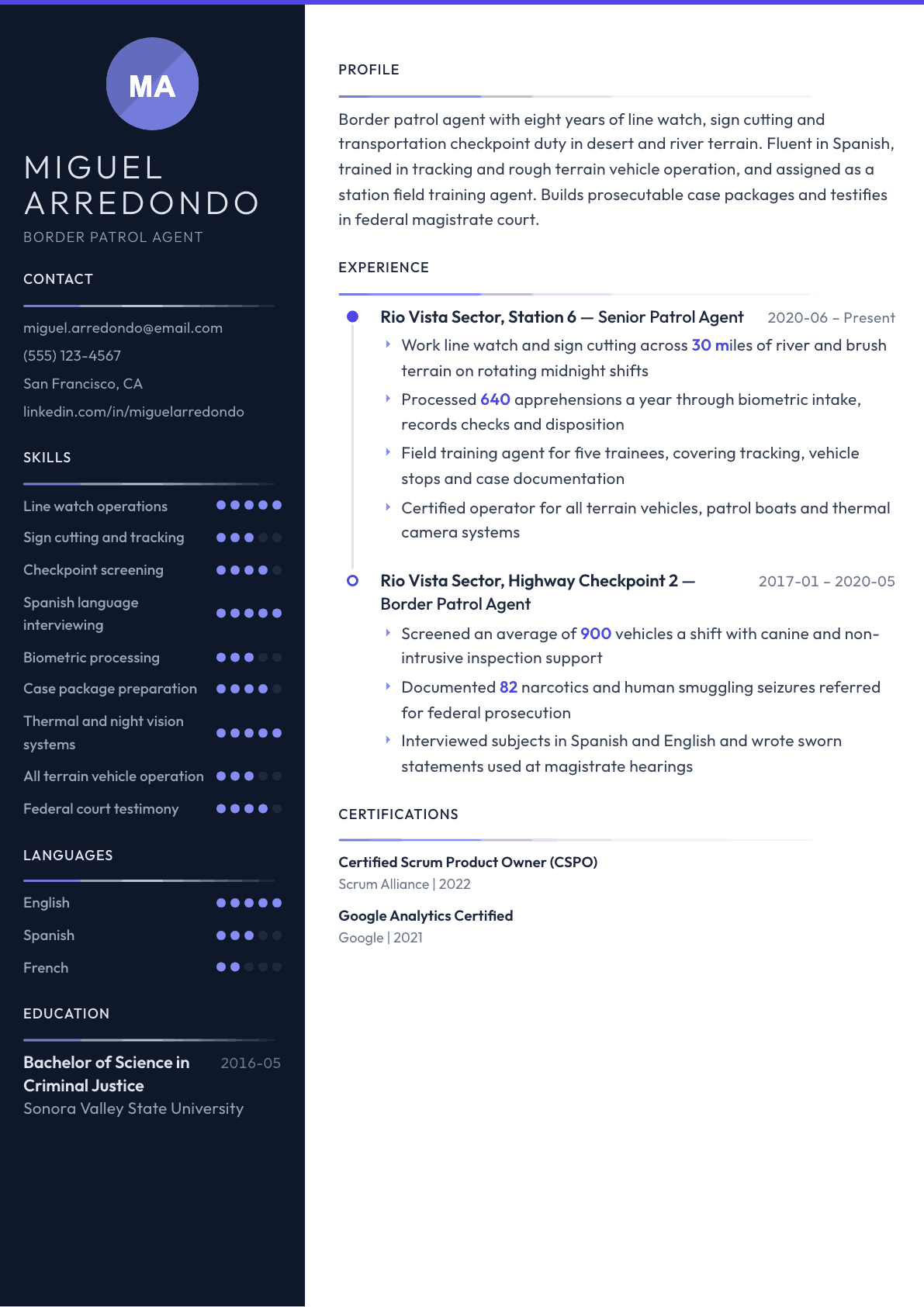
Example Border Patrol Agent summary
Border patrol agent with eight years of line watch, sign cutting and checkpoint duty across river and desert terrain. Processes apprehensions end to end, builds smuggling case packages accepted for federal prosecution, and interviews subjects in Spanish and English. Certified on patrol boats, terrain vehicles and thermal systems, and trains new agents at station level. Seeking an intelligence unit assignment.
Skills to list on a Border Patrol Agent resume
- Line watch and area control
- Sign cutting and tracking
- Traffic checkpoint operations
- Apprehension and processing
- Biometric and records checks
- Spanish language proficiency
- Smuggling interdiction
- Evidence and property handling
- Sworn statement writing
- Federal magistrate testimony
- Thermal imaging and sensor monitoring
- Patrol boat and terrain vehicle operation
- Search and rescue
- Firearms qualification
- Field training delivery
- Interagency coordination
What actually gets this resume read
- Write the federal version of this resume long, with hours per week and supervisor details for every assignment.
- Name your sector, your station and the terrain you patrolled, because desert, river and urban work differ sharply.
- Quantify apprehensions, seizures and vehicles screened so a rating panel can score your experience level.
- Put your Spanish proficiency and how it was tested near the top, since it drives assignment and pay decisions.
- Detail the specialty units you served on: horse patrol, boat, canine, search and rescue or intelligence.
- Spell out every federal training course by its full name before you use the acronym anywhere on the page.
How to write a border patrol agent resume
Applications for border patrol agent positions go through a federal rating process before any supervisor sees them. A human resources specialist reads your experience against the specialized experience statement in the announcement and decides whether you qualify at the grade you applied for. That specialist is not an investigator and will not infer anything, so every qualifying duty has to be visible in your own words.
The federal format that follows from this is unfamiliar to anyone used to a one page civilian resume. You give hours worked per week, supervisor names, grade levels and long duty narratives. Detail that would look excessive elsewhere is what earns points here, and brevity costs you the rating rather than impressing anyone.
This guide covers both versions of the page: the federal resume that survives rating, and the shorter version you hand a task force partner or use when applying laterally. It also covers how to write line watch, tracking, checkpoint and processing work so the duties read as qualifying rather than as scenery.
Format: the federal resume runs long on purpose
For a federal announcement, write several pages. Each position gets the employing organization, the location, the grade or pay band, start and end dates by month and year, hours worked per week, your supervisor and whether the supervisor may be contacted. Omitting hours per week is the most common reason an otherwise qualified agent is rated ineligible.
Under each position, write duty paragraphs rather than clipped bullets, and mirror the phrasing of the specialized experience statement. If the announcement asks for experience conducting surveillance and apprehending violators, those words should appear in your narrative attached to real work, not as a claim in a skills list at the bottom of the page.
- Every federal entry carries organization, location, grade, dates by month, hours per week and supervisor contact permission.
- Border patrol page order: summary, citizenship and clearance status, sworn experience, federal training, languages, education.
- Keep a two page version for lateral moves and interagency work where nobody is rating your points.
- Applicants with no sworn time lead with military service, language ability and any outdoor, tracking or rescue work.
Summary: sector, terrain, language, specialty
Four lines here rather than three, because the reader needs the sector, the terrain, your language ability and your specialty before the narrative starts. Desert line watch, river work, an urban corridor and a highway checkpoint are different jobs with different skills, and naming yours saves the reader from assuming the easiest one.
Language belongs in the opening lines. Spanish proficiency drives station assignment, interview responsibility and in many cases pay, so state the level you were tested at rather than describing yourself as conversational. If you speak a third language used in your sector, that is worth more than most of the certifications on your page.
Experience: line watch, tracking and processing volume
Write the patrol work in the terms the agency uses. Line watch, sign cutting, roving patrol, transportation checks, camera and sensor response, boat and terrain vehicle operation. Give the miles of responsibility, the terrain type and the shift, then the volume: apprehensions processed, vehicles screened, seizures made, rescues performed.
Processing deserves its own paragraph because it is where most of the hours actually go. Biometric intake, records checks, disposition decisions, custody and property handling, family and minor procedures, and the case packages you built for federal prosecution. An agent who can show clean processing at volume is easier to place than one who only describes field work.
Search and rescue work belongs on the page too. Rescues in remote terrain, the equipment you carried, medical certification and the coordination with air support all show judgment under conditions where nobody was watching. That is exactly what a supervisor is trying to assess from paper.
Training, clearance and specialty units
Spell out every federal training course in full before using its acronym, since the rating specialist may not know the abbreviations your station uses daily. Group academy training, in service courses, firearms and tactical qualifications, and medical certification so the block can be read as a single credential picture.
Then the specialty assignments: horse patrol, canine handling, boat operations, mobile response, intelligence, tactical unit or field training agent. These are the assignments a supervisor uses to fill a roster, and they matter more to your next posting than a general statement about being a dependable agent. Note your clearance level and its current standing without describing any classified work.
Keywords, honesty and the background stage
Border patrol announcements repeat a set of terms: patrol operations, surveillance, apprehension, interdiction, questioning, evidence handling, report writing, testimony, terrain navigation. Use them where the work appears rather than clustering them in a keyword block that a rating specialist will read as filler.
Everything on the page will be checked against a polygraph interview and a full background investigation. Overstated volume, inflated titles and vague dates cause more failures at that stage than gaps in experience do. Write numbers you can defend from memory under questioning, because you will be asked to explain them without your notes.
Border Patrol Agent resume summary examples
First federal application
Marine Corps infantry veteran with four years of security patrol, land navigation and radio reporting, plus native Spanish. Emergency medical technician certified, comfortable on midnight shifts in remote terrain, and applying for a border patrol agent position with a complete background packet prepared.
Eight years in the field
Border patrol agent with eight years of line watch, sign cutting and checkpoint duty across river and brush terrain. Processes roughly 640 apprehensions a year through biometric intake and disposition, interviews in Spanish and English, and operates patrol boats, terrain vehicles and thermal camera systems.
Senior agent
Senior patrol agent with fourteen years across two sectors, serving as field training agent and mobile response team member. Builds smuggling case packages accepted for federal prosecution, testifies at magistrate hearings, and has led station level tracking instruction for five trainee classes.
Work experience bullets: before and after
Before: Patrolled the border area and apprehended illegal entrants.
After: Worked line watch and sign cutting across 30 miles of river and brush terrain on rotating midnight shifts, responding to sensor and camera activations without immediate backup.
Terrain, distance and shift show what the patrol actually demanded of you.
Before: Processed subjects at the station.
After: Processed 640 apprehensions a year through biometric intake, records checks, custody and property handling and final disposition, with case files accepted without return.
Processing volume with the steps named proves the part of the job that fills most hours.
Before: Worked at the highway checkpoint.
After: Screened an average of 900 vehicles a shift at a highway checkpoint with canine and imaging support, referring 82 narcotics and smuggling cases for federal prosecution.
Volume plus referral outcomes turns a post assignment into measurable enforcement work.
Before: Used Spanish when needed on the job.
After: Conducted subject interviews and sworn statements in Spanish and English daily, and interpreted for agents from three stations during joint operations.
It converts a language claim into a duty other agents depended on.
Before: Trained newer agents.
After: Served as field training agent for five trainees, covering tracking, vehicle stops, processing documentation and courtroom preparation through their probationary period.
Naming the subjects taught and the trainee count makes the role verifiable.
Hard skills
- Line watch and area control
- Sign cutting and tracking
- Highway checkpoint screening
- Apprehension and custody procedure
- Biometric intake and records checks
- Smuggling and narcotics interdiction
- Evidence and property handling
- Sworn statement and report writing
- Federal magistrate testimony
- Thermal imaging and ground sensor monitoring
- Patrol boat and terrain vehicle operation
- Remote terrain search and rescue
- Spanish language interviewing
Soft skills
- Situational awareness on solo night patrol
- Judgment when backup is far away
- Physical endurance across long shifts
- Cross agency cooperation at operation level
- Steady questioning without escalation
Certifications worth listing
- Emergency Medical Technician (EMT) (National Registry of Emergency Medical Technicians)
- Basic Life Support Provider (American Heart Association)
- Wilderness First Responder (National Association for Search and Rescue)
Mistakes that cost border patrol agent candidates the interview
- Writing a one page civilian resume for a federal announcement that rates you on narrative detail.
- Leaving out hours worked per week, the omission that most often makes an experienced agent ineligible.
- Describing patrol without naming the terrain, the miles covered or how far away backup sat.
- Treating processing as clerical work when it is the duty that occupies most of a station shift.
- Listing federal course acronyms with no explanation of what each one qualified you to do.
- Inflating apprehension or seizure numbers that will be tested during the polygraph and background interview.
Border Patrol Agent resume questions
How long should a border patrol agent federal resume be?
Several pages is normal and expected. Rating specialists score the narrative against the specialized experience statement, so cutting detail cuts your score. Keep a separate two page version for lateral applications and interagency work where the federal rating process does not apply.
Does military experience count toward qualifying experience?
Often yes, particularly military police, infantry, security forces and investigative work. Write unit size, the security duties you held, weapons qualifications and any law enforcement authority. Claim veterans preference through the application system rather than announcing it across your resume.
How should I present my Spanish ability?
State the level you were formally tested at and the duties you performed in the language: interviews, sworn statements, interpreting for other agents. Native and tested proficiency are stronger claims than conversational, and the ability shapes both your station assignment and your usefulness on operations.
What if I have never worked in law enforcement?
Lead with what transfers: outdoor navigation, physical endurance, night operations, radio discipline, incident reporting, and any language ability. Agencies hire at entry grades and train at the academy, so the resume needs to show reliability and fitness rather than prior sworn authority.
How do I move from the field to an intelligence or task force assignment?
Show the analytical half of your record: case packages built, patterns identified across apprehensions, work with prosecutors, and any collection or reporting you contributed to. Name the systems you used and the partner agencies you coordinated with on joint operations.
Related resume examples
- Customs Officer Resume example
- Federal Agent Resume example
- Police Officer Resume example
- Federal Resume example
- TSA Officer Resume example
- State Trooper Resume example