TSA Officer Resume Examples: free ATS score and gap list
Write a TSA Officer Resume That Survives Checkpoint Hiring
By Mustafa Tarabya, founder of CVBooster · Published · Updated
TSA officer resume example, keyword list and writing guide covering checkpoint screening, image interpretation, bag search and passenger throughput.
Sample resumes for a tsa officer
The same tsa officer content laid out in three CVBooster templates, so you can see what the finished document looks like before you write a word.
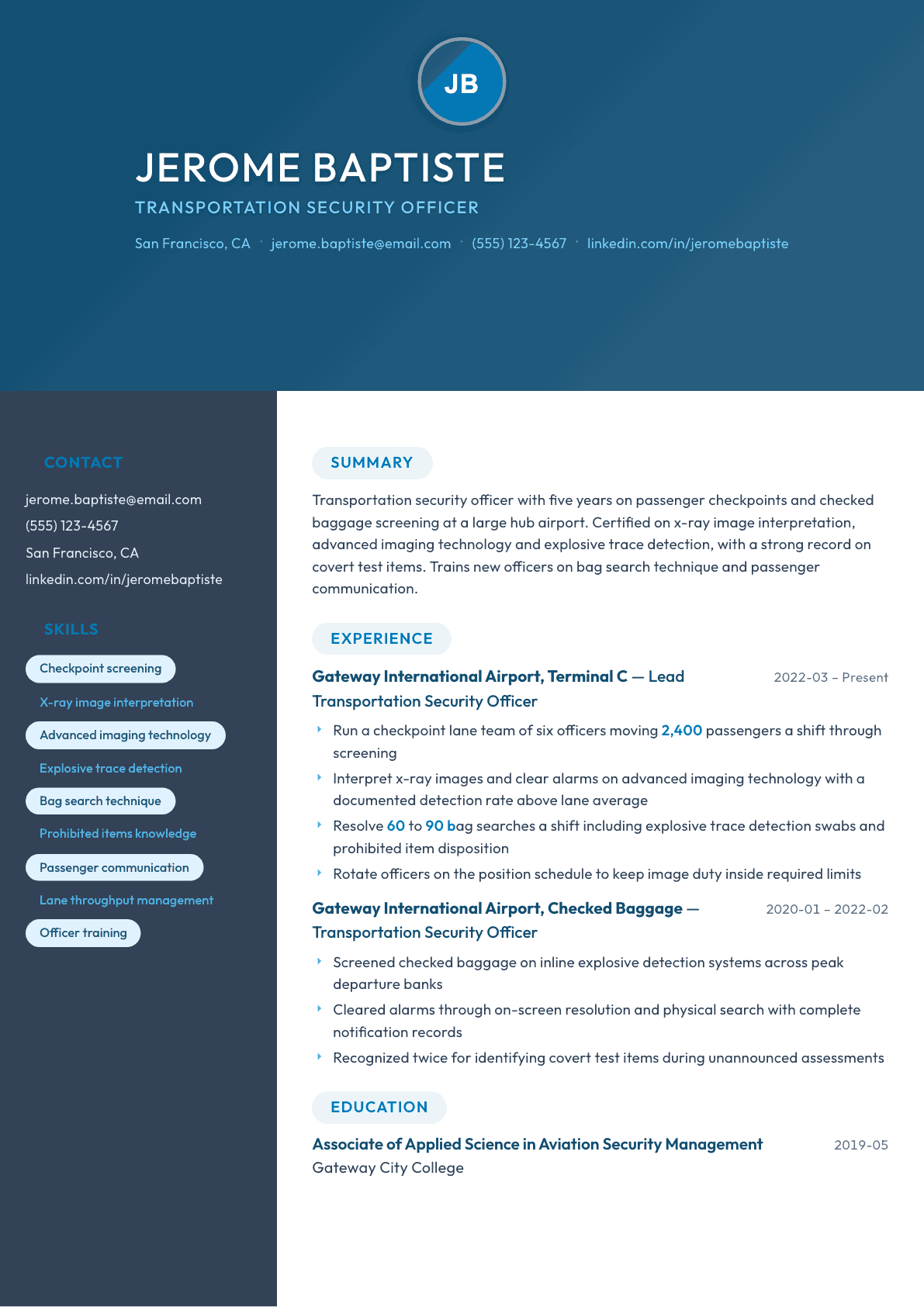
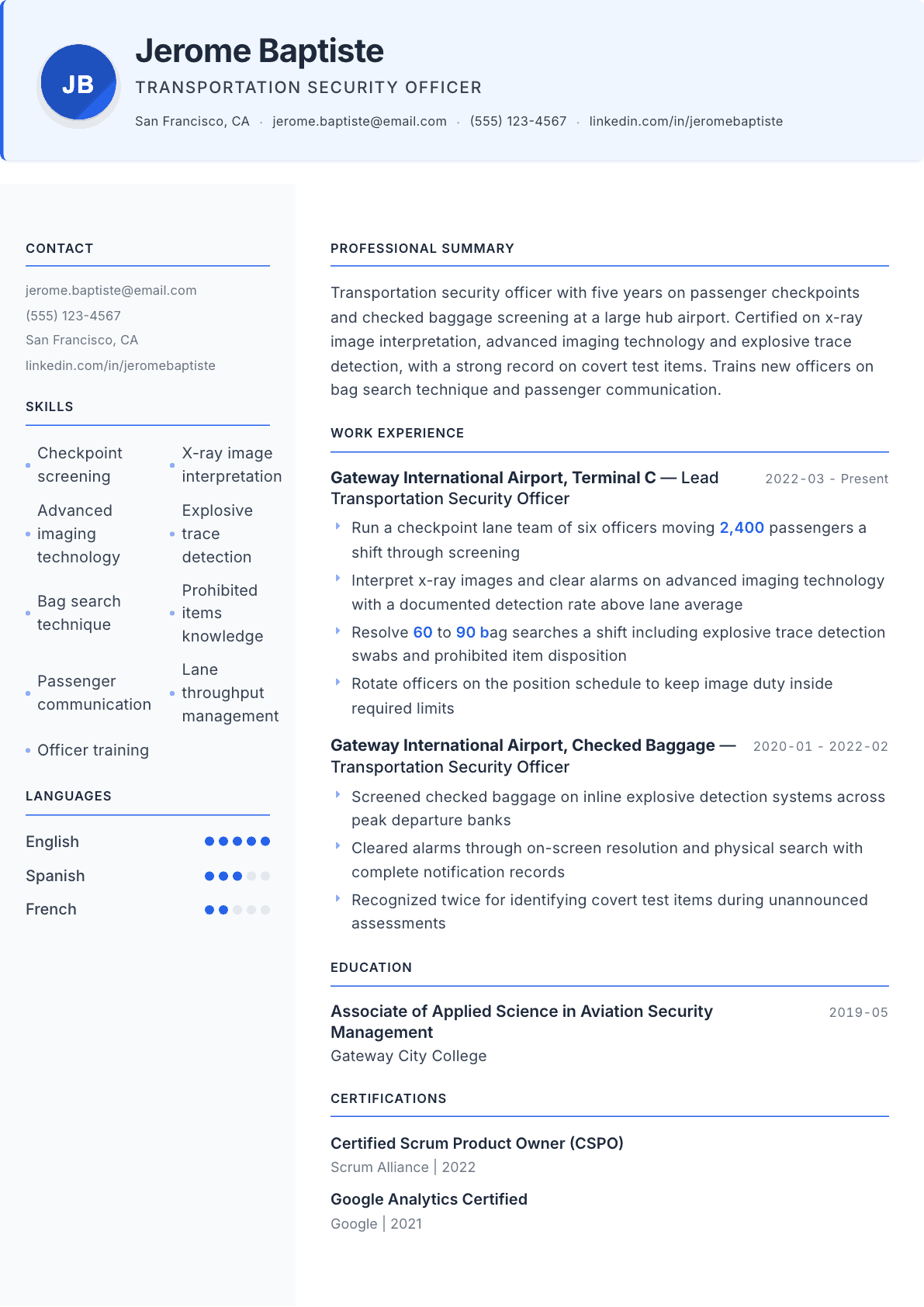
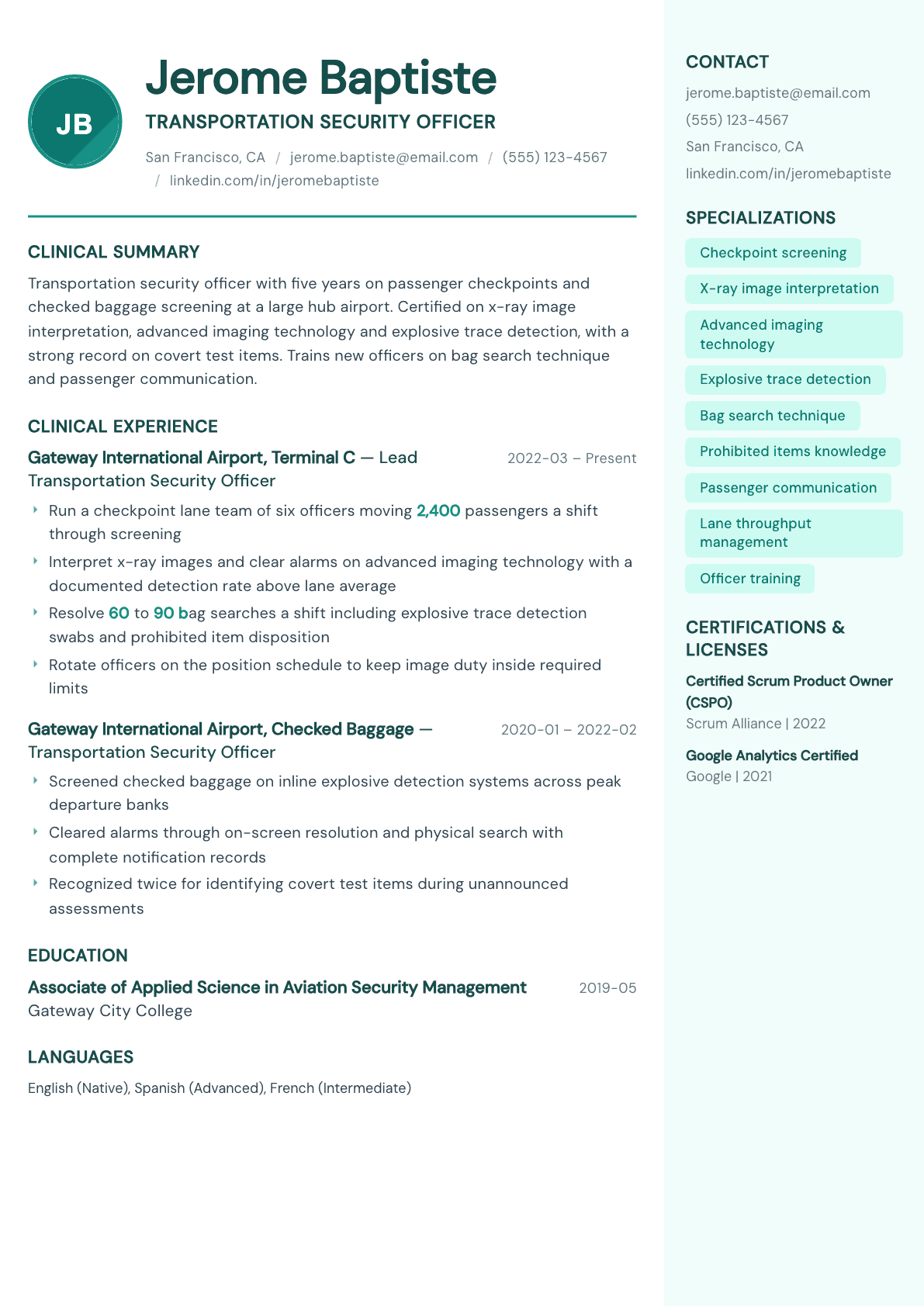
Example TSA Officer summary
Transportation security officer with five years at a hub airport across passenger checkpoints and checked baggage. Certified on x-ray interpretation, advanced imaging technology and explosive trace detection, with recognition for catching covert test items. Leads a six officer lane team, manages position rotation, and trains new officers on bag search and passenger communication. Seeking a supervisory transportation security officer role.
Skills to list on a TSA Officer resume
- Passenger checkpoint screening
- Checked baggage screening
- X-ray image interpretation
- Advanced imaging technology operation
- Explosive trace detection
- Explosive detection system alarm resolution
- Physical bag search
- Pat down procedure
- Prohibited items determination
- Travel document checking
- Passenger de-escalation
- Lane throughput and staffing rotation
- Incident documentation
- On the job training delivery
- Radio and supervisor notification
What actually gets this resume read
- Name the screening technologies you are certified on, because a checkpoint schedule is built around those positions.
- Give passenger or bag volume per shift so a supervisor can judge the pace you have worked at.
- Mention covert test results and detection performance in general terms rather than claiming perfection.
- Show your customer facing side, since most complaints at a checkpoint start with how a search was explained.
- Include any lead, training or scheduling duties, which are the step toward supervisory transportation security roles.
- Keep the federal version detailed with hours per week, grade level and supervisor contact for each assignment.
How to write a tsa officer resume
A TSA officer resume is read against a checkpoint schedule. The supervisor filling the vacancy has lanes to staff, position rotations to respect, and a set of screening technologies each officer must be certified on before they can stand at that spot. Your page is useful to her exactly to the degree that it tells her which positions you can cover on day one.
Most applicants write the job as customer service with a metal detector. The work is closer to sustained visual analysis under time pressure, with a public relations problem attached. An officer interprets x-ray images, resolves alarms, conducts searches that people resent, and does it while a line builds behind them. The resume should show both halves of that.
This guide covers the federal application format these roles use, how to write screening volume, image interpretation and covert test results, three summaries by career stage, rewritten bullets, and the questions officers ask when they apply for lead and supervisory transportation security positions.
Format: federal detail, technologies named, positions listed
Transportation security roles are federal positions, so the resume you submit through the application system carries the full apparatus: dates by month and year, hours worked per week, pay band or grade, and supervisor contact details for each assignment. Leaving out hours per week is the fastest way for an experienced officer to be screened out by a rating specialist who never sees the rest of your record.
Inside each assignment, list the positions you are certified and rotated on. Walk through metal detection, advanced imaging technology, x-ray, bag search, travel document checking, exit lane and checked baggage. A supervisor building a lane assignment reads that list the way a charge nurse reads a skills checklist, and an officer certified on more positions is simply easier to schedule.
- Header for a transportation security officer: name, city and state, phone, email, airport and terminal currently assigned.
- Position block under the summary: every screening technology and checkpoint position you are certified to work.
- Order the page as summary, certified positions, airport assignments, federal training, awards, education.
- Applicants new to aviation lead with security, military, retail floor or any role combining vigilance with public contact.
Summary: airport size, positions, detection record
Three lines. Give the airport category or passenger scale, your years, the technologies you are certified on, and a line about your detection performance. A hub airport officer who has worked peak departure banks at a large terminal has proven something an officer at a small regional field has not had the chance to.
If you are applying for a lead or supervisory transportation security officer position, use the summary differently. Name the team size you already direct, the rotation you manage, and the training you deliver, because the panel is looking for someone who has been doing the job informally before the title existed.
Experience: throughput, image work and alarm resolution
Open each assignment with the terminal, the lane count and the shift, then give throughput. Passengers screened per shift, bags screened per hour, peak bank volume. Those numbers tell a supervisor the pace you have sustained, and pace is the single biggest difference between a small field and a hub.
Then the technical work. Image interpretation with the systems you operated, alarm resolution through on screen review and physical search, explosive trace detection swabbing, pat down procedure, and prohibited item determinations. Give the number of bag searches you resolve in a shift, since that is where officer judgment and passenger friction both concentrate.
Covert testing results deserve a careful line. Say that you have identified test items during unannounced assessments and how you were recognized for it. Do not describe test scenarios, thresholds or detection standards. A hiring panel reads discretion here as evidence that you understand what stays inside the checkpoint.
The passenger half of the job
Complaints at a checkpoint almost never come from the fact that a search happened. They come from how it was explained, whether the traveler understood what was about to occur, and whether their property was handled visibly. Write that skill as a procedure: the explanation you give before a pat down, how you handle a passenger with a medical device, how you manage families and unaccompanied minors.
Add the accessibility side if you have it. Screening travelers with mobility equipment, prosthetics, service animals or communication differences is skilled work with its own protocols, and an officer who can describe it accurately stands out from a stack of pages that all claim strong communication skills.
Keywords, awards and the path to lead officer
Announcements repeat a defined vocabulary: screening, prohibited items, alarm resolution, image interpretation, pat down, checked baggage, throughput, standard operating procedure, notification. Use the exact term the announcement uses and attach it to work you did, since a rating specialist matches language rather than inferring equivalence.
Awards and recognition matter more in this workforce than in most, because the daily work generates few other visible markers. On the spot awards, detection recognition, perfect attendance records and any acting lead coverage all belong on the page. So does any collateral role: training instructor, scheduling support, checkpoint equipment coordination or behavior detection duties.
TSA Officer resume summary examples
New applicant
Retail loss prevention associate with three years of surveillance monitoring, bag checks and public contact at a busy store. Comfortable with rotating early shifts, trained in de-escalation, and applying for a transportation security officer position at a large hub airport.
Five years on the checkpoint
Transportation security officer with five years at a hub airport, certified on x-ray interpretation, advanced imaging technology and explosive trace detection. Resolves 60 to 90 bag searches a shift, has been recognized twice for identifying covert test items, and holds an above average detection record on the lane.
Lead officer
Lead transportation security officer directing a six officer lane team moving 2,400 passengers a shift. Manages position rotation to keep image duty inside required limits, trains new officers on bag search and passenger communication, and has covered supervisory shifts through two peak travel seasons.
Work experience bullets: before and after
Before: Screened passengers and their belongings at the airport.
After: Screened up to 2,400 passengers a shift across a six lane checkpoint during peak departure banks, rotating through walk through metal detection, imaging and x-ray positions.
Throughput and position rotation tell a supervisor which lanes you can cover.
Before: Operated x-ray machines to check bags.
After: Interpreted x-ray images and resolved 60 to 90 bag searches a shift, clearing alarms through on screen review, physical search and explosive trace detection swabbing.
The alarm resolution chain shows the actual skill instead of naming a machine.
Before: Followed all standard operating procedures.
After: Maintained a detection record above lane average across three annual evaluation cycles and was recognized twice for identifying covert test items during unannounced assessments.
Recognition tied to assessments is evidence, where procedure compliance is an assumption.
Before: Provided customer service to travelers.
After: Explained pat down procedure before contact, offered private screening on request, and handled travelers with mobility equipment and service animals under accessibility protocols.
Named procedures show a method rather than a claim of being good with people.
Before: Helped train new officers.
After: Trained eleven new officers on bag search technique, prohibited item determination and passenger communication, signing off their on the job qualification records.
A trainee count and the sign off responsibility make the training role concrete.
Hard skills
- Passenger checkpoint screening
- X-ray image interpretation
- Advanced imaging technology operation
- Explosive trace detection swabbing
- Checked baggage and detection system alarm resolution
- Physical bag search technique
- Pat down and private screening procedure
- Prohibited item determination
- Travel document checking
- Accessibility screening protocols
- Lane throughput and position rotation
- Incident documentation and notification
- On the job training delivery
Soft skills
- Sustained visual attention through a long shift
- Explaining an unwelcome search without escalation
- Steadiness when a line is backing up
- Discretion about checkpoint procedure
- Team coordination across a lane
Certifications worth listing
- Certified Protection Officer (CPO) (International Foundation for Protection Officers)
- Basic Life Support Provider (American Heart Association)
Mistakes that cost tsa officer candidates the interview
- Writing the role as customer service and omitting image interpretation, the skill the position is built around.
- Skipping the list of positions you are certified on, which is what a supervisor schedules against.
- Giving no throughput figures, so a hub and a small regional field look identical on the page.
- Describing covert test scenarios or detection standards instead of noting recognition and stopping there.
- Omitting hours worked per week and pay band on a federal application that is rated on those details.
- Treating awards as unimportant when they are among the few visible performance markers this work produces.
TSA Officer resume questions
What is the difference between a transportation security officer and a lead officer?
A lead directs a lane team, manages position rotation so image duty stays inside required limits, resolves passenger issues that officers escalate, and trains new hires. Applying for lead means showing you already carry those duties informally, not only that you screen well.
Do I need aviation experience to apply?
No. The workforce hires heavily from retail, security, military and customer service backgrounds. What transfers is vigilance across a long shift, comfort with rules that cannot bend, and the ability to explain an unwelcome procedure to someone who is already late.
How much can I say about screening procedures?
Name the positions and technologies you are certified on, and describe your work in general operational terms. Do not publish thresholds, detection standards, covert test scenarios or anything marked sensitive. Panels read that restraint as professionalism rather than as a thin resume.
How should I present part time or split shift work?
State the schedule plainly with hours per week, since many checkpoint positions are part time by design and a rating specialist needs the hours to calculate qualifying experience. Split shifts and early morning banks are worth naming because they show availability the airport needs.
What helps a transportation security officer move into a different federal role?
Emphasize the transferable core: federal experience, a completed background investigation, procedural discipline, incident documentation and public contact under pressure. Then add whatever specialization you built, such as training delivery, scheduling, equipment coordination or behavior detection work.
Related resume examples
- Security Guard Resume example
- Border Patrol Agent Resume example
- Customs Officer Resume example
- Security Officer Resume example
- Federal Resume example
- Event Security Resume example