Public Relations Manager Resume Examples: free ATS score
Write a Public Relations Manager Resume Editors Would Respect
By Mustafa Tarabya, founder of CVBooster · Published · Updated
A public relations manager resume built on placements, media relationships and crisis work, with a sample resume, keywords and a writing guide.
Sample resumes for a public relations manager
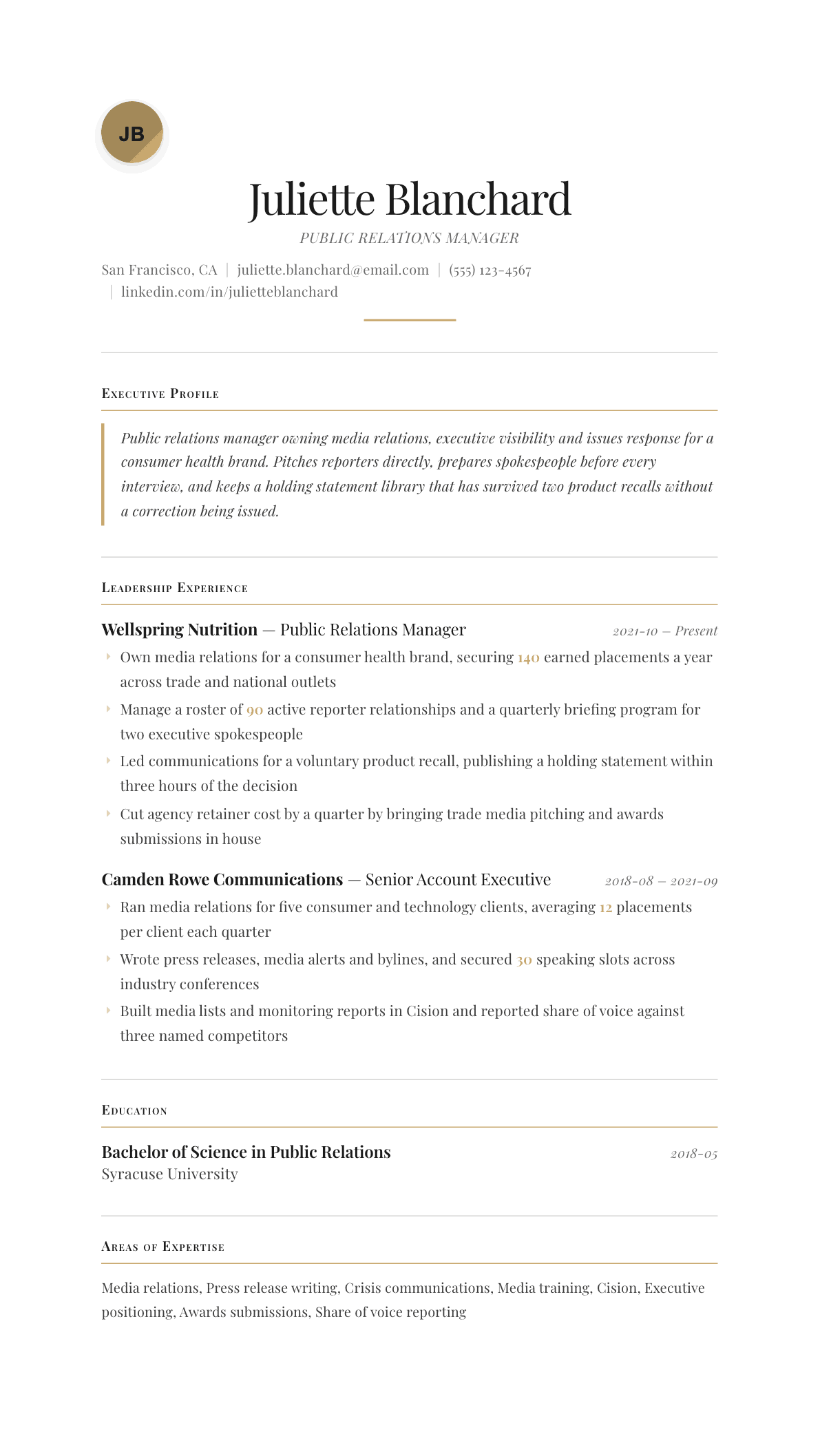
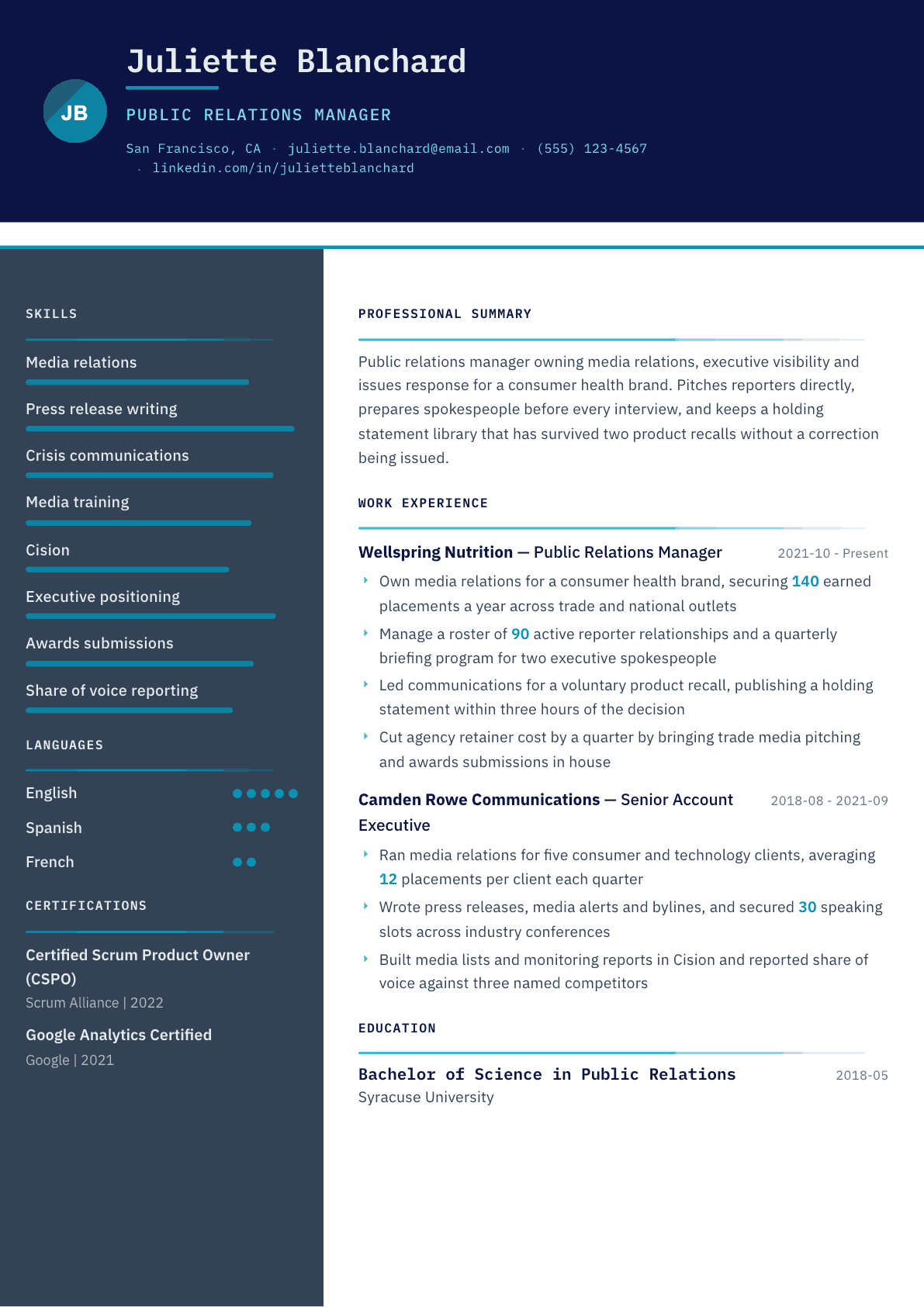
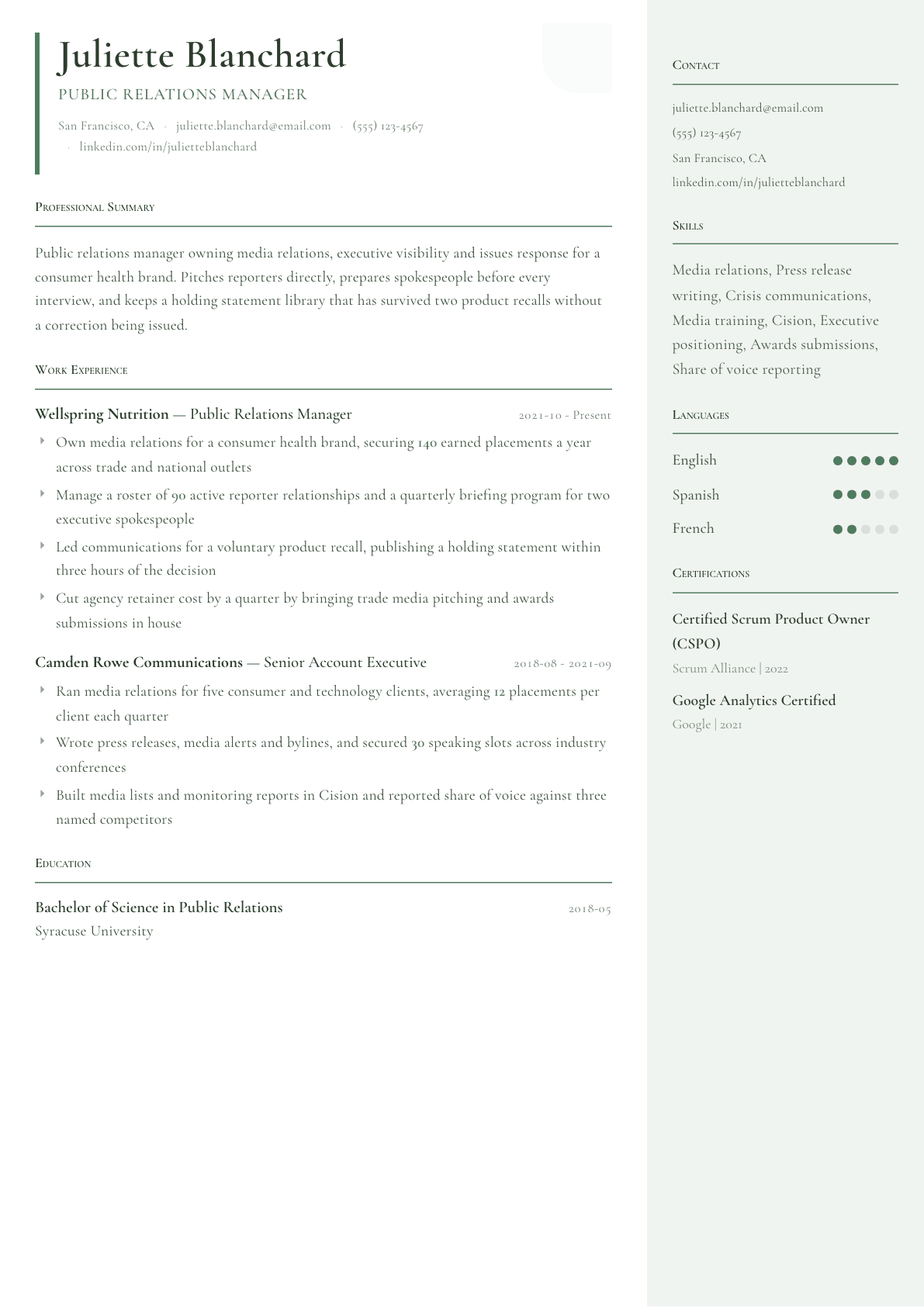
The same public relations manager content laid out in three CVBooster templates, so you can see what the finished document looks like before you write a word.
Example Public Relations Manager summary
Public relations manager with seven years across agency and in-house teams, currently owning media relations and issues response for a consumer health brand. Secures around 140 earned placements a year, maintains 90 active reporter relationships, and runs quarterly briefings for two executive spokespeople. Led communications through a voluntary recall with a holding statement published within three hours of the decision.
Skills to list on a Public Relations Manager resume
- Media relations
- Press release writing
- Crisis communications
- Issues management
- Media training
- Executive positioning
- Thought leadership
- Cision
- Muck Rack
- Media monitoring
- Share of voice analysis
- Awards and speaking submissions
- Analyst relations
- Newsroom management
What actually gets this resume read
- Name the outlets and beats you have actually placed in, because that is the first thing a communications director checks.
- Show the size and health of your media list, since relationships, not press release volume, are what you are hired for.
- Include crisis and issues work with the response time and the outcome, kept within what you are allowed to disclose.
- Describe your spokesperson preparation process, from message house to hostile question rehearsal.
- Report on share of voice, message pull-through or sentiment rather than counting impressions from a monitoring tool.
- Say whether your experience is agency side, in house, or both, as hiring managers weigh the two differently.
How to write a public relations manager resume
A public relations manager is hired for two things that look unrelated on paper: the relationships that get a story placed, and the composure that keeps a bad week from becoming a bad year. A resume that only shows the first reads as a publicist. One that only shows the second reads as a compliance officer. The strong ones show both.
Communications directors screen this resume by looking for named outlets and beats, then for crisis or issues work, then for whether you can prepare a spokesperson. Everything else, the release volume, the tools, the award submissions, is supporting evidence. Placements without outlet names are the single most common weakness in this pile.
This guide covers how to structure the page, how to write about earned coverage and crisis work within the limits of what you can disclose, a complete public relations resume sample, three summaries by level, before and after bullets, and the questions that come up when public relations people move between agency and in-house roles.
Format: coverage first, one page until you are managing a team
Reverse chronological, single column. Under your name, add a line naming your beats and your strongest outlet relationships by publication type: national business press, trade titles in your category, broadcast, podcasts. A communications director reads that line and decides in seconds whether to keep going.
If you can, add a short selected coverage block near the top with four to six placements: outlet, story angle and your role in securing it. This is the public relations equivalent of a portfolio and very few candidates include one.
- Header: name, title, city, contact details, and a link to a coverage clip file if you keep one.
- Section order: summary, selected coverage, experience, crisis and issues work, skills, education.
- Say whether your experience is agency side, in house, or both, because the two are read differently.
Write placements with outlets, angles and your actual role
A placement count on its own is unverifiable and every reader knows it. Give the shape of the coverage instead: roughly how many earned placements a year, in which tiers, across which beats, and how many came from proactive pitching rather than inbound requests. The proactive share is the number that separates a media relations professional from a press office administrator.
Be honest about your role. Securing an exclusive with a named reporter is different from supporting an agency that secured it, which is different again from responding to an inbound query. Communications directors ask this question directly in interviews, so answer it on the page first.
Include your media list as an asset. The number of active reporter relationships you maintain, how you keep them current, and whether you have moved a relationship with you between employers all speak to the thing you are actually being hired for.
Crisis and issues work, written within your limits
Crisis experience is the highest-value item on this resume and the hardest to write, because much of it is confidential. Describe the class of event rather than the specifics where you must: a voluntary product recall, a data incident, an executive departure, a regulatory inquiry, an activist campaign. Then give the parts that are safe and useful: your response time, the approval chain you operated inside, the channels you covered and the outcome in terms of accuracy of coverage.
Preparation counts as much as response. A holding statement library kept current, a scenario planning exercise, a tested escalation tree with legal and operations, and a media training cycle for spokespeople are all concrete deliverables that show you do not improvise under pressure.
- Name the response time you achieved from decision to published statement.
- Say who signed off, since legal, regulatory and executive approval chains shape everything.
- State what you protected: factual accuracy, employee communication sequencing, customer notification.
- Include the after-action work, such as a debrief and a revised protocol.
Spokesperson preparation and executive visibility
Describe your preparation process rather than claiming media training as a skill. A message house with three supporting proof points, a hostile question rehearsal, a bridging practice session, a recorded mock interview with playback: these are the specific things a communications director wants to know you can run.
Executive visibility programs belong here too. Speaking submissions, byline placement, podcast bookings, awards entries and analyst briefings all build a spokesperson's standing, and they are measurable in a way that general thought leadership language is not.
Measurement, tools and keywords
Impression counts from a monitoring tool convince nobody. Report share of voice against named competitors, message pull-through in coverage, sentiment trend, or the share of placements that carried your key message unedited. These are defensible, and they show you evaluate coverage rather than counting it.
Name your tools: Cision, Muck Rack, Meltwater or Prowly for media databases and monitoring, plus the newsroom or content platform you publish through. For keywords, postings recycle media relations, press release, earned media, crisis communications, issues management, media training, thought leadership, executive communications, share of voice and reputation management. Use the posting's own wording once in the summary and once in a bullet.
Public relations resume sample: a complete page
A public relations resume sample is most useful when it is a whole page, so here is one in outline for an in-house manager. The person, employer and outlets are invented or generic; the order is what to copy. Coverage and crisis work sit near the top because that is where a communications director looks first.
Header: Olivia Grant, Public Relations Manager, city and state, phone, email, portfolio link with selected coverage. Summary: public relations manager with eight years across agency and in-house roles in consumer technology, placing stories with national business and trade outlets, running issues response and preparing executives for interviews and panels.
- Current role, in-house: lead media relations for a consumer technology company, owning the press calendar, the pitch list and relationships with business, technology and trade reporters.
- Placed feature and interview coverage in national business publications and leading trade outlets for two product launches, writing the angle and briefing the spokesperson before each interview.
- Ran the issues response during a product recall with legal and customer support, drafting the holding statement, the customer notice and the reporter Q and A within the first day.
- Prepare three executives for interviews, podcasts and conference panels, with message documents and mock interviews before each appearance.
- Previous role, agency: account manager for consumer and technology clients, managing two account executives, monthly coverage reports and client calls.
- Close with education, any professional accreditation, and tools such as a media database, monitoring software and analytics.
Public Relations Manager resume summary examples
Account executive, agency
Public relations account executive supporting five consumer and technology clients, averaging around 12 placements per client each quarter. Writes releases, media alerts and bylines, builds media lists in Cision, and secured 30 conference speaking slots across a year for client spokespeople.
In-house manager
Public relations manager owning media relations for a consumer health brand, securing around 140 earned placements a year across trade and national outlets. Maintains 90 active reporter relationships, runs quarterly briefings for two executive spokespeople, and led communications through a voluntary product recall.
Communications director
Communications director with twelve years across agency and in-house teams, leading a group of five and the retained agency relationship. Owns the crisis protocol, the executive visibility program and analyst relations, and reports share of voice and message pull-through to the executive committee quarterly.
Work experience bullets: before and after
Before: Secured media coverage for the brand across various outlets.
After: Secured around 140 earned placements a year across category trade titles and national consumer press, with roughly two thirds coming from proactive pitching.
The volume, the outlet tiers and the proactive share tell a communications director what kind of media professional you are.
Before: Handled communications during a difficult company issue.
After: Led communications for a voluntary product recall, publishing a holding statement within three hours of the decision and coordinating customer, retailer and employee messaging in sequence.
A response time and a named sequencing order show crisis discipline without disclosing anything confidential.
Before: Prepared executives for media interviews.
After: Ran quarterly media preparation for two executive spokespeople: a message house with three proof points each, hostile question rehearsal and recorded mock interviews with playback.
Naming the format and cadence proves a repeatable preparation practice rather than an ad hoc briefing.
Before: Monitored coverage and reported results to leadership.
After: Reported share of voice against three named competitors and message pull-through rate on quoted coverage, replacing impression counts in the monthly leadership report.
Swapping a vanity metric for two evaluative ones shows measurement judgment the discipline values.
Before: Reduced agency costs by taking work in house.
After: Brought trade media pitching and awards submissions in house, cutting the agency retainer by a quarter while holding trade placement volume steady.
A cost decision paired with a maintained output shows the saving was not paid for with lost coverage.
Hard skills
- Media relations and proactive pitching
- Press release and media alert writing
- Crisis and issues communications
- Holding statement development
- Media training and spokesperson preparation
- Executive visibility and byline placement
- Awards and speaking submissions
- Cision and Muck Rack
- Meltwater media monitoring
- Share of voice and message analysis
- Analyst relations
- Newsroom and press page management
Soft skills
- Composure under time pressure
- Judgment on what not to say
- Relationship building with reporters
- Persuading executives to speak plainly
- Working with legal and compliance
- Fast, accurate writing on deadline
Certifications worth listing
- Accredited in Public Relations (APR) (Public Relations Society of America)
- Chartered Practitioner (Chartered Institute of Public Relations)
- Crisis Communication Certificate (Public Relations Society of America)
Mistakes that cost public relations manager candidates the interview
- Quoting placement counts without naming outlets or beats, which makes the entire record unverifiable.
- Reporting impressions from a monitoring tool as if they were a result.
- Blurring your role, so the reader cannot tell a secured exclusive from an inbound response.
- Leaving crisis experience off the page out of caution instead of describing it at a safe level of detail.
- Treating media training as a listed skill rather than a process you can describe step by step.
- Ignoring the preparation work, such as holding statements and escalation trees, which shows you plan.
- Failing to label agency and in-house experience, when hiring managers weigh the two very differently.
Public Relations Manager resume questions
How do I write about crisis work that is confidential?
Describe the class of event rather than the specifics: a voluntary recall, a data incident, a regulatory inquiry. Then give the safe operational detail such as response time, approval chain and channels covered. That satisfies the reader without breaching anything.
What should a public relations resume sample include?
A summary naming your sector, level and the outlets or beats you work with; experience bullets with named placements, crisis or issues work and spokesperson preparation; and tools, accreditation and education at the end. The complete sample on this page shows the order a communications director reads it in.
Is the Accredited in Public Relations credential worth it?
It signals commitment and ethical grounding, and it helps in nonprofit, government and regulated environments where credentialing matters. It rarely decides a commercial in-house hire, where your media relationships and crisis record carry more weight.
How do I move from agency to an in-house public relations role?
Emphasize depth over breadth: the client you knew best, the categories you understand, and any issues work. In-house hiring managers worry that agency people lack ownership, so show where you set strategy rather than executing somebody else's brief.
What metrics should replace impressions on a public relations resume?
Share of voice against named competitors, message pull-through in quoted coverage, sentiment trend, the proactive share of placements, and outlet tier mix. Each is defensible in an interview and shows you evaluate coverage rather than counting it.