Busser Resume Examples: what a hiring manager reads first
A Busser Resume That Proves You Keep the Floor Moving
By Mustafa Tarabya, founder of CVBooster · Published · Updated
Busser resume example with reset times and side work detail, the skills restaurants hire for, and how to write one with no work history.
Sample resumes for a busser
The same busser content laid out in three CVBooster templates, so you can see what the finished document looks like before you write a word.
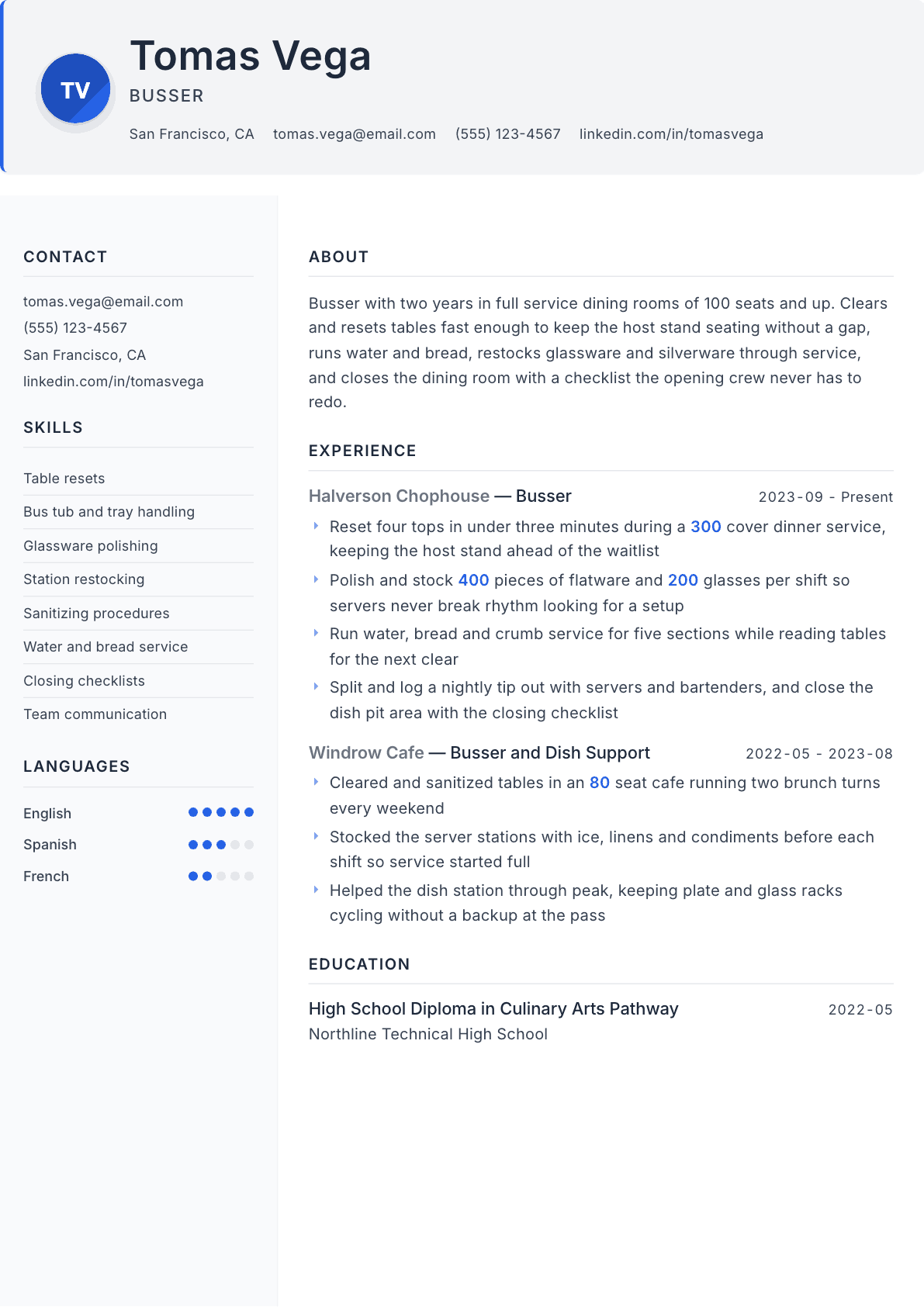
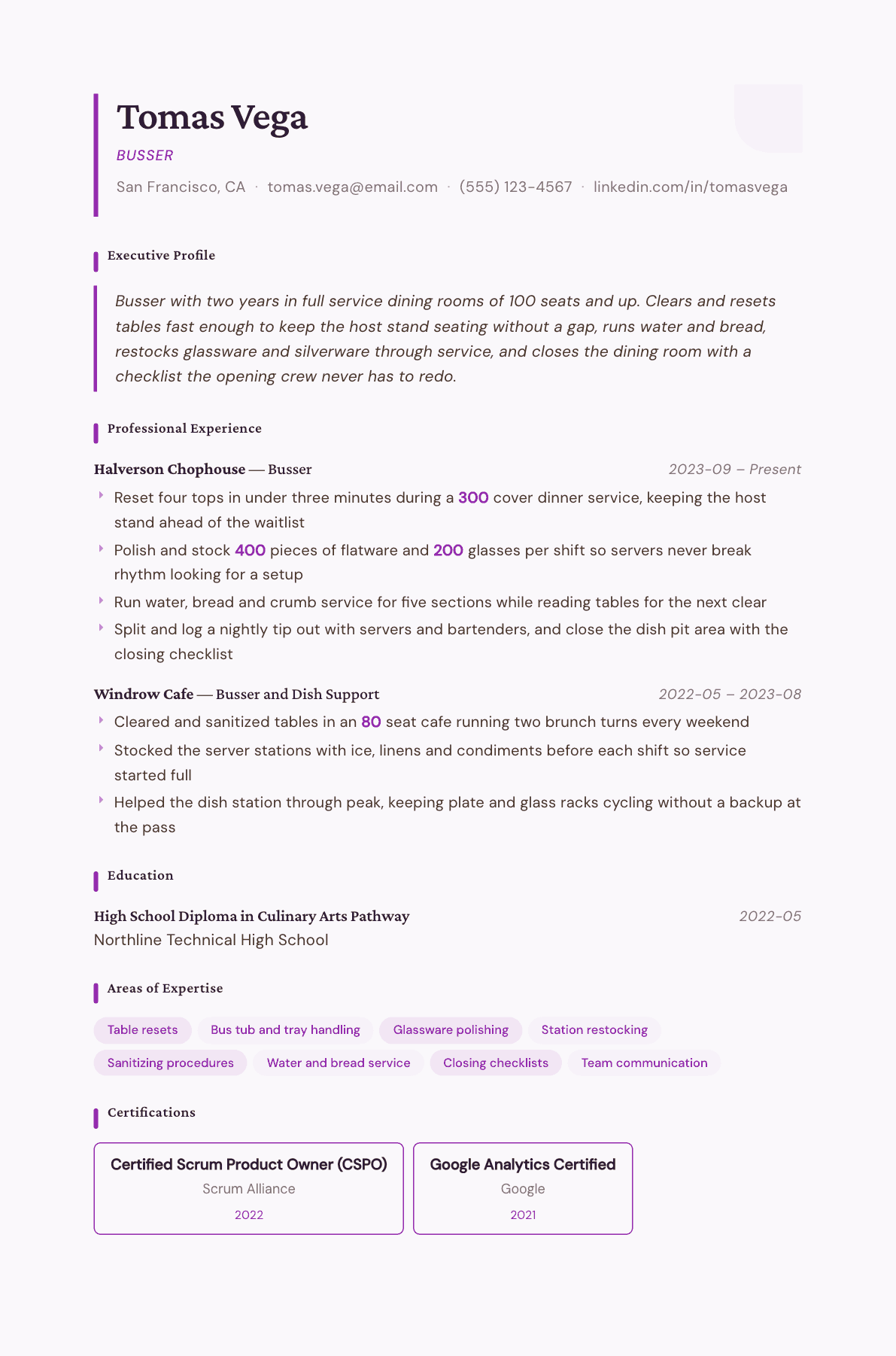
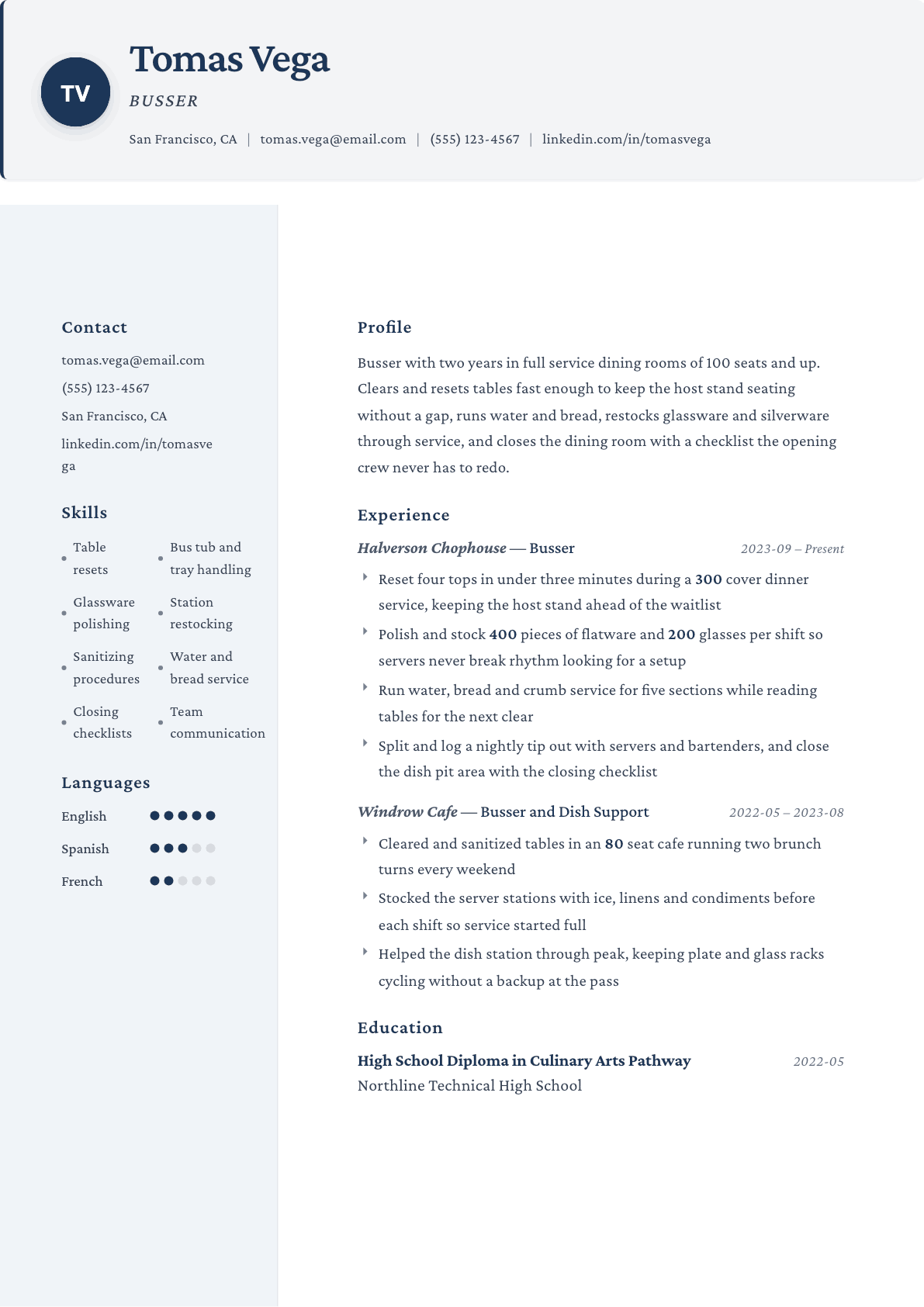
Example Busser summary
Busser with two years in a 120 seat dining room running three turns a night. Clears and resets a table in under three minutes, keeps flatware, glassware and server stations stocked through service, and runs water and bread without being asked. Holds a current food handler card and closes the floor to a checklist. Available nights, weekends and holidays.
Skills to list on a Busser resume
- Table clearing and resetting
- Dining room sanitation
- Glass and flatware polishing
- Bus tub and tray carrying
- Server station stocking
- Water and bread service
- Crumbing and linen changes
- Dish pit support
- Food running
- Opening and closing side work
- Sanitizer and chemical handling
- Teamwork under rush
What actually gets this resume read
- Give a reset time and a cover count, because speed on the clear is the whole reason a dining room hires a busser.
- List the side work you own by name: polishing, ice, linens, condiments, sanitizer buckets and closing duties.
- Mention tray and bus tub carrying if you can handle a loaded tray, since not every applicant can.
- Note any food handler card or sanitation training, and put the issuing state or program next to it.
- If you have helped in the dish pit or run food, say so, because managers value a busser who can cover two stations.
- Show availability for weekend and holiday shifts, the exact shifts restaurants struggle hardest to fill.
How to write a busser resume
A busser is hired for one measurable thing: how fast a dirty table becomes a table the host can seat again. Everything else on the page, the side work, the stocking, the sanitizing, exists to support that. So the manager reading your application is doing arithmetic in his head. If a four top takes six minutes to reset instead of three, the room loses turns all night, and he will hire the applicant whose page suggests three.
Almost nobody writes it that way. The typical busser application says cleaned tables, helped servers, kept the restaurant tidy. None of that gives the manager a number, a room size or a piece of side work he can picture. The applications that get called back name the seat count, the covers, the reset time, and the closing duties the writer owns without being reminded.
This guide breaks down the page section by section for a busser, including how to write it when this is your first job, how to show that you can carry a loaded tray and cover the dish pit, and the five bullet rewrites that make the biggest difference.
Format: one page, plain, and easy to read on a phone
Reverse chronological order, one page, no columns, no graphics. Many restaurants receive applications through a job board app and read them on a phone at the host stand, so a clean single column survives that trip and a designed layout does not.
Put your city, phone, email, availability and food handler card in the header. Nights, weekends and holidays are exactly the shifts a dining room struggles to fill, and a busser who states that coverage up front has already answered the manager's first question.
- Header: name, city and state, phone, email, availability, food handler card.
- Order: summary, experience, skills, education, certifications.
- No objective statement. Use the space for a summary with a reset time in it.
Summary: seat count, turns, and how fast you clear
Two or three sentences, and one of them should carry a reset time. A busser with two years in a room of one hundred twenty seats running three turns a night, clearing and resetting a table in under three minutes, is a specific claim a manager can test on a trail shift and therefore trusts on paper.
Add the second station you can cover. Bussers who can run food, help at the dish pit or handle water and bread service without being asked are scheduled more and promoted first, so name that in the summary rather than leaving it to be discovered.
Experience: reset speed, side work by name, and the close
For every job, open with the room: chophouse, cafe, brunch spot, and give the seat count and the peak covers. Then write bullets that name the physical work in units. Pieces of flatware polished, glasses stocked, tables reset per hour, bus tubs run during a three hundred cover service. Managers understand those units immediately because they have counted them themselves.
Side work is where a busser application either becomes serious or stays generic. List the tasks you own by name: polishing, ice, linens, condiments, sanitizer buckets, server station restock, crumbing, and the closing list. A manager who reads a specific closing routine knows the opening crew will not be redoing your work.
One bullet should go to the parts of the job that need judgment: reading a table for the next clear so you arrive as the guest finishes, timing a reset so the host can seat without a gap, or helping the dish station through a peak so racks keep cycling and the pass never backs up.
Skills and physical work: say plainly what you can carry
The skills block should hold the concrete things: table clearing and resetting, dining room sanitation, glass and flatware polishing, bus tub and tray carrying, server station stocking, water and bread service, dish pit support, food running. Add sanitizer and chemical handling if you have been trained on dilution and contact time, because health inspections check it.
Tray carrying deserves its own mention. Not every applicant can carry a loaded oval tray through a full dining room, and a manager who reads that you can will assume you have worked a real floor rather than a counter service room.
- Name the tasks, not the attitude: polishing, restocking, crumbing, sanitizing, resetting.
- Say whether you can carry a loaded tray, and whether you can lift and stack bus tubs through a full shift.
- List food running and dish pit cover if you have done them, since two stations is worth more on a schedule.
A first job, school, and certifications
A high school diploma or a culinary pathway certificate is enough. List the school, the credential and the field, and if the program included a kitchen or sanitation course, name it, because that is the closest thing to prior training a busser applicant usually has.
With no work history, build the experience section from anything physical and repetitive that you did to a standard: stocking shelves, cleaning a facility, kitchen work at a camp, event setup and breakdown, a school cafeteria shift. Describe the volume and the checklist you followed. A current food handler card, listed with its issuing program, closes the gap further because it means the restaurant does not have to wait to put you on the floor.
Busser resume summary examples
First restaurant job
Reliable worker seeking a first busser role, with a year of weekend event setup and breakdown for a banquet hall of 200 guests: tables, linens, glass racks and a full sanitation reset after each event. Food handler card current, available nights, weekends and holidays.
Two years on the floor
Busser with two years in a 120 seat dining room running three turns a night. Clears and resets a table in under three minutes, keeps flatware, glassware and server stations stocked through service, and runs water and bread without being asked. Closes the floor to a checklist the opening crew never has to redo.
Lead busser
Lead busser with four years in high volume steakhouse and cafe dining rooms, currently supporting five sections through a 300 cover service. Resets four tops in under three minutes, polishes and stocks glassware and flatware for the full room, covers the dish pit at peak, and trains new bussers on the closing list.
Work experience bullets: before and after
Before: Cleared and cleaned tables during service.
After: Reset four tops in under three minutes during a 300 cover dinner service, keeping the host stand ahead of the waitlist all night.
A reset time tied to a cover count is the number a manager uses to calculate turns.
Before: Kept the restaurant stocked with clean dishes.
After: Polished and stocked 400 pieces of flatware and 200 glasses per shift so servers never broke rhythm hunting for a setup.
Counted units and the reason behind the task show you understand why the stocking matters.
Before: Helped the servers when they were busy.
After: Ran water, bread and crumb service across five sections while reading tables for the next clear so plates left before the server had to ask.
Naming the sections and the anticipation habit turns generic help into a described working method.
Before: Cleaned the dining room at the end of the night.
After: Closed the dining room and dish pit area to a written checklist: sanitizer buckets, linens, condiments, station restock and floor reset for the morning crew.
The itemized close proves the opening shift will not be repairing your work.
Before: Helped in the kitchen sometimes.
After: Covered the dish station through peak service, keeping plate and glass racks cycling so the pass never backed up behind a full rack.
A second station described with its purpose is a scheduling argument, not a throwaway line.
Hard skills
- Table clearing and resetting
- Dining room sanitation
- Glass and flatware polishing
- Bus tub and tray carrying
- Server station stocking
- Water and bread service
- Crumbing and linen changes
- Dish pit support
- Food running
- Opening and closing side work
- Sanitizer and chemical handling
- Ice and condiment restocking
Soft skills
- Stamina through a long service
- Anticipating the next clear
- Working without being told
- Teamwork under a rush
- Care with fragile glassware
- Punctuality
Certifications worth listing
- ServSafe Food Handler (National Restaurant Association)
- ServSafe Allergens (National Restaurant Association)
Mistakes that cost busser candidates the interview
- Writing cleaned tables and helped servers, which describes the job title and gives the manager nothing to picture.
- Leaving out a reset time, the single number that tells a dining room how many turns you make possible.
- Skipping the side work list, so it reads as if someone else has always handled the polishing and the close.
- Not saying whether you can carry a loaded tray, when tray work is a real dividing line between applicants.
- Ignoring the tip out and the team side of the role, which suggests you have not worked a floor with servers and bartenders.
- Omitting availability for weekends and holidays, the shifts restaurants are actually trying to fill when they post.
Busser resume questions
How do I write a busser resume with no work experience?
Use physical, repeatable work you have done to a standard: event setup, facility cleaning, shelf stocking, camp kitchen shifts, a school cafeteria. Give the volume and the checklist you followed, then add your food handler card and open availability.
Do I need a food handler card to be a busser?
Many jurisdictions require one for anyone handling food contact surfaces or bread and water service, and most restaurants prefer it before your first shift. Hold a current card and list it with the issuing program right under your contact details.
How do I move from busser to server?
Put menu knowledge, point of sale entry, food running and any guest facing work on the page. Those are the gaps a manager considers before promoting, so a busser who already runs food and knows the menu is the obvious internal candidate.
Should I mention the tip out on my resume?
One mention is useful if you split or logged it, because it shows you understand the shared economics of the floor and have been trusted with money. Do not give amounts, just the responsibility of splitting and recording it accurately.
What sets a lead busser apart on paper?
Training other bussers, owning the closing checklist, covering a second station such as dish or food running, and keeping the reset pace during a peak service. Name how many people you have trained and what routine you handed them.
Related resume examples
- Restaurant Manager Resume example
- Bartender Resume example
- Food Runner Resume example
- Dishwasher Resume example
- Server Resume example
- Hostess Resume example