C# Developer Resume Examples: free ATS score and gap list
Write a C# Developer Resume For Modern .NET Teams
By Mustafa Tarabya, founder of CVBooster · Published · Updated
A C# developer resume with ASP.NET Core and Entity Framework examples, Azure keywords, sample experience bullets and a complete writing guide.
Sample resumes for a c# developer
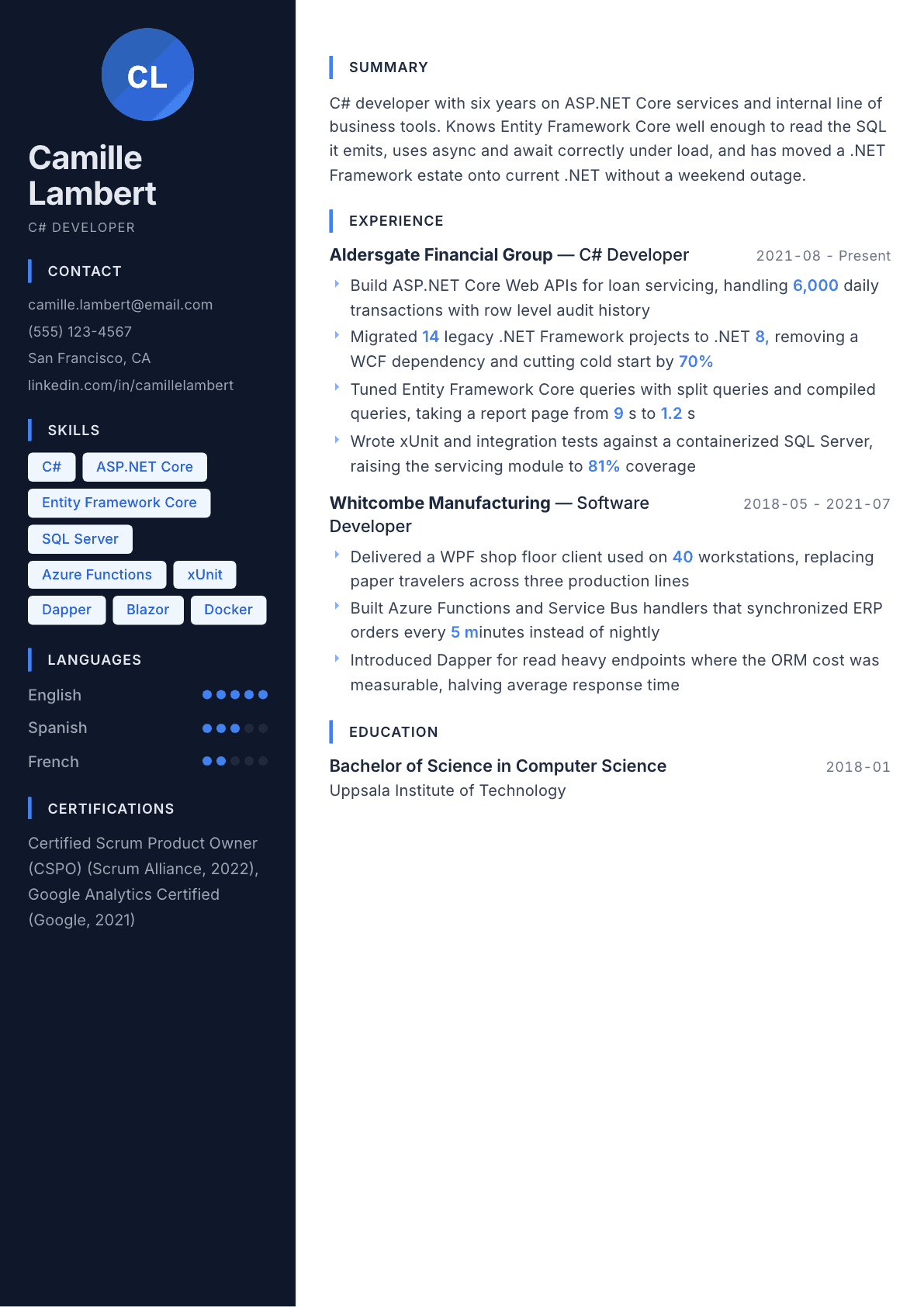
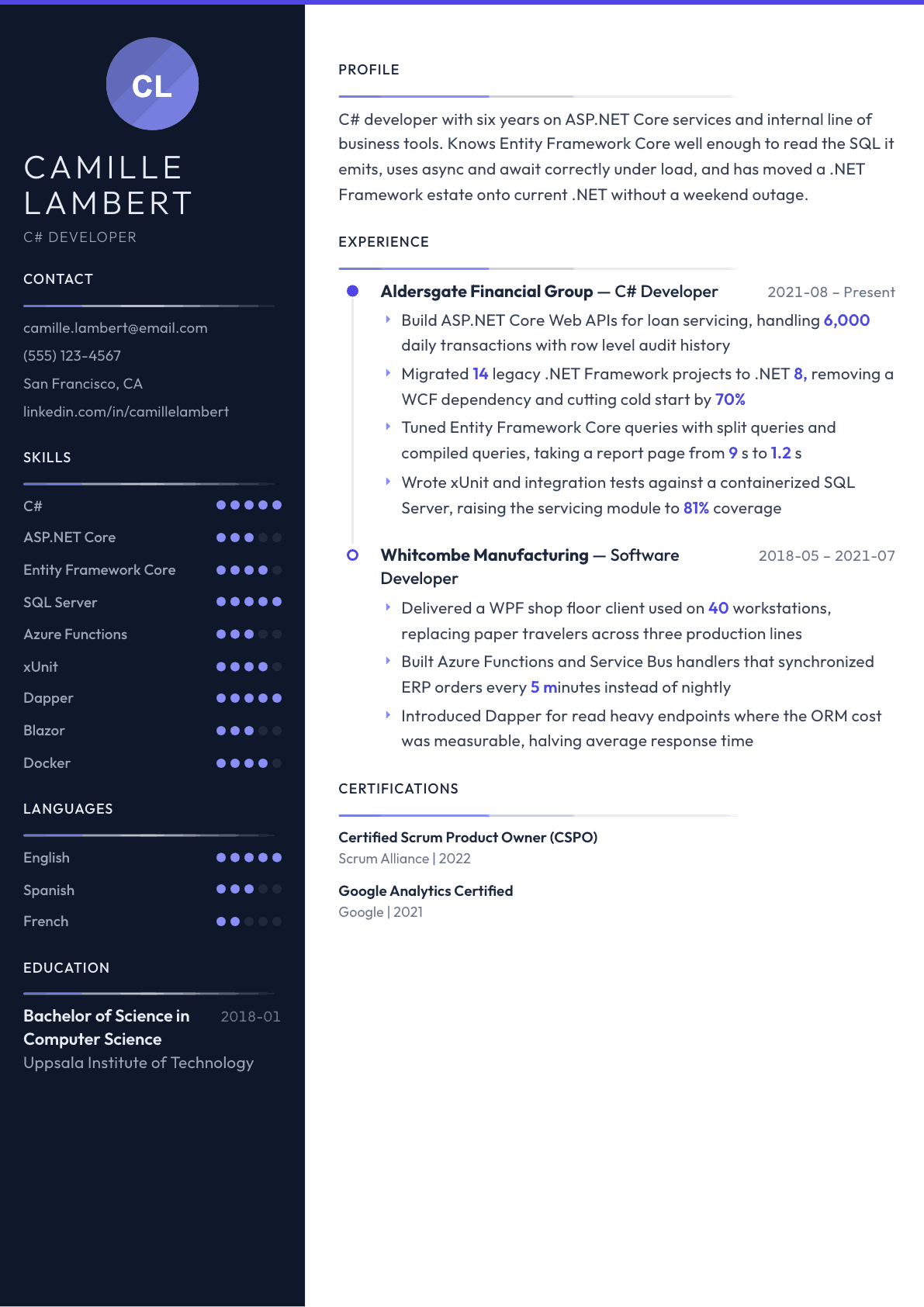
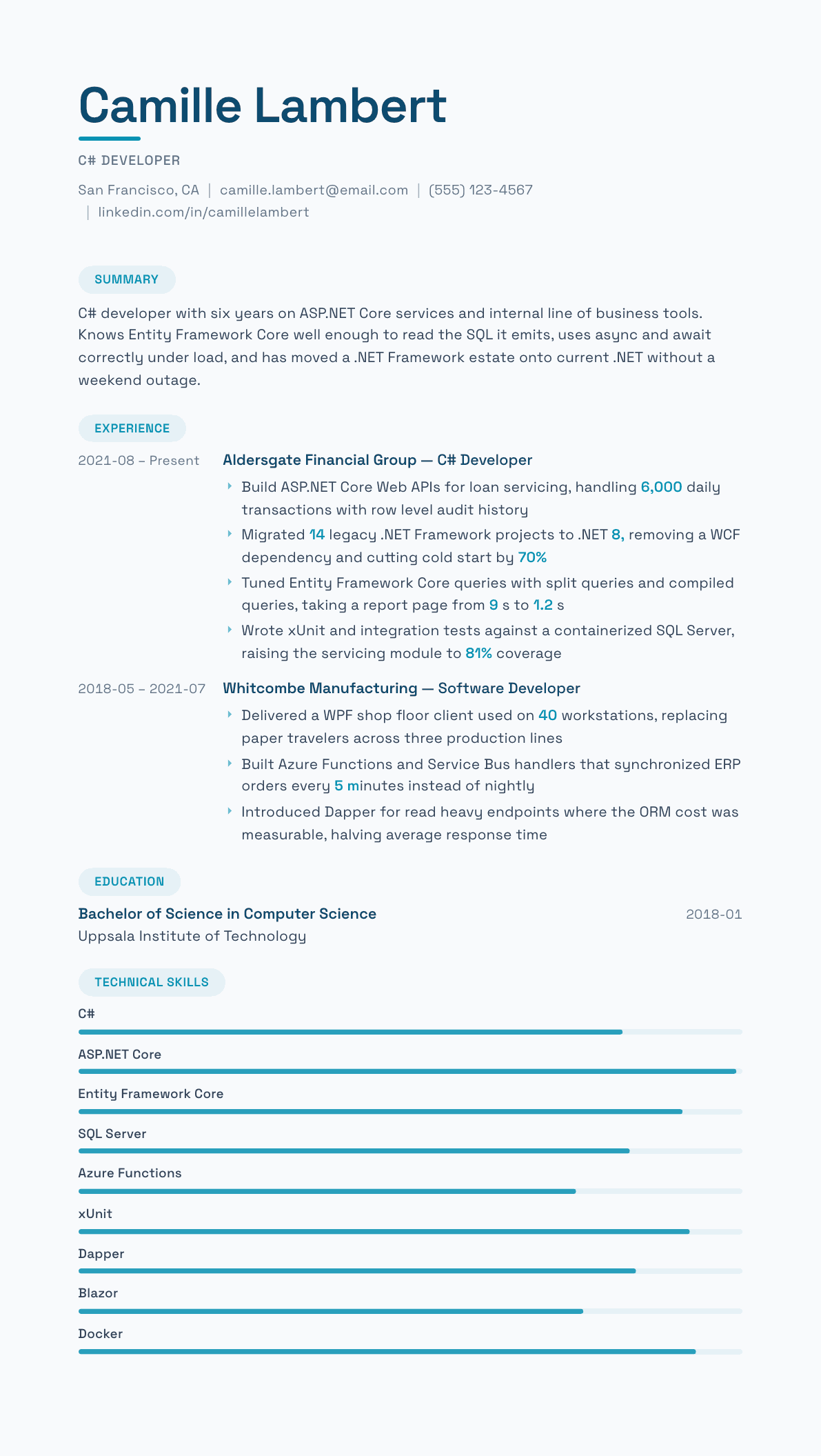
The same c# developer content laid out in three CVBooster templates, so you can see what the finished document looks like before you write a word.
Example C# Developer summary
C# developer with six years across financial services APIs and manufacturing desktop tools. Builds ASP.NET Core services, tunes Entity Framework Core when the generated SQL gets expensive, and has led a fourteen project move from .NET Framework onto current .NET. Comfortable with Azure Functions, Service Bus and containerized SQL Server test runs. Looking for a senior backend role on a .NET product with real reliability requirements.
Skills to list on a C# Developer resume
- C#
- .NET 8
- ASP.NET Core
- Entity Framework Core
- LINQ
- SQL Server
- Dapper
- Azure Functions
- Azure Service Bus
- Blazor
- WPF
- xUnit
- Docker
- REST API design
- CI/CD pipelines
What actually gets this resume read
- Distinguish .NET Framework from modern .NET in every job, because that single detail decides many first round screens.
- Name your data access layer: Entity Framework Core, Dapper or stored procedures, and say when you chose each one.
- Give an async and await example tied to throughput, since misuse of async is the most common technical interview probe.
- Include cloud work with the specific Azure service, Functions, Service Bus or App Service, rather than the word cloud.
- Mention desktop experience separately if you have WPF or WinForms history, as those postings are a distinct market.
- List your test framework, xUnit, NUnit or MSTest, because .NET hiring managers treat the choice as a signal of habits.
How to write a c# developer resume
A C# developer resume is read against a specific worry. The reviewer has an estate that is partly modern and partly not, and they need to know which side of that line your experience sits on. Modern .NET on Linux containers and .NET Framework on Windows servers are both real jobs, but they are different jobs, and the resume that does not say which one it describes gets set aside while the reader opens the next file.
The second thing the reviewer checks is how close you work to the data. Entity Framework Core makes it easy to build something that works in development and falls over in production, so hiring managers look for candidates who read the generated SQL, know what a split query is for, and can tell when Dapper or a stored procedure is the right answer instead.
This guide walks through the layout, the wording for each section, three summaries by career stage, five rewritten bullets, the errors that get good C# candidates filtered out, and the questions that come up most when developers in this stack update their resume.
Format: single column, the platform generation stated in every job
Reverse chronological, one column, plain headings. Many .NET employers are large organizations running conservative recruitment software, so avoid sidebars and text inside shapes. One page under six years of experience, two pages once you have several substantial systems to describe.
In every role, say which platform generation the work used. A reader should be able to see at a glance that the last three years were modern .NET and the earlier years were .NET Framework, and that you were the person who moved between them.
- Header: name, target title, city, phone, email, code profile if it is worth reading.
- Order: summary, technical skills, experience, education, certifications.
- First line of each role: the domain, the system type, and the platform generation.
Summary: platform, domain, data layer, one migration or scale fact
Four lines is enough. Years, the version family you work in, the domain, and something concrete: a migration you led, a transaction volume, or a latency figure you improved. Financial services, healthcare and manufacturing are all worth naming because domain knowledge shortens the ramp.
If you have led a move from .NET Framework to current .NET, put it in the summary. It is the most in demand piece of experience in this stack and it is the one thing an interviewer will definitely want to talk about.
Experience: services, data access, and asynchronous behavior
Open each role with the system: what it does, who uses it, and its size in transactions, tables or workstations. Then write bullets that show the engineering. Building Web APIs is assumed; what distinguishes you is how you handled authorization, versioning, validation and audit history.
Data access should have its own bullet. Say what you tuned and how: a split query that removed a Cartesian explosion, a compiled query on a hot path, a missing index found in an execution plan, or a move to Dapper for read heavy endpoints where the object mapping cost was measurable.
Asynchronous work is the third pillar. Async and await misuse is the most common technical interview probe in this stack, so a bullet showing that you understand thread pool starvation, cancellation tokens or a background service under load is worth more than three bullets about features delivered.
Cloud and messaging: name the service, not the category
Most .NET work now touches Azure, and the screens filter on service names. Write Azure Functions, Service Bus, App Service, Key Vault, Blob Storage or Cosmos DB rather than the word cloud. If your estate is on AWS or on premises, say so plainly; being clear beats implying a platform you have not used.
Integration patterns matter alongside the service names. A Service Bus subscription with dead letter handling, an outbox pattern that keeps a database write and a message publish consistent, or a scheduled function replacing a nightly job are all details that show system thinking.
- Web: ASP.NET Core, minimal APIs, MVC, Razor Pages, Blazor.
- Data: Entity Framework Core, Dapper, SQL Server, PostgreSQL, stored procedures.
- Cloud and messaging: Azure Functions, Service Bus, Storage, Key Vault, Docker.
- Quality: xUnit, NUnit, Moq, Testcontainers, static analysis in the pipeline.
Desktop and legacy work: keep it, but frame it
WPF, WinForms and Windows Services still run a large amount of industry, and that experience is valuable to the employers who own it. Keep it on the resume with the scale attached: how many workstations, what process it replaced, what it integrated with.
If you are trying to move away from desktop work, keep the entries short and lead each of those roles with any web or service work you did alongside. If you are targeting those employers, do the opposite and give the desktop bullets the space.
C# Developer resume summary examples
Junior developer
Software developer with eighteen months building ASP.NET Core Web APIs and Razor Pages for an internal ordering tool, backed by SQL Server and Entity Framework Core. Comfortable with dependency injection, xUnit and Git based releases. Seeking a junior .NET role on a team that reviews code closely.
Six years in
C# developer with six years across financial services APIs and manufacturing desktop tools. Migrated 14 legacy projects to current .NET, tuned Entity Framework Core queries that took a report page from 9 s to 1.2 s, and builds Azure Functions and Service Bus handlers for order synchronization.
Lead .NET engineer
Senior .NET engineer with eleven years in regulated financial systems, currently technical lead for a team of six. Owns the loan servicing platform, set the testing and static analysis standards, and led the retirement of a WCF integration layer in favor of versioned HTTP APIs with contract tests.
Work experience bullets: before and after
Before: Developed web APIs in ASP.NET Core.
After: Built ASP.NET Core Web APIs for loan servicing handling 6,000 daily transactions, with row level audit history and policy based authorization for four internal roles.
Volume, audit requirements and authorization model describe a regulated system rather than a generic API.
Before: Upgraded the application to a newer .NET version.
After: Migrated 14 .NET Framework projects to .NET 8, replacing a WCF dependency with versioned HTTP endpoints and cutting service cold start by 70%.
The project count, the dependency retired and the measured result make the migration concrete.
Before: Improved slow database queries.
After: Reduced a reporting page from 9 s to 1.2 s using Entity Framework Core split queries, a compiled query on the hottest path, and a covering index found in the execution plan.
Three specific techniques prove you work below the abstraction rather than around it.
Before: Used Azure for cloud services.
After: Built Azure Functions and Service Bus handlers that synchronize ERP orders every five minutes instead of nightly, with dead letter handling and alerting on failed messages.
Named services, a new schedule and failure handling turn cloud into an engineered integration.
Before: Wrote unit tests for the services.
After: Wrote xUnit unit and integration tests against a containerized SQL Server instance, raising the servicing module to 81% coverage and catching two rounding defects before release.
Real database integration tests and the defects caught show the tests did work worth doing.
Hard skills
- C# and modern language features
- ASP.NET Core and minimal APIs
- Entity Framework Core
- LINQ
- Dapper
- SQL Server and T-SQL
- Async, await and cancellation tokens
- Dependency injection and middleware
- Azure Functions and Service Bus
- Blazor and WPF
- xUnit, NUnit and Moq
- Docker and continuous delivery pipelines
Soft skills
- Working with compliance and audit requirements
- Estimating legacy migration work honestly
- Explaining technical debt in business terms
- Reviewing pull requests with clear reasoning
- Supporting operations teams during releases
Certifications worth listing
- Microsoft Certified: Azure Developer Associate (Microsoft)
- Microsoft Certified: Azure Solutions Architect Expert (Microsoft)
- Microsoft Certified: Azure Fundamentals (Microsoft)
- Certified Kubernetes Application Developer (CKAD) (Cloud Native Computing Foundation)
Mistakes that cost c# developer candidates the interview
- Writing .NET without a generation, which leaves the reader assuming the oldest platform you could plausibly mean.
- Listing Entity Framework Core with no evidence you have ever looked at the SQL it produces.
- Describing Azure in the abstract instead of naming Functions, Service Bus, Key Vault or whatever you actually deployed.
- Hiding a Framework to modern platform migration in a single sub bullet, when it is the most marketable thing on the page.
- Mixing desktop and web work into one undifferentiated list so neither hiring track sees a clean match.
- Claiming microservices for a solution that was one deployable with several class libraries.
C# Developer resume questions
How do I show the difference between .NET Framework and modern .NET?
Put the platform generation in the first line of each role and again in the skills block. If your history spans both, describe the migration you were part of, because that experience is what employers with mixed estates are actively hunting for.
Do Microsoft certifications help a C# developer?
The Azure credentials help more than language certificates, because they cover infrastructure ground the resume otherwise only asserts. They matter most in consultancies and partner organizations where certification counts are part of client proposals.
Should I mention WPF or WinForms if I want web work?
Keep it, but compress it. One line per role showing the scale is enough, and lead those roles with any service or API work you did alongside. Removing it entirely creates gaps that raise more questions than the desktop work does.
What database detail belongs on a .NET resume?
Name the database, the access technology, and one tuning example with the technique. Interviews in this stack move to query performance quickly, and a candidate who can talk through an execution plan stands out from one who lists an ORM.
How do I present Blazor experience?
Say which hosting model you used, server or WebAssembly, because their constraints differ sharply. Add the application size and whether it replaced an older front end, since Blazor projects are often modernizations and that context is the interesting part.
Related resume examples
- .NET Developer Resume example
- Backend Developer Resume example
- Software Engineer Resume example
- Software Architect Resume example
- Java Developer Resume example
- RPA Developer Resume example