.NET Developer Resume Examples: the lines they read
Build a .NET Developer Resume That Compiles Success
By Mustafa Tarabya, founder of CVBooster · Published · Updated
Create a polished .NET developer resume highlighting C#, ASP.NET Core, and Azure expertise with ATS-optimized formatting and real-world examples.
Sample resumes for a .net developer
The same .net developer content laid out in three CVBooster templates, so you can see what the finished document looks like before you write a word.
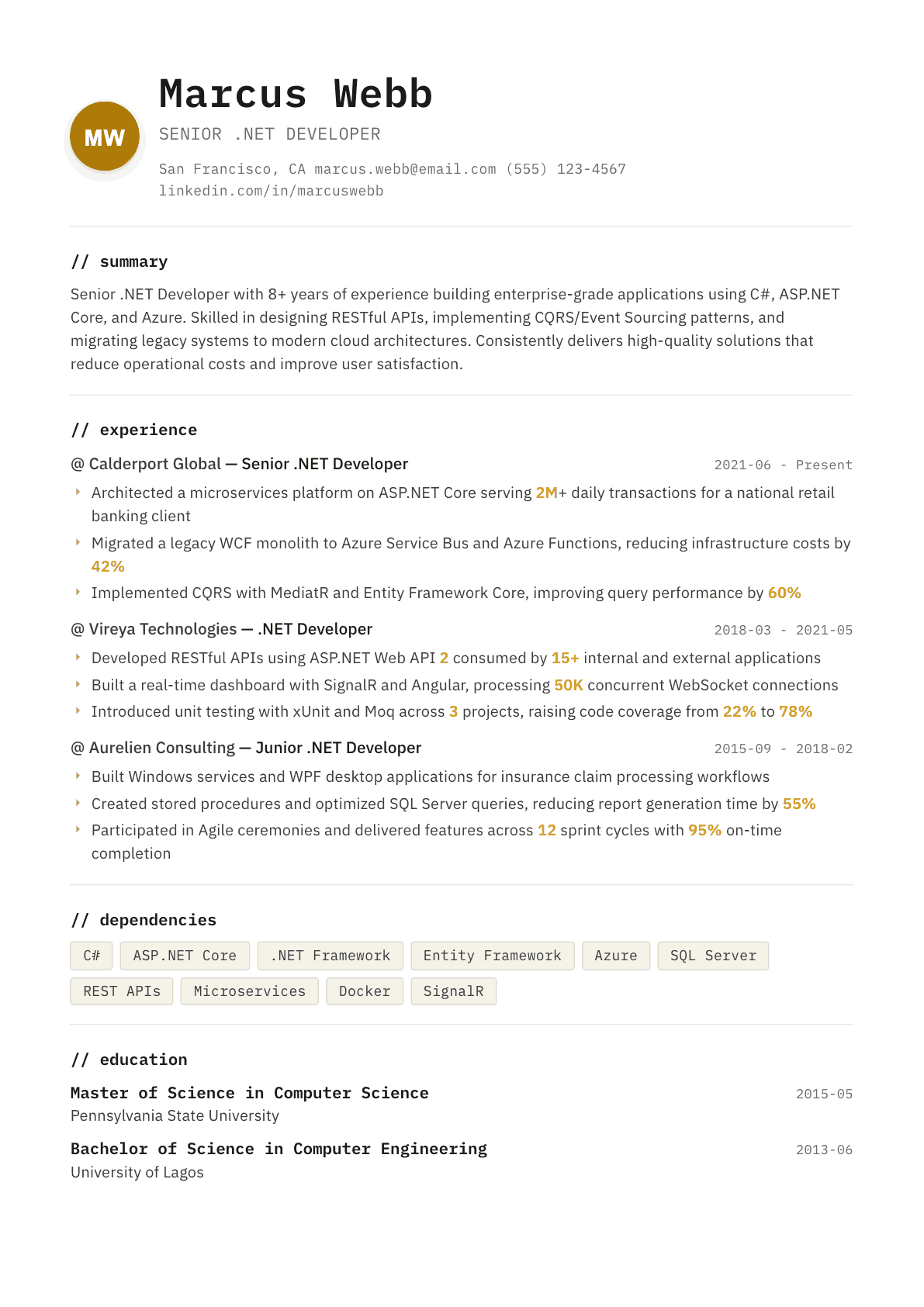
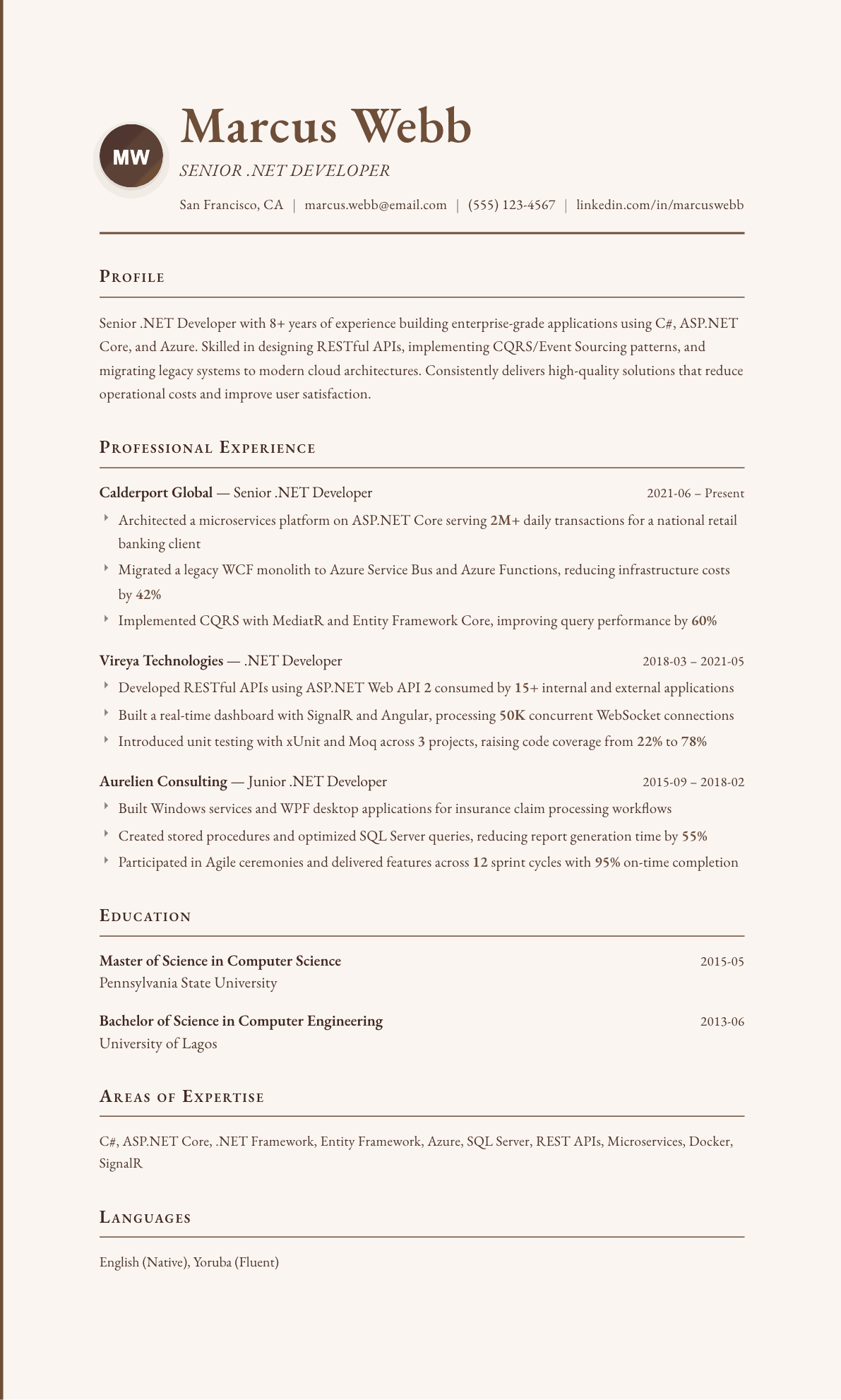
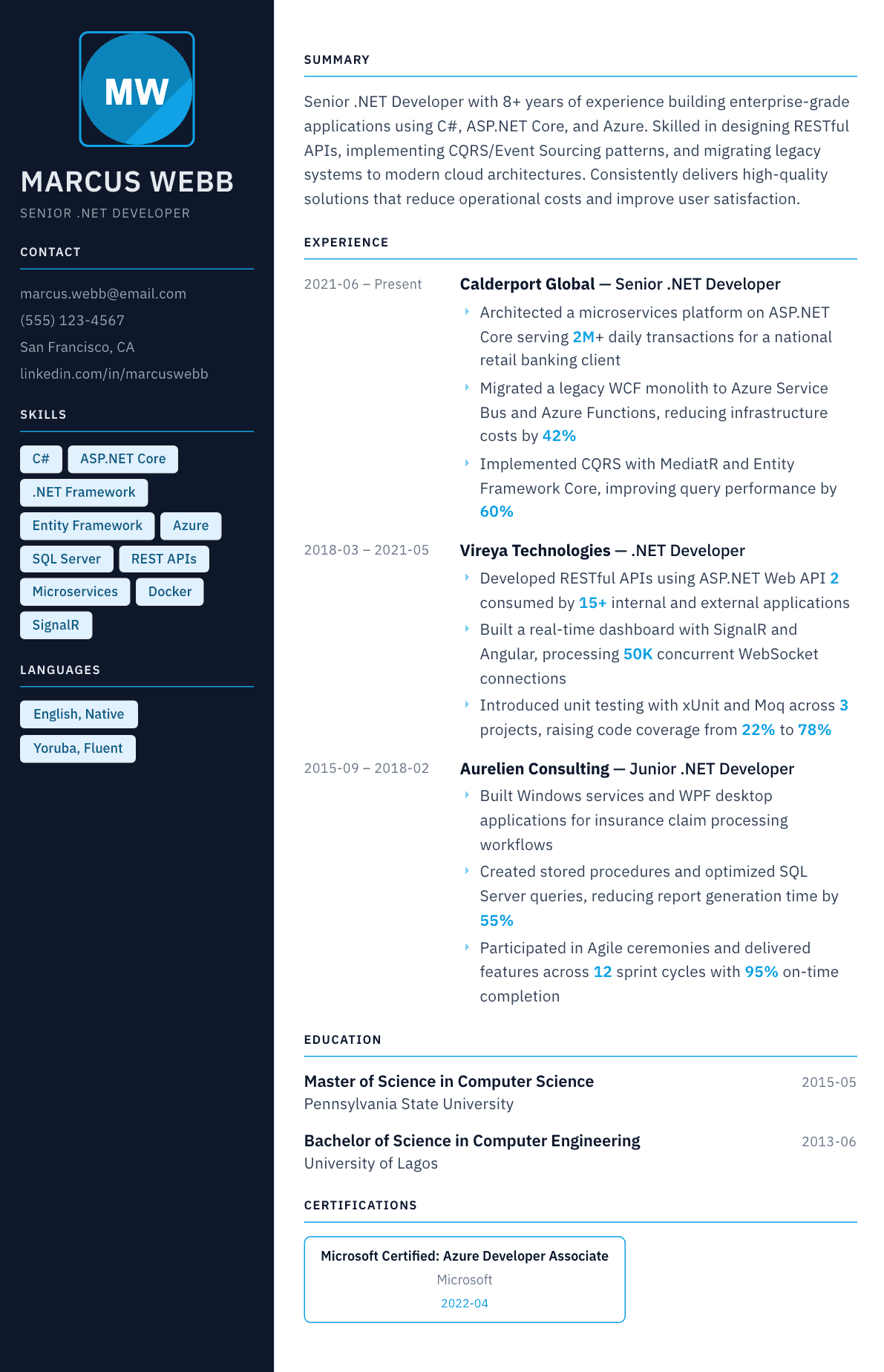
Example .NET Developer summary
.NET Developer with 8 years in C#, ASP.NET Core, and Azure, working on enterprise banking and insurance systems. Migrated a legacy WCF monolith to Azure Functions and Service Bus, cutting infrastructure costs 42% and improving query performance 60%. Works in clean architecture and CQRS, and reviews code for a team of eight.
Skills to list on a .NET Developer resume
- C#
- ASP.NET Core
- .NET Framework
- Entity Framework Core
- Azure
- SQL Server
- REST APIs
- Microservices
- Docker
- SignalR
- LINQ
- xUnit
What actually gets this resume read
- Specify .NET versions clearly: distinguish between .NET Framework 4.x, .NET Core, and .NET 6/7/8.
- Quantify performance improvements: API response times, throughput gains, cost reductions.
- Highlight Azure services you have used: App Service, Functions, Service Bus, SQL Database, DevOps.
- Include architectural patterns like CQRS, DDD, Clean Architecture, or Mediator pattern.
- Show migration experience from legacy systems to modern .NET stacks, which is highly valued.
How to write a .net developer resume
A .NET developer resume carries one piece of information that decides most screening calls, and many candidates leave it out: which .NET you actually work in. A developer maintaining Web Forms and WCF services on the old Framework, one writing ASP.NET Core APIs on the current runtime, and one running Blazor or MAUI are three different hires. Hiring managers in this ecosystem read for that first and everything else second.
The second thing they read for is whether you have modernized anything. The .NET job market is full of teams sitting on a large legacy application that must move forward, and a developer who has taken a Framework application onto the current runtime, or split a monolith into services without breaking the business, is close to the top of the pile before the interview starts.
This guide covers each section as a .NET team lead reads it, three summaries at recognizable levels, before-and-after bullets that put engineering evidence behind the usual claims, and the questions developers in this stack ask when they update their resume.
Format: one to two pages, runtime versions stated plainly
One page under five years, two after. Reverse chronological, single column. Under each job title, state the runtime and the versions: .NET Framework 4.8, .NET Core 3.1, or the current long-term support release. Also state whether the application is a monolith, a set of services, or a desktop product, because the daily work differs enormously.
Microsoft-stack hiring often runs through recruiters at consultancies who filter on strings, so write C#, ASP.NET Core, Entity Framework Core, SQL Server and Azure exactly as they appear in postings.
- Header: name, title, location, email, GitHub, and any Azure certifications.
- Order: summary, technical stack, experience, notable projects, certifications, education.
- Say whether the environment is on Windows or Linux containers, and whether hosting is on-premises or in Azure.
Summary: runtime, application type, and the modernization story
Three lines. Name the runtime and how long you have been in the ecosystem, the type of application you build, the database, and the hosting. Then a clause on the direction of your work: modernization, greenfield services, high-throughput APIs, or desktop and line-of-business systems.
If your history is on the old Framework and you are targeting current .NET roles, say what you have already done on the modern runtime. A migrated service, a new API, a proof of concept that went to production. That single clause is what stops a screener from filing you as legacy only.
Experience: architecture decisions, not framework nouns
The weakest .NET resumes list technologies used per project. The strong ones describe decisions. Why you split a module into its own service and how you handled the shared database. Why you introduced a mediator pattern or a vertical slice structure and what it fixed in the team review process. Why you replaced an Entity Framework query with a compiled query or raw SQL and what it did to response time.
Give the runtime facts a backend team cares about: request volume, response time targets, database size, background processing, and how the application handles concurrency. Asynchronous work, cancellation tokens, channel or hosted service background processing and connection pool exhaustion are the details that show real production experience.
Testing belongs in the bullets. xUnit or NUnit for units, integration tests against a real database in a container, and contract tests between services. A .NET developer who describes their test strategy stands out because most pages skip it.
Data access: where most .NET performance problems live
Entity Framework Core deserves specific treatment rather than a mention in a list. Say what you have done about the classic failures: the multiplied query problem from lazy loading, tracking on read-only queries, projections instead of loading whole entities, split queries for large includes, and migrations run safely against a live database.
Where you have used Dapper or stored procedures alongside it, say why. A developer who can explain when the object relational mapper is the wrong tool is a developer who has debugged a slow endpoint under real load.
Azure and delivery: the half of the stack that decides seniority
Most .NET postings now expect cloud familiarity. Name the services you have actually built with: App Service or Container Apps for hosting, Azure Functions for event work, Service Bus or Storage Queues for messaging, Azure SQL or Cosmos DB for storage, Key Vault for secrets and Application Insights for telemetry.
Then delivery. Azure DevOps pipelines or GitHub Actions, containerized builds, database migrations in the release, feature flags and how you deploy without downtime. A .NET developer who owns their deployment path reads as senior regardless of years.
.NET Developer resume summary examples
Junior developer
Junior .NET developer with 2 years building ASP.NET Core web APIs against SQL Server for an internal logistics product. Wrote the integration test suite that runs against a containerized database, and converted 3 legacy Web Forms screens into Razor Pages during a phased rebuild.
Five years in
Mid-level .NET developer with 5 years across .NET Framework 4.8 and current ASP.NET Core. Owns two customer-facing APIs handling around 400 requests per second, migrated the reporting module off Framework, and cut the slowest endpoint from 2.1 seconds to 240 milliseconds.
Senior or lead developer
Senior .NET developer with 11 years, currently leading 4 engineers on a payments platform. Extracted 6 services from a Framework monolith without downtime, introduced clean architecture and contract testing across the team, and moved hosting to Azure Container Apps with blue-green releases.
Work experience bullets: before and after
Before: Developed web applications using ASP.NET Core and C#.
After: Built and owned two ASP.NET Core APIs serving around 400 requests per second for the customer portal, with minimal API endpoints, FluentValidation on request models, and structured logging into Application Insights.
Throughput and named implementation choices show what you built and at what scale, not just which framework.
Before: Migrated a legacy application to .NET Core.
After: Migrated a Framework 4.8 monolith to the current .NET runtime module by module behind a routing proxy, converting WCF endpoints to gRPC and keeping both stacks live for 4 months so the business never had a cutover weekend.
The strangler approach and the parallel running period prove a real migration rather than a rewrite claim.
Before: Optimized database queries for better performance.
After: Fixed a dashboard endpoint that issued 300 queries per request by replacing lazy loading with a projection and split query, then added a compiled query for the hot path, bringing the response from 2.1 seconds to 240 milliseconds.
Naming the exact Entity Framework failure mode and the fixes shows data access depth a generic claim cannot.
Before: Wrote unit tests for the codebase.
After: Raised coverage on the billing domain from 18% to 76% with xUnit unit tests and integration tests running against SQL Server in a container, which caught a rounding defect in proration before a release.
A caught defect and a realistic test environment prove the tests are useful rather than a coverage exercise.
Before: Deployed applications to Azure.
After: Set up the release path in Azure DevOps: containerized build, database migrations gated behind a manual approval, deployment to a staging slot, and a swap once smoke tests passed, removing the previous out-of-hours release window.
A described pipeline with gates and a business result outranks the word deployed by a wide margin.
Hard skills
- C#
- ASP.NET Core
- .NET Framework maintenance and migration
- Entity Framework Core
- Dapper and raw SQL
- SQL Server
- REST and gRPC service design
- Asynchronous and concurrent programming
- xUnit and integration testing
- Azure App Service and Container Apps
- Azure Functions and Service Bus
- Docker on Linux containers
- Azure DevOps pipelines
- Clean architecture and domain modeling
Soft skills
- Code review that teaches
- Estimating migration risk
- Explaining technical debt to product owners
- Mentoring junior developers
- Working within change control
- Writing readable documentation
Certifications worth listing
- Microsoft Certified: Azure Developer Associate (Microsoft)
- Microsoft Certified: Azure Solutions Architect Expert (Microsoft)
- Microsoft Certified: DevOps Engineer Expert (Microsoft)
- Microsoft Certified: Azure Fundamentals (Microsoft)
Mistakes that cost .net developer candidates the interview
- Writing .NET without a version, which forces the screener to assume the oldest possible answer.
- Listing every Microsoft product you have opened instead of the ones you have built and maintained something in.
- Describing a migration as a rewrite with no mention of how the business kept running during it.
- Skipping data access detail, when slow Entity Framework queries are the most common problem in this stack.
- Leaving out cloud experience entirely on a page targeting roles that all mention Azure in the first paragraph.
- Using design pattern names as decoration. If a pattern is listed, a bullet should show the problem it solved.
- Presenting only maintenance work with no example of something you designed, which caps the level you are read at.
.NET Developer resume questions
Should I still list .NET Framework experience?
Yes. A large share of paid work is maintaining and modernizing Framework applications, and teams hiring for that specifically want it. List it with the version, then make sure current runtime work appears above it so you are not read as legacy only.
How do I show modern .NET skills if my job is stuck on an old version?
Build something real on the current runtime outside work and describe it like a project: an API with tests, containerized, deployed somewhere public. Then push for any modernization at work, even one module, and write that up as your lead experience bullet.
Is Azure experience required for a .NET developer role?
Not required, but it is expected often enough that omitting it narrows your options considerably. Naming the handful of services you have genuinely used, with what you built on them, is enough for most postings without a certification.
Should a .NET developer include front-end skills?
Include them if you use them, since many .NET roles are full stack with Blazor, Razor or a JavaScript framework. Keep them in a clearly separate group so the reader can see your backend depth is not diluted by a long list of front-end tools.
How do I describe work on an internal application nobody has heard of?
Describe the domain and the scale instead of the brand: what the system does, how many users, transaction volume, integrations and uptime expectations. Those facts tell a reader more about the difficulty than a recognizable product name would.
Related resume examples
- Software Engineer Resume example
- Backend Developer Resume example
- Full-Stack Developer Resume example
- C# Developer Resume example
- RPA Developer Resume example
- Ruby Developer Resume example