RPA Developer Resume Examples: free ATS score and gap list
Write an RPA Developer Resume That Proves Automation Impact
By Mustafa Tarabya, founder of CVBooster · Published · Updated
Build an RPA developer resume with UiPath and Power Automate examples, the bot metrics screeners look for, keyword lists, and a full writing guide.
Sample resumes for a rpa developer
The same rpa developer content laid out in three CVBooster templates, so you can see what the finished document looks like before you write a word.
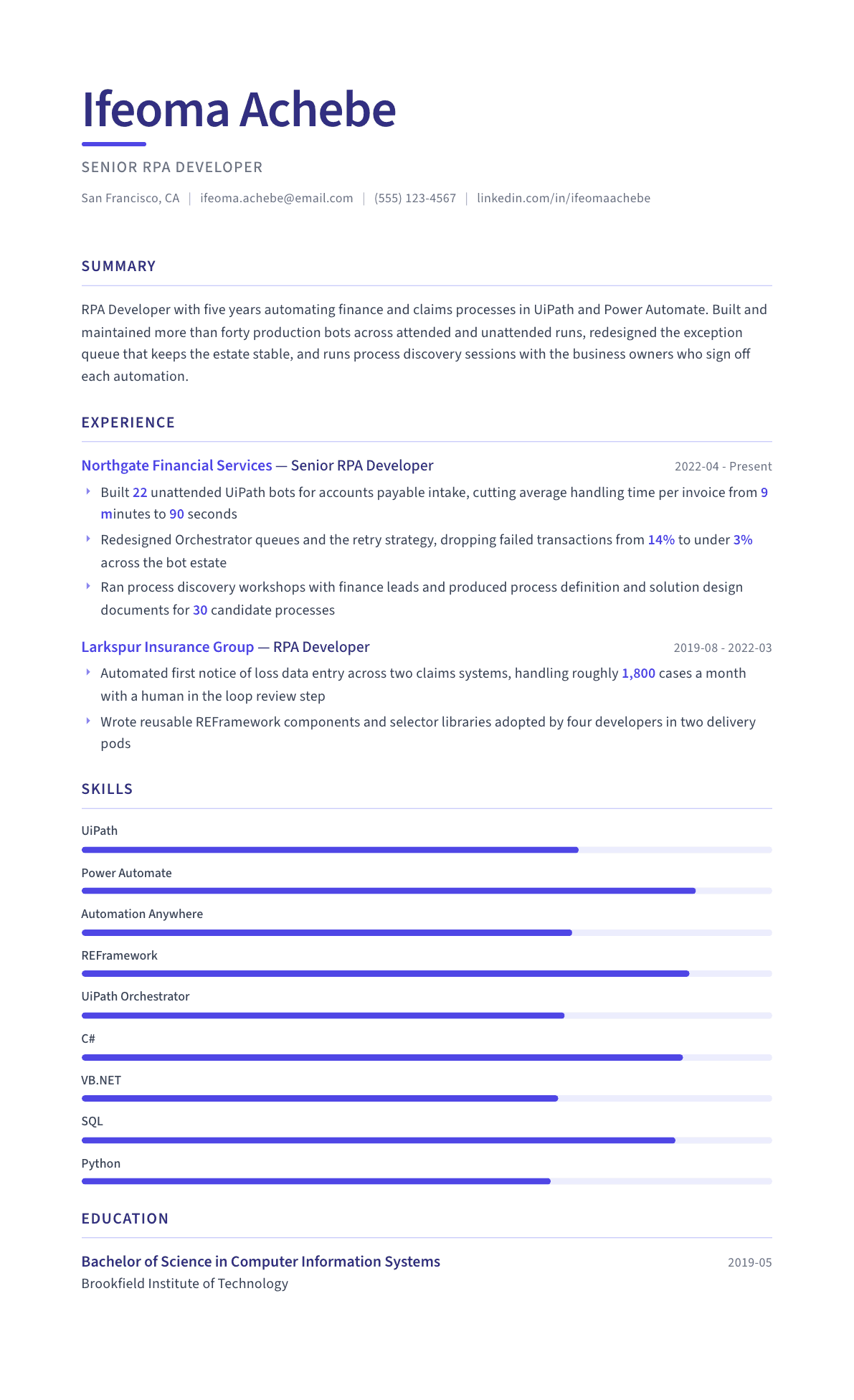
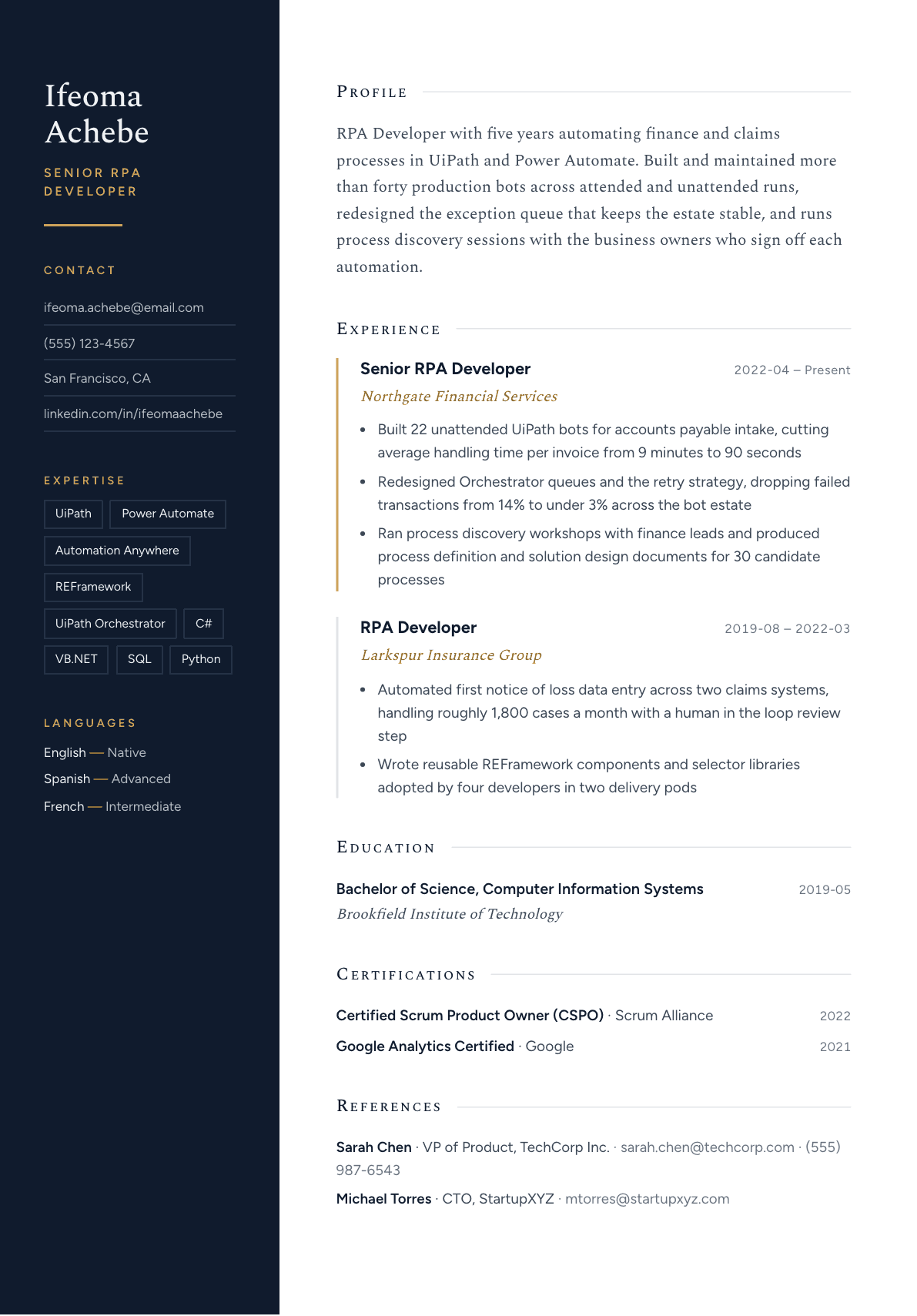
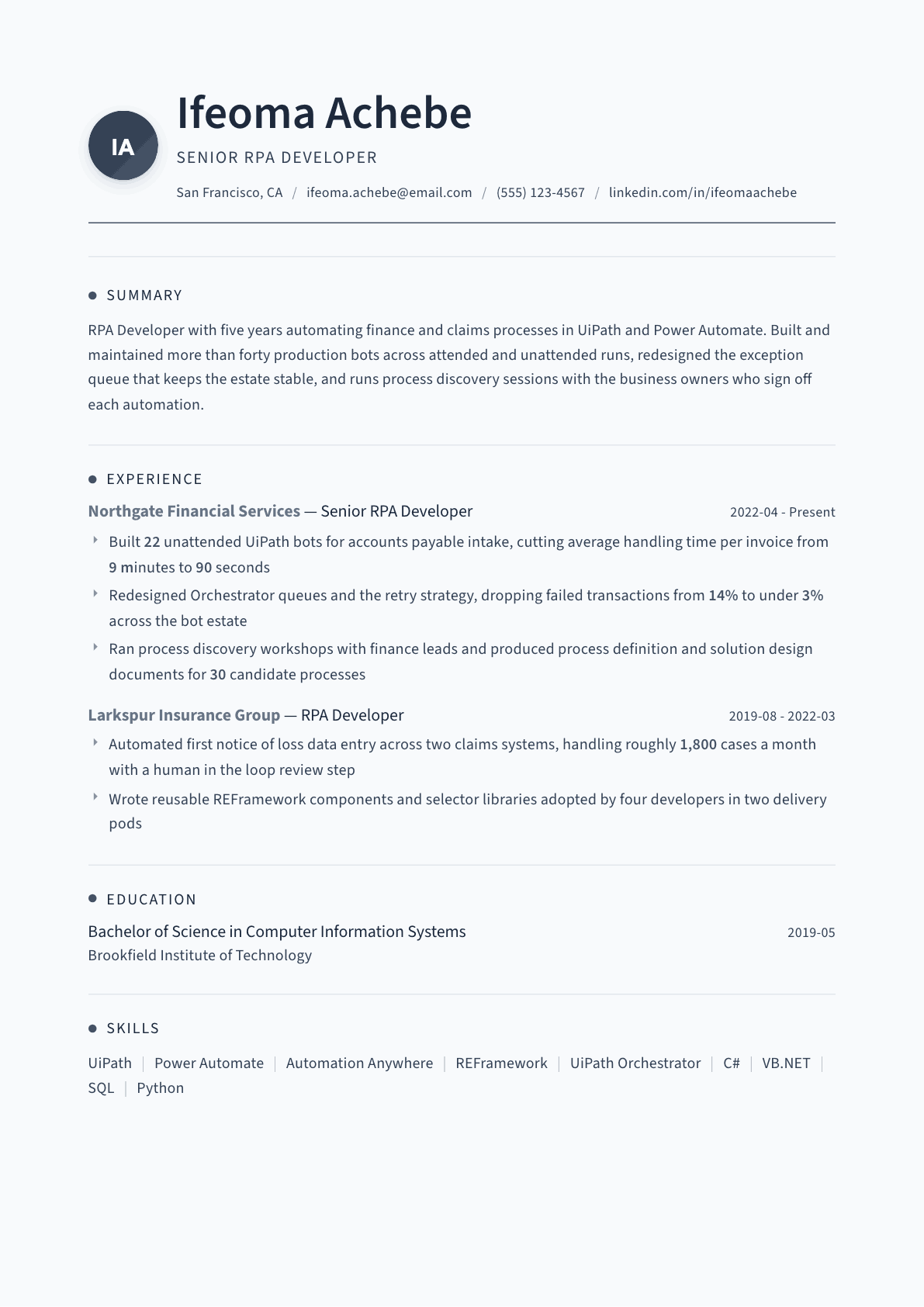
Example RPA Developer summary
RPA Developer with six years delivering attended and unattended automations in UiPath and Power Automate for finance, procurement, and claims teams. Designed a shared REFramework component library, consolidated forty bots onto a single Orchestrator tenant, and pushed failed transactions below three percent. Comfortable running process discovery with business owners and writing design documents that survive a handover to a support team.
Skills to list on a RPA Developer resume
- UiPath
- Automation Anywhere
- Blue Prism
- Power Automate
- UiPath Orchestrator
- REFramework
- C#
- VB.NET
- Python
- SQL
- Process Discovery
- Solution Design Documentation
- Exception Handling
- API Integration
- Citrix Automation
- Document Understanding
- Unattended Automation
What actually gets this resume read
- Name each automation platform with the components you used, such as UiPath Studio with Orchestrator, so screeners match the exact stack.
- Quantify every bot in transactions per day, handling time saved, and exception rate rather than listing the process name on its own.
- Show the delivery artifacts you produced: process definition documents, solution design documents, test scripts, and hypercare handover notes.
- State the business domain of each automated process, because finance, claims, and human resources automations are screened very differently.
- Keep programming languages in their own line, since most teams still expect C#, VB.NET, or Python for custom activities and reusable libraries.
- Include exception handling and bot maintenance work, because managers have been burned by automations that fail silently after go live.
How to write a rpa developer resume
An RPA developer resume is screened by an automation lead who has inherited broken bots before. She is not looking for someone who can drag activities onto a canvas. She is looking for evidence that your automations still run six months after handover, that you know why a selector breaks when a Citrix session resizes, and that you can sit with a finance manager and separate a process worth automating from one that should simply be deleted.
That means the resume has to carry two layers. The platform layer is the obvious one: UiPath, Automation Anywhere, Blue Prism, Power Automate, the orchestration tier, the languages you extend them with. The delivery layer is the one most candidates leave out: process discovery, the design documents, testing, hypercare, and how you handled the exceptions the business never mentioned in the workshop.
This guide covers the section order an automation lead reads in, three example summaries at different stages, before and after bullets from real automation work, the credentials that carry weight, and the questions developers ask when they sit down to rewrite this resume.
Format: one page until you have a real bot portfolio
Reverse chronological, one clean column, no icons. Many automation teams sit inside a shared services or finance function and use the same applicant tracking system as the rest of the company, so a two column layout risks having your platform list parsed out of order.
Put a short technical block directly under the summary listing platforms, orchestration tier, languages, and the applications you have automated against. An automation lead wants to know within five seconds whether you have touched her stack, because retraining a Blue Prism developer on UiPath is a real cost.
- Header: name, city, phone, email, and a link to a public repository if your custom activities are open.
- Section order: summary, technical stack, automation experience, education, certifications.
- Career changers from a business or accounting background should keep the domain experience visible, because it is an advantage in discovery.
Summary: platform, domain, and the size of the estate you ran
Three lines. Name the platform family, the business domains you automated in, roughly how many production automations you own or have owned, and whether they run attended, unattended, or both. An estate size tells a lead more than a years number, because a developer with three bots and a developer with forty have solved very different problems.
If you are moving from one platform to another, say it plainly. A Blue Prism developer learning UiPath should write that, name the transferable parts such as process design and exception handling, and let the reader stop guessing.
Experience: the process, the volume, and what broke
Structure each automation as process, applications touched, volume, and outcome. Invoice intake across a scanning tool and an accounting package at two thousand documents a month is a different engineering problem from a nightly reconciliation that reads two spreadsheets, and the bullet should make that obvious.
Give the applications by name where you can, because integration difficulty lives there. Automating against a modern web application with stable identifiers is routine work. Automating a mainframe terminal emulator, a Citrix published desktop, or a legacy thick client is the experience teams pay for, so it deserves its own bullet.
Include at least one bullet on stability. Retry strategy, queue design, orchestration schedules, credential handling in a vault, and how you cut failed transactions all say that your work survives contact with production. Leave out bullets that describe the tool rather than your work, such as building workflows in a studio environment, which is true of everyone who has held the title.
Discovery and documentation: the half most candidates omit
Automation programs stall in discovery, not in development. Show that you can run a process walkthrough, capture the as is steps, calculate the handling time, and reject a candidate process when the underlying system is about to be replaced. Naming the artifacts you produced, process definition documents, solution design documents, test scripts, and handover packs, tells a lead you have worked inside a governed program rather than building side projects.
If you worked in a center of excellence, describe its shape: how intake was scored, who approved the business case, and whether you sat in the review board. Teams hiring at senior level screen for that as hard as they screen for the code.
Skills and keywords a screener filters on
Automation job descriptions are unusually literal. They ask for a platform, a version of orchestration, a language, and often a domain. Mirror the exact terms: the studio product, the orchestrator, REFramework or the equivalent reusable framework, the language you write custom activities in, and the systems of record. Then keep a short list of application types you have automated against, because that is where a lead judges difficulty.
- Platforms: name each one you have used in production and mark the one you are strongest in.
- Languages: C#, VB.NET, Python, and any scripting used for custom activities or pre processing.
- Adjacent skills worth listing: SQL, REST APIs, message queues, document understanding, and test automation.
RPA Developer resume summary examples
First automation role
Certified UiPath developer with a business systems degree and one year automating internal finance tasks. Built four attended automations for expense coding and vendor onboarding, wrote the test scripts, and shadowed process discovery workshops. Comfortable in Studio, Orchestrator queues, and basic C# activities.
Four years in
RPA Developer with four years across UiPath and Power Automate, owning 18 unattended automations in accounts payable and order management. Cut failed transactions to under 4% by redesigning queue retries and adding a human review step. Writes solution design documents and runs hypercare after every release.
Lead developer in a center of excellence
Senior RPA Developer and technical lead for a center of excellence running 40 production automations across finance, claims, and human resources. Owns the reusable component library, the code review standard, and the intake scoring model. Migrated the estate to a single Orchestrator tenant with no unplanned outage.
Work experience bullets: before and after
Before: Developed bots using UiPath to automate business processes.
After: Built 22 unattended UiPath automations for accounts payable invoice intake across a scanning tool and the accounting package, moving average handling time per invoice from 9 minutes to 90 seconds.
Naming the process, the applications, the count, and the before and after turns a job description into evidence.
Before: Fixed issues with bots that were failing.
After: Redesigned Orchestrator queue retries, selector strategy, and credential refresh after a password policy change, dropping failed transactions across the estate from 14% to under 3%.
The specific failure causes show diagnostic skill rather than a general claim about maintenance.
Before: Worked with business users to gather requirements.
After: Ran process discovery workshops with three finance leads, timed the as is steps, and produced process definition documents for 30 candidate processes, rejecting 11 where the source system was due for replacement.
The rejected processes prove judgment, which is what separates a developer from an order taker.
Before: Created reusable components for the team.
After: Wrote a shared REFramework component library for logging, retry, and credential access that four developers across two delivery pods adopted, cutting new automation build time by roughly a third.
Adoption by named teams and a build time result make reuse measurable instead of aspirational.
Before: Automated data entry for the claims team.
After: Automated first notice of loss entry across two legacy claims systems behind a Citrix session, handling around 1,800 cases a month with a human in the loop review for low confidence extractions.
Citrix, the volume, and the human review step signal technical difficulty and responsible design.
Hard skills
- UiPath Studio and Orchestrator
- Automation Anywhere
- Blue Prism
- Power Automate
- REFramework and reusable libraries
- Exception handling and retry design
- C# and VB.NET custom activities
- Python for pre processing
- SQL and data reconciliation
- REST API integration
- Citrix and thick client automation
- Document understanding and extraction
- Process definition documentation
- Unit and user acceptance testing
Soft skills
- Process discovery interviewing
- Business stakeholder communication
- Structured troubleshooting
- Handover and knowledge transfer
- Prioritizing an intake backlog
- Coaching business users through change
Certifications worth listing
- UiPath Certified Professional Automation Developer Associate (UiPath)
- UiPath Certified Professional Automation Developer Professional (UiPath)
- Automation Anywhere Certified Essentials RPA Professional (Automation Anywhere)
- Blue Prism Developer Certification (SS&C Blue Prism)
- Microsoft Certified: Power Automate RPA Developer Associate (Microsoft)
Mistakes that cost rpa developer candidates the interview
- Listing every activity in the studio toolbox as a skill, which reads as padding to anyone who has used the product.
- Describing automations by process name only, with no volume, no applications, and no result to judge them by.
- Leaving out maintenance and exception work, so the reader assumes your bots were handed over and quietly failed.
- Claiming a platform you touched once in training next to one you ran in production, with no distinction between them.
- Skipping the discovery and documentation side, which is what separates a senior candidate from a builder of small tools.
- Burying the platform certification at the bottom of page two when it is the first thing a screener filters on.
RPA Developer resume questions
Do I need a UiPath certification to get an RPA developer job?
It is not required, but it clears a common filter and proves platform depth when your production experience is thin. Once you have several live automations with volumes and outcomes attached, that history matters more than the badge.
How do I show RPA experience when my automations were internal and confidential?
Describe the process type, the application categories, the transaction volume, and the outcome without naming the client or the internal system. Automation leads read those resumes constantly and understand the constraint, so abstract the names but keep every number.
Should an RPA developer resume include programming languages?
Yes, in their own line. Most production estates need custom activities, data transformation, or integration code, so C#, VB.NET, Python, and SQL tell a lead you can go past the drag and drop layer when a process demands it.
How do I move from a business analyst role into RPA development?
Lead with the process discovery and documentation you already do, add a platform certification, and build two or three automations you can describe end to end. Domain knowledge in finance or claims is genuinely valuable, so keep it visible rather than hiding it.
Is intelligent automation experience worth adding to the resume?
Add it when it is real. Document understanding, machine learning extraction models, and orchestration across an API layer are what many programs are moving toward, so name the specific components you built and the accuracy or review rate you achieved.
Related resume examples
- Automation Engineer Resume example
- Software Engineer Resume example
- Test Automation Engineer Resume example
- IT Business Analyst Resume example
- Solutions Engineer Resume example
- Systems Analyst Resume example