Paid Media Manager Resume Examples: the lines they read
Build a Paid Media Manager Resume Buyers Take Seriously
By Mustafa Tarabya, founder of CVBooster · Published · Updated
A paid media manager resume built around budget scale, ROAS and channel mix, with a sample resume, the keywords recruiters search, and a writing guide.
Sample resumes for a paid media manager
The same paid media manager content laid out in three CVBooster templates, so you can see what the finished document looks like before you write a word.
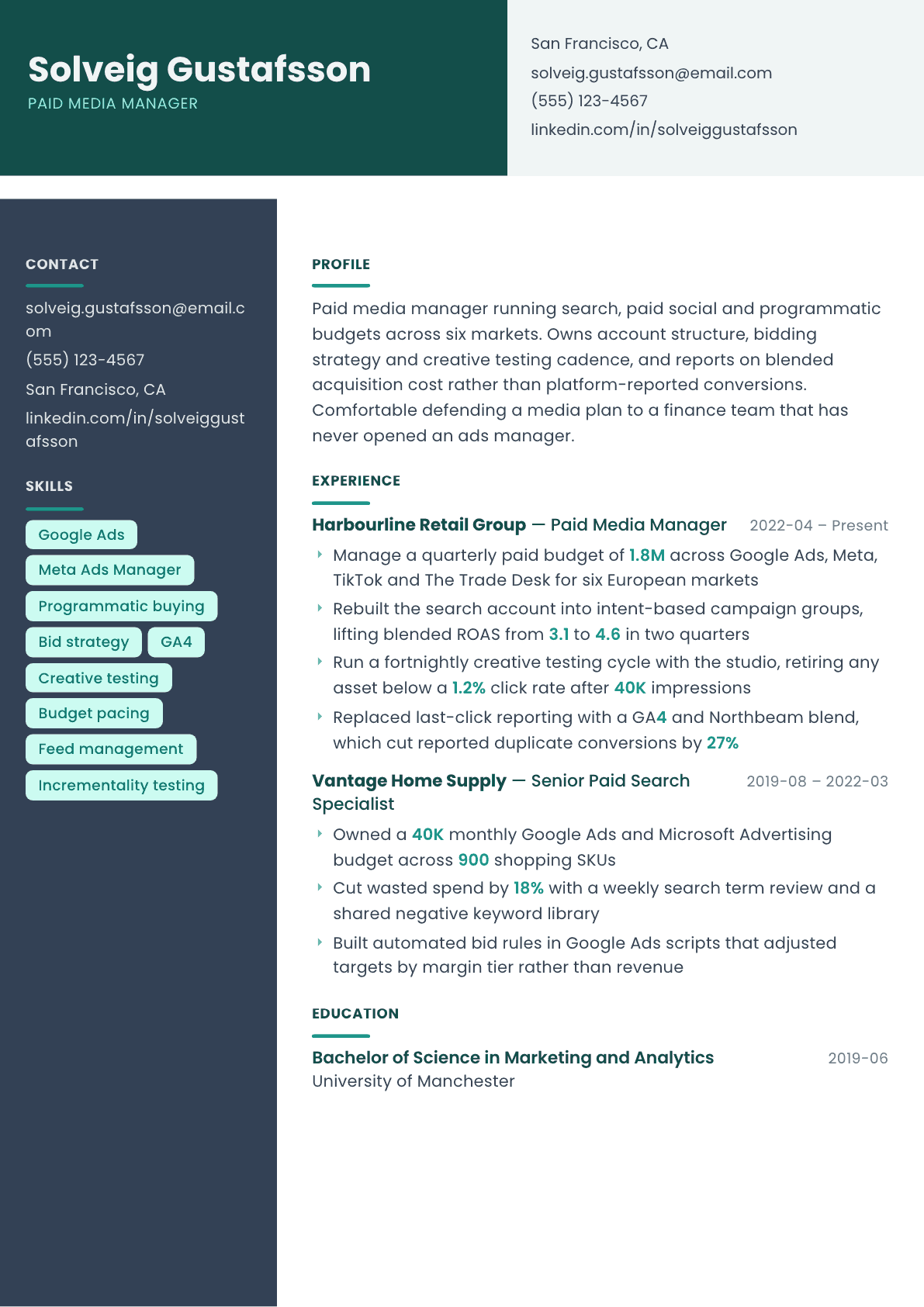
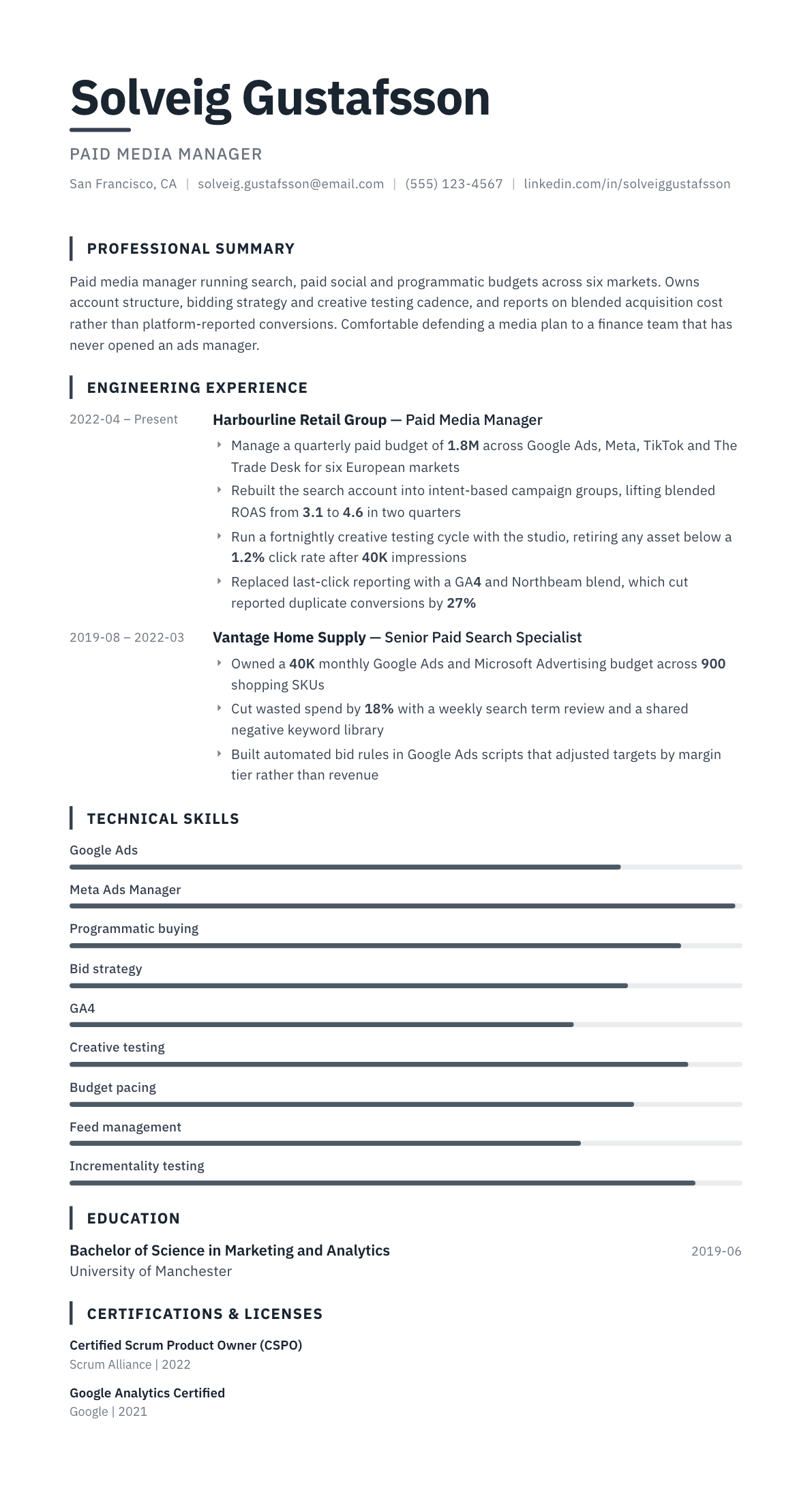
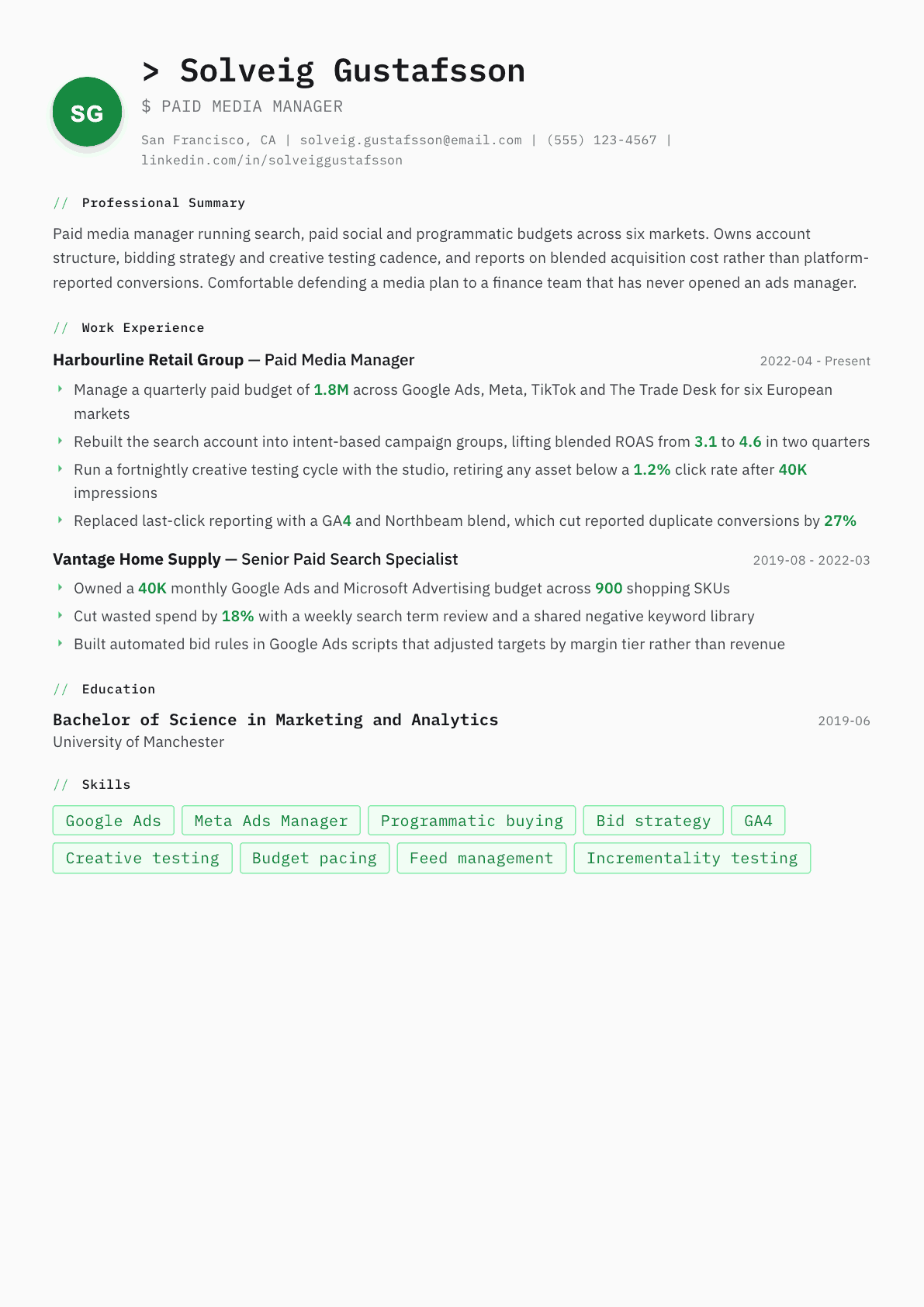
Example Paid Media Manager summary
Paid media manager with six years buying across search, paid social and programmatic for retail and subscription brands. Currently responsible for a 1.8M quarterly budget in six markets, where an account restructure and a disciplined creative testing cycle moved blended ROAS from 3.1 to 4.6. Fluent in GA4, feed management and geo holdout testing, and used to defending a media plan in a finance review.
Skills to list on a Paid Media Manager resume
- Google Ads
- Meta Ads Manager
- TikTok Ads
- LinkedIn Campaign Manager
- DV360
- The Trade Desk
- Google Merchant Center
- Bid strategy
- Audience segmentation
- Creative testing
- Budget pacing
- GA4
- Looker Studio
- Incrementality testing
- Attribution modeling
- Feed optimization
What actually gets this resume read
- State the budget you personally controlled per month or quarter, because scale is the first filter every hiring manager applies.
- Name every platform you buy on by its real product name, since recruiters search for Google Ads, DV360 and The Trade Desk separately.
- Pair each efficiency number with the volume it held, so a falling cost per acquisition does not read as a shrinking account.
- Show one restructure you led, such as a campaign consolidation or a feed rebuild, rather than only ongoing optimization work.
- Say which measurement stack you trusted, whether platform-reported, a media mix model, or a geo holdout test.
- List the verticals you have bought for, because retail, lead generation and app install accounts behave nothing alike.
How to write a paid media manager resume
A paid media manager resume is screened by someone who buys media for a living, and they read it in a fixed order: how much budget did this person control, on which platforms, in which verticals, and how did they know the spend worked. Everything else on the page is secondary. A resume that opens with a paragraph about being data-driven and passionate about growth has spent its best real estate on nothing.
The second reader is usually a finance or ecommerce lead who has never opened an ads manager. That person cares whether you can explain a media plan in business terms: blended acquisition cost, contribution margin, the payback window. So the resume has to work at two altitudes, platform detail for the practitioner and business outcome for the approver.
This guide covers the section order that suits paid media, how to write budget and efficiency numbers so they stay credible, three summaries at different levels of scale, before and after bullets, and the questions media buyers ask when they sit down to rewrite their resume.
Format: reverse chronological, one page until you have run a large account
Use reverse chronological order and keep it to one page until you have managed a seven-figure annual budget or a team. Media buying hiring moves fast, and a two-page resume from someone with four years of experience reads as padding.
Put a short channel and budget line directly under your name, before the summary. Something like "Search, paid social, programmatic. Largest account: 1.8M per quarter across six markets" answers the screener's first question before they have to hunt for it.
- Header: name, title, city, phone, email, and a link to a portfolio or case study page if you have one.
- Section order: summary, channels and budget scale, experience, technical skills, certifications, education.
- Avoid two-column layouts with icons for platform logos, since the parser drops the labels and keeps the pictures.
Experience: budget, platform, vertical, then what you changed
Each job needs four facts before the bullets start: the budget you controlled and over what period, the platforms, the markets, and the business model. "1.8M per quarter, Google Ads, Meta, TikTok and The Trade Desk, six European markets, retail" tells a buyer more in one line than three bullets of optimization language.
Then write bullets around decisions, not maintenance. Every buyer checks search terms and adjusts bids. What separates candidates is the structural work: a campaign consolidation, a move from manual to value-based bidding, a feed rebuild, a shift from broad to intent-based campaign groups, an account migration after a merger. Name the change, the mechanism, and the result in that order.
Include at least one bullet about something that did not work. A geo holdout that showed a channel was less incremental than the platform claimed, followed by a reallocation, is the single most convincing thing a paid media candidate can put on a page, because it proves you measure rather than report.
Numbers: pair every efficiency claim with a volume
Cost per acquisition falls whenever you shrink an account, so an efficiency number alone is unreadable. Always attach the volume it held. "Lifted return on ad spend from 3.1 to 4.6 while growing spend by a third" is a claim a buyer believes. "Improved return on ad spend by half" invites the interviewer to assume you cut spend.
Be honest about the measurement source. If the number came from the platform, say so. If it came from a media mix model, a geo test or a warehouse-level blended figure, say that instead, because senior interviewers will ask and a vague answer undoes the bullet.
- Budget: state it per month or per quarter, consistently, and say whether it is gross media or total including fees.
- Efficiency: return on ad spend, cost per acquisition or cost per qualified lead, always with the volume alongside.
- Scale: impressions, sessions or conversions per month, so the reader can picture the account size.
- Measurement: name the source, whether platform-reported, modeled, or from a holdout test.
Skills: platforms, measurement, and the feed layer
Split the skills block into three groups so the reader can scan it. Buying platforms first, using their real product names: Google Ads, Microsoft Advertising, Meta Ads Manager, TikTok Ads, LinkedIn Campaign Manager, Amazon Ads, DV360, The Trade Desk. Then measurement: GA4, server-side tagging, Looker Studio, incrementality and holdout testing, attribution modeling. Then the operational layer that most candidates forget: Google Merchant Center, feed management tools, catalog structure, dynamic creative and creative production workflow.
Add the languages and markets you have bought in. Managing a Nordic account with four languages and separate feeds is a different job from a single English market, and a recruiter hiring for a multi-market team will filter on it.
Keywords the applicant tracking system is matching on
Paid media job descriptions reuse a narrow set of phrases. Expect to see paid media, performance marketing, PPC, return on ad spend, cost per acquisition, bid strategy, audience segmentation, budget pacing, creative testing, attribution and the specific platform names. Mirror the exact wording of the posting once in your summary and once inside an experience bullet, in a sentence that would still make sense to a human.
One warning: abbreviations and full terms are matched separately by some systems. Write "return on ad spend (ROAS)" the first time, then use the short form. Do the same for cost per acquisition and conversion rate optimization.
Paid Media Manager resume summary examples
Two years buying
Paid search and paid social buyer with two years managing 40K a month in Google Ads and Meta for an ecommerce catalog of 900 SKUs. Cut wasted spend 18% through weekly search term reviews and a shared negative keyword library. Google Ads Search and Shopping certified.
Managing a multi-market account
Paid media manager running 1.8M a quarter across Google Ads, Meta, TikTok and The Trade Desk in six markets. Rebuilt the search account into intent-based groups and moved blended return on ad spend from 3.1 to 4.6 in two quarters while holding spend flat.
Head of paid media
Paid media lead with nine years across retail and subscription, now running a team of four and an annual budget above 8M. Introduced geo holdout testing that reset the channel mix, replaced last-click reporting with a blended model, and owns the media plan finance approves each quarter.
Work experience bullets: before and after
Before: Managed large paid media budgets across multiple channels.
After: Managed a 1.8M quarterly budget across Google Ads, Meta, TikTok and The Trade Desk covering six European markets and four languages.
The exact figure, the named platforms and the market count let a buyer place your experience against their own account.
Before: Improved ROAS through ongoing campaign optimization.
After: Rebuilt the search account into intent-based campaign groups, lifting blended return on ad spend from 3.1 to 4.6 over two quarters at flat spend.
A named structural change with a before and after figure, and the spend held constant so the gain cannot be read as a budget cut.
Before: Responsible for creative testing with the design team.
After: Ran a fortnightly creative testing cycle with the in-house studio, retiring any asset below a 1.2% click rate after 40K impressions.
A cadence and a written retirement rule show a repeatable process rather than occasional ad swaps.
Before: Worked on improving attribution and reporting accuracy.
After: Replaced last-click reporting with a blended view combining GA4 and a warehouse model, which removed 27% of double-counted conversions.
Naming both the old method and the new one, plus the size of the correction, shows measurement judgment.
Before: Reduced spend on underperforming campaigns.
After: Ran a four-cell geo holdout on paid social, found incremental lift below the platform-reported figure, and reallocated 90K a quarter to search and affiliate.
The test design and the reallocation prove the decision was evidence-led, which is what separates a buyer from an optimizer.
Hard skills
- Google Ads
- Microsoft Advertising
- Meta Ads Manager
- TikTok Ads
- LinkedIn Campaign Manager
- DV360 and The Trade Desk
- Google Merchant Center and feed management
- Bid strategy and budget pacing
- Audience segmentation and retargeting
- GA4 and server-side tagging
- Looker Studio reporting
- Incrementality and geo holdout testing
- Attribution modeling
- Creative testing frameworks
Soft skills
- Explaining media plans to finance
- Vendor and platform rep management
- Prioritizing under a fixed budget
- Working with creative teams
- Written reporting discipline
- Comfort saying a channel is not working
Certifications worth listing
- Google Ads Search Certification (Google Skillshop)
- Google Ads Shopping Certification (Google Skillshop)
- Google Analytics Certification (Google Skillshop)
- Meta Certified Media Buying Professional (Meta Blueprint)
- Microsoft Advertising Certified Professional (Microsoft)
- The Trade Desk Edge Academy Certification (The Trade Desk)
Mistakes that cost paid media manager candidates the interview
- Leaving the budget off the resume, which forces the recruiter to guess your scale and usually guess low.
- Quoting an efficiency gain with no volume attached, so the reader cannot tell growth from a spending cut.
- Listing every platform you have ever logged into instead of separating the ones you actually bought on.
- Describing routine account maintenance, since checking search terms and adjusting bids is assumed of everyone.
- Reporting platform-attributed conversions as fact without saying they came from the platform.
- Hiding the vertical, when retail, lead generation and app install accounts run on completely different mechanics.
- Using a graphic template with platform logo icons that an applicant tracking system cannot read as text.
Paid Media Manager resume questions
How much budget do I need to have managed to apply for a paid media manager role?
There is no fixed threshold, but state your number plainly. Employers match scale to their own account, so a buyer used to 40K a month is a strong fit for a similar advertiser and a stretch for one spending ten times that.
Should I put agency and in-house experience on the same resume?
Yes, and label each clearly. Agency work shows breadth across clients and fast onboarding. In-house work shows depth, ownership of a single business model and exposure to margin data. Hiring managers value the combination when they can see which is which.
Do Google Ads and Meta certifications actually help?
They help junior applicants pass an early screen and confirm platform familiarity. They carry little weight for senior roles, where account scale and measurement judgment decide the interview. List them in a compact certifications block, never in the summary.
How do I show results when the account was already performing well?
Report maintaining efficiency while growing volume, which is genuinely hard and well understood by buyers. Holding cost per acquisition flat while doubling spend is a stronger claim than a percentage improvement on a small, easy account.
What should I put on my resume if an agency handled the buying and I managed them?
Say so directly and describe the management work: budget allocation, the brief, the testing roadmap, quality assurance on account structure, and the reporting you challenged. Overstating hands-on buying is exposed in the first technical interview question.