Growth Hacker Resume Examples: free ATS score and gap list
Build a Growth Hacker Resume That Shows Explosive Results
By Mustafa Tarabya, founder of CVBooster · Published · Updated
Create an unconventional growth hacker resume with viral loop design, rapid experimentation, and user acquisition skills that startups are searching for.
Sample resumes for a growth hacker
The same growth hacker content laid out in three CVBooster templates, so you can see what the finished document looks like before you write a word.
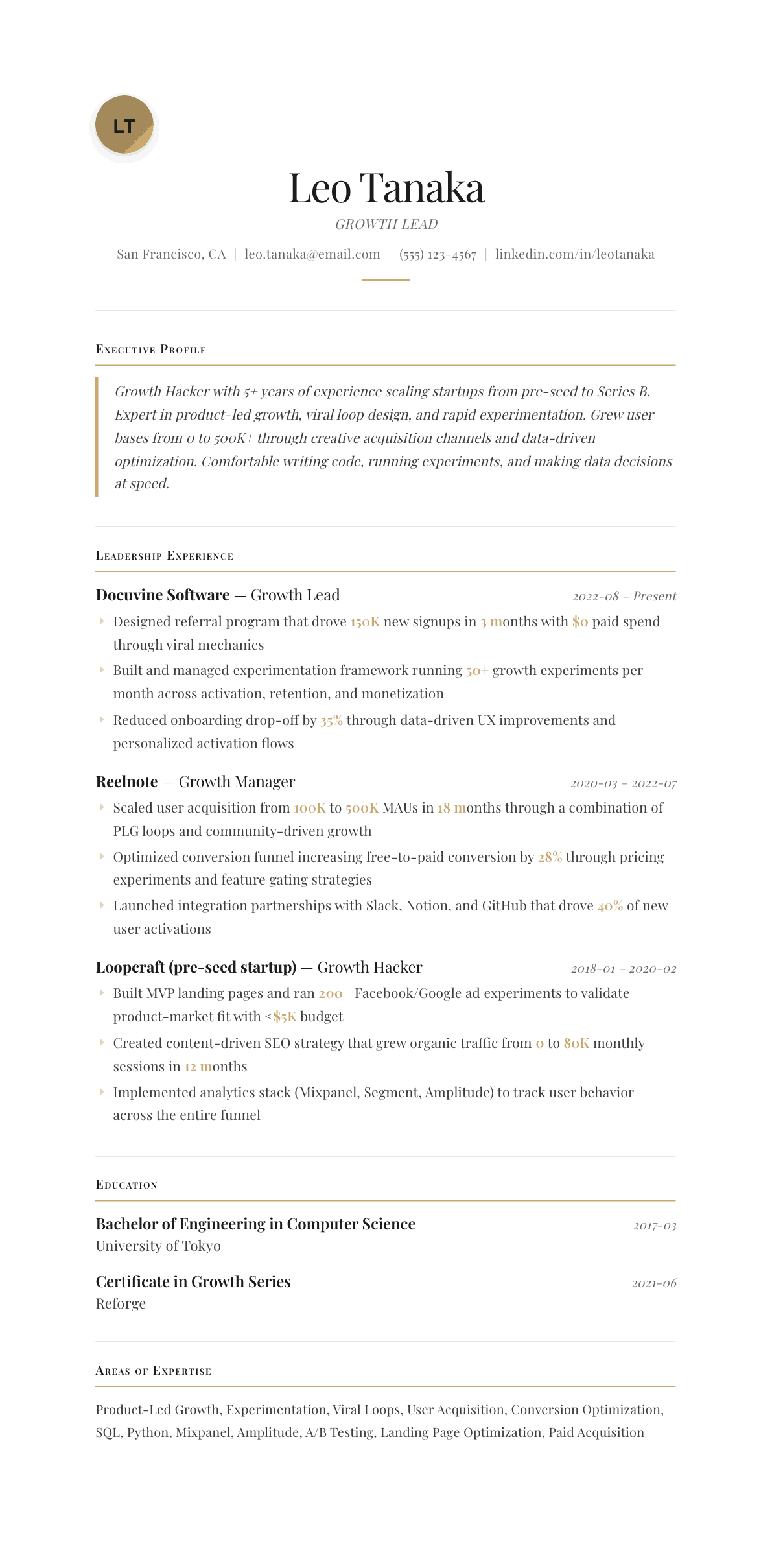
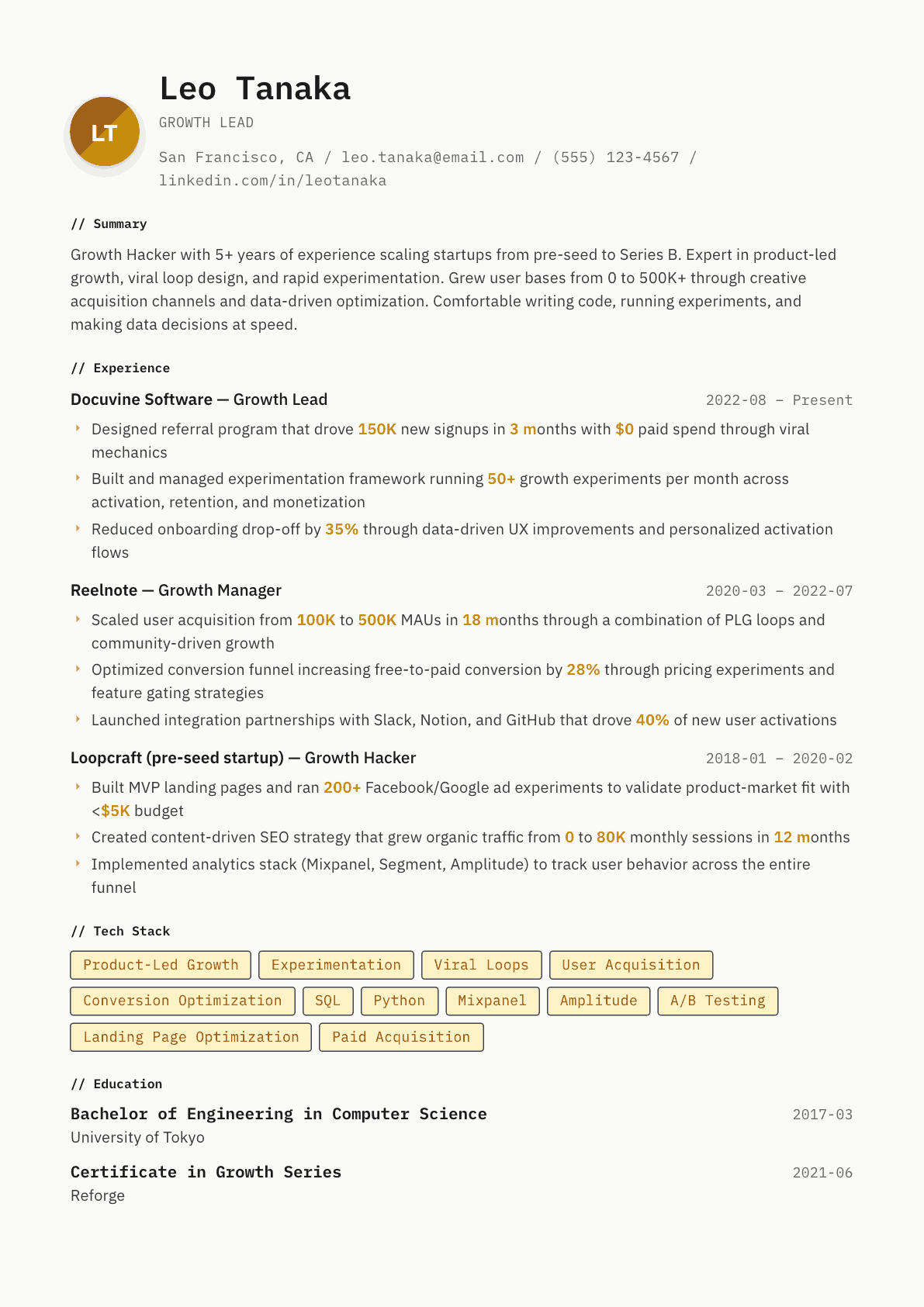
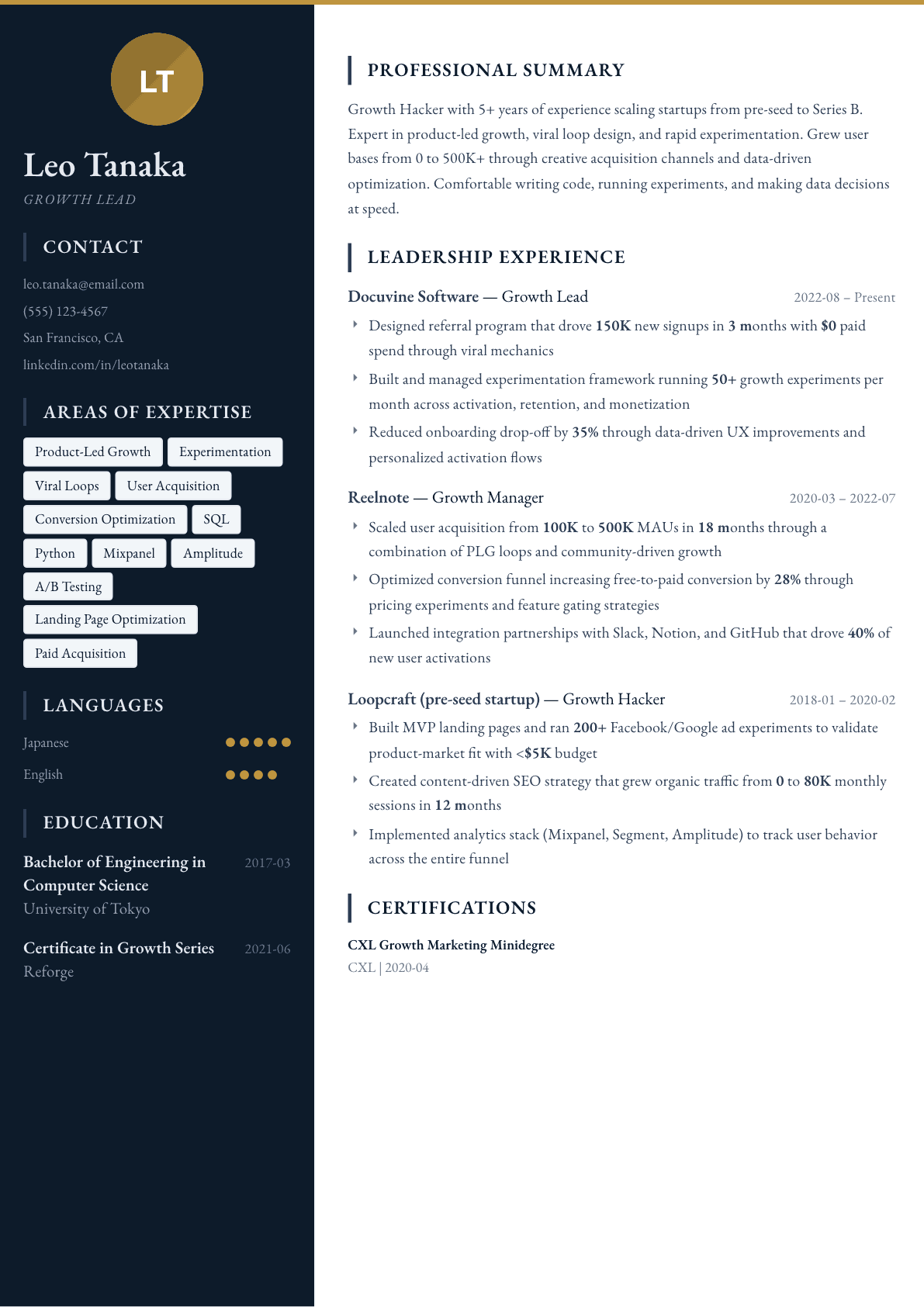
Example Growth Hacker summary
Scrappy Growth Hacker with 5 years of experience scaling SaaS products from zero to 500K+ users through product-led growth, viral mechanics, and rapid experimentation. Built referral programs driving 150K signups with $0 spend and improved free-to-paid conversion by 28%. Seeking a growth leadership role at an ambitious startup.
Skills to list on a Growth Hacker resume
- Growth Hacking
- Product-Led Growth
- Experimentation
- A/B Testing
- Viral Loop Design
- User Acquisition
- Conversion Rate Optimization
- Referral Programs
- SQL
- Python
- Mixpanel
- Amplitude
- Paid Acquisition
- SEO
- Landing Page Optimization
What actually gets this resume read
- Lead with growth metrics: user acquisition numbers, conversion rate improvements, revenue impact, and viral coefficients.
- Showcase your experimentation velocity: how many experiments you run per month and your methodology.
- Highlight technical skills (SQL, Python, basic coding) that differentiate you from traditional marketers.
- Demonstrate product-led growth expertise: referral programs, freemium optimization, activation flows.
- Include your analytics stack experience: Mixpanel, Amplitude, Segment, Google Analytics.
- Show scrappiness and resourcefulness, especially at early-stage companies with limited budgets.
How to write a growth hacker resume
The growth hacker title attracts more applicants than any other marketing job and converts fewer of them into interviews, because most of the resumes are marketing resumes with a different heading. The founder or head of growth reading yours is looking for a specific and unusual profile: someone who can form a hypothesis, instrument the product to test it, read the result honestly, and repeat that loop faster than a normal marketing calendar allows.
That means the screen is different from a channel marketing screen. The reader looks for a stage of the funnel you have genuinely moved (acquisition, activation, retention, referral or monetization), evidence that you can query data yourself rather than wait for an analyst, and a testing record that includes losses. A resume with only wins reads as a resume with only reported wins, and experienced growth leads treat it that way.
This guide covers how to build the document around the growth loop, how to write experiments as evidence, three summaries from a first growth role to a growth lead, before-and-after bullets, and the questions people ask when the honest answer is that most of their tests did not work.
Format: one page, with a funnel and stack block
One page. This is a role where a dense, plainly formatted document is read as a signal of clear thinking. Under the summary, put two compact lines: the funnel stages you have owned, and the stack you work in, separated into analytics, experimentation, data querying and the parts of the product you can change yourself.
If you write code or SQL, say what level. There is a large practical difference between a marketer who can pull a cohort in SQL, one who can build a landing page and wire an event, and one who can push a change into the product with an engineer reviewing it. Growth leads care about this and postings almost never define it.
- Header: name, title, city, email, plus a link to anything you built that is publicly visible.
- Funnel line: the stages you have owned and the metric you were accountable for at each.
- Stack line: analytics, experimentation, data warehouse and query tools, and what you can build yourself.
- Sections in this order: summary, funnel and stack, experiments, experience, skills, education.
Summary: the loop you built and the metric you moved
Three lines. Name the product type and stage, the funnel stage you own, the loop or mechanism you built, and the metric it moved. Product-led signup flows, referral loops, marketplace supply seeding, paid acquisition with a payback constraint, and onboarding activation are all specific claims a reader can test in the interview.
Scrappy and hustle are self-descriptions with no information in them. Replace them with the constraint you worked under, since resourcefulness is only visible against a limit: a small budget, a two-person team, an engineering queue you could not jump.
An experiments section beats a duties section
Consider replacing part of your experience section with a short selected experiments list. Three or four entries, each with the hypothesis, what you changed, the population and duration, the result, and what you did next. This is the format that most closely matches how growth work is actually reviewed internally.
Include at least one that failed and what it taught you. A candidate who reports that a referral incentive raised invitations but not activated users, and that they then rebuilt the reward around the moment of value, demonstrates the reasoning growth leads hire for. A page of unbroken wins does the opposite.
Give experiment velocity honestly. Say how many tests you ran in a period and how many reached significance, rather than claiming a large number with no completion rate. Anyone who has run a real testing program knows most cannot be conclusively read.
Data work: prove you can answer your own questions
Say what you query and where. Product analytics tools such as Mixpanel or Amplitude, the warehouse tables you wrote SQL against, the dashboards you maintained, and the event taxonomy you defined or cleaned up. Instrumentation work is underrated on resumes and is often the reason a growth hire becomes useful in the first month.
Describe your cohort and retention work, since that is where the honest picture of growth lives. Retention curves by acquisition source, activation defined against a specific action within a specific window, payback period on paid channels, and the difference between a signup and an account that came back a third time.
Channels, loops and the vocabulary that matches the job
Growth roles mix channels and product. Name both sides: paid acquisition, search, content and programmatic pages, partnerships and integrations, referral and invitation loops, onboarding and activation flows, pricing and packaging tests, and win-back messaging. Be precise about which you ran and which you supported.
The vocabulary that postings use includes product-led growth, activation, retention, north star metric, funnel conversion, cohort analysis, experimentation, viral loop, and payback period. Use only the ones your experience supports, because in this role each of them is an interview question waiting to be asked.
Growth Hacker resume summary examples
First growth role
Marketer moving into growth for a self-serve productivity app, owning the signup and onboarding funnel. Rebuilt the activation definition around a first shared document, instrumented the missing events with an engineer, and lifted week-one activation from 22% to 31% across four tested onboarding variants.
Five years in
Growth marketer with five years across two consumer subscription products, owning acquisition and activation with a payback constraint under six months. Runs six to eight experiments a month in SQL and Amplitude, built a referral loop that supplies a fifth of new signups, and cut cost per activated user by 34%.
Growth lead
Growth lead running a team of four across acquisition, lifecycle and product experimentation for a marketplace. Rebuilt the event taxonomy and cohort reporting the company now plans against, moved the team to a weekly experiment review with documented losses, and raised month-three retention by 9 points.
Work experience bullets: before and after
Before: Ran growth experiments to increase user acquisition.
After: Ran six to eight experiments a month across signup, onboarding and pricing pages, with a written hypothesis and a stopping rule for each, and documented outcomes in a shared log the whole team reviewed weekly.
Cadence, written hypotheses and a review ritual show a repeatable process rather than occasional tinkering.
Before: Built a referral program that drove signups.
After: Built a two-sided referral loop triggered at first successful project export rather than at signup, which raised invitations sent per active user and now supplies a fifth of new accounts.
Naming the trigger moment shows the product reasoning behind the loop, which is the part that is hard to copy.
Before: Improved onboarding and activation rates.
After: Redefined activation as a first shared document within seven days, instrumented the missing events, and lifted week-one activation from 22% to 31% over four sequential onboarding tests.
A stated definition and a window make an activation claim verifiable rather than a moving target.
Before: Used data to inform growth decisions.
After: Wrote SQL against the warehouse to build retention curves by acquisition source, which showed one paid channel producing signups that never reached month two, and moved that budget into partnerships.
A query, a finding and a budget decision demonstrate the full loop instead of a claim about being data led.
Before: Tested different landing pages and messaging.
After: Tested three positioning angles on the paid landing page against a control, found no difference in signup but a 14% gap in activation, and rewrote the ad copy to match the winning angle.
Reporting a null result at one step and the real effect at the next shows honest reading of a test.
Hard skills
- Experiment design and analysis
- A/B and holdout testing
- SQL and cohort analysis
- Product analytics instrumentation
- Mixpanel
- Amplitude
- Funnel and retention modeling
- Onboarding and activation design
- Referral and invitation loops
- Paid acquisition with payback targets
- Landing page building
- Pricing and packaging tests
- Event taxonomy design
- Lifecycle messaging
Soft skills
- Hypothesis thinking
- Reading results honestly
- Working inside an engineering queue
- Prioritizing by expected value
- Writing up findings clearly
- Comfort with most ideas failing
Mistakes that cost growth hacker candidates the interview
- Submitting a channel marketing resume under a growth title, with campaigns instead of experiments.
- Reporting only wins, which tells an experienced growth lead that the losses were left out on purpose.
- Claiming a large number of tests with no completion or significance rate behind it.
- Using activation and retention without defining the action and the window, so the numbers cannot be compared.
- Overstating technical ability, since a SQL claim is usually tested in the interview with a real question.
- Ignoring retention entirely and presenting signups as growth, which any subscription business will discount.
- Naming the whole analytics category instead of the one or two tools you have queried directly.
Growth Hacker resume questions
Do I need to know SQL for a growth role?
For most product-led roles, yes, at the level of joining a few tables and building a cohort. If you do not have it, say what you can do instead, such as building funnels in a product analytics tool, and start learning before you interview, because you will be asked.
Should I include experiments that failed?
Yes, one or two with the reasoning. A failed test that changed your next decision is the strongest evidence that you run a real program, and growth leads read a page of unbroken successes as reporting bias rather than talent.
What is the difference between a growth hacker and a digital marketing manager?
A digital marketing manager owns channels and a budget against a demand target. A growth role works across the whole funnel including the product surface, and is measured on activation, retention and loops as much as on acquisition volume.
How do I get a growth role without startup experience?
Show the loop somewhere real. A side project with instrumented events, a tested landing page, or a documented experiment log inside your current job all count. What the reader needs is proof you can form a hypothesis and read a result, not a specific logo.
What metrics should a growth resume lead with?
Lead with the metric you owned at your funnel stage, defined precisely: activation rate with its action and window, month-three retention, cost per activated user with payback period, or referral share of new accounts. Signup counts alone carry little weight.