Kubernetes Engineer Resume Examples: what gets the call
Write a Kubernetes Engineer Resume That Survives a Deep Screen
By Mustafa Tarabya, founder of CVBooster · Published · Updated
A Kubernetes engineer resume covering cluster scale, workload density, networking, upgrades and on-call, with a sample resume and a writing guide.
Sample resumes for a kubernetes engineer
The same kubernetes engineer content laid out in three CVBooster templates, so you can see what the finished document looks like before you write a word.
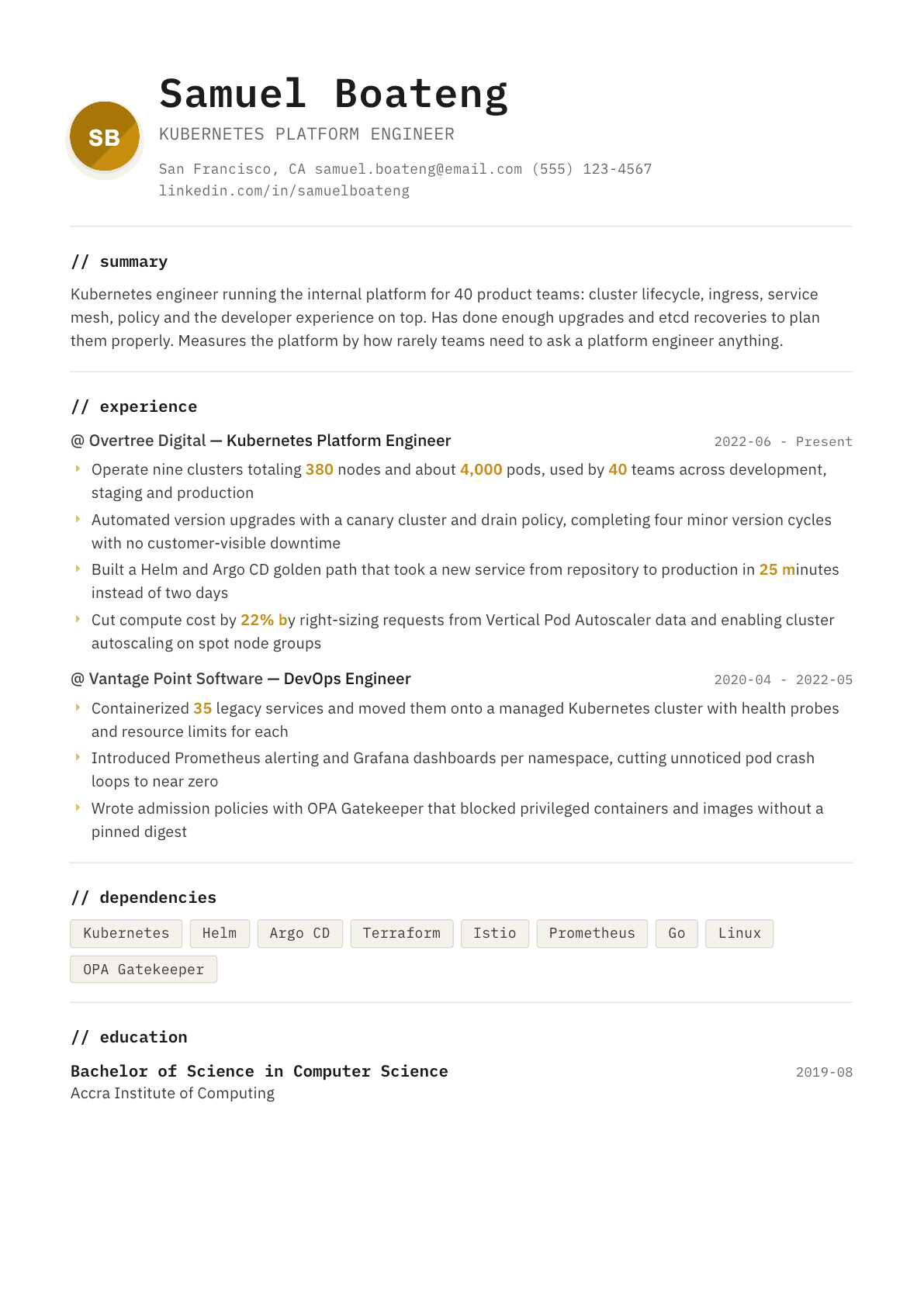
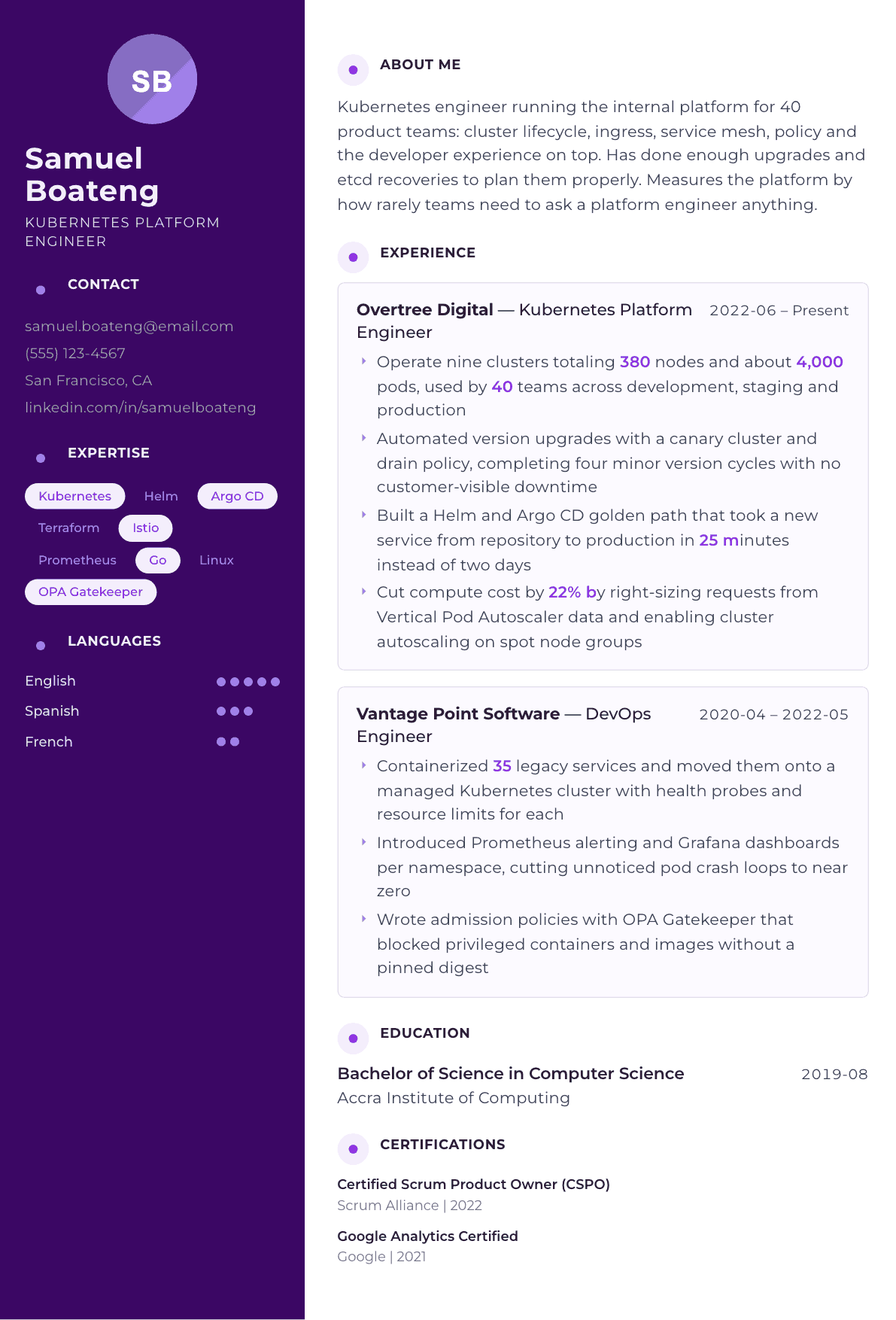
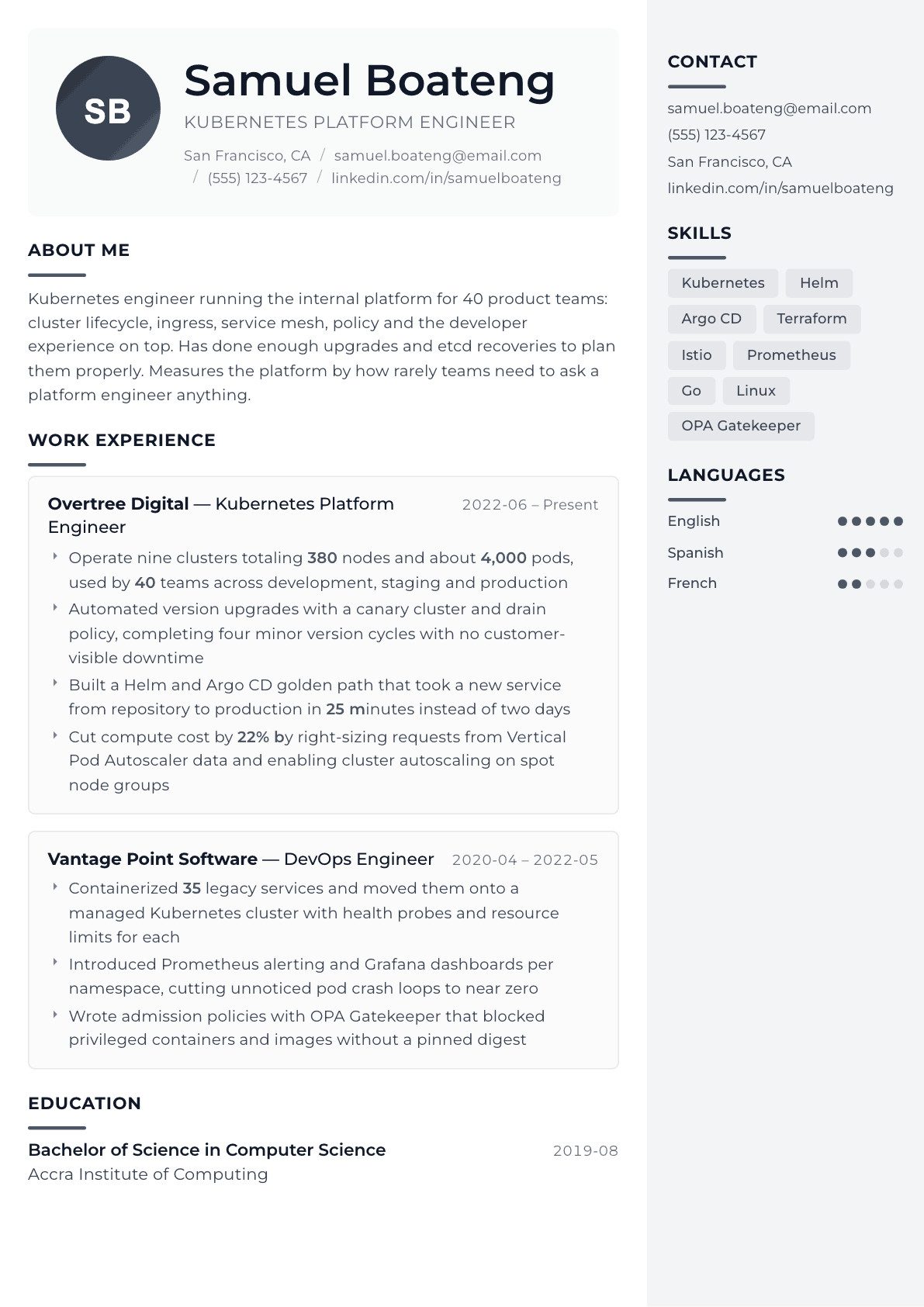
Example Kubernetes Engineer summary
Kubernetes engineer with five years operating multi-cluster platforms for large product organizations. Runs nine clusters and several hundred nodes used by forty teams, and owns upgrades, ingress, service mesh and admission policy. Built a Helm and Argo CD golden path that shortened a new service launch from two days to under half an hour, and cut compute cost by 22% through request right-sizing and autoscaling on spot capacity.
Skills to list on a Kubernetes Engineer resume
- Kubernetes
- Helm
- Kustomize
- Argo CD and GitOps
- Container runtimes and Docker
- Istio and service mesh
- Ingress and CNI networking
- OPA Gatekeeper policy
- Prometheus and Grafana
- Terraform
- Go scripting
- Linux administration
- Cluster autoscaling
- etcd operations
- Incident response
What actually gets this resume read
- Give cluster numbers in three dimensions: clusters, nodes and workloads, plus how many teams depend on them.
- Say whether the clusters are managed services or self-hosted, because control plane operations are a different job.
- Describe an upgrade path you designed, since version lifecycle work is the clearest signal of production Kubernetes experience.
- Name your delivery tooling, such as Helm, Kustomize or Argo CD, and what a developer has to do to use it.
- Include networking and policy specifics: ingress controller, CNI, service mesh and admission control you configured.
- Add one bullet about a failure you handled, such as an etcd recovery or a node pool exhaustion, and what changed afterward.
How to write a kubernetes engineer resume
Every second infrastructure resume now claims Kubernetes, so the people hiring for it have become good at spotting the difference between running workloads on a cluster somebody else operates and owning the cluster itself. The distinction shows up in a handful of details: upgrades, control plane care, admission policy, networking choices and what happened the night something went wrong.
Numbers settle it fastest. Clusters, nodes, workloads and dependent teams describe the operation in one line. Version lifecycle work describes maturity, because upgrades are the recurring obligation that separates a platform from a science project, and most candidates have never planned one.
This guide lays out the section order for the role, three summaries by stage, before and after bullets that turn container claims into evidence, and the questions engineers ask when they are trying to prove platform ownership rather than application deployment.
Format: one column, cluster numbers in the first six lines
Reverse-chronological, plain, no charts. Under the summary, put a platform block split into orchestration, delivery, networking, policy and observability. The split matters because a reader is looking for the operational layers, not a pile of tool logos.
Keep application language experience short unless the role is platform engineering with a heavy development component. Go and Python are worth naming; a long list of frameworks dilutes the page.
- Header: name, title, location, email, and hands-on credentials such as an administrator certification.
- Order: summary, platform block, experience, certifications, education.
- State whether clusters are managed or self-hosted, since control plane and etcd ownership is a separate job.
Summary: clusters, nodes, workloads, tenants
Four numbers and one sentence about who depends on you. Nine clusters, several hundred nodes, a few thousand pods and forty teams tells a reader more about your day than any adjective could. Then say what you own within that: lifecycle, networking, policy, delivery or all of it.
If you have run multi-tenant clusters, say so plainly. Isolating teams with namespaces, quotas, network policy and admission rules is harder than running a single-tenant cluster twice the size.
Experience: upgrades, delivery path, policy, incidents
Start with the scale line, then write about the four areas an interviewer will probe. How you upgrade, how developers deploy, how you constrain what runs, and what you do when a cluster misbehaves.
Upgrades should describe a method: a canary cluster, drain and cordon policy, node pool rotation, deprecated API discovery before the version jump. Saying you completed several minor version cycles without customer-visible downtime is a strong, checkable claim.
For the delivery path, describe what a developer does. A golden path where a new service goes from repository to production in under half an hour, without a platform engineer touching anything, is the outcome platform teams are built to produce.
For incidents, pick one real failure. Node pool exhaustion, a control plane recovery, a certificate expiry, a bad admission rule that blocked deployments. Name what you changed afterward, because the follow-up is the part that shows judgment.
- Scale: clusters, nodes, pods, namespaces, teams and environments.
- Delivery: the tool chain and the time from repository to production.
- Policy: admission rules enforced, such as blocking privileged containers or unpinned images.
Networking and storage: the layers people forget
Container networking is where most difficult cluster problems live. Name the interface plugin, the ingress controller, whether you run a service mesh and what it is actually used for, plus any network policy you enforce between namespaces.
Storage deserves a line too. Stateful workloads, volume classes, snapshot handling and the failure modes you have seen with them mark you as someone who has run more than stateless web services.
Keywords that appear in these postings
The recurring terms are consistent: Helm, Kustomize, GitOps, admission control, network policy, ingress, service mesh, autoscaling, resource requests and limits, node pools, observability and multi-tenancy. Use the posting phrasing once in the platform block and once inside a bullet that carries a measurement.
Kubernetes Engineer resume summary examples
First platform role
Developer with three years of backend work moving into platform engineering. Containerized eight services, wrote Helm charts with health probes and resource limits, and maintains a home lab cluster with GitOps delivery. Holds a certified administrator credential and is seeking a junior Kubernetes engineering role.
Four years in
Kubernetes engineer operating four clusters and 140 nodes for a software company, used by 18 product teams. Owns Helm and Argo CD delivery, ingress and certificate automation, and cluster upgrades. Cut compute cost by 22% by right-sizing resource requests and enabling autoscaling on spot node groups.
Platform lead
Platform lead with eight years in container infrastructure, running nine clusters and about 4,000 pods for 40 teams across three environments. Designed the upgrade method, the admission policy set and the golden path that takes a new service from repository to production in 25 minutes.
Work experience bullets: before and after
Before: Deployed and managed applications on Kubernetes.
After: Operated nine clusters totaling 380 nodes and roughly 4,000 pods across development, staging and production for 40 engineering teams.
Four counts and the tenant number establish platform ownership rather than application deployment.
Before: Upgraded Kubernetes versions when required.
After: Automated version upgrades using a canary cluster, deprecated API scanning and a drain policy, completing four minor version cycles with no customer-visible downtime.
The method plus the completed cycles turns a maintenance chore into proof of lifecycle ownership.
Before: Used Helm and Argo CD for deployments.
After: Built a Helm and Argo CD golden path that takes a new service from repository to production in 25 minutes without platform team involvement.
Measuring the developer path shows the platform reduced friction rather than adding a gatekeeper.
Before: Improved cluster security.
After: Enforced admission policies with OPA Gatekeeper that blocked privileged containers and images without a pinned digest, remediating 60 existing workloads before enforcement.
Naming the rules and the remediation work shows the policy was rolled out rather than announced.
Before: Reduced infrastructure costs.
After: Cut compute cost 22% by right-sizing requests from autoscaler recommendations and moving batch workloads onto spot node groups with disruption budgets.
The mechanism and the safeguard show cost work that did not quietly trade away reliability.
Hard skills
- Kubernetes cluster operations
- Helm and Kustomize
- Argo CD and GitOps delivery
- Container runtimes and image building
- Ingress controllers and certificate automation
- Container network interfaces and network policy
- Service mesh
- OPA Gatekeeper and admission control
- Horizontal and vertical autoscaling
- Prometheus, Grafana and tracing
- Terraform for cluster provisioning
- etcd backup and recovery
- Linux administration
- Go and Python scripting
Soft skills
- Designing for other engineers
- Writing platform documentation
- Blameless incident review
- Balancing guardrails against developer speed
- On-call ownership
- Teaching container concepts to application teams
Certifications worth listing
- Certified Kubernetes Administrator (The Linux Foundation)
- Certified Kubernetes Application Developer (The Linux Foundation)
- Certified Kubernetes Security Specialist (The Linux Foundation)
- HashiCorp Certified: Terraform Associate (HashiCorp)
Mistakes that cost kubernetes engineer candidates the interview
- Listing Kubernetes as a skill when your only experience is deploying into a cluster that another team operates.
- Never mentioning an upgrade, which tells a platform lead you have not carried the recurring obligation of the job.
- Skipping networking detail, so the reader cannot tell whether you have debugged a service that failed to resolve.
- Presenting cost reductions without mentioning disruption budgets or resource limits that kept workloads safe.
- Filling the platform block with adjacent tools while leaving the core cluster responsibilities undescribed.
- Leaving out multi-tenancy work such as quotas and namespace isolation, which is where cluster complexity really lives.
Kubernetes Engineer resume questions
Does a managed cluster count as real Kubernetes experience?
Yes, and most production experience is on managed services. Be explicit about it, then show the parts you still own such as node pools, upgrades, ingress, policy and autoscaling, because those responsibilities exist regardless of who runs the control plane.
Is the certified administrator exam worth taking?
It carries weight because it is performance based rather than multiple choice, so passing it proves you can operate a cluster from a terminal under time pressure. It clears filters and gives early-career candidates credible evidence when production scope is thin.
How do I show platform engineering rather than operations work?
Measure the developer experience. Time from repository to production, number of teams self-serving without a ticket, and the templates or charts they reuse all demonstrate that you built a product for engineers rather than only maintaining infrastructure.
Should I mention service mesh experience if it was limited?
Mention it with the scope attached. Say which mesh, what it was used for, whether that was traffic routing, mutual authentication or telemetry, and how many services were enrolled. Overstating mesh experience is risky because the failure modes are distinctive.
What does a senior Kubernetes engineer resume include that a mid-level one does not?
Standards and consequences. Upgrade methodology, admission policy that others must satisfy, multi-tenant isolation, capacity planning and incident reviews that changed the platform. Mid-level resumes describe operating clusters, senior resumes describe the rules the clusters run under.
Related resume examples
- Platform Engineer Resume example
- Site Reliability Engineer Resume example
- Cloud Engineer Resume example
- Linux Administrator Resume example
- Golang Developer Resume example
- Infrastructure Engineer Resume example