Acting Resume: A Credits Sheet, Not a CV
By Mustafa Tarabya, founder of CVBooster · Published · Updated
12 min read
An acting resume is not a resume in the office sense. It is a one-page credits sheet, trimmed to the size of your headshot and attached to the back of it, listing what you have been cast in, who you trained with, and what you can physically do. Almost every piece of standard resume advice is wrong for it.
No professional summary. No career objective. No bullet points describing your responsibilities. No employment dates, no addresses, and no keyword optimisation, because there is usually no parsing software between you and the casting director — there is a person holding a stack of headshots.
Why is an acting resume different from every other resume?
Because the reader is answering a different question. A hiring manager is asking whether you can do a job. A casting director is asking whether you are the person in the picture, whether you are castable in this role, and whether someone they trust has already worked with you.
That changes the document completely. What you did in a role is irrelevant — the script says what you did. What matters is the size of the role, the medium, and the name of the company or director attached to it. Your resume is a list of who has already said yes to you.
It also changes the physical object. The convention is a single page cut to the same footprint as your headshot and attached to its back, so that the two never separate in a pile. Two pages is not a thing. If your credits outgrow the page, you cut the weakest ones, not add a second sheet.
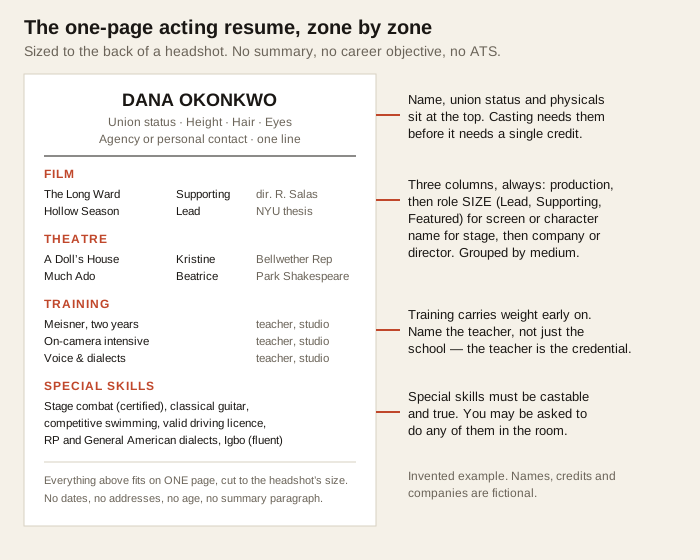
What goes in the header?
Your name, large, at the top. Then a compact block of the things casting needs before it needs anything else: union status, height, and usually hair and eye colour. Then one contact route — your agent if you have one, and your own email or a service number if you do not.
- Name as you are credited, matching your union name if you have one
- Union status, written plainly: your union's name, "eligible" if that applies to you, or "non-union"
- Height, and hair and eye colour where the market you are in expects them
- Vocal range, if you audition for musicals
- One contact block: agency and agent, or your own professional email
- Any reel or profile link, kept to a single short URL
What does not go there: your home address, your date of birth, your age, your weight, or your social security or national insurance number. Membership rules and what you are entitled to write differ by union and by country, so take the wording for that line from your own union — for the American screen and broadcast unions that is sagaftra.org, and for UK stage and screen it is Equity.
Tip: If you are not in a union, write "non-union" rather than leaving the line blank. A blank looks like an omission, and casting will assume the least flattering explanation.
How do you lay out credits?
Three columns, grouped by medium, strongest medium first. Column one is the production. Column two is the size of your part. Column three is the company, the director, or the network — the name that gives the credit its weight.
The convention on column two differs by medium, and getting it wrong is one of the fastest ways to look new. On screen you list the role size, not the character name: Lead, Supporting, Featured, Recurring, Guest Star, Co-Star, Principal. On stage you list the character name, because in theatre the character is the information.
- Group by heading: Film, Television, Theatre, Commercial, New Media, Voiceover, Industrial
- Lead with whichever section is strongest, not with a fixed order
- Never date a credit — a year turns your resume into a timeline with gaps in it
- Use the director's name where the director is the draw, and the company's where the company is
- For commercials, the standard line is "conflicts available upon request" rather than a list, because naming brands can cost you a booking
- Student and independent films count. Label them honestly and let the role size do the work
What belongs in training?
The teacher, the discipline, and the school — in that order of importance. In this industry the teacher's name is the credential, because a casting director who knows that teacher's work knows something real about how you will behave in a room.
- Degree programmes and conservatories with the school and the years of study
- Ongoing technique study, named by method and teacher
- On-camera and audition technique classes
- Voice, speech, dialects, singing, and who you study with
- Movement: stage combat, dance styles, clown, mask, Alexander technique
- Workshops and intensives, only where they represent real study rather than an afternoon
Early in a career, training is the section that carries the page. That is normal, and it is not something to disguise. A short credits list with serious training reads as an actor at the beginning; a padded credits list reads as an actor who is willing to overstate things.
What counts as a special skill?
Something a production could cast you for, and something you could do on demand in the room. That second test is the one that matters: this section is famous for being tested on the spot, and every actor knows someone who put "horseback riding" and was handed a horse.
- Sports and physical skills at a real level: swimming, martial arts, gymnastics, skiing, stage combat certifications
- Instruments, with an honest level, and singing with the voice type
- Dance styles you have actually trained in
- Dialects you can hold through a scene, not ones you can do for one line
- Languages, with fluency stated honestly, because a native speaker will be in the room
- Licences that unlock casting: a driving licence, a motorcycle licence, a manual transmission, a passport, a firearms safety certificate
- Genuinely unusual things — juggling, whistling, beatboxing, a party trick — which are there to be memorable and are fair game to be asked for
Cut anything you added to fill space. "Team player", "fast learner" and "good with people" are office-resume words that signal, immediately, that you have never been given this advice.
What does an acting resume look like with almost no credits?
Short and honest. Everything below is an invented example — the actor, the productions, the studios and the teachers are all fictional and exist to show the format.
Example header block: "DANA OKONKWO. Non-union. 5'7", brown hair, brown eyes. dana.okonkwo.actor@example.com. Reel: example.com/dana."
Example film section, three columns across: "Hollow Season — Lead — NYU thesis film, dir. R. Salas. The Long Ward — Supporting — Fenwick Pictures, dir. M. Adeyemi. Cold Open — Featured — independent short, dir. J. Park."
Example theatre section: "A Doll's House — Kristine Linde — Bellwether Rep. Much Ado About Nothing — Beatrice — Park Shakespeare Festival. The Wolves — #14 — Ridgeway Studio Theatre."
Example training section: "Meisner technique, two years — Ruth Calder, Calder Studio. On-camera audition intensive — T. Whitfield, Frame One. Voice and dialects, ongoing — S. Ibarra. BA Theatre, State University."
Example special skills line: "Stage combat (unarmed, certified), classical guitar, competitive swimming, valid driving licence including manual, RP and General American dialects, Igbo (fluent), passport."
That is a complete acting resume for someone a few years in. Nine credits, four training entries, one skills line. It fits on one page with room to breathe, and every line on it could be checked by a phone call.
The mistakes that mark a resume as new
- A career objective or a paragraph about your passion for storytelling
- Dates against credits, which turn the sheet into an employment history
- Non-acting jobs listed as experience — waiting tables belongs nowhere on this page
- Extra and background work listed as credits, which is widely read as padding
- Inflating a role size: a co-star written as a lead is checkable in about a minute
- Two pages, tiny type, or a page that does not match the headshot's dimensions
- Naming commercial brands you have conflicts on
- A skills list you could not perform if asked today
Does an acting resume ever need to be ATS-friendly?
Rarely, but not never. The credits sheet itself is read by humans. The exception is the profile you fill in on a casting platform, where your credits, physicals, skills and union status are entered as structured fields and searched by casting teams.
Treat that profile as the machine-readable copy of the same information. Keep the two in step: every credit, dialect, language, licence and skill that is on your page should be entered in the profile, spelled the way the industry spells it. That is where keyword matching actually happens for actors.
The other exception is the standard office resume you may need for a day job, a teaching post, or an arts administration role. That is a genuinely separate document, written to normal rules — and if you need one of those, the general guides on this site apply to it rather than this one.
Theatre, screen and commercial: what changes
The three markets read the same sheet differently, and an actor who works across all of them often keeps three ordered versions of one master document rather than three different documents.
- Theatre: character names in column two, the company and the venue in column three, and the director's name where the director carries weight. Classical work, new writing and devised credits all read differently, so group them so a reader can see your range.
- Film and television: role size in column two — Lead, Supporting, Featured, Series Regular, Recurring, Guest Star, Co-Star — and the production company, studio, network or director in column three. Student and independent work is normal and belongs here, labelled honestly.
- Commercial: the standard convention is a single line reading that conflicts are available on request rather than a list of brands, because naming a brand you are still on hold for can cost you a booking elsewhere.
- Voiceover and audio: usually a separate resume entirely, organised by category — commercial, narration, animation, games, audiobook — with your home studio setup listed, because the setup is part of the casting decision.
- New media, industrials and immersive work: give them their own heading rather than burying them in film, so nobody has to guess what they were.
- Musical theatre: add your vocal range and any dance training near the top, because those decide whether you are seen at all.
The ordering rule is the same across all of them: whichever section is strongest goes first. There is no fixed hierarchy that says film outranks theatre. If your theatre credits are the serious ones, theatre leads.
Weak lines and the fixes
These are invented examples, but they cover the four mistakes that appear on almost every early acting resume.
Weak: "OBJECTIVE: To secure a challenging role with a production company where I can use my passion for storytelling." Fix: delete it. There is no objective line on an acting resume, and its presence tells a casting director that nobody in the industry has looked at your page yet.
Weak: "The Long Ward (2024) — Lead — Fenwick Pictures." Fix: "The Long Ward — Supporting — Fenwick Pictures, dir. M. Adeyemi." Two changes. The year comes off, because dates turn a credits sheet into an employment history with visible gaps. And the role size becomes the honest one, because an inflated credit takes about a minute to check and ends the relationship permanently.
Weak: "Special skills: hard worker, punctual, works well with others, basic Spanish, some horseback riding." Fix: "Stage combat (unarmed, certified), classical guitar, competitive swimming, valid driving licence including manual, RP and General American dialects, Igbo (fluent)." The first three items are office-resume words. "Basic" and "some" are invitations to be asked and to fail, so either train the skill or take it off.
Weak: a header carrying a home address, a date of birth, a weight and three phone numbers. Fix: name, union status, height, hair and eyes, and one contact route. This page goes to strangers in a stack, and personal detail beyond what casting needs is a safety issue as much as a formatting one.
What does the casting process actually look like?
The credits sheet only has to do one job, and knowing where in the process it sits explains why it is built the way it is.
- Most submissions now start on a casting platform or through an agent, where your headshot, credits, physicals and skills are structured fields rather than a document.
- A casting team filters those fields down to a shortlist, which is where your union status, height range, dialects, languages and skills do the actual work.
- The resume itself is read at the point of the audition or the self-tape review, alongside the headshot, usually in seconds, and usually to answer one question: who has already worked with this person?
- Self-tapes, callbacks, chemistry reads, producer sessions and availability checks follow, and none of them are influenced by the layout of your page.
- References in this industry are informal and fast. A director who knows the company in your third column will simply ring them.
That last point is the reason the third column matters more than anything else on the sheet, and the reason inflating a credit is a much worse idea here than in an office job. The industry is small, and every line on your page is one phone call from being confirmed.
What goes with the resume
The sheet never travels alone, and the materials around it are part of the same submission.
- The headshot, current and looking like you today rather than three years and one haircut ago.
- A reel, kept short and led by your strongest work, with your own scenes first rather than a montage of the production.
- A self-tape setup you can use at short notice: even lighting, a plain background, clean sound and a reader who can actually act.
- Your casting platform profiles, kept in step with the paper resume so the credits match line for line.
- Sides marked up and ready, because the turnaround on a self-tape request is often measured in hours.
Keep those five current and the resume becomes the least demanding part of your admin, which is exactly the status it should have.
The check before you print it
- One page, cut to the headshot's size, and attached to the back of it
- Name, union status, height and one contact route are at the top
- Credits are in three columns, grouped by medium, with no dates
- Screen credits list role size; stage credits list character names
- Training names teachers, not only institutions
- Every special skill is something you could do today, in the room
- Nothing on the page is an adjective about you
Get those seven right and the sheet disappears, which is the point. Nobody admires an acting resume. They read it in fifteen seconds, and either your headshot and your credits earn you the room or they do not. Dancers use a close cousin of this sheet, shown in the CV for a dancer, and crew members list credits too, as the film industry resume samples show.
Related articles
- Accounting Executive Resume: 5 Examples by Career Level
- Administration Resume Examples: 8 Samples, Entry to Manager
- Aged Care Resume: 6 Australian Examples and a Template
- Another Word for Resume: CV, Bio and 10 More Options
More articles
- Activity Resume Example: 6 Samples for College Applications
- How to Address Selection Criteria: 6 Worked STAR Examples
- Adjectives to Describe Yourself and the Sentence for Each