Instrumentation Engineer Resume Examples: free ATS score
Write an Instrumentation Engineer Resume That Proves Loop Ownership
By Mustafa Tarabya, founder of CVBooster · Published · Updated
Instrumentation engineer resume examples, loop and control keywords, sample bullets and a writing guide for process plant hiring.
Sample resumes for a instrumentation engineer
The same instrumentation engineer content laid out in three CVBooster templates, so you can see what the finished document looks like before you write a word.
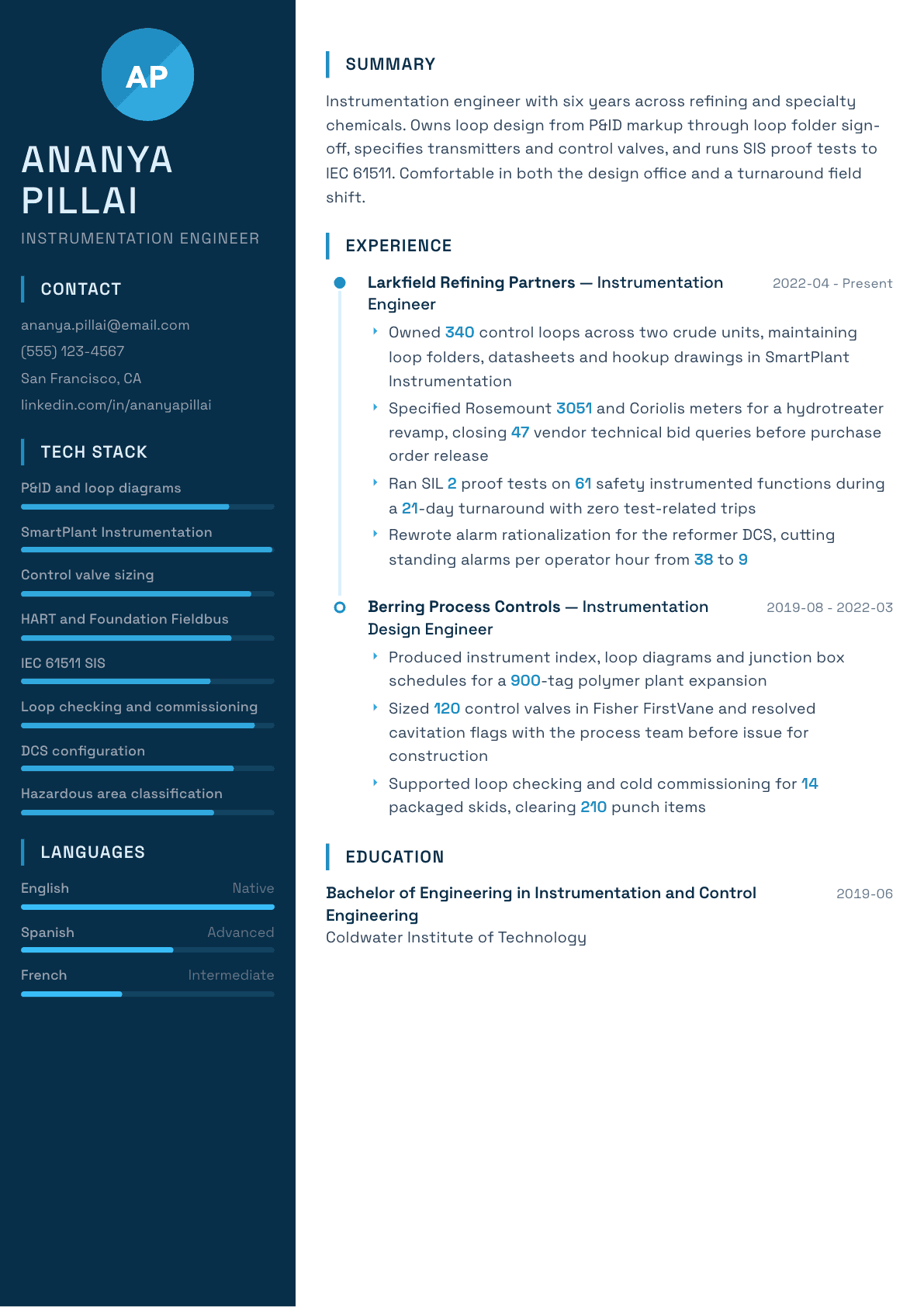
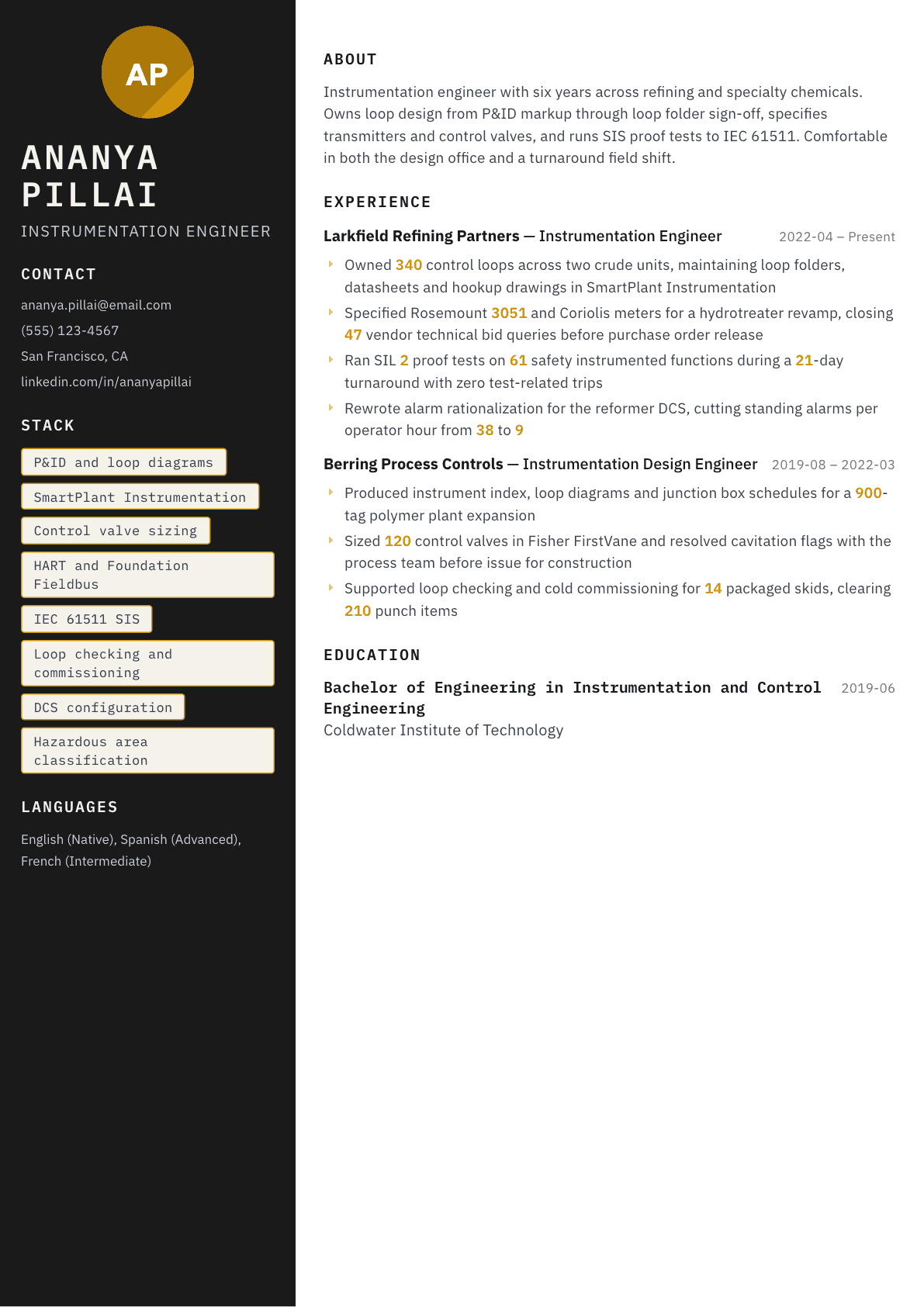
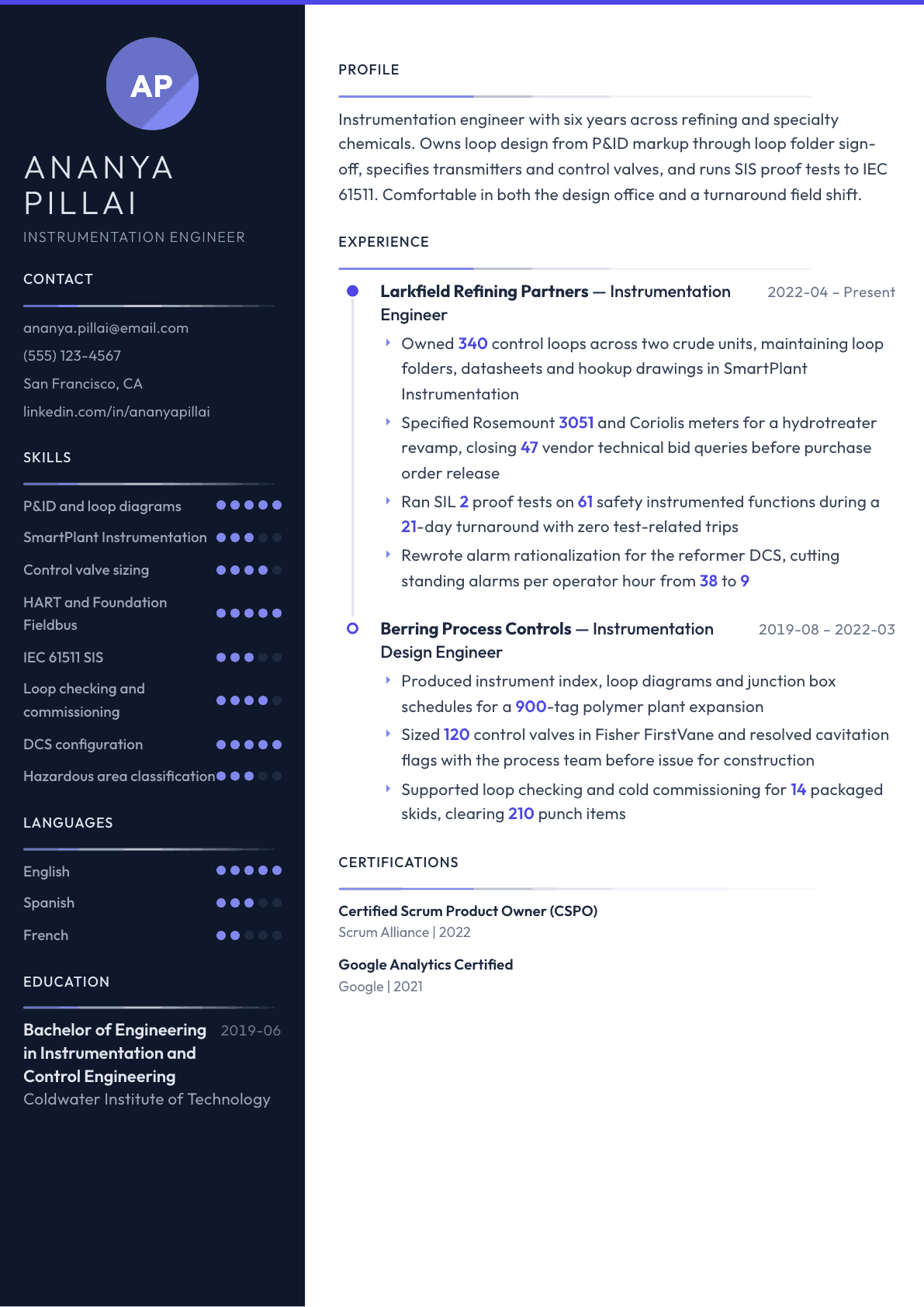
Example Instrumentation Engineer summary
Instrumentation engineer with six years in continuous process plants, responsible for loop design, instrument specification and field commissioning. Maintains instrument databases of several thousand tags, sizes control valves against process datasheets, and leads proof testing on safety instrumented functions. Known for closing vendor technical queries early so procurement never waits on engineering. Seeking a lead instrumentation role on a capital project.
Skills to list on a Instrumentation Engineer resume
- Loop diagrams
- Instrument index
- Control valve sizing
- Flow measurement
- Pressure and level transmitters
- HART communication
- Foundation Fieldbus
- Profibus PA
- IEC 61511
- SIL verification
- Loop checking
- DCS and PLC interfaces
- Hazardous area classification
- Calibration management
- Cause and effect matrices
- Commissioning support
What actually gets this resume read
- Name the plant type in every job: refining, pharma, water treatment and semiconductor fabs hire on very different instrument sets.
- Give tag counts and loop counts, because a hiring manager reads scale before technology and cannot infer it from a job title.
- Separate design office work from field work, since one resume line rarely proves you can do both credibly.
- List the instrument database and drafting tools by name so the applicant tracking system matches the posting keywords exactly.
- State your safety instrumented systems exposure clearly: SIL verification, proof testing and cause and effect review are screened for.
- Mention hazardous area experience with the code you worked to, because IECEx, ATEX and NEC 500 are not interchangeable.
How to write a instrumentation engineer resume
An instrumentation engineer resume gets read by someone who knows exactly how much work sits behind a loop folder. That reader wants to see the plant type, the tag count, the instrument database you kept clean, and whether you have ever stood in a field shelter at three in the morning proving a transmitter against a deadweight tester. Generic engineering language tells that reader nothing.
The confusion most candidates create is between design office work and field work. Specifying transmitters, sizing control valves and issuing loop diagrams is one job. Loop checking, calibration, commissioning and turnaround proof testing is another. Plenty of instrumentation engineers do both, but only if the resume separates them clearly does the hiring manager believe it.
What follows is how to structure the document, what each section should carry for this discipline, three example summaries at different career stages, before and after bullets, and the questions instrumentation engineers ask when they sit down to rewrite.
Format: put the plant and the tag count where the eye lands
Reverse chronological, two pages once you pass five years. Instrumentation work is measured in projects and turnarounds, so each job entry needs a one line context header before any bullets: the facility type, the process units, the approximate instrument tag count and whether you sat in engineering, in projects or in operations.
Keep the layout single column through the experience section. Instrument tags, valve sizes and standard numbers survive text extraction badly when a parser has to read across two columns, and losing a standard reference costs you the keyword match.
- Header: name, discipline, city and state, phone, email, and professional engineer status if you hold it.
- Section order: summary, technical skills, experience, projects or turnarounds, education, certifications.
- Context line per job: facility type, units, tag count, and design or field emphasis.
Summary: discipline scope in three lines
Name the industry first, because refining, pharmaceutical, water treatment, pulp and semiconductor fabrication use overlapping but distinct instrument sets. Then say what you own end to end. A reader wants to know whether you can carry a package from process datasheet through purchase order, or whether you have only checked other work.
Close the summary with the one thing the posting is clearly hunting for. If the job description mentions functional safety three times, your safety instrumented system experience belongs in line three, not on page two.
Experience: loops, instruments and the documents you signed
Lead each job with the deliverables you produced by name. Instrument index, loop diagrams, hookup drawings, junction box schedules, cable schedules, datasheets, cause and effect matrices and I/O lists are the currency of this discipline, and a hiring manager counts them the way an accountant counts entries.
Then show the technical judgment. Sizing a control valve is a task. Catching a cavitation condition at forty percent travel and moving to an anti-cavitation trim before the order went out is a decision, and it is what separates two resumes that both say control valve sizing.
Field work deserves its own bullets. Loop checking counts, cold and hot commissioning counts, and a proof test campaign completed inside a turnaround window counts double because it proves you can work to an outage clock.
Technical skills: measurement types, protocols and software
Split the skills block into measurement, final elements, systems and software. Under measurement, name the principles you have actually specified: differential pressure, Coriolis, magnetic, vortex, ultrasonic, radar level, guided wave, thermocouple and resistance temperature detector. Under final elements, list valve types, actuators and positioners.
For systems, name the distributed control system and programmable controller platforms you have interfaced with, and the field protocols: HART, Foundation Fieldbus, Profibus PA, Modbus and increasingly Ethernet-APL. For software, name the instrument database, the drafting package and any valve sizing tool. These are the exact strings a recruiter pastes into a search.
Standards and functional safety
Give functional safety its own short block if you have real exposure. State the standard family, whether you performed safety integrity level verification or only executed proof tests, and what tools you used. Hiring managers on process safety roles read this block before anything else.
Do the same for hazardous area work. Say which code you worked to, because a career built under one classification scheme does not transfer silently to another, and the reader will assume nothing.
- Functional safety: SIL verification, proof test procedures, cause and effect review, bypass management.
- Hazardous area: intrinsic safety barriers, explosionproof and increased safety enclosures, cable gland selection.
- Metrology: calibration procedures, traceability, uncertainty budgets, deadweight and dry block equipment.
Instrumentation Engineer resume summary examples
Graduate instrumentation engineer
Instrumentation and control engineering graduate with a 6-month plant placement supporting loop checking on a 400-tag water treatment upgrade. Trained in HART communicators, deadweight calibration and SmartPlant Instrumentation data entry. Seeking a graduate instrumentation role in process industry design or commissioning.
Five years in
Instrumentation engineer with 5 years in specialty chemicals, owning 300 plus control loops from datasheet through loop folder sign-off. Sizes control valves, evaluates vendor bids, and executes SIL 2 proof tests during turnarounds. Fluent in HART and Foundation Fieldbus commissioning.
Lead instrumentation engineer
Lead instrumentation engineer with 12 years across refining and gas processing, responsible for discipline deliverables on capital projects up to 3,000 tags. Runs functional safety assessments, chairs vendor technical reviews, and mentors 4 junior engineers through loop folder and commissioning discipline.
Work experience bullets: before and after
Before: Worked on instrumentation for process plants.
After: Owned 340 control loops across two crude units, maintaining the instrument index, loop diagrams and hookup drawings in SmartPlant Instrumentation.
Loop count, unit type and the named database turn a job description into evidence of scope.
Before: Selected instruments and valves for projects.
After: Specified 180 transmitters and 120 control valves against process datasheets, catching a cavitation condition at 40% travel and moving the design to anti-cavitation trim before order release.
The catch shows engineering judgment, not just the routine act of filling in a specification sheet.
Before: Involved in safety system testing.
After: Executed proof tests on 61 safety instrumented functions during a 21-day turnaround, writing the test procedures and closing every deviation before startup.
Naming the function count, the outage window and the procedure ownership proves functional safety competence.
Before: Helped with commissioning activities.
After: Led loop checking on 14 packaged skids through cold and hot commissioning, clearing 210 punch items and handing over signed loop folders to operations.
The handover artifact and the punch list volume show the job was finished, not merely attended.
Before: Improved plant alarms.
After: Rationalized reformer DCS alarms against the operator load target, reducing standing alarms per operator hour from 38 to 9 and documenting the philosophy for future changes.
A measurable operator burden reduction is far stronger than the word improved.
Hard skills
- P&ID interpretation and markup
- Instrument index and datasheets
- Loop and hookup drawings
- Control valve sizing
- Flow, level, pressure and temperature measurement
- HART and Foundation Fieldbus
- Profibus PA and Modbus
- IEC 61511 functional safety
- SIL verification and proof testing
- Hazardous area classification
- Calibration and traceability
- DCS and PLC interface design
- Loop checking and commissioning
- Vendor technical bid evaluation
Soft skills
- Vendor query discipline
- Turnaround pressure management
- Cross-discipline coordination
- Clear technical documentation
- Operator communication
- Punch list follow-through
Certifications worth listing
- Certified Automation Professional (CAP) (International Society of Automation)
- Certified Control Systems Technician (CCST) (International Society of Automation)
- Functional Safety Engineer, TUV Rheinland Program (TUV Rheinland)
- Professional Engineer (PE) (NCEES member state licensing boards)
Mistakes that cost instrumentation engineer candidates the interview
- Leaving out the plant type, so the reader cannot tell whether you calibrated laboratory instruments or ran a refinery instrument shop.
- Listing every protocol you have heard of instead of the two or three you have commissioned in the field.
- Blending design office deliverables and field commissioning into one paragraph, which makes both claims look thin.
- Writing control valve sizing with no mention of the service conditions, trim choice or sizing tool used.
- Skipping the functional safety detail on a posting that clearly centers on safety instrumented systems.
- Naming a proprietary internal document system that no one outside your former employer recognizes.
- Using a two column template that scrambles tag numbers and standard references during text extraction.
Instrumentation Engineer resume questions
Should an instrumentation engineer resume include a project list?
Yes, once you have three or more capital projects. Give each project the facility, the scope in tags or loops, your role, and the deliverables you owned. A short project table stops the reader from having to reconstruct scale from your job bullets.
How do I show field experience if most of my work is in the design office?
Create a short commissioning and site support block listing each site visit, its duration and what you did there. Loop checking, vendor witness testing and turnaround support all belong there, and a few weeks of real site time is worth naming.
Do I need to list every instrument manufacturer I have specified?
List the manufacturers whose products dominate the plants you are applying to, then stop. Four or five names covering transmitters, valves, analyzers and safety devices is enough to prove familiarity without turning the skills block into a catalog.
Is functional safety experience worth a separate section?
It is when the posting mentions safety instrumented systems, SIL or IEC 61511. Give the standard, whether you performed verification calculations or executed tests, the tool you used, and the number of functions involved. Otherwise fold it into your experience bullets.
How should I handle a move between industries?
Name the transferable core in the summary, which is loop design, instrument specification and commissioning discipline, then translate your process vocabulary. A pulp mill engineer applying to pharmaceutical work should highlight documentation rigor and calibration traceability rather than digester control detail.
Related resume examples
- Electrical Engineer Resume example
- Automation Engineer Resume example
- Controls Engineer Resume example
- Instrument Technician Resume example
- Commissioning Engineer Resume example
- Electrical Engineering Technician Resume example