Communications Manager Resume Examples: read this first
Craft a Communications Manager Resume for Internal and External Work
By Mustafa Tarabya, founder of CVBooster · Published · Updated
A communications manager resume covering internal channels, executive messaging and media, with a sample resume, keyword list and a writing guide.
Sample resumes for a communications manager
The same communications manager content laid out in three CVBooster templates, so you can see what the finished document looks like before you write a word.
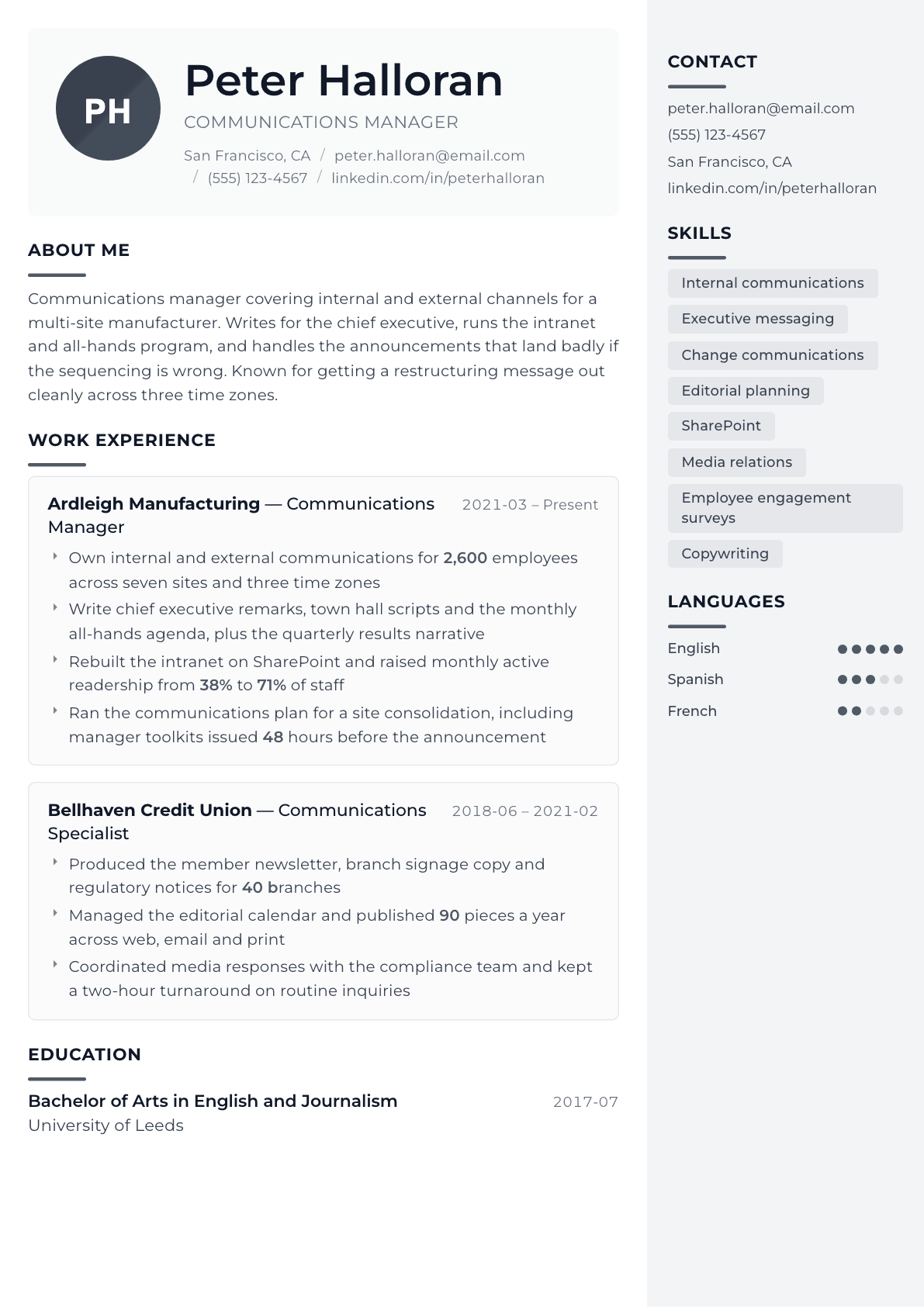
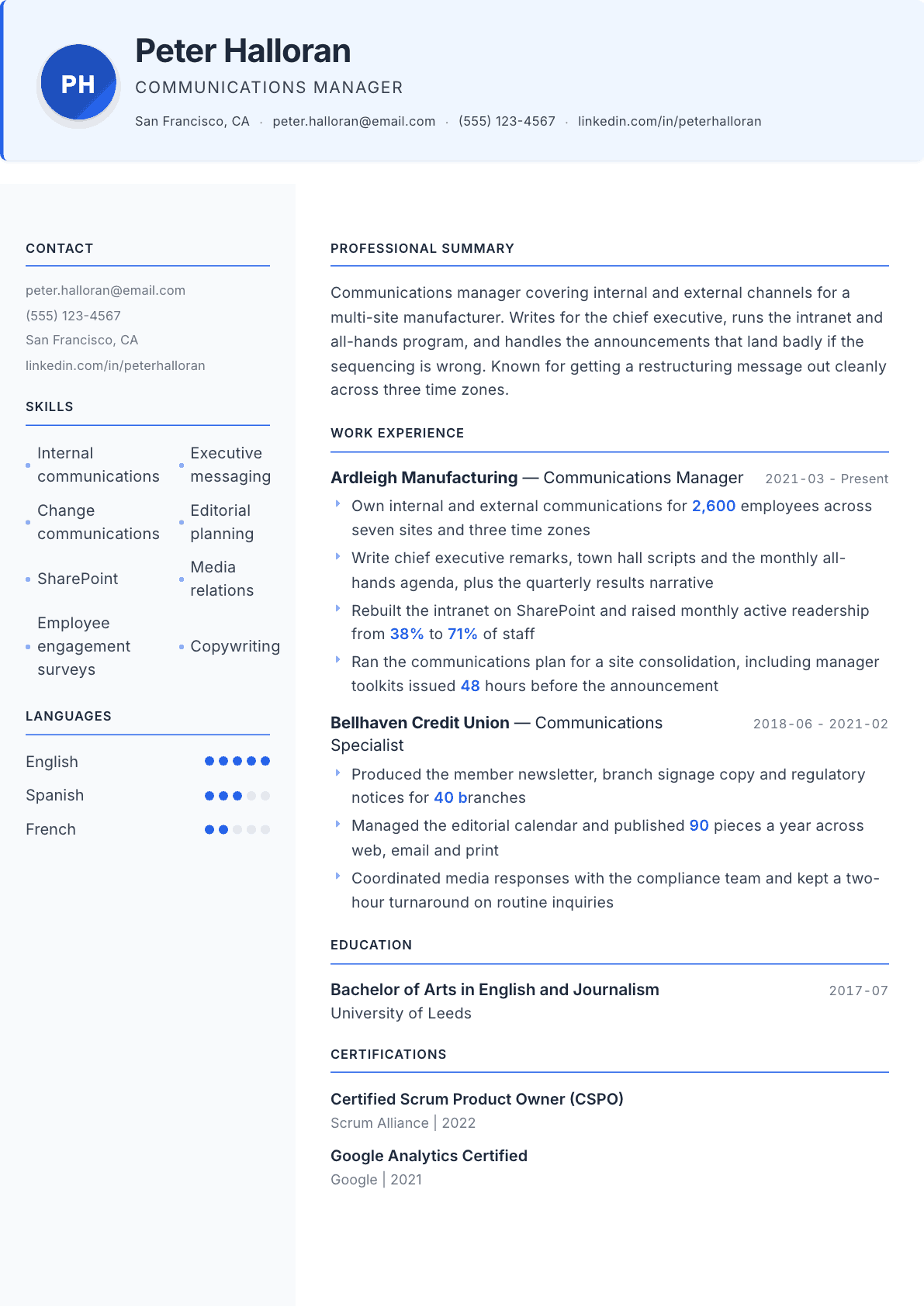
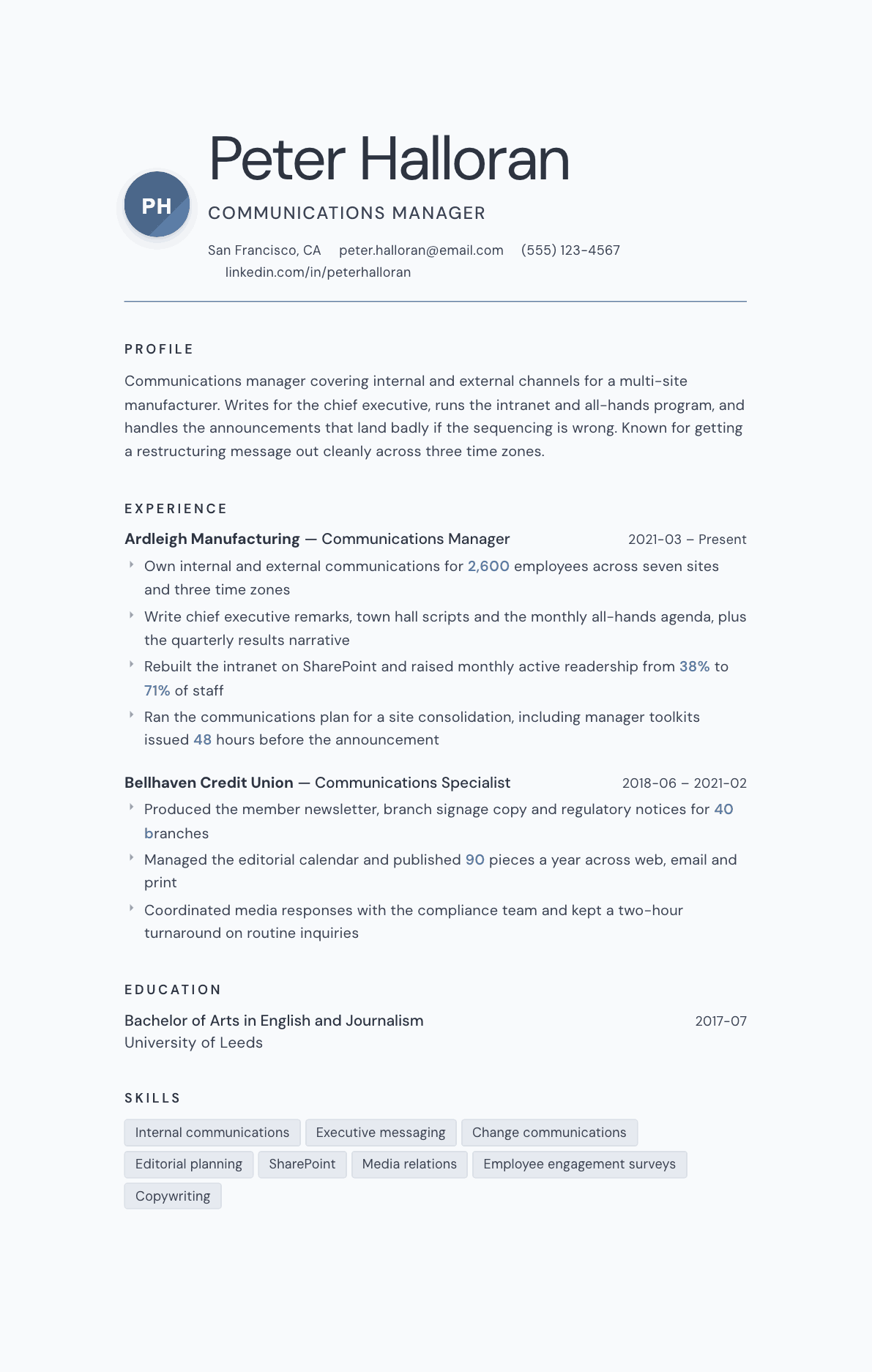
Example Communications Manager summary
Communications manager with eight years covering internal and external channels, currently for a manufacturer with 2,600 employees across seven sites. Writes chief executive remarks, town hall scripts and the quarterly results narrative, and rebuilt an intranet that took monthly readership from 38% to 71% of staff. Led the communications plan for a site consolidation, including manager toolkits issued ahead of the announcement.
Skills to list on a Communications Manager resume
- Internal communications
- External communications
- Executive messaging
- Change communications
- Editorial planning
- Copywriting
- Intranet management
- SharePoint
- Media relations
- Crisis communications
- Employee engagement measurement
- Stakeholder management
- Town hall production
- Brand voice
What actually gets this resume read
- Say clearly which side you own: internal, external, or both, because that is the first question on every screening call.
- Give the employee headcount, site count and time zones you communicate across, as that defines the operational difficulty.
- Show one change or restructuring program you communicated, since that is the hardest work in the discipline.
- Name the channels you run, from intranet platform and all-hands format to newsletter tooling and manager toolkits.
- Include how you measure, whether readership rates, engagement survey items or message recall in a pulse check.
- Prove your writing range by naming the formats: executive remarks, regulatory notices, crisis holding lines and web copy.
How to write a communications manager resume
Communications manager is one of the least standardized titles in the profession. At one company it means internal communications for a workforce spread across sites. At another it means press office, executive writing and the corporate website. At a third it means all of it plus the annual report. A resume that does not state which version you have done makes the reader guess, and readers guess unfavorably.
The work is judged on two capabilities. First, writing range: can you produce chief executive remarks, a regulatory notice, an intranet article and a crisis holding line without a change of hand. Second, sequencing judgment: do you know who hears an announcement first, and what happens when that order is wrong. Restructuring and change programs are where both are tested.
This guide covers how to declare your scope, what to measure in a discipline whose output is words, three summaries by level, before and after bullets, and the questions communications managers ask when moving between internal, external and combined roles.
Declare your scope in the first line
Say whether you own internal, external, or both, and give the scale in the same sentence: employee headcount, site count and time zones for internal work, plus outlet tiers or audience for external. "Internal and external communications for 2,600 employees across seven sites and three time zones" answers the screening question immediately.
If your role includes areas people often forget to mention, list them: investor communications, regulatory notices, employer brand, community relations or the annual report. Each one narrows the field of candidates who can do the job.
- Header: name, title, city, contact details, and a link to a writing portfolio if you have one.
- Section order: summary, scope, experience, channels owned, skills, education, certifications.
- One page under seven years, two pages once you have run a change program or managed a team.
Internal communications: channels, reach and the manager layer
Internal communications is an operations job wearing an editorial coat. Name the channels you run and the platform behind each: the intranet and whether it sits on SharePoint, Workplace, Staffbase or something built in house, the all-hands format and cadence, the newsletter tool, digital signage for sites without desks, and the messaging channel where people actually read things.
Then give reach honestly. Monthly active readership as a share of headcount, open and click behavior on the staff newsletter, all-hands attendance, and how you reach frontline employees without a corporate email address. That last group is the hardest audience in the discipline and the one hiring managers ask about most.
Do not skip the manager cascade. Toolkits, briefing packs, talking points and manager question and answer documents are how a message reaches people who never read the intranet. A candidate who has built a manager cascade has done the part that actually works.
Change and restructuring communications
This is the work that gets a communications manager hired at the next level, and it is worth several bullets. Describe the program at a level you are free to share: a site consolidation, an acquisition integration, a systems rollout, a policy change with employee impact. Then show the mechanics: the stakeholder map, the sequencing plan, when managers were briefed relative to the announcement, what employees received, and how questions were collected and answered.
Sequencing detail is the credibility signal here. Issuing manager toolkits forty-eight hours before an announcement, holding an all-hands within the same day, and running an open question channel for the following two weeks are concrete, and they demonstrate that you have done this rather than read about it.
- Name the change type and the population affected, within what you can disclose.
- State the sequence: leadership, managers, affected employees, all staff, external.
- Describe the listening mechanism, such as a question inbox, pulse survey or manager feedback loop.
- Say what you would change, since interviewers often ask and a considered answer lands well.
Writing range: name the formats
Prove range by listing what you have written, because a communications manager is bought on writing. Chief executive remarks and all-hands scripts. Quarterly results narrative. Regulatory and compliance notices. Crisis holding lines. Intranet articles and staff newsletters. Web and campaign copy. Award and speaking submissions. Board papers.
Add editing to that. Most communications managers spend as much time improving other people's drafts as writing their own, and saying you edit executive drafts and hold a house style guide is a differentiator that almost nobody claims.
Measurement and keywords
Communications teams that do not measure get cut first, so put your measures on the page. Intranet readership as a share of staff, newsletter engagement, all-hands attendance, engagement survey items on whether people feel informed, message recall in a pulse check, and time to publish on an announcement. Any one of these is stronger than describing your output volume.
For keywords, postings recycle: internal communications, corporate communications, employee engagement, change communications, executive communications, stakeholder management, editorial calendar, intranet, crisis communications and media relations. Mirror the posting's exact phrasing once in your summary and once in an experience bullet.
Communications Manager resume summary examples
Communications specialist
Communications specialist producing the member newsletter, branch signage copy and regulatory notices for a credit union with 40 branches. Manages the editorial calendar, publishes around 90 pieces a year across web, email and print, and coordinates media responses with compliance on a two-hour turnaround.
Owning internal and external
Communications manager covering internal and external channels for a manufacturer with 2,600 employees across seven sites. Writes chief executive remarks, town hall scripts and the quarterly results narrative, and rebuilt the intranet on SharePoint to take monthly readership from 38% to 71% of staff.
Head of communications
Head of communications with twelve years across manufacturing and financial services, leading a team of five covering internal, media and executive communications. Owns the crisis protocol and the change communications playbook, and reports on informed scores from the engagement survey to the executive committee.
Work experience bullets: before and after
Before: Responsible for internal communications across the business.
After: Owned internal and external communications for 2,600 employees across seven sites and three time zones, including the intranet, all-hands and manager cascade.
Headcount, site spread and named channels convert an ownership claim into a measurable scope.
Before: Improved employee engagement with the intranet.
After: Rebuilt the intranet on SharePoint around role-based landing pages, raising monthly active readership from 38% to 71% of staff within two quarters.
The platform, the design decision and a readership figure make an engagement claim checkable.
Before: Communicated a major organizational change to staff.
After: Ran the communications plan for a site consolidation: manager toolkits issued 48 hours ahead, an all-hands on announcement day, and a question inbox answered daily for two weeks.
The sequence and the listening mechanism show change communications competence, which is the hardest part of the role.
Before: Wrote content for the chief executive and leadership team.
After: Wrote chief executive remarks, town hall scripts and the quarterly results narrative, and edited executive drafts against a house style guide I maintained.
Naming the formats and the editing responsibility demonstrates range rather than a single register.
Before: Made sure frontline employees received company updates.
After: Reached 900 employees without corporate email accounts through site digital signage, printed shift briefings and a manager talking-point card issued weekly.
The deskless audience is the hardest problem in internal communications, and three named mechanisms prove you solved it.
Hard skills
- Internal communications strategy
- Change and restructuring communications
- Executive and chief executive writing
- Editorial calendar management
- Intranet management on SharePoint or Staffbase
- Town hall and all-hands production
- Media relations and press office
- Crisis communications
- Employee engagement survey analysis
- Regulatory and compliance notices
- Manager cascade and toolkit design
- Plain language editing
Soft skills
- Sequencing judgment on announcements
- Discretion with sensitive information
- Coaching executives on tone
- Stakeholder negotiation
- Calm under a compressed deadline
- Editing other people without friction
Certifications worth listing
- Accredited in Public Relations (APR) (Public Relations Society of America)
- Chartered Practitioner (Chartered Institute of Public Relations)
- Prosci Change Management Certification (Prosci)
Mistakes that cost communications manager candidates the interview
- Not stating whether you own internal, external or both, which forces the reader to guess your scope.
- Describing output volume instead of reach, engagement or informed scores.
- Leaving change and restructuring work off the page when it is the most valuable experience you have.
- Ignoring deskless and frontline employees, the audience every interviewer asks about.
- Listing writing as a skill without naming the formats that prove range.
- Omitting the manager cascade, which is how messages actually travel in a large organization.
- Using a heavily designed layout for a role where plain, well-structured writing is the whole proposition.
Communications Manager resume questions
Should a communications manager resume cover internal and external work?
Include both if you have done both, but label them clearly and lead with the one the posting emphasizes. Employers hiring for an internal role often assume an external-heavy candidate will drift toward media work and neglect the employee audience.
How do I measure internal communications for a resume?
Use intranet readership as a share of headcount, newsletter engagement, all-hands attendance, informed scores from the engagement survey, and time to publish on announcements. Any of these beats a description of how much content you produced.
How do I write about a restructuring I communicated?
Describe the change type and affected population at a level you are permitted to share, then focus on the mechanics: the sequence, the manager briefing lead time, the listening channel and what you learned. The process detail is what the interviewer wants.
Do I need a writing portfolio for a communications manager role?
It helps a great deal. Two or three samples showing different registers, such as an executive script, an employee announcement and a plain language notice, prove range faster than any bullet point and are often requested before an interview.
What if my role had no budget and no team?
Say so and lead with scope instead. Running all communications for a mid-sized organization alone is a strong credential, since it means you set priorities, wrote everything and handled sensitive announcements without a layer of review above you.