Communications Specialist Resume Examples: free score
Communications Resumes: Specialist Resume Examples That Show Range
By Mustafa Tarabya, founder of CVBooster · Published · Updated
A communications specialist resume built on writing range, channel ownership and measurement, with a sample resume, keywords and a writing guide.
Sample resumes for a communications specialist
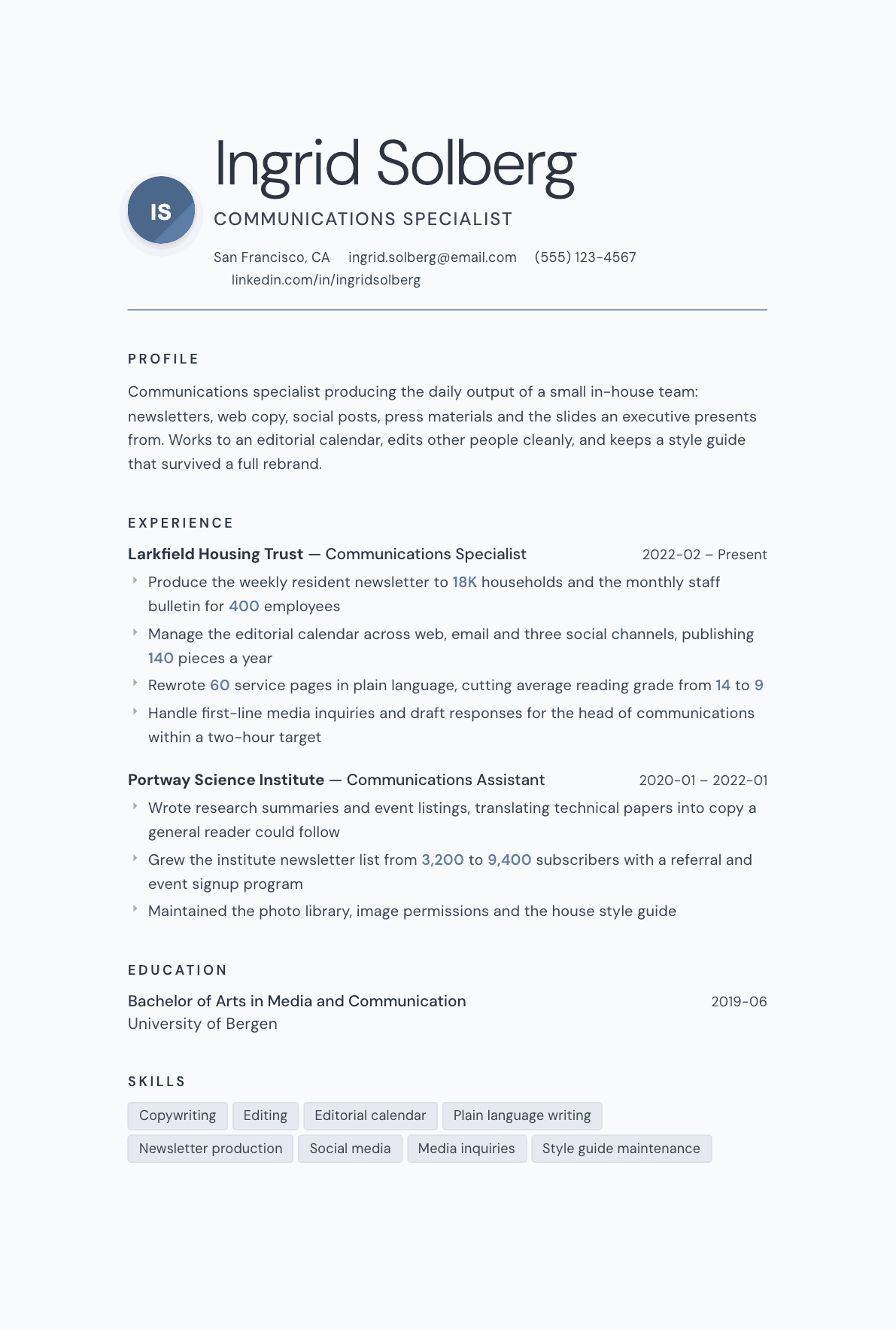
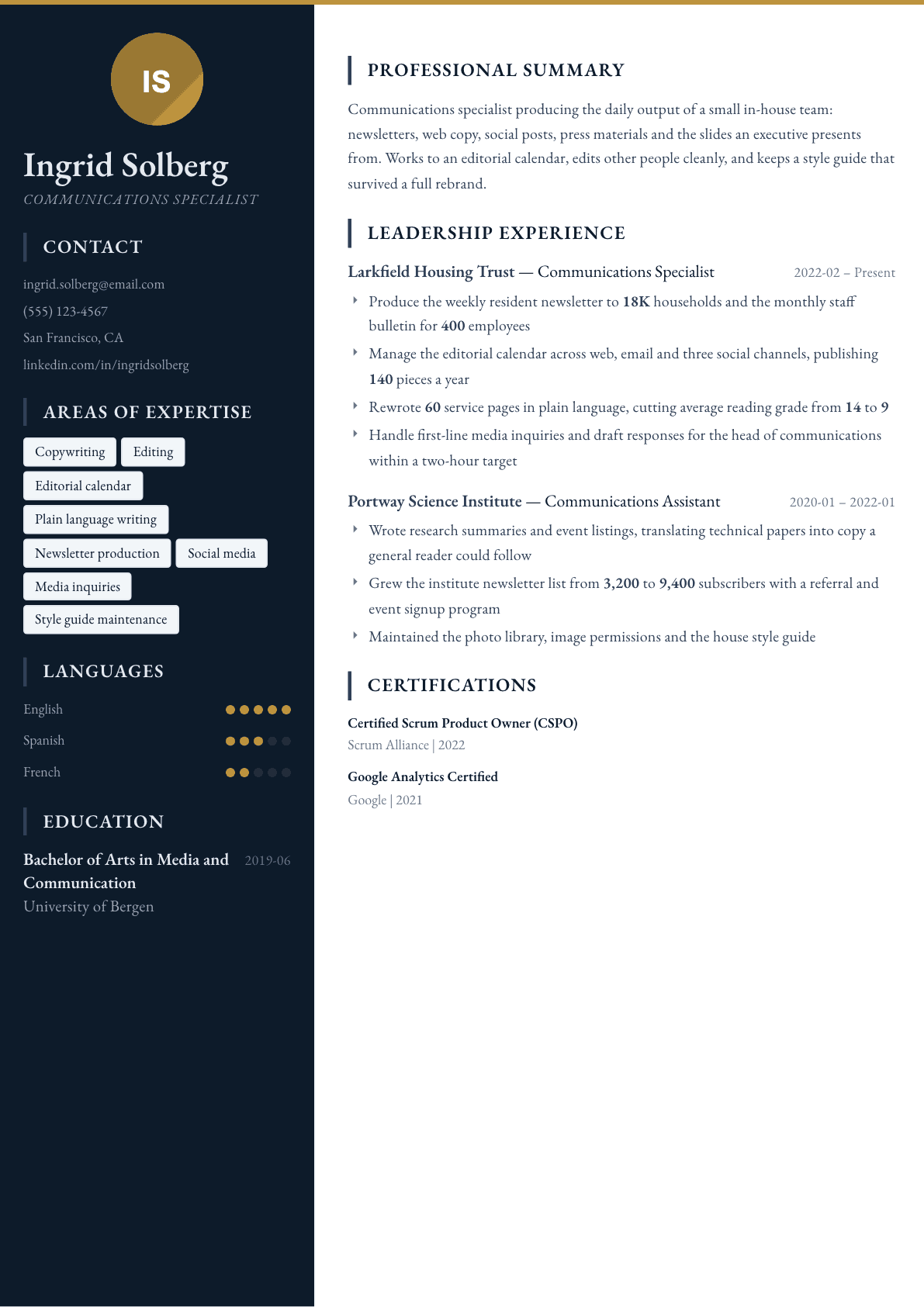
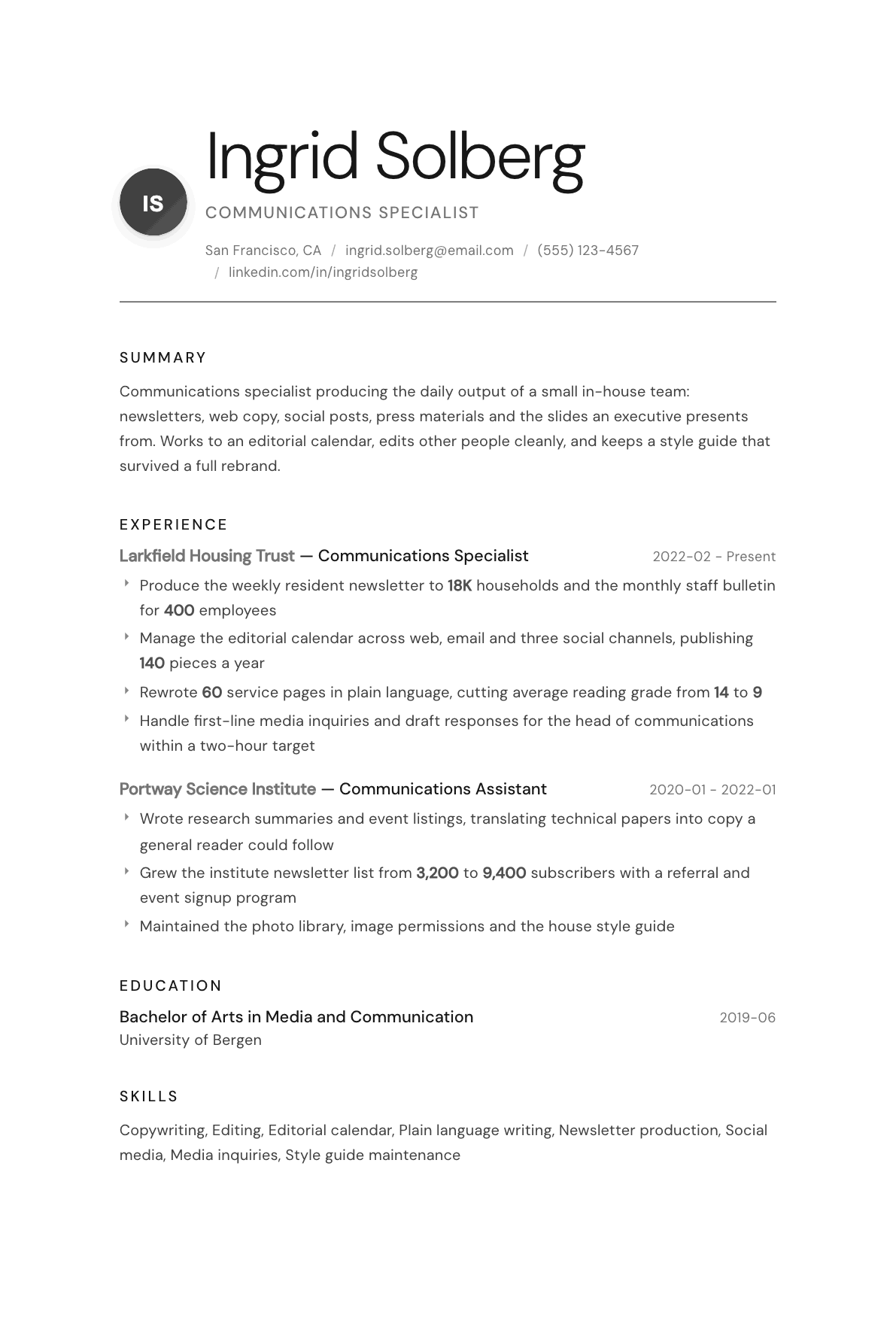
The same communications specialist content laid out in three CVBooster templates, so you can see what the finished document looks like before you write a word.
Example Communications Specialist summary
Communications specialist with five years producing the daily output of small in-house teams across housing and research. Writes and edits a weekly newsletter reaching 18K households, manages an editorial calendar of 140 pieces a year, and rewrote 60 service pages in plain language to bring average reading grade from 14 to 9. Handles first-line media inquiries and maintains the house style guide.
Skills to list on a Communications Specialist resume
- Copywriting
- Editing and proofreading
- Editorial calendar management
- Plain language writing
- Newsletter production
- Content management systems
- Mailchimp
- Social media management
- Press materials
- Media inquiries
- Style guide maintenance
- Accessibility standards
- Canva and Adobe InDesign
- Analytics reporting
What actually gets this resume read
- Show range with named formats: newsletters, web copy, press materials, executive slides and social posts.
- Give reach numbers for the channels you own, such as subscriber counts, readership rates and publishing volume.
- Include an editing or plain language project, because most teams need an editor more than another writer.
- Name the tools you produce in, from the content management system to the email platform and design software.
- Mention accessibility and inclusive language work, since public sector and nonprofit employers screen for it.
- Link to a portfolio of published pieces, because writing roles are decided on samples more than on bullet points.
How to write a communications specialist resume
A communications specialist is the person who produces the work. Newsletters go out, web pages get rewritten, the press statement is drafted before lunch, the executive gets slides that make sense, and the social account stays current. Hiring for this role is a hiring decision about craft, so the resume is really a claim about how well you write and edit, backed by evidence.
The people reading it are usually a communications manager and a head of department who both have too much to write themselves. What they want is someone who needs little supervision, works to a calendar, handles a house style guide, and can turn a technical or bureaucratic source document into something a normal person can follow. Every part of the resume should support that picture.
The advice holds for most communications resumes, whether the posting says specialist, officer, coordinator or corporate communications. This guide covers how to show range without listing every task, why an editing and plain language project belongs on the page, three summaries by level, before and after bullets, and the questions specialists ask when they want to move up or across sectors.
Format: one page, and link the portfolio
One page for this role, nearly always. The resume gets you to the writing test or the portfolio review, so it does not need to carry everything. Put a portfolio or clip link directly in the header and make it work without a login.
Communications resumes share one format across titles, and the difference is what leads. A corporate communications officer leads with press, executive and crisis work. An internal communications specialist leads with staff channels and change projects. A public relations hire leads with coverage and media contacts. A communications major applying for a first job leads with clips from the student paper, an internship and any campus account they ran.
Order the sections so the craft is visible early: a short summary, then the channels and formats you produce, then experience. Recruiters for writing roles skim for evidence of range before they read employment dates.
- Header: name, title, city, contact details, and a public portfolio or clips link.
- Section order: summary, formats and channels, experience, tools and skills, education, certifications.
- Include a short line on the sectors you know, since public sector, nonprofit and regulated writing differ sharply.
Show range by naming formats, then give volume
Range is the core of the role, so list what you actually produce: staff bulletins, resident or member newsletters, web service pages, press statements, social copy, executive slides and speaking notes, case studies, annual review content, event listings and printed material. A reader can tell instantly whether that list matches their needs.
Then attach volume and reach. Publishing around 140 pieces a year across web, email and social, or writing a weekly newsletter reaching 18K households, gives the reader a sense of pace. Volume without reach is a workload; reach without volume is a one-off. Give both.
Where you write for a specialist audience, say so. Translating research papers, clinical information, planning notices or financial products into general reader copy is a distinct skill and it commands a different rate.
Editing and plain language belong on the resume
Most teams need an editor more urgently than another writer, and very few candidates say they can edit. If you hold a house style guide, review other people's drafts, or run a final read before publication, put that on the page with the volume attached.
A plain language project is even better. Rewriting a set of service pages, cutting reading grade, removing internal jargon, restructuring around what the reader needs to do: that is measurable work with a before and after, and it is exactly what public sector, health and financial employers are looking for.
- Say how many pieces you edit versus write, so the balance is clear.
- Name the style authority you work to, whether an internal guide or a recognized style manual.
- Give a readability measure if you have one, such as an average reading grade before and after.
- Include accessibility work: alternative text, heading structure, link text and caption practice.
Tools, channels and the production reality
Name the systems you produce in, because a new employer wants to know how quickly you can be useful. The content management system, whether WordPress, Drupal, Sitecore or an internal platform. The email tool, such as Mailchimp, Campaign Monitor or a marketing automation platform. Social scheduling. Design tools such as Canva or Adobe InDesign for the print and template work that always lands on a specialist.
Add the production habits that make you easy to work with: running an editorial calendar, holding an approvals workflow with legal or compliance, maintaining a photo library with permissions recorded, and keeping the style guide current. These are the things a manager notices in the first month.
Measurement and keywords
Writing roles are still expected to report. Use newsletter engagement, page views on the content you rewrote, search visibility if you optimize web copy, social reach and growth, and any readability improvement. Where you support internal audiences, use readership as a share of staff instead.
Postings for this role reuse a compact vocabulary: communications specialist, corporate communications, internal communications, copywriting, editing, proofreading, editorial calendar, content management system, press materials, plain language, accessibility and stakeholder liaison. Use the posting's wording once in the summary and once in a bullet.
Communications Specialist resume summary examples
Communications assistant
Communications assistant writing research summaries and event listings for a science institute, turning technical papers into copy a general reader can follow. Grew the newsletter list from 3,200 to 9,400 subscribers, and maintains the photo library, image permissions and the house style guide.
Three to five years
Communications specialist producing a weekly resident newsletter to 18K households and a monthly staff bulletin for 400 employees. Runs the editorial calendar across web, email and three social channels, and rewrote 60 service pages in plain language to cut average reading grade from 14 to 9.
Senior specialist
Senior communications specialist covering internal and external output for a housing organization, editing as much as writing. Owns the style guide, runs the approvals workflow with legal, handles first-line media inquiries, and mentors two junior writers on plain language and accessibility standards.
Work experience bullets: before and after
Before: Wrote newsletters and other content for the organization.
After: Produced a weekly resident newsletter to 18K households and a monthly staff bulletin for 400 employees, working to a rolling editorial calendar.
Two named publications with their audiences and a cadence show a production role rather than occasional writing.
Before: Rewrote website content to make it clearer.
After: Rewrote 60 service pages in plain language, restructuring each around the reader task and cutting average reading grade from 14 to 9.
A page count, a structural principle and a measured readability change make an editing claim verifiable.
Before: Helped grow the organization's mailing list.
After: Grew the institute newsletter list from 3,200 to 9,400 subscribers through a referral prompt and an event registration opt-in.
Absolute figures plus the two mechanisms behind them show the growth was designed rather than incidental.
Before: Dealt with press enquiries when they came in.
After: Handled first-line media inquiries and drafted responses for the head of communications within a two-hour internal turnaround target.
Naming the boundary of your authority and the turnaround shows reliability without overstating your seniority.
Before: Made content accessible for all users.
After: Applied accessibility standards across published content: descriptive alternative text, logical heading order, meaningful link text and captions on every video.
Four specific practices prove real accessibility knowledge, which most candidates only claim in the abstract.
Hard skills
- Copywriting across channels
- Editing and proofreading
- Plain language writing
- Editorial calendar management
- Newsletter production
- Content management systems
- Mailchimp and email production
- Social media scheduling and copy
- Press materials and media inquiries
- Canva and Adobe InDesign
- Accessibility standards for content
- Photo library and permissions management
Soft skills
- Working to a publishing deadline
- Taking edits without friction
- Interviewing colleagues for stories
- Discretion with pre-announcement material
- Juggling requests from several teams
- Attention to factual accuracy
Mistakes that cost communications specialist candidates the interview
- Applying for a writing role without a portfolio link that opens without a login.
- Listing tasks instead of naming the formats that demonstrate range across registers.
- Giving publishing volume with no audience size, so the reader cannot judge the reach.
- Leaving out editing, when most teams need an editor more than another writer.
- Skipping accessibility, which public sector and nonprofit employers screen for directly.
- Never naming the content management system or email tool, so onboarding speed is unclear.
- Letting a typo through, which in this discipline ends the application on the spot.
Communications Specialist resume questions
What should be in a communications specialist portfolio?
Five to eight pieces covering different registers: a newsletter, a rewritten web page with the original alongside, a press statement, a piece of social copy and something written for an executive. Add one line on each explaining the brief.
What do good communications resumes have in common?
A working portfolio link in the header, a summary that names the audiences and channels you write for, formats listed before employment dates, and bullets with volume and one result each. Content writing resumes chase audience growth; communications resumes also show staff bulletins, press material, executive support and the approval steps behind them.
Do I need experience in the same sector to apply?
Not always, but sector matters more here than in marketing. Public sector, health and financial employers value plain language and compliance familiarity. If you are moving across, lead with a rewriting project and any experience with regulated or technical source material.
How do I show impact when I mostly produce content?
Use reach and quality measures: subscriber growth, readership as a share of staff, page views on rewritten content, engagement on the channels you run, and readability improvements. A before and after on a rewrite is the most persuasive single item.
How do I move from specialist to communications manager?
Take on the parts of the manager role you can reach: owning the editorial calendar, running an approvals workflow, briefing and editing colleagues, and planning a campaign rather than producing it. Then write the resume around those ownership items.