Career Coach Resume Examples: free ATS score and gap list
Craft a Career Coach Resume Built on Placement and Client Outcomes
By Mustafa Tarabya, founder of CVBooster · Published · Updated
Career coach resume example with placement rate language, labor market keywords and coaching credentials, plus a full writing guide.
Sample resumes for a career coach
The same career coach content laid out in three CVBooster templates, so you can see what the finished document looks like before you write a word.
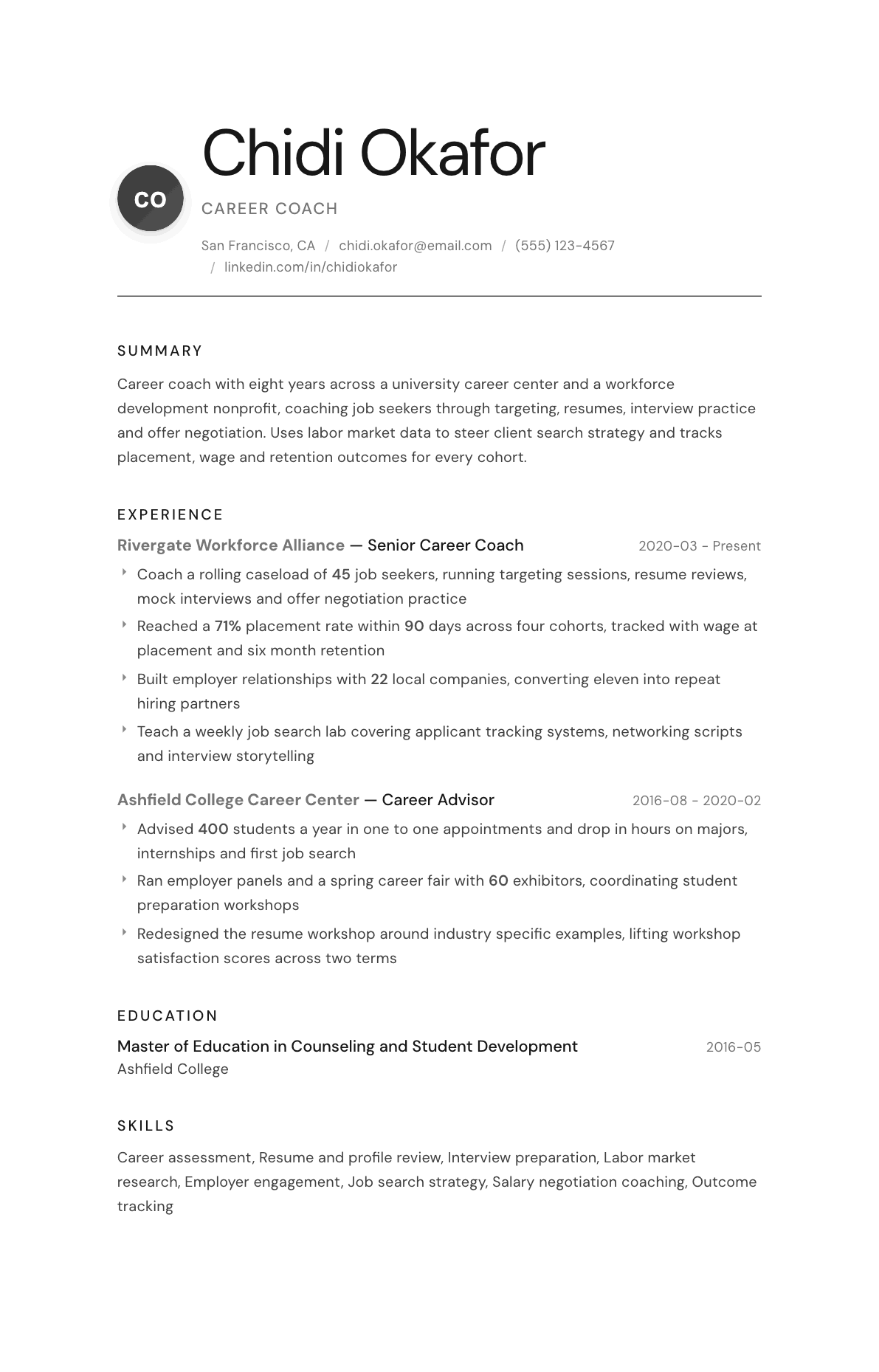
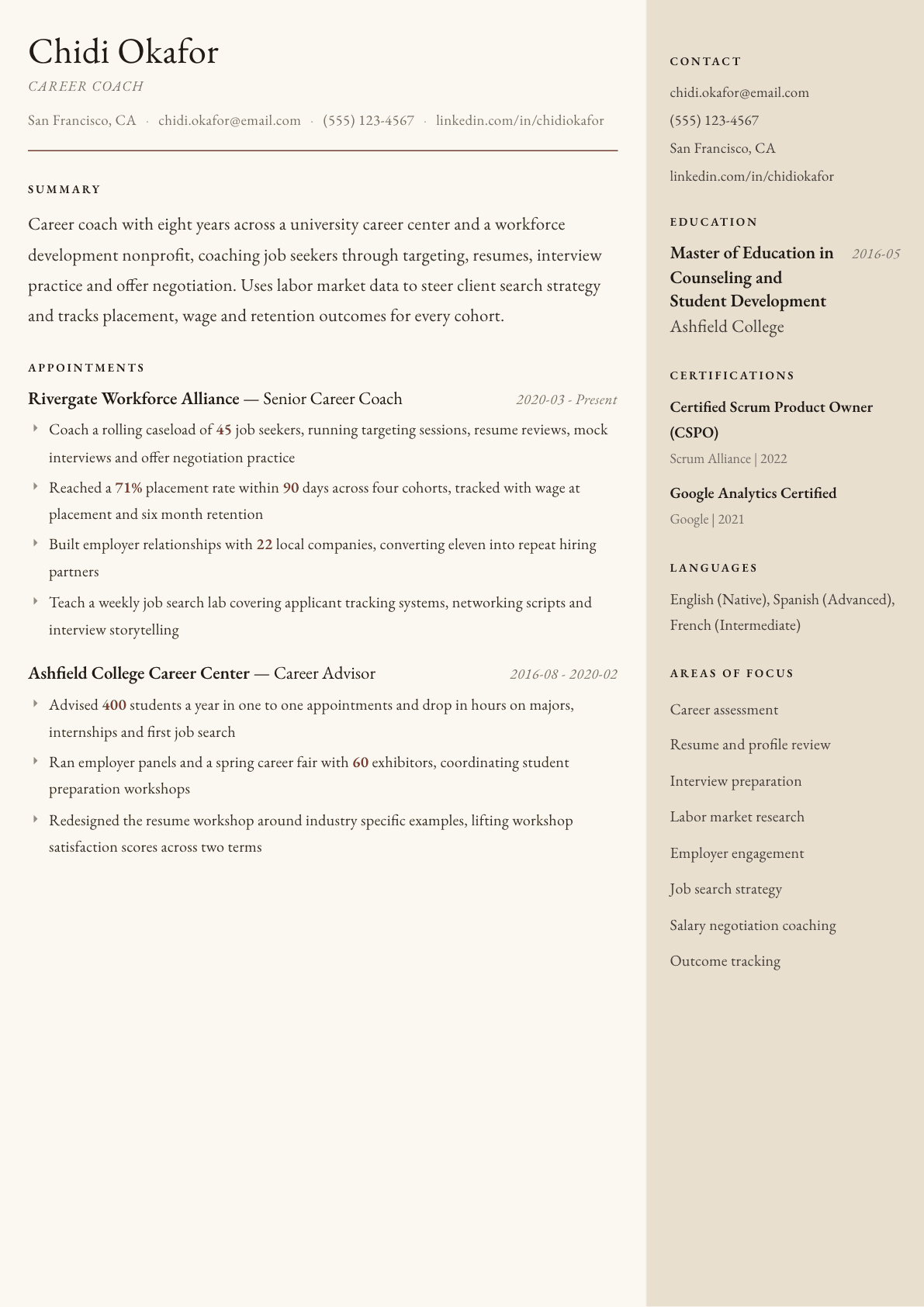
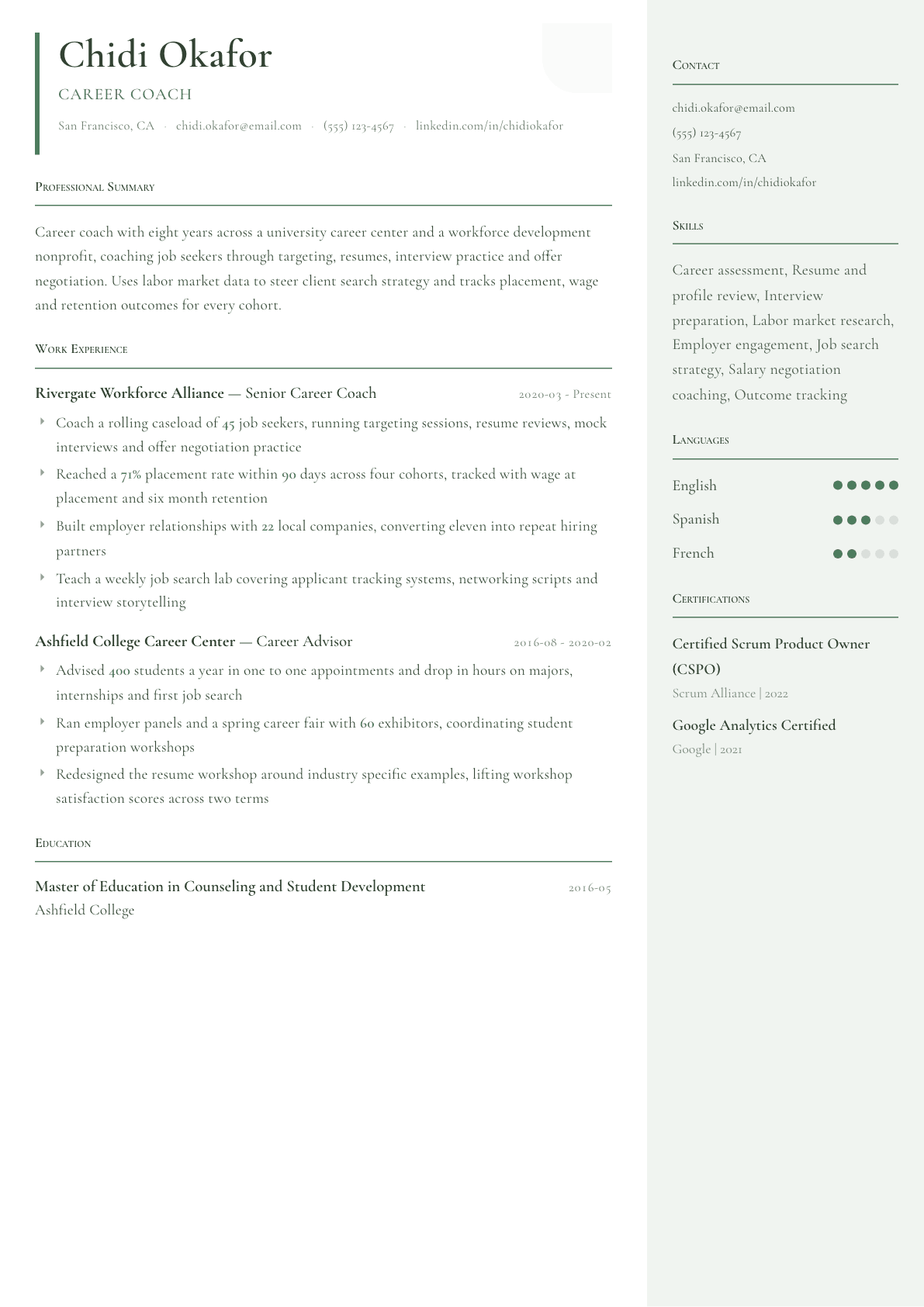
Example Career Coach summary
Career coach with eight years across higher education and workforce development, guiding job seekers through targeting, application materials, interview practice and offer negotiation. Reached a placement rate above seventy in one program while tracking wage at hire and six month retention, and built a partner network of local employers. Seeking a lead coaching role in a workforce program with strong employer ties.
Skills to list on a Career Coach resume
- Career assessment administration
- Resume and cover letter coaching
- Interview preparation and mock interviews
- Job search strategy
- Labor market information
- Applicant tracking system literacy
- Salary negotiation coaching
- Employer engagement
- Workshop facilitation
- Case noting and outcome tracking
- Networking strategy
- Career change planning
- Motivational interviewing
- Group facilitation
What actually gets this resume read
- Report placement outcomes with a timeframe and a wage measure, because funders and employers both ask for those.
- Say which population you coach: students, veterans, career changers, returning citizens or laid off professionals.
- Name the assessments you are qualified to administer and the body that qualified you to use them.
- Show employer side work, since a career coach who knows hiring managers places clients faster than one who does not.
- Include the case management or student system where you logged appointments and outcomes.
- Describe the curriculum you built, such as a job search lab or interview clinic, and how many people it reached.
How to write a career coach resume
Career coaching is one of the few helping professions with a hard number attached to it. Somebody got a job or they did not, at a wage, and they either kept it at six months or they did not. Whoever hires you, a workforce board, a university career center, a corporate outplacement provider or an employer running internal mobility, is reading your resume for those outcomes and for evidence that you know how hiring actually works right now.
The trap is writing like a counselor and not like an operator. Postings for this role talk about caseload, cohorts, placement, wage at hire, retention, employer partnerships and case notes in a system. A resume that describes empowering people to reach their potential answers none of it and reads as if you have never had a target.
This guide covers how to structure the page, how to report outcomes honestly, how to show the employer side of the job, three summaries from advisor to program lead, before and after bullets, and the questions career coaches ask when they move between education, workforce and corporate settings.
Format: outcomes on page one, credentials in a block
One page under eight years, two after. Reverse chronological. Put a credentials block under your contact line: your career development credential and issuing body, any assessment qualifications with the publisher, and coaching credentials if you hold them. Assessment qualification matters because you legally cannot administer some instruments without it.
Then make sure at least one outcome number is visible in the top third of the page. A hiring manager who has to reach page two to find a placement figure usually does not reach page two.
- Credentials block: career development credential, assessment qualifications with publisher, coaching credential.
- Population line: students, career changers, veterans, returning citizens, dislocated workers, executives.
- Systems line: the case management or student appointment system where you logged work and outcomes.
Summary: population, caseload, outcome, employer network
Four elements again. Who you coach, how many at once, what happened to them, and whether you bring employer relationships. Employer relationships are the rarest of the four and the most valuable, because a coach who can call twenty hiring managers places people faster than one working only from job boards.
If you come from recruiting or human resources, say so early. Having sat on the hiring side is a genuine credential in this job and candidates undersell it constantly.
Experience: caseload, method, and the numbers behind them
Give the caseload as a rolling number and a throughput number if they differ. Forty five active job seekers with four cohorts a year describes a real week. Then describe your method in stages, because the stages are what an employer trains new coaches on: assessment and targeting, application materials, search strategy and networking, interview practice, offer evaluation and negotiation, then early tenure follow-up.
Report outcomes with a window and a denominator. Placement within ninety days across four cohorts is a claim someone can check in interview. A placement rate with no timeframe is the sort of number every experienced program manager discounts on sight.
Include the follow-up. Retention at six months separates coaches who place people into any job from coaches who place people into the right one, and funded programs are increasingly measured on it.
- Caseload: active clients, cohorts per year, appointment volume, group session load.
- Method: assessment, targeting, materials, search strategy, interview practice, negotiation, follow-up.
- Outcomes: placement within a stated window, wage at hire, retention at six months.
- Curriculum: workshops or labs you designed, topics covered, participants reached per term.
The employer side: the half most resumes leave out
A career coach who only faces clients is doing half the job. Write about employer engagement as its own strand: how many companies you built relationships with, which converted into repeat hiring, whether you ran hiring events, and whether you fed employer feedback back into how you coached.
Feedback loops are persuasive. If interviewers told you candidates were weak on structured behavioral answers and you rebuilt your interview lab around that, say so. It shows you treat coaching as a system that responds to evidence.
Keywords and the vocabulary of current hiring
Recurring posting terms are career assessment, job search strategy, labor market information, applicant tracking system, resume review, mock interview, salary negotiation, case notes, placement, retention, employer engagement and workshop facilitation. Mirror the posting language once in your skills block and once inside a bullet.
Show that you know how hiring works now, not how it worked when you started. Screening questions, structured interviews, referral hiring, skills-based postings and profile optimization on professional networks are the things clients ask about, and naming them tells a reader you are current.
Career Coach resume summary examples
New career advisor
Career advisor with two years in a college career center, running one-to-one appointments and drop-in hours for students on majors, internships and first job search. Facilitates resume and interview workshops, administers an interest inventory, and logs appointments and outcomes in the student system.
Five years in
Career coach carrying a rolling caseload of 45 job seekers in a workforce program, covering targeting, application materials, mock interviews and offer negotiation. Reached a placement rate above seventy within 90 days across four cohorts and tracks wage at hire and six month retention.
Program lead
Career services program lead with a decade across higher education and workforce development, supervising four coaches and owning the coaching curriculum. Built an employer partner network of local companies, half of them repeat hirers, and reports placement, wage and retention outcomes to the funder each quarter.
Work experience bullets: before and after
Before: Helped clients find jobs through coaching sessions.
After: Coached a rolling caseload of 45 job seekers through targeting, resume rewriting, mock interviews and offer negotiation, reaching a 71% placement rate within 90 days across four cohorts.
A caseload, a stage list and a placement rate with a window give a program manager numbers she can compare.
Before: Reviewed resumes and cover letters for clients.
After: Rebuilt client resumes around target job descriptions, teaching keyword alignment and achievement bullets, and tracked interview invitation rates before and after each rewrite.
Measuring the interview invitation change proves the rewriting worked instead of asserting that it did.
Before: Built relationships with local employers.
After: Developed relationships with 22 local employers, converting eleven into repeat hiring partners and running four hiring events that led to interviews for 38 clients.
Named counts and conversions describe a pipeline rather than a networking habit, which is what a program buys.
Before: Ran workshops on job search topics.
After: Designed and taught a weekly job search lab covering applicant tracking systems, networking scripts and structured interview storytelling, reaching about 200 participants a term.
A named curriculum with topics and reach turns generic facilitation into a product you can bring to a new employer.
Before: Tracked client progress and kept records.
After: Logged every appointment, goal and outcome in the case management system, and produced quarterly placement, wage and retention reports used in the funder review.
Linking documentation to funder reporting shows you understand that record quality protects the program contract.
Hard skills
- Career assessment administration
- Job targeting and search strategy
- Resume and profile development
- Mock interview and behavioral question practice
- Salary and offer negotiation coaching
- Labor market information analysis
- Applicant tracking system literacy
- Employer engagement and partnership building
- Workshop and curriculum design
- Case noting and outcome tracking
- Cohort program management
- Networking and informational interview strategy
Soft skills
- Honest feedback on unrealistic targets
- Motivation through a long search
- Rapport across education and income levels
- Persistence with employer contacts
- Composure with clients facing job loss
Certifications worth listing
- Certified Career Services Provider (CCSP) (National Career Development Association)
- Certified Career Counselor (CCC) (National Career Development Association)
- Global Career Development Facilitator (GCDF) (Center for Credentialing and Education)
- Associate Certified Coach (ACC) (International Coaching Federation)
Mistakes that cost career coach candidates the interview
- Quoting a placement rate with no timeframe and no cohort size, which any funded program manager discounts immediately.
- Describing only client-facing work and never mentioning the employer relationships that make placement possible.
- Writing in helping-profession abstractions when the posting asks for caseload, cohorts and measurable outcomes.
- Claiming to administer an assessment instrument without naming the qualification that permits you to use it.
- Ignoring retention, when funded programs increasingly grade coaches on whether the placement lasted.
- Sounding out of date by never mentioning applicant tracking systems, structured interviews or skills-based postings.
Career Coach resume questions
What qualifications do career coach jobs ask for?
A bachelor degree is the usual floor, with counseling, human resources or education backgrounds common. A career development credential and qualification on the assessments you administer strengthen the application, and recruiting experience is valued more than most applicants realize.
How do I report placement outcomes honestly?
State the window, the cohort and what counts as a placement. Placement within ninety days among clients who completed the program is checkable. A bare rate invites doubt, and a hiring manager will ask for the denominator in the interview anyway.
Is a career coach the same as a career counselor?
They overlap, but counseling roles often require a counseling degree and address deeper vocational and psychological questions, while coaching roles focus on search execution and outcomes. Read the posting language and mirror the title it uses.
How do I move from recruiting into career coaching?
Lead with the hiring-side knowledge, because it is your advantage. Translate screening, interview design and offer negotiation into coaching value, then show any group facilitation or mentoring you have done to demonstrate you can teach rather than only assess.
Should I include the workshops and curriculum I built?
Yes, in their own bullets with topics and reach. Curriculum is portable intellectual property, and an employer hiring a coach who arrives with a tested interview lab or negotiation module is buying immediate program capacity.
Related resume examples
- Job Coach Resume example
- Employment Specialist Resume example
- Vocational Rehabilitation Counselor Resume example
- Case Manager Resume example
- Counselor Resume example
- Life Coach Resume example