Content Marketing Manager Resume Examples: free score
Write a Content Marketing Manager Resume That Proves Editorial Judgment
By Mustafa Tarabya, founder of CVBooster · Published · Updated
A content marketing manager resume example with editorial and pipeline bullets, keyword lists, and a guide to writing each section.
Sample resumes for a content marketing manager
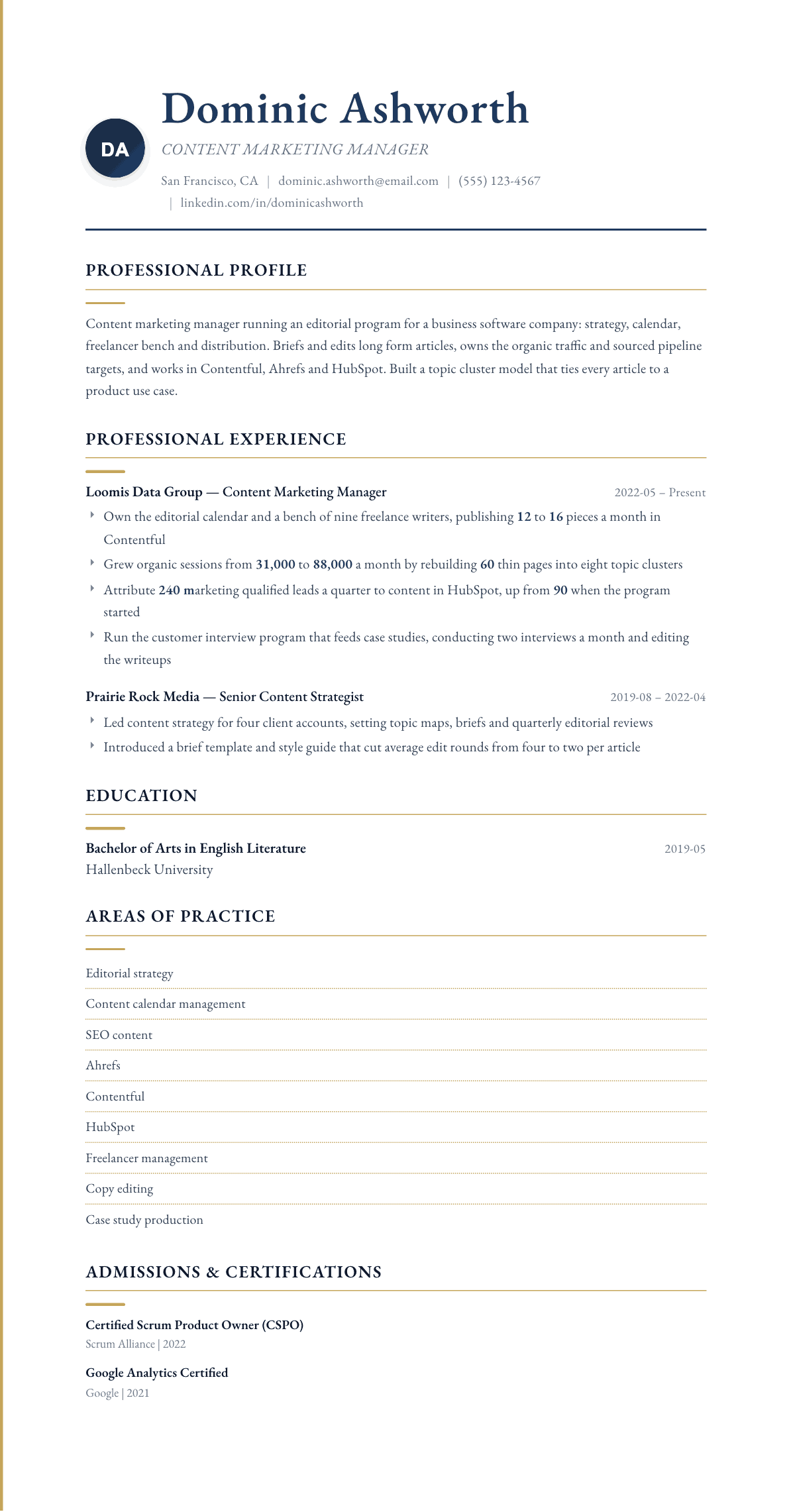
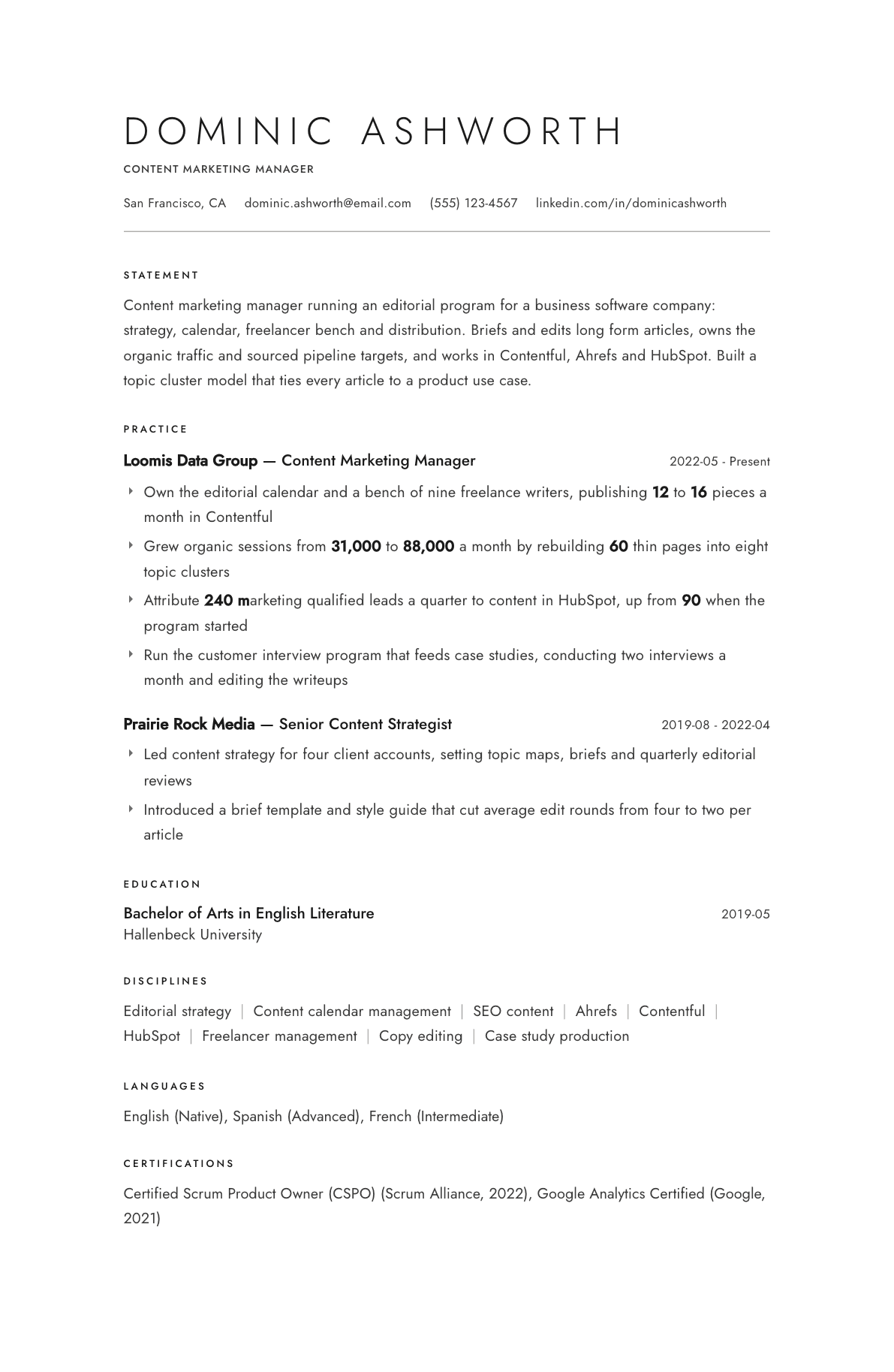
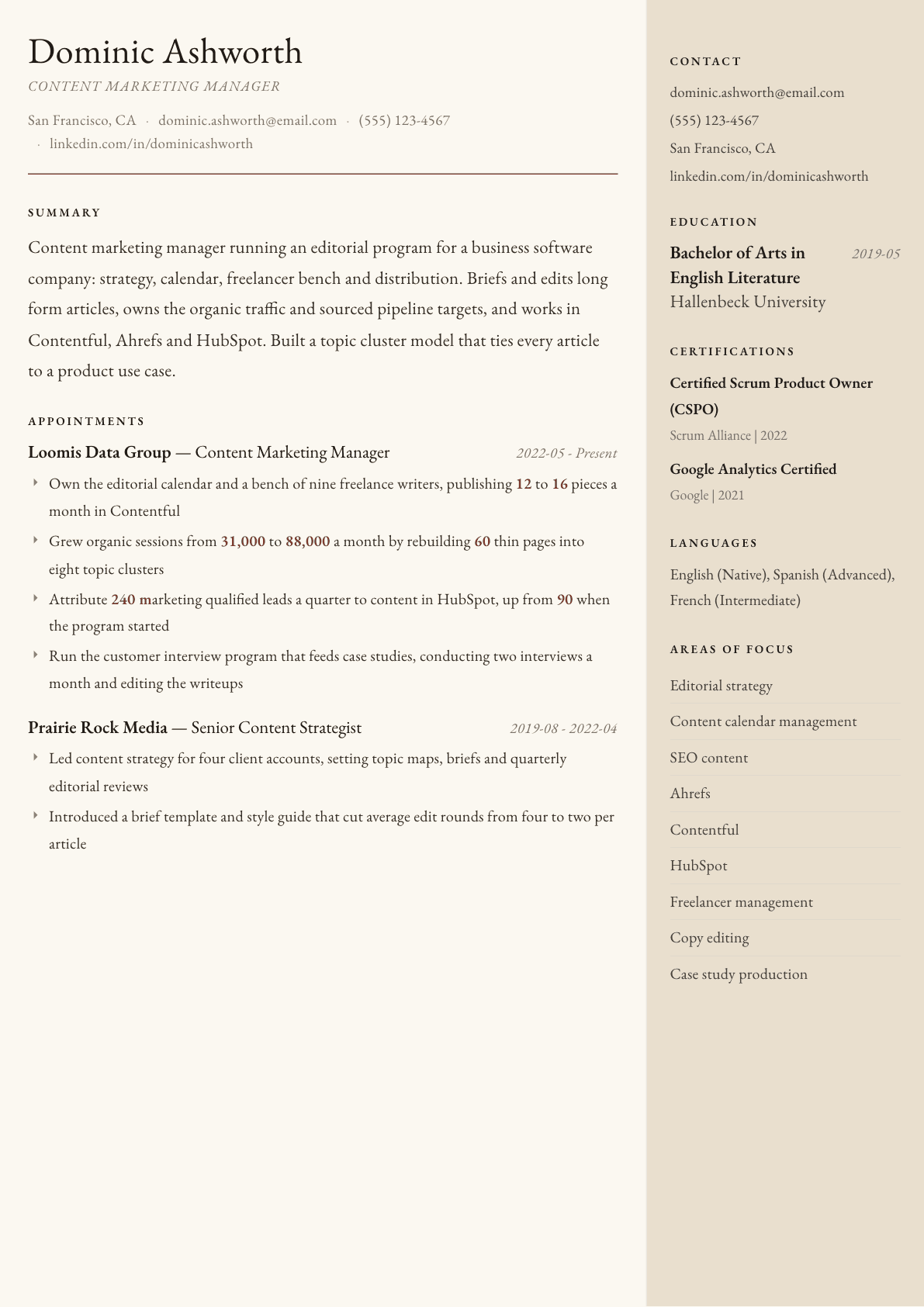
The same content marketing manager content laid out in three CVBooster templates, so you can see what the finished document looks like before you write a word.
Example Content Marketing Manager summary
Content marketing manager with seven years in business software editorial, owning strategy, calendar, a freelance bench and the organic traffic target. Nearly tripled organic sessions by consolidating thin pages into topic clusters mapped to product use cases. Runs a customer interview program that feeds case studies, and reports content sourced leads in HubSpot alongside traffic so the program defends its budget.
Skills to list on a Content Marketing Manager resume
- Content strategy
- Editorial calendar management
- SEO content
- Keyword research
- Copy editing
- Freelancer management
- Ahrefs
- Contentful
- HubSpot
- Content distribution
- Case study production
- Content analytics
- Style guide development
- Topic clustering
What actually gets this resume read
- Show the two halves of the job: editorial judgment on one side, traffic and pipeline accountability on the other.
- Give publishing volume and the team behind it, including freelancers, agencies and in house writers you brief and edit.
- Tie content to revenue with an attribution method you can explain, such as sourced leads or assisted opportunities in the customer platform.
- Name the content operations stack, since a content management system, a research tool and a project tracker appear in most postings.
- Include a rewrite or consolidation project, because pruning weak pages is the work senior content roles are judged on.
- Link two or three published pieces you personally wrote or edited, and pick ones that match the target company subject matter.
How to write a content marketing manager resume
A content marketing manager is judged on two things that rarely appear on the same resume. The first is editorial judgment: can this person tell a good brief from a bad one, edit a specialist's draft without flattening it, and decide what not to publish. The second is commercial accountability: does the content program produce traffic, leads or influenced revenue that survives a budget review.
Candidates who come from journalism or agency writing usually prove the first and skip the second. Candidates who come from demand generation usually prove the second and write bullets that could belong to any channel. The resume that gets an interview shows both in the same job, ideally in adjacent bullets, so the reader sees that the numbers came from taste rather than volume.
Below is the structure senior content resumes use, how to describe an editorial operation, three example summaries, before and after bullet rewrites, and the questions writers ask when they step into a role that owns a budget and a bench of freelancers.
Format: one to two pages with links that work
One page is fine up to about six years; two pages once you have managed writers and owned a traffic or pipeline target. Use a clean single column body. Content roles tolerate slightly more typographic personality than an operations resume, but the parser still has to read it.
Include a portfolio link in the header and two or three inline links to specific pieces inside the experience section, chosen to match the target company subject matter. A content manager applying to a technical company and linking three consumer lifestyle articles has answered the wrong question.
- Header: name, title, city and state, phone, email, portfolio link, professional profile link.
- Sections: summary, experience, selected work, education, certifications if relevant.
- Keep the selected work block to three or four pieces with one line each on the goal and the result.
Summary: program scope, subject matter, and the target you own
Three or four lines. Name the industry and the audience you write for, the size of the program in pieces published and people managed, the systems you work in, and the number you carry. Subject matter fluency matters more in content than in any other marketing role, so make yours obvious.
State whether you are a player coach who still writes or a manager who briefs and edits. Both are legitimate and they are hired for different teams, and leaving it ambiguous means neither hiring manager is confident you are the right fit.
Experience: the editorial operation behind the output
Publishing volume alone is a weak signal because volume without standards is easy. Pair it with the machinery: the brief template, the style guide, the review path, the freelance bench and how you source and pay it, the average number of edit rounds, and how you decide what goes on the calendar.
Then attach the outcomes. Organic sessions by month with a starting and ending point, keyword coverage, leads or subscribers attributed to content in the customer platform, sales usage of a piece, or a case study that shortened a deal cycle. Say which system reported it, because content attribution is contested and naming the source shows you know that.
Give one bullet to pruning. Consolidating thin pages, retiring outdated posts, merging overlapping articles and redirecting them is the work that separates a content manager from a content producer, and it is a favorite interview topic precisely because it requires judgment.
- Name the content management system and the research tool, since both appear in most postings.
- Give the freelance bench size and how you managed quality across it.
- Include distribution as well as production: newsletter, social, sales enablement, syndication, partnerships.
Search, structure and the part that is not writing
Most content manager roles carry an organic search target, so show that you can build a topic map, run keyword research, brief for search intent and structure a cluster with internal links. Naming the research tool and the way you group topics tells a hiring manager you are not guessing at demand.
Show the interface with product and sales too. Customer interviews, product launch messaging, sales collateral, objection handling pages and enablement material are all content work, and a candidate who can do them is worth more than one who only publishes to a blog.
Skills and credentials worth listing
Recurring posting keywords: content strategy, editorial calendar, search engine optimization, keyword research, copy editing, content management system, brand voice, distribution, content performance. Prove each in a bullet rather than parking it in a noun list.
Formal credentials are thin in this field and that is fine. A HubSpot content marketing certification or a Google Analytics certification is worth listing when you hold it. A degree in journalism, English or communications is worth naming, and a portfolio always outweighs both.
Content Marketing Manager resume summary examples
Writer stepping up
Content marketer with three years writing and editing for a business software blog, now owning the editorial calendar and two freelance writers. Publishes eight pieces a month, runs keyword research in Ahrefs, and grew organic sessions by roughly half in a year through a rewrite of the top twenty existing pages.
Program owner
Content marketing manager running strategy, calendar and a bench of nine freelancers for a business software company, publishing twelve to sixteen pieces a month. Nearly tripled organic sessions by consolidating sixty thin pages into eight topic clusters, and reports content sourced leads alongside traffic each quarter.
Senior content lead
Senior content marketing manager owning editorial, search and customer storytelling for two product lines, managing two writers and an outside agency. Built the customer interview program that feeds case studies, set the brand voice guide now used company wide, and defends the content budget with sourced pipeline reporting.
Work experience bullets: before and after
Before: Managed the company blog and published articles regularly.
After: Owned the editorial calendar and a bench of nine freelance writers, publishing twelve to sixteen pieces a month in Contentful with a two round edit standard and a published style guide.
The bench size, the volume, the system and the editorial standard describe an operation rather than a habit.
Before: Improved SEO performance of content.
After: Grew organic sessions from thirty one thousand to eighty eight thousand a month by auditing sixty thin pages, merging them into eight topic clusters and rebuilding internal links between the pillar and supporting articles.
The method behind the traffic number is what makes it repeatable in the reader's mind.
Before: Content contributed to lead generation.
After: Attributed 240 marketing qualified leads a quarter to content in HubSpot, up from 90 at program start, using gated research pieces and a first touch report the sales team reviews monthly.
A before and after figure plus the attribution method turns a claim into something a manager can verify.
Before: Worked with freelance writers.
After: Recruited and managed nine freelance writers with a standard brief template and a subject matter screening test, cutting average edit rounds from four to two per article.
Naming how you selected writers and what improved shows management, not just delegation.
Before: Created customer case studies.
After: Ran a customer interview program producing two case studies a month, conducting the interviews myself and editing the writeups, which sales now sends in roughly half of late stage deals.
The cadence, your personal involvement and the sales usage prove the content is used rather than archived.
Hard skills
- Content strategy
- Editorial calendar management
- Keyword research
- Search optimized writing
- Copy editing and line editing
- Freelance bench management
- Ahrefs
- Content management systems
- HubSpot
- Content analytics and attribution
- Style guide development
- Case study and interview production
Soft skills
- Editorial judgment
- Giving useful edits
- Subject matter curiosity
- Managing creative people to deadlines
- Defending a program to finance
Certifications worth listing
- HubSpot Content Marketing Certification (HubSpot Academy)
- Google Analytics Certification (Google Skillshop)
- Semrush SEO Toolkit Certification (Semrush Academy)
Mistakes that cost content marketing manager candidates the interview
- Listing article titles as accomplishments without a single audience or business number beside them.
- Showing traffic growth with no explanation of what you changed, which reads as luck or as somebody else's work.
- Omitting the editorial process entirely, so a hiring manager cannot tell whether you can manage writers.
- Linking a portfolio full of pieces from a different industry than the company you are applying to.
- Ignoring pruning and consolidation work, which is often the highest impact project on a mature content site.
- Writing a resume that never mentions distribution, as though publishing were the end of the job.
Content Marketing Manager resume questions
How do I prove content drove revenue when attribution is imperfect?
Report the method along with the number. First touch or last touch leads in the customer platform, assisted opportunities, sales usage of a specific asset, or a controlled comparison between pages. Naming the limitation makes the figure more credible rather than less.
Should a content marketing manager resume include writing samples?
Yes. A portfolio link in the header plus three inline links inside experience, chosen to match the hiring company's subject matter. Include at least one piece where you can explain the goal, the research behind it and what it produced.
Do I need SEO skills for a content marketing manager role?
Almost always. Most postings expect keyword research, search intent judgment, topic clustering and internal linking, even when a separate search specialist exists. You do not need deep technical skill, but you do need to brief for demand rather than for taste alone.
How do I move from journalism into content marketing?
Keep the reporting and interviewing strengths visible, then add the commercial layer: audience research, keyword demand, a piece tied to a product use case, and any traffic or subscriber number you can attach. Editors translate well once the business framing is present.
How much publishing volume should I show?
Enough to indicate pace, paired with a standard that shows quality was controlled. Twelve pieces a month with a two round edit process and a named brief template says more than a raw output count, which invites the assumption that the work was thin.