SEO Manager Resume Examples: free ATS score and gap list
Write an SEO Manager Resume That Shows Traffic and Revenue
By Mustafa Tarabya, founder of CVBooster · Published · Updated
An SEO manager resume example with technical, content and link bullets, plus the keywords, skills and section guide hiring teams expect.
Sample resumes for a seo manager
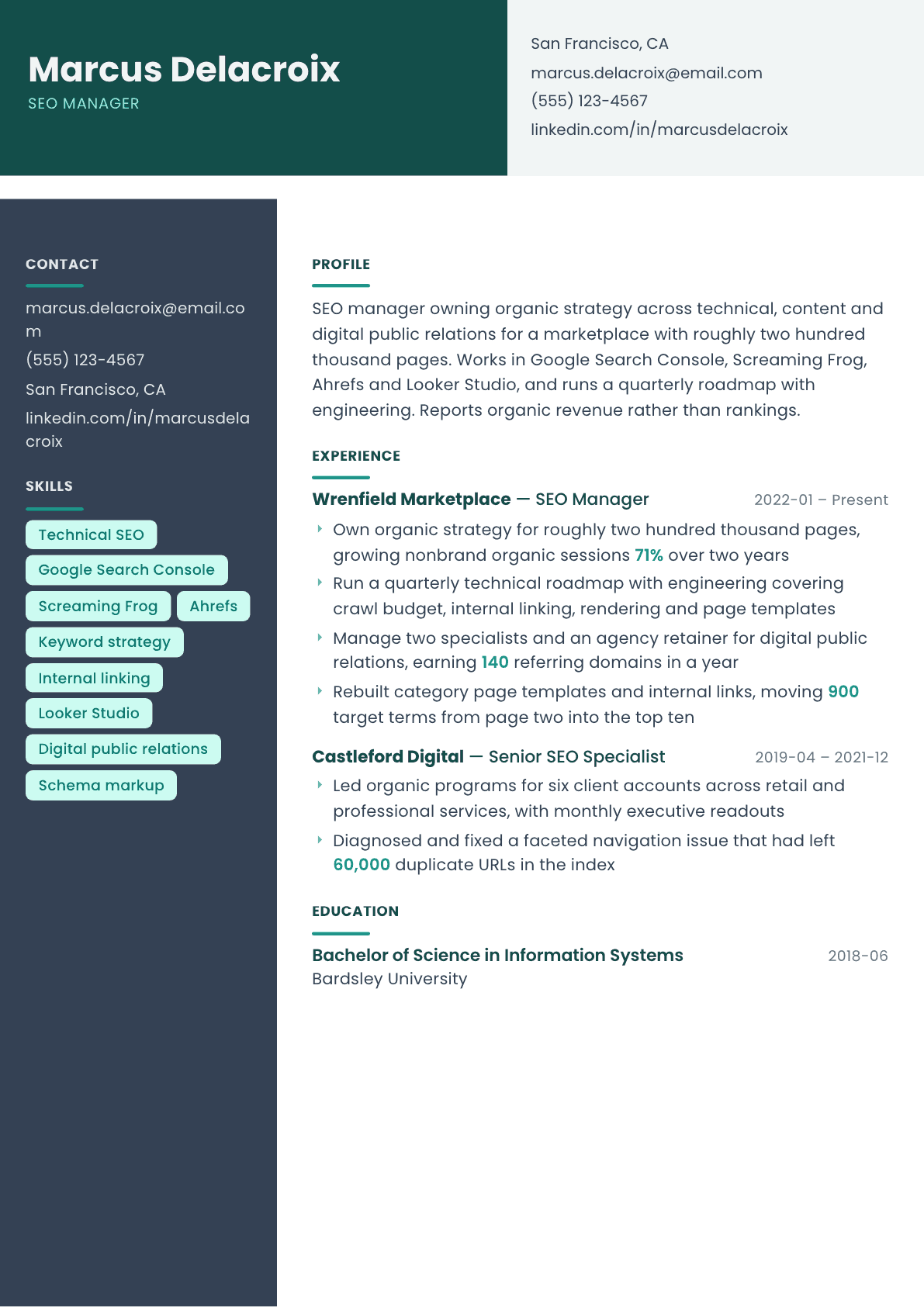
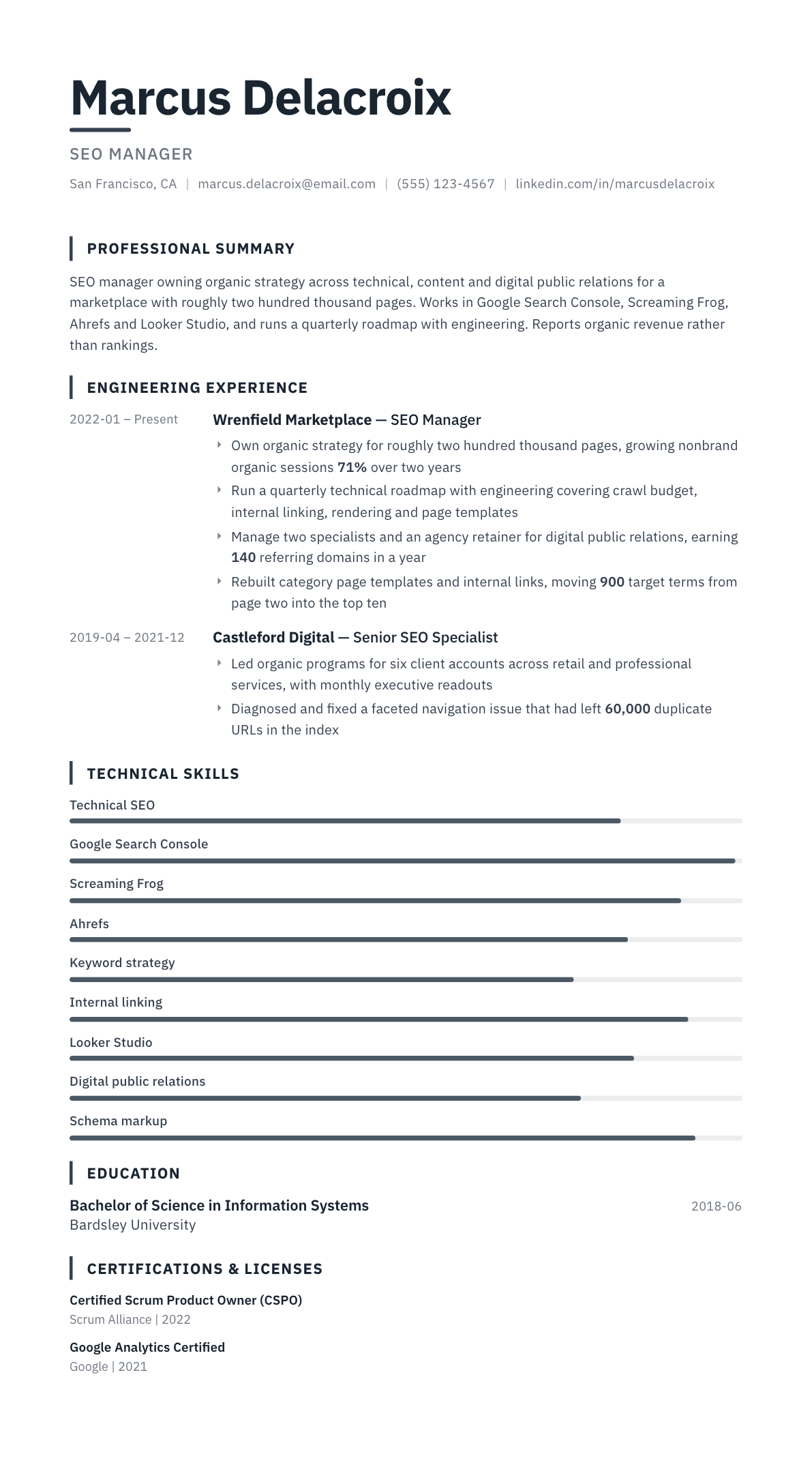
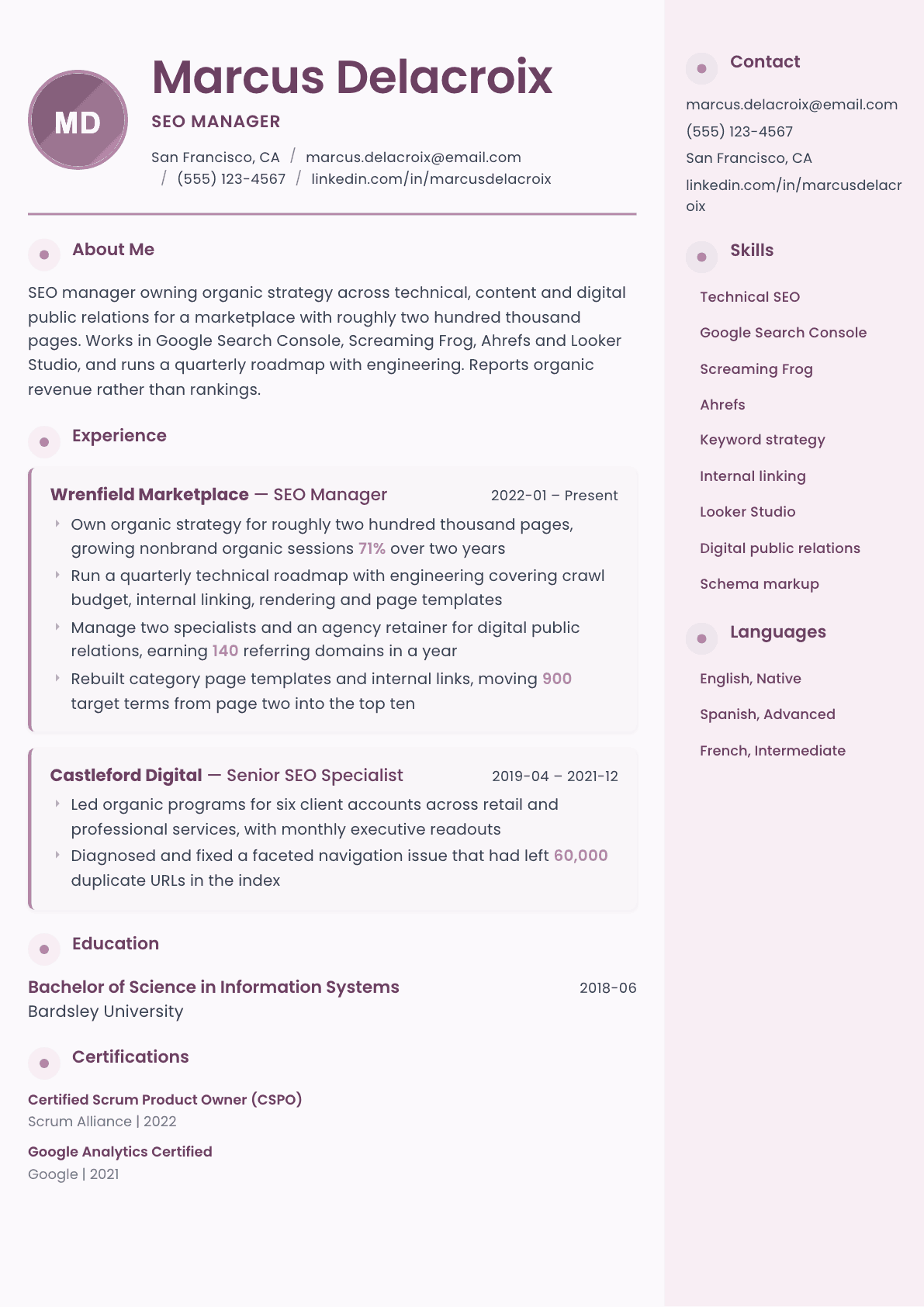
The same seo manager content laid out in three CVBooster templates, so you can see what the finished document looks like before you write a word.
Example SEO Manager summary
SEO manager with seven years across marketplace and agency work, owning technical, content and off site strategy for a site of roughly two hundred thousand pages. Grew nonbrand organic sessions by seventy one percent in two years through template rebuilds, internal linking and a quarterly roadmap delivered with engineering. Manages two specialists and an outside agency, and reports organic revenue to the leadership team.
Skills to list on a SEO Manager resume
- Technical SEO
- Keyword strategy
- On page optimization
- Internal linking
- Site migrations
- Google Search Console
- Screaming Frog
- Ahrefs
- Schema markup
- Core Web Vitals
- Content strategy
- Link acquisition
- Looker Studio
- Log file analysis
- Team leadership
What actually gets this resume read
- Report organic revenue or qualified leads first and rankings last, because a manager is hired to defend a business number.
- State the site scale in pages or templates, since optimizing two hundred pages and two hundred thousand are different jobs.
- Show that you can move engineering: a shipped roadmap, a template rebuild, a rendering fix, a migration you led without traffic loss.
- Split your bullets across technical, content and off site work so the reader can see which pillar you are strongest in.
- Name the crawler, the rank tracker and the analytics stack, because those tool names are the first ATS filter on SEO postings.
- Include one recovery story: an algorithm drop, an indexation bug or a migration you diagnosed and what the traffic did afterward.
How to write a seo manager resume
An SEO manager is hired to own an organic channel that other teams keep breaking. Engineering ships a template change, product launches a faceted filter, content publishes four hundred pages nobody searched for, and the manager is the person who has to see it coming, price the risk and get it on a roadmap. That is why hiring teams read these resumes for influence and diagnosis, not for a list of on page tactics.
The second thing they check is scale. Running organic for a two hundred page brochure site and running it for a marketplace with hundreds of thousands of URLs are different disciplines, and a candidate from one is often unprepared for the other. State your site size, template count and publishing rate early, because it determines whether the rest of your experience transfers.
This guide covers how to structure an SEO manager resume, how to write across the technical, content and off site pillars without sounding generic, three summaries by level, before and after bullet rewrites, and the questions specialists ask when they step into a role with a team and a revenue target.
Format: one to two pages, scale stated in the first block
One page up to about seven years, two after that. Reverse chronological, single column, with a scope block under the summary giving site size in pages or templates, the platform, the publishing rate, the team you lead and the target you own.
Site platform matters more than most candidates realize. Managing organic on a headless setup with a custom rendering layer is a different job from managing it on a hosted commerce platform where you cannot touch the templates. Name it, because it tells a hiring manager whether your fixes were shipped by you or requested from someone else.
- Header: name, title, city and state, phone, email, professional profile link.
- Sections: summary, scope, experience, tools, education, certifications or speaking if relevant.
- Skip rank screenshots and keyword lists; they date immediately and take space from decisions.
Summary: the business number, then the pillars you own
Three or four lines. Years in search, the type of site, the pillars you personally own across technical, content and off site, the team and agency you direct, and the business metric you report. Organic revenue or qualified leads first; sessions second; rankings last or not at all.
Say which stakeholders you work through. An SEO manager who runs a quarterly roadmap with engineering has a different skill set from one who works through an agency, and hiring managers screen for whichever fits their organization.
Experience: diagnosis, roadmap, and shipped fixes
The strongest bullets follow a diagnosis to outcome shape: what was wrong, how you found it, what shipped, and what happened. Crawl and index problems are the clearest examples, because they require a specific tool, a specific finding and a fix that another team had to agree to build.
Cover all three pillars with at least one bullet each. Technical: crawl budget, rendering, internal linking, page templates, site speed, structured data. Content: topic strategy, briefs, consolidation, cannibalization cleanup. Off site: digital public relations, partnerships, unlinked mentions, agency direction and the referring domains earned.
Include one migration or recovery. A platform move, a domain consolidation, an algorithm update drop or an indexation bug, with what you did and what traffic did afterward. These are the stories interviews are built around, and a resume without one leaves the interviewer to guess.
- Name the crawler, the rank tracker, the search console and the analytics stack you actually use.
- Give the number of terms, pages or templates affected rather than describing a fix in the abstract.
- Show how you got engineering time: a roadmap, a prioritized backlog, a forecast, a business case.
Forecasting and stakeholder work
Managers are expected to size opportunities before requesting resources. A simple model that estimates traffic and revenue from a fix, with stated assumptions, is what turns a technical request into a funded project. Show that you build one, and say what got approved because of it.
Add the reporting rhythm and audience. A monthly organic readout to a marketing leader, a quarterly review with engineering, an annual plan tied to the content calendar. Search work fails inside organizations far more often than it fails technically, and evidence that you can run those meetings is worth a bullet.
Skills, tools and credentials
Postings repeat a stable set: technical search optimization, keyword strategy, on page optimization, internal linking, structured data, site migrations, link acquisition, content strategy and page experience metrics. Prove each one, do not list it.
Formal certification carries less weight here than a portfolio of case studies, and the field has no licensing body. Where you hold a real credential, such as the Semrush or the Google Analytics certification, list it with the issuer. A conference talk, a public case study or an open tool you built is worth more.
SEO Manager resume summary examples
Specialist moving to manager
SEO practitioner with four years across agency and in house work, now leading organic for a retail site of roughly eight thousand pages. Diagnosed and fixed a faceted navigation issue that had left sixty thousand duplicate URLs indexed, and runs the quarterly technical backlog with two engineers.
Marketplace manager
SEO manager owning technical, content and off site strategy for a marketplace of roughly two hundred thousand pages. Grew nonbrand organic sessions 71% in two years through category template rebuilds and internal linking. Manages two specialists and a digital public relations agency, and reports organic revenue monthly.
Head of organic
Senior SEO manager leading organic across three brands and two languages, with four specialists, an agency roster and a quarterly engineering roadmap. Led a platform migration that held traffic flat through cutover and returned to growth within two months, and forecasts organic revenue for annual planning.
Work experience bullets: before and after
Before: Improved the site technical SEO.
After: Ran a quarterly technical roadmap with engineering covering crawl budget, rendering, internal linking and category templates, with each item sized by a forecast before it entered the sprint backlog.
It shows how technical work actually gets built, which is the part of the job a manager is hired for.
Before: Fixed duplicate content problems.
After: Diagnosed a faceted navigation issue in Screaming Frog and log files that had left sixty thousand duplicate URLs in the index, then shipped parameter rules and canonical fixes that cleared them within two crawl cycles.
The tools, the specific defect, the volume and the fix make this a diagnosis story rather than a task.
Before: Increased organic traffic significantly.
After: Grew nonbrand organic sessions 71% over two years by rebuilding category page templates, adding structured internal links between related listings and consolidating four overlapping page types into one.
Attaching the traffic gain to three concrete structural changes makes the result attributable and repeatable.
Before: Managed link building efforts.
After: Directed a digital public relations agency against a quarterly data story calendar, earning 140 referring domains in a year and killing two tactics that produced links no editor would have placed.
Naming the method, the outcome and what you stopped shows editorial standards rather than volume chasing.
Before: Helped with the website migration.
After: Led the search workstream of a platform migration: redirect mapping for forty thousand URLs, template parity checks, staged crawl testing and a post launch monitoring dashboard that caught two broken templates in week one.
Migrations are judged on preparation and monitoring, so the specific steps are what prove competence.
Hard skills
- Technical search optimization
- Crawl and index management
- Log file analysis
- Internal linking architecture
- Keyword and topic strategy
- Site migrations and redirect mapping
- Structured data
- Page experience metrics
- Google Search Console
- Screaming Frog
- Ahrefs
- Looker Studio reporting
Soft skills
- Influence without authority
- Prioritization by expected value
- Explaining technical risk to executives
- Patience across long feedback cycles
- Coaching specialists
Certifications worth listing
- Semrush SEO Toolkit Certification (Semrush Academy)
- Google Analytics Certification (Google Skillshop)
- Ahrefs Certification Course (Ahrefs Academy)
Mistakes that cost seo manager candidates the interview
- Leading with rankings when the hiring team measures organic revenue, qualified leads or subscriptions.
- Leaving out site scale, so the reader cannot judge whether your experience transfers to their catalog.
- Describing fixes with no mention of how engineering time was won, which is the hardest part of the job.
- Listing tool names without a single diagnosis that shows what you found and what you did about it.
- Omitting migrations and recoveries, which are the stories most interviews for this role are built around.
- Claiming a traffic increase over a period when the site also launched thousands of pages for other reasons.
- Filling the resume with tactics that any specialist could list instead of decisions only a manager makes.
SEO Manager resume questions
What metrics should an SEO manager resume report?
Organic revenue or qualified leads first, then nonbrand sessions, then coverage measures such as indexed pages or terms in the top ten. Rankings alone are the weakest evidence because they move without the business moving with them.
How do I show technical SEO skill without an engineering background?
Describe diagnoses rather than code. A crawl finding, a rendering problem, a redirect chain, a log file pattern, and the specification you wrote for the engineers who fixed it. Managers are judged on identifying and specifying, not on implementing.
Should I include agency clients on an in house SEO application?
Yes, grouped under the agency employer with the industries and site sizes named. Client breadth is a strength, but add one line showing depth on a single account, because in house hiring managers worry about candidates who never lived with a site for years.
Do SEO managers need to know how to code?
Reading code helps and writing it is optional. What matters is being able to inspect rendered output, understand how a template produces its markup, work with a crawler and a spreadsheet at scale, and write a specification an engineer can build from without follow up.
How do I explain a traffic drop on my resume?
Do not hide it. Describe the cause, the diagnosis and the recovery in one bullet. A candidate who has managed an algorithm update or a broken migration and can explain what happened is more valuable than one whose graphs only ever went up.