YouTube Creator Resume Examples: the lines they read
Turn Your YouTube Channel Into a Hireable Resume
By Mustafa Tarabya, founder of CVBooster · Published · Updated
Write a YouTube creator resume that shows watch time, retention and production skills, with sample bullets, keywords and a full writing guide.
Sample resumes for a youtube creator
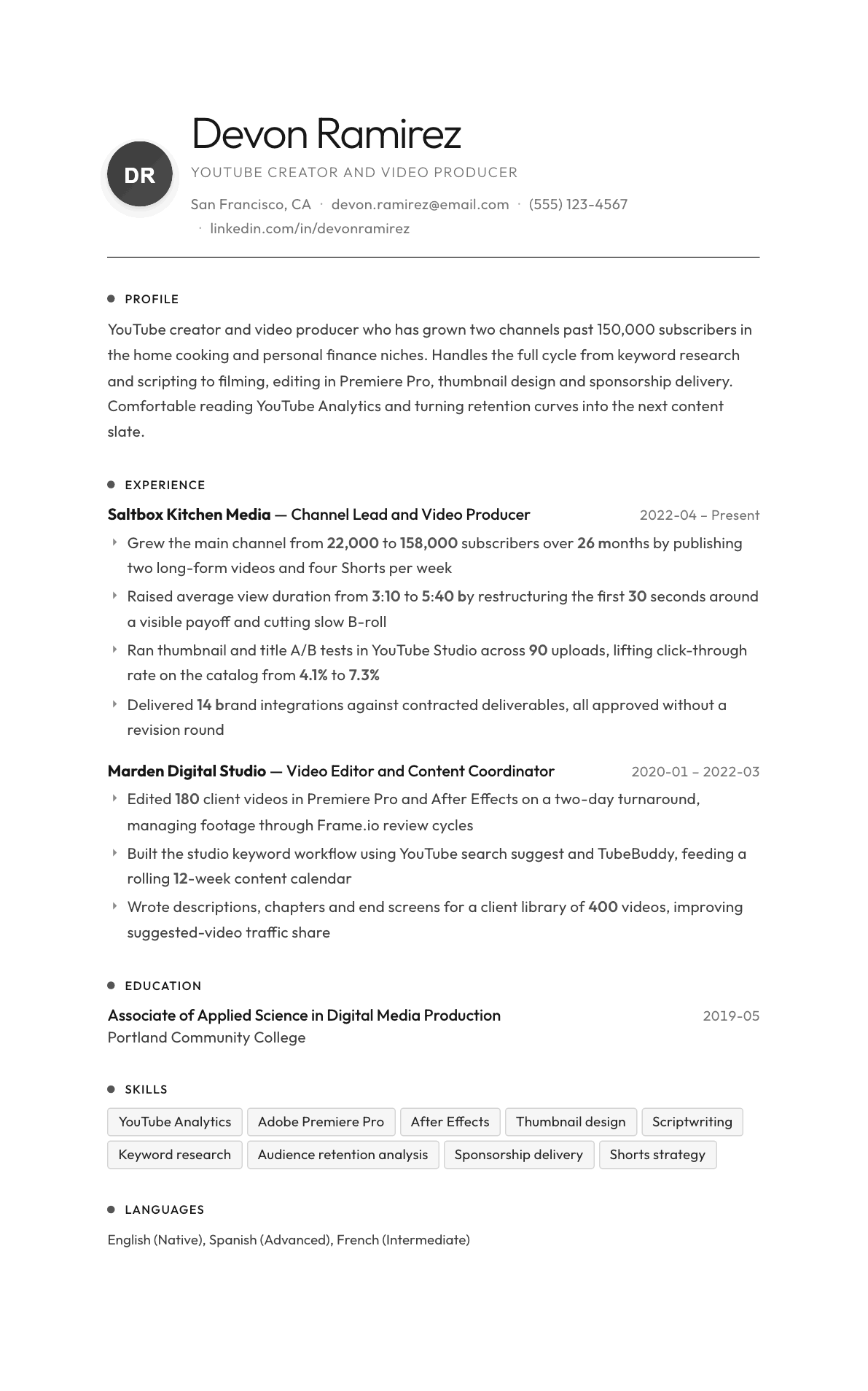
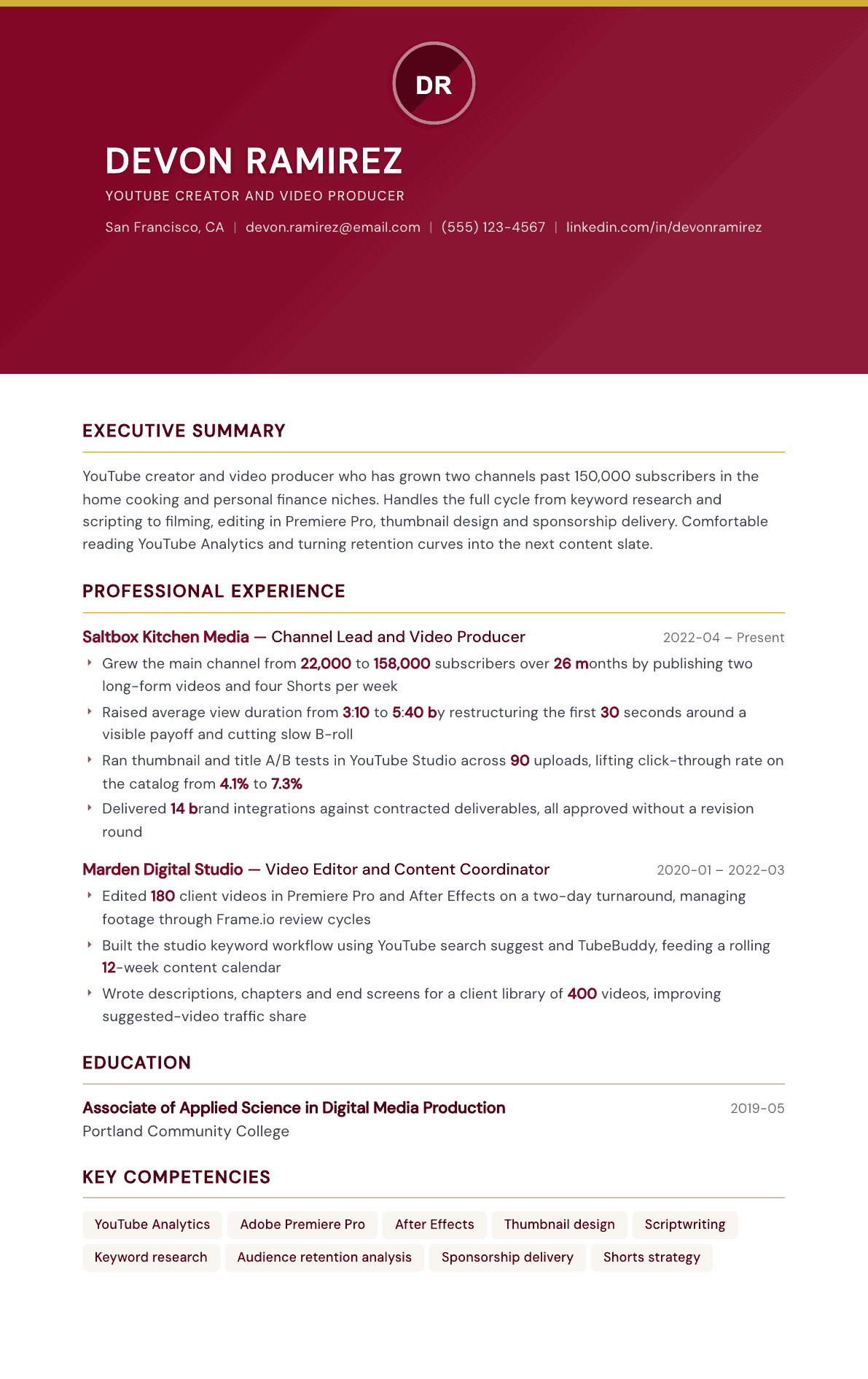
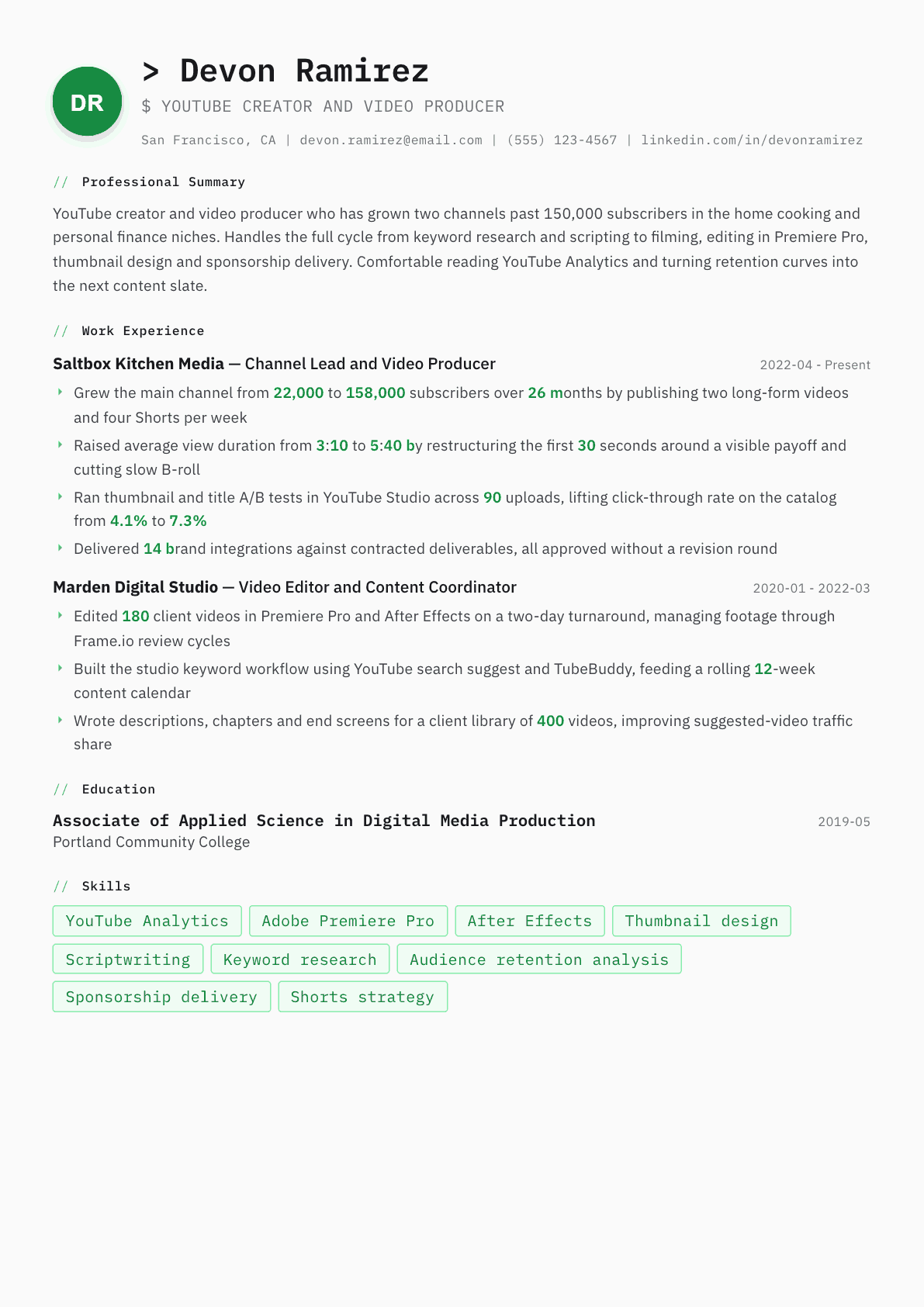
The same youtube creator content laid out in three CVBooster templates, so you can see what the finished document looks like before you write a word.
Example YouTube Creator summary
YouTube creator with five years running channels in the food and finance niches, most recently taking one from 22,000 to 158,000 subscribers in a little over two years. Owns research, scripting, filming, editing in Premiere Pro and thumbnail design, and reads retention curves to decide what gets made next. Has delivered fourteen paid brand integrations on contract terms.
Skills to list on a YouTube Creator resume
- YouTube Analytics
- Audience retention
- Click-through rate optimization
- Thumbnail design
- Scriptwriting
- Video editing
- Adobe Premiere Pro
- DaVinci Resolve
- After Effects
- Keyword and topic research
- Content calendar planning
- Shorts and vertical video
- Brand sponsorship delivery
- Community management
- Lighting and audio setup
What actually gets this resume read
- Put your channel link, subscriber count and total watch hours in the header so a hiring manager can verify the work in one click.
- Report retention and click-through rate rather than subscriber count alone, because those are the numbers a content lead trusts.
- Name the editing stack you actually own: Premiere Pro, DaVinci Resolve, After Effects, Descript, Photoshop for thumbnails.
- Separate the creator work from the client work, since brands hiring a producer want proof you can hit someone else's brief.
- Describe your publishing cadence and how long you held it, because consistency is the hardest thing for a channel to prove.
- List sponsorship deliverables you have shipped out and the approval process you ran, from media kit to final integration cut.
- Add a portfolio section with three linked videos and one line each on the goal, the format and the result.
How to write a youtube creator resume
A YouTube creator resume has a problem no other resume has: the work is public, and the person reading it can check every claim in about forty seconds. Whoever screens you will open the channel, look at the last six uploads, read two thumbnails and form an opinion before they finish your summary. The resume exists to point them at the right evidence and to explain the parts of the job that the public page cannot show.
Creators apply for two different kinds of job and often send the same document to both. One is the studio or brand role: content producer, channel manager, video editor, social video lead, where the employer needs somebody who can run a publishing operation on a schedule. The other is a partnership or media deal where you are the talent. The first wants process, tooling and metrics. The second wants audience, niche and brand safety.
This guide covers the production side, because that is where the resume actually decides an outcome. It walks through the header and channel evidence, how to write about analytics without sounding like a dashboard, how to present a channel that is small but well made, and the questions creators ask when they try to translate a personal channel into an employable track record.
Header: the channel is the portfolio, so link it properly
Put the channel handle and a clickable link directly under your name, next to your city, phone and email. Add subscriber count and total watch hours in plain figures. If you run more than one channel, list the two that support the application and leave the abandoned gaming channel from high school out of it.
If your best work is client work rather than your own channel, say so in the header line: "video producer, work shown on client channels" and then link a portfolio page or a private review link. A hiring manager who cannot find any video within one click assumes there is none.
Keep the channel name consistent with the name on the resume. Screeners quietly discard applications when the person in the videos and the person on the page appear to be different people with no explanation.
- Name, role line, city, email, phone, channel link, portfolio link.
- Subscriber count, total watch hours, and publishing cadence in one short line.
- Niche stated plainly: cooking, personal finance, tech reviews, fitness, education.
Metrics: retention and click-through beat subscriber count
Subscriber count is the number every applicant leads with and the number a content lead trusts least, because it reflects history rather than current craft. The numbers that show craft are average view duration, average percentage viewed, impressions click-through rate, and the share of views coming from browse and suggested rather than from external links.
Report a before and an after. "Raised average view duration from three minutes to five and a half across the catalog" tells a reader you diagnosed something and fixed it. A single number floating alone tells them nothing about whether you caused it.
Be honest about scale. A channel with twelve thousand subscribers and a nine minute average view duration is more interesting to a serious employer than a channel with two hundred thousand subscribers built on one viral upload and nothing since.
- Average view duration and average percentage viewed, with the before and after.
- Impressions click-through rate on the catalog, and what you changed to move it.
- Traffic source mix: browse, suggested, search, external.
- Publishing cadence and how many consecutive weeks you held it.
Experience: describe the production pipeline you own
Break each role into the stages you personally owned: topic research and keyword work, scripting, filming and lighting, editing, sound, thumbnail design, packaging the title, publishing, and the community reply pass afterward. An employer hiring one person needs to know which of those nine stages they still have to hire for.
Give volume and turnaround, because that is how production capacity is judged. Two long form uploads and four Shorts a week for eighteen months, or a two day edit turnaround on client footage, tells a producer whether you can hold their calendar.
Treat sponsorship work as a delivery job with a client. Name the deliverable structure, the approval rounds, the disclosure requirements you followed, and whether integrations were delivered on the contracted date. Brands hire creators who can hit a brief without three rounds of rework.
Tools: list the stack, not the software category
Name what you actually operate. Editing in Premiere Pro, DaVinci Resolve or Final Cut. Motion in After Effects. Thumbnails in Photoshop or Figma. Audio in Audition or Izotope. Camera bodies and lens choices if you shoot. Research in YouTube search suggest and a keyword tool. Review workflow in Frame.io. Publishing and analytics in YouTube Studio.
Separate what you use daily from what you have touched. A producer will test the top three items in the interview, so put the tool you can screen share on at the front of the list.
If you also handle distribution beyond the platform, add the newsletter tool, the podcast host, the vertical clip workflow and the community platform. Channels are rarely hired as a single surface any more.
Portfolio section: three videos, three reasons
End the resume with three linked videos rather than a long list. For each one give the goal, the format, one production detail and the result: a documentary style upload built around an on location shoot that became the channel best performer by watch time, a Shorts series that fed the long form catalog, a sponsored integration that the brand renewed.
Choose videos that show range rather than three versions of the same thing. If every link is a talking head at a desk, the reader assumes that is your ceiling.
YouTube Creator resume summary examples
First channel, no employer yet
Self-taught creator with 60 uploads over two years on a tech review channel at 11K subscribers and a 58% average percentage viewed. Writes, films, edits in DaVinci Resolve and designs every thumbnail. Seeking a junior video producer role where the same pipeline runs on a brand calendar.
Four years, one channel scaled
Video producer who grew a cooking channel from 22K to 158K subscribers in 26 months on a two long form and four Shorts per week cadence. Raised average view duration from 3:10 to 5:40 by rebuilding the opening 30 seconds. Owns research, script, edit, thumbnail and sponsorship delivery.
Channel lead running a team
Channel lead directing a team of six across two owned properties and a client slate. Sets the content strategy from retention and click-through data, runs the weekly packaging review, and negotiates brand integrations directly. Grew combined watch hours by 140% year over year while cutting edit turnaround by two days.
Work experience bullets: before and after
Before: Grew my YouTube channel to a large audience.
After: Grew a cooking channel from 22K to 158K subscribers in 26 months by publishing two long form videos and four Shorts every week without a missed slot.
The starting point, the end point, the timeframe and the cadence turn an unverifiable boast into a track record.
Before: Made thumbnails and titles for videos.
After: Ran thumbnail and title tests in YouTube Studio across 90 uploads, lifting catalog click-through rate from 4.1% to 7.3% and rebuilding the packaging guide the team now follows.
A design task becomes an experiment with a method, a sample size and a result somebody else can reuse.
Before: Edited videos using Adobe Premiere Pro.
After: Edited 180 client videos in Premiere Pro and After Effects on a two day turnaround, managing footage and revision rounds through Frame.io review links.
Volume and turnaround show production capacity, and the review workflow shows you can work with clients rather than alone.
Before: Worked with brands on sponsored content.
After: Delivered 14 brand integrations against contracted deliverables and disclosure requirements, all approved on the first review round and two renewed for a second flight.
Sponsorship work is judged on delivery discipline, so the approval rounds and renewals matter more than the brand names.
Before: Improved viewer retention on the channel.
After: Raised average view duration from 3:10 to 5:40 by restructuring the first 30 seconds around a visible payoff and cutting the slow B-roll opening the channel had used for a year.
The before and after plus the specific edit decision shows diagnosis, not luck.
Hard skills
- YouTube Analytics
- Audience retention analysis
- Click-through rate optimization
- Thumbnail design
- Scriptwriting and story structure
- Adobe Premiere Pro
- DaVinci Resolve
- After Effects
- Lighting and audio capture
- Keyword and topic research
- Shorts and vertical editing
- Sponsorship delivery and disclosure
- Content calendar planning
Soft skills
- On camera presence
- Creative direction
- Deadline discipline
- Community moderation judgment
- Feedback and revision handling
- Collaboration with brand partners
Certifications worth listing
- Adobe Certified Professional in Video Design (Premiere Pro) (Adobe)
- DaVinci Resolve Certified User (Blackmagic Design)
- Google Ads Video Certification (Google Skillshop)
Mistakes that cost youtube creator candidates the interview
- Leading with subscriber count and nothing else, which tells a content lead about your past rather than your craft.
- Leaving the channel link out or burying it at the bottom, forcing the reader to search for work they could have watched.
- Listing every video you have ever made instead of three linked pieces chosen to show range.
- Describing yourself as a storyteller and a visionary with no mention of retention, packaging or turnaround time.
- Hiding the fact that your best numbers came from a single viral upload rather than a repeatable format.
- Using a heavily designed two column layout with icons that a brand recruiter's tracking system parses out of order.
- Ignoring the client half of the job: briefs, approval rounds, disclosure and delivery dates all belong on the page.
YouTube Creator resume questions
Can I put my personal YouTube channel on a resume?
Yes, and you should when it is relevant to the role. Treat it as a job entry with a title, a date range, the cadence you held, the tools you used and the analytics you moved. A hobby channel with no consistency is better left off.
How many subscribers do I need before a channel counts as experience?
There is no threshold. What counts is evidence of a repeatable process: a real publishing cadence, a coherent niche, watch time that holds across uploads and thumbnails that were designed rather than screenshotted. A small channel made well reads better than a large abandoned one.
Should a YouTube creator resume include analytics screenshots?
No. Keep the resume as text so tracking systems can read it, and offer a short analytics walkthrough in the interview or a linked portfolio page. Quote the numbers in your bullets instead and be ready to open YouTube Studio and prove them.
How do I write a resume when I have only ever worked for myself?
Give yourself a title such as channel lead or independent video producer, name the channel as the employer, and write bullets on the same production stages an employed producer would own. Add any freelance client work as a second entry to show you can hit somebody else's brief.
What should a YouTube creator resume say about sponsorships?
Give the number of integrations delivered, the deliverable structure, how many approval rounds were needed and whether any brand came back for a second flight. Employers read that section for delivery reliability and for whether you follow disclosure rules correctly.